Transform reporting with Sage Intacct accounting dimensions

Sage Intacct accounting dimensions can revolutionize the way your business manages and analyzes data. Traditional ERP systems often require creating a fully qualified GL account for every reporting segment. This not only increases complexity but results in a bloated chart of accounts that can be challenging to manage. With Sage Intacct accounting dimensions, you’ll experience an easier, scalable way to categorize and tag financial transactions, leading to better reporting and faster decision-making. Streamline your general ledger (GL) reporting, while enhancing financial management and insights.
The challenges of traditional GL account structures
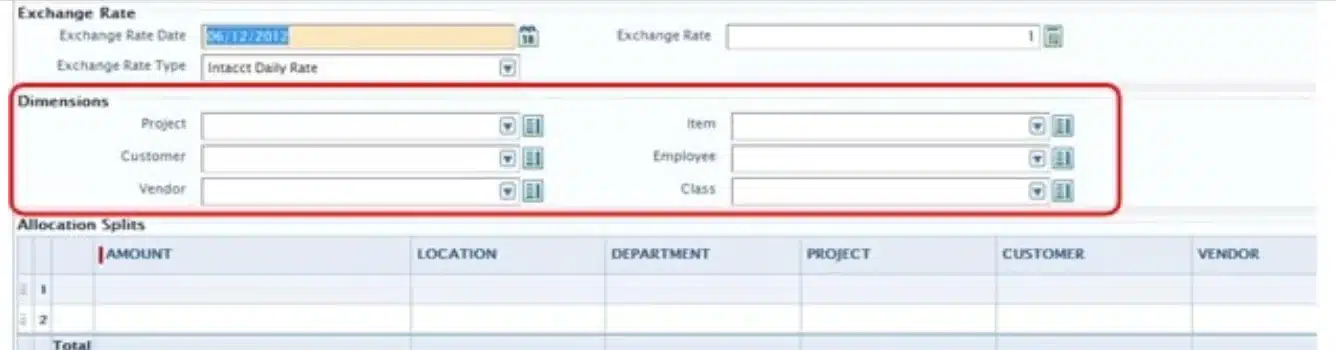
Imagine a company that needs to report on 50 natural GL accounts across five departments. Traditional accounting methods would require creating 250 fully qualified accounts (50 accounts × 5 departments), and that’s before factoring in other dimensions like location. Managing such a setup can become time-consuming and prone to error. This is where dimensional accounting makes all the difference. In the image below you can see an example of dimensions, encircled in red.
What are Sage Intacct accounting dimensions?
Think of accounting dimensions as advanced tags for your accounting transactions, replacing traditional subaccounts in your GL. Instead of maintaining multiple account segments for “location,” “project,” or “department,” dimensional accounting simplifies data management and enhance reporting flexibility. Key features include:
- Tagging transactions: Easily categorize accounting transactions by tagging them with predefined dimension values
- Streamlined chart of accounts: Keep your GL clean by eliminating the need to create multiple subaccounts
- Dynamic relationships: Establish relationships between multiple dimensions such as: one location to multiple departments; many projects to a single department; or many-to-many relationships, specific to your organizational structure
With these capabilities, Sage Intacct accounting dimensions reduces administrative burden while improving accuracy and scalability.

Get started with Sage Intacct today
Ready to take your business to the next level? With Sage Intacct, you can streamline operations, enhance efficiency, and drive growth. Contact us today to begin your Sage Intacct journey and propel your business forward into success!
How Sage Intacct accounting dimensions work
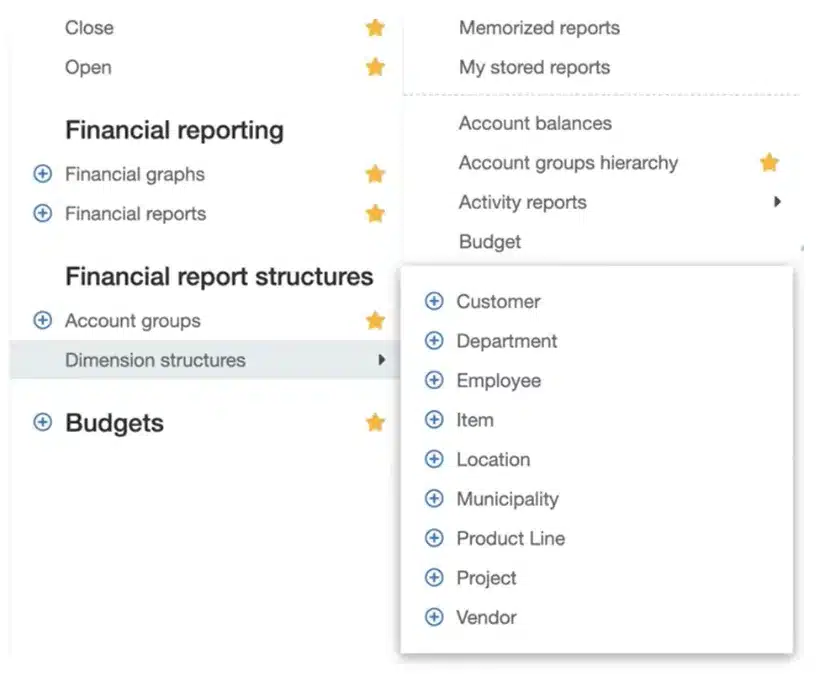
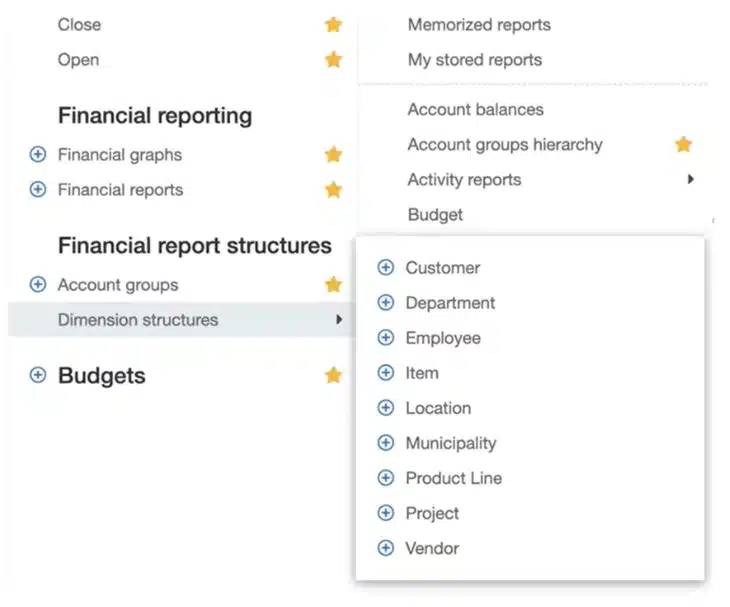
Sage Intacct allows you to define each key segment of your reporting structure as a separate dimension. For instance, you can track financial data by project, location, salesperson, or department. Each transaction can be tagged accordingly, ensuring your financial data remains clean and consistent while providing in-depth reporting capabilities. Additionally, Sage Intacct’s unique built-in reporting tools make dimensional accounting incredibly user-friendly. You no longer need advanced technical expertise to generate detailed departmental or location-based reports. Here’s an example:
When your organization adds a new department, traditionally, you’d need to update your GL to reflect this change, which could involve multiple hours of administrative work. With Sage Intacct, you simply add a new dimension value for the department, and it becomes available system-wide for tagging and reporting instantly.
Benefits of Sage Intacct accounting dimensions
- Simplified data entries: Reduce the need for complex GL accounts by tagging transactions with relevant dimensions
- Streamlined reporting: Create more elegant, detailed, and insightful financial reports
- Improved decision-making: Gain greater visibility into financial performance across various segments, such as departments, locations, or projects
- Time and cost savings: Eliminate the redundancies of maintaining multiple accounts, freeing up more time for strategic activities
- Enhanced scalability: Easily adapt to organizational growth without burdening the back end
Dimensional accounting also supports complex multi-entity structures, where you can tag transactions across dimensions while keeping the financial data unified and accessible. This ensures accurate and consolidated reporting.

How dimensional accounting transforms reporting
See the power of Sage Intacct accounting dimensions in action. Discover how they allow you to create more dynamic reports, while minimizing overhead and maintenance. Get ready to unleash the power and flexibility of dynamic filtering on reports and dashboards across the Sage Intacct system.
How Sage Intacct accounting dimensions help with financial reporting
- Simplified data entries: Reduce the need for complex GL accounts by tagging transactions with relevant dimensions
- Streamlined reporting: Create more elegant, detailed, and insightful financial reports
- Improved decision-making: Gain greater visibility into financial performance across various segments, such as departments, locations, or projects
- Time and cost cavings: Eliminate the redundancies of maintaining multiple accounts, freeing up more time for strategic activities
- Enhanced scalability: Easily adapt to organizational growth without burdening the back end
Dimensional accounting also supports complex multi-entity structures, where you can tag transactions across dimensions while keeping the financial data unified and accessible. This ensures accurate and consolidated reporting.
Use cases for Sage Intacct dimensions
Here are a few examples of how businesses are leveraging Sage Intacct’s accounting dimensions:
- Assign a single salesperson to a customer for precise revenue tracking
- Link employees to multiple projects to monitor productivity and cost allocation
- Limit certain GL accounts by specific locations or cost centers for better budget management
- Tag transactions by project to track resource allocation and overall performance
These flexible applications make Sage Intacct a powerful tool across various industries and business sizes.
Unlock your business potential with Sage Intacct accounting dimensions
If your organization is seeking a streamlined, scalable, and efficient way to manage financial reporting, Sage Intacct accounting dimensions is the answer. By categorizing transactions using dimensions, you can simplify administrative tasks, gain deeper insights, and focus on what matters most—achieving your business goals. Interested in seeing Sage Intacct in action? Contact us today to learn how this powerful cloud-based solution can transform your financial operations.
Subscribe to our Insights
Related Blogs

Best ERP software for family offices
Managing a family office involves far more complexity than traditional financial operations. From multi-entity accounting and consolidated reporting to investment tracking and multi-generational wealth oversight, family offices must manage diverse assets, entities,...

Sage Intacct vs. Acumatica: Which cloud ERP is right for your business?
Choosing the right cloud financial management or ERP system is one of the most important decisions a growing organization will make. Companies evaluating Sage Intacct vs. Acumatica often find themselves comparing two highly capable platforms, one built as a...

Sage Intacct AI: What it is, how it works, and why it matters
Artificial intelligence is changing the way businesses operate, and finance teams are no exception. Sage Intacct AI accelerates that transformation by embedding intelligence into routine finance tasks. Featuring Sage Copilot, an AI assistant, it streamlines repetitive...