What is Sage 100?

As businesses grow, their financial and operational needs quickly outpace the capabilities of basic accounting tools. Managing finance, inventory, manufacturing, and reporting in separate systems often leads to inefficiencies and data silos. Sage 100 offers an integrated solution designed to connect these critical functions within a single platform. In this guide, we’ll explore what Sage 100 is, its core capabilities, deployment options, ideal use cases, pricing, and what businesses should consider when evaluating the platform.
Sage 100 at a glance
Sage 100 is a modular ERP and business management solution designed for small and mid-sized organizations that need more functionality than entry-level accounting software. It combines financial management with inventory, purchasing, sales, distribution, manufacturing, reporting, and other operational capabilities. Sage 100 can be deployed on-premise or in a hosted environment, making it particularly relevant for organizations that want flexibility in how their ERP is managed. The platform continues to evolve through regular releases, integrations, add-ons, and modernization options that allow businesses to extend its capabilities as their requirements change.
What is Sage 100?
Sage 100 is a modular enterprise resource planning (ERP) system built for small to mid-sized businesses. It began as Sage MAS 90 / MAS 200, later renamed Sage 100 ERP, then Sage 100cloud (or Sage 100c) when Sage adopted cloud-connected capabilities for Sage 100. At its core, Sage 100 provides financial and accounting modules plus modules for distribution and inventory, manufacturing, reporting and integrations. If your company has moved beyond entry-level bookkeeping and needs greater financial and operational control, explore our Sage 100 reviews to learn more about the platform’s strengths, limitations, and user experiences.
What can Sage 100 do?
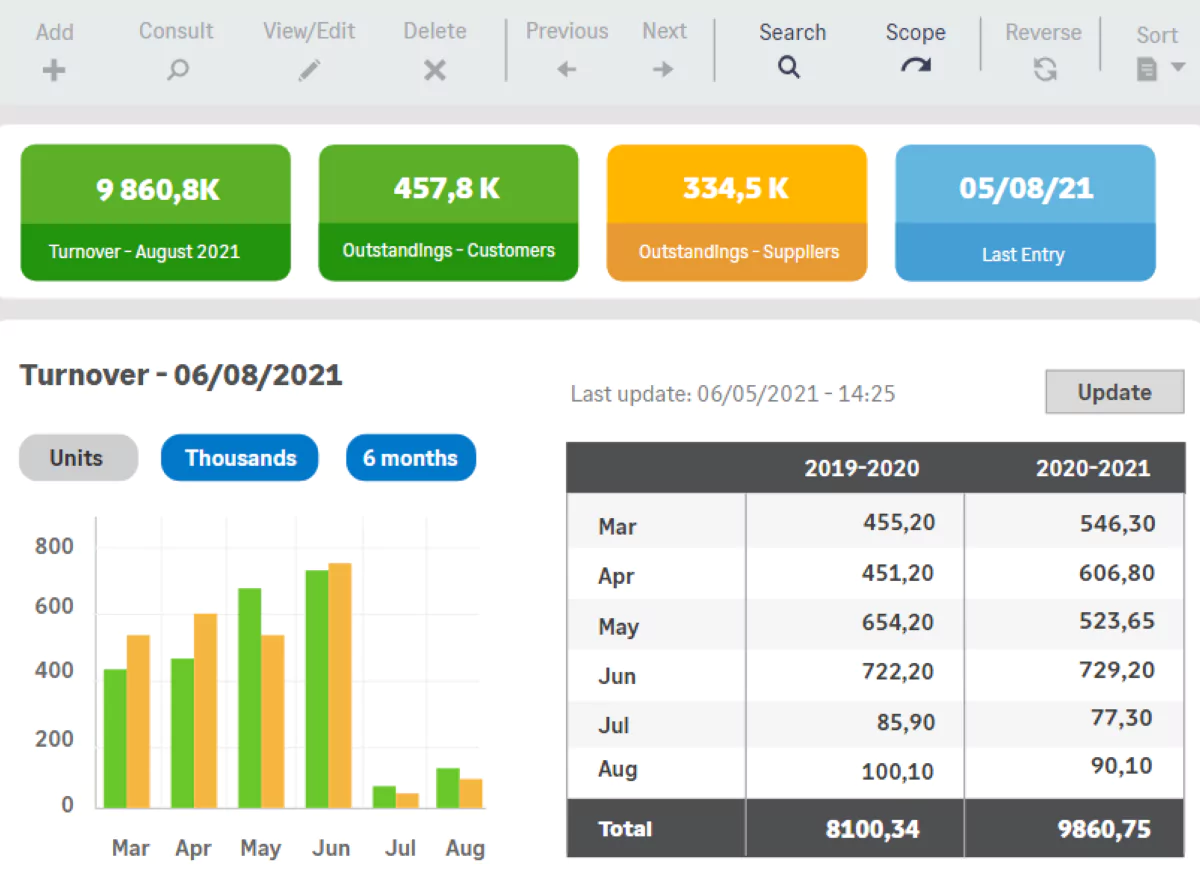
Sage 100 is used to unify key business processes across finance, operations, inventory, distribution, manufacturing, reporting, and analytics. With its broad range of capabilities, Sage 100 provides the tools growing businesses need to streamline workflows, gain greater visibility, and improve overall performance across departments.
Key use-cases include:
- Financial management: General Ledger, Accounts Receivable, Accounts Payable, Bank Reconciliation, Fixed Assets.
- Distribution and inventory operations: Sales order processing, purchase orders, inventory management, returns management, supply chain intelligence.
- Manufacturing / light-assembly: Bills of Materials (BOM), work order processing, material requirement planning (MRP) in environments where manufacturing is part of the business.
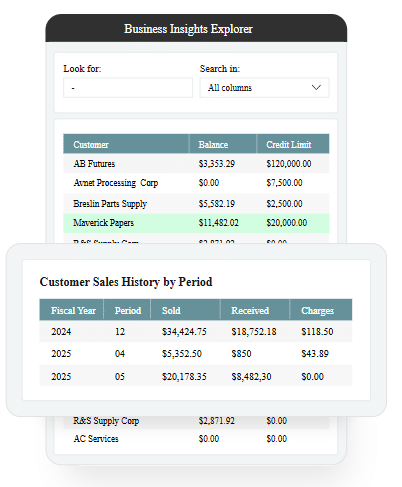
- Reporting & business intelligence: Integrations with Crystal Reports, Sage Intelligence, dashboards, data export to Excel for deeper analysis.
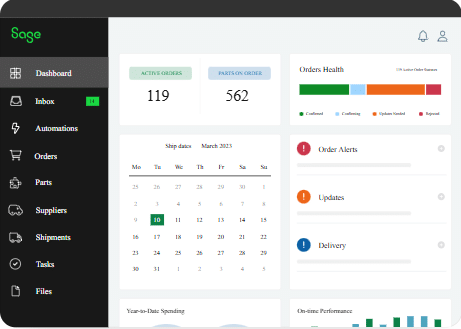
- Workflow and automation: Automating repeated tasks (bank feeds, reconciliation, order flows), reducing spreadsheets and manual entry.
- Integration with other systems: CRM, e-commerce, 3PL/warehouse management, mobile applications. Sage 100 helps companies move beyond disconnected systems.

See Sage 100’s capabilities in action
Schedule a Sage 100 demo with our experts today. See a live Sage 100 dashboard, learn more about the benefits of Sage ERP for your organization, and get your questions answered.
Deployment and hosting options for Sage 100
One of Sage 100’s greatest strengths is its flexibility in how it can be deployed and managed. Unlike many modern ERP systems that are cloud-only, Sage 100 gives businesses the freedom to choose the hosting model that best fits their IT strategy, budget, and control requirements. With Sage 100 you can choose from on-premise, cloud-hosted, or a hybrid approach.
It’s important to note that while Sage 100 offers cloud-hosted and remote-access options, it is not a cloud-native ERP like Sage Intacct. Sage 100 was originally designed as an on-premise system and has since evolved to include “cloud-connected” capabilities. This means you can host Sage 100 in the cloud for remote access and easier maintenance, but the core architecture still runs on traditional Windows-based servers rather than being built entirely for the web.
On-premise deployment
Sage 100 continues to offer robust on-premise deployment for organizations that prefer to maintain full control over their systems and data. With an on-premise setup, the software is installed on servers managed by your internal IT team. This model offers:
- Greater control over infrastructure, data, and security settings.
- Potential long-term cost savings if you already maintain your own IT environment, since recurring hosting fees are avoided.
- Enhanced performance for companies with heavy local use or large data volumes.
- Extensive customization flexibility, allowing deeper technical configuration and integration control.
- A familiar deployment model for businesses accustomed to traditional ERP systems.
Cloud and hosted options
Although Sage 100 originated as an on-premise ERP, Sage and its partner ecosystem have evolved the platform to support modern cloud and hosted deployments. For businesses seeking reduced infrastructure management or greater accessibility, Sage 100 can be hosted through a Sage Partner Cloud provider or a private hosting environment on platforms like Microsoft Azure or AWS. These cloud options maintain the same full Sage 100 functionality while offering remote access, simplified maintenance, and a subscription-based pricing model.
Hybrid environments
Many organizations choose a hybrid approach, keeping core Sage 100 functionality on-premise while connecting to cloud-enabled modules or remote access tools. This model offers the best of both worlds, maintaining control over core data and processes while benefiting from modern mobility, reporting, and third-party integrations.
Key benefits of Sage 100
Organizations implementing Sage 100 typically experience measurable improvements in efficiency, decision-making, and scalability:
- Scalable modular architecture: Start with core financials and expand into distribution, manufacturing, and CRM as your business evolves.
- Improved visibility and reporting: Enhanced access to financial and operational data supports faster, more informed decision-making.
- Operational efficiency: Connected workflows eliminate redundant data entry and streamline processes between departments such as sales, inventory, purchasing, and finance.
- Affordability for growing businesses: Provides ERP-grade functionality at a mid-market price point, making it accessible to expanding companies.
- Industry-specific strength: Purpose-built for organizations managing inventory, distribution, or light manufacturing operations.
Key Sage 100 features
Sage 100 distinguishes itself from simpler accounting platforms and many competing ERPs through the breadth and depth of its native capabilities:
- Integrated business management: Links financials with inventory, purchasing, sales, and manufacturing for end-to-end visibility.
- Extensive modular design: Offers dedicated modules for accounting, distribution (Inventory, Sales Order, Purchase Order, Returns), manufacturing (Bill of Materials, Work Order), reporting, and business intelligence.
- Powerful customization and integration tools: Through Custom Office and Visual Integrator, users can tailor screens, automate workflows, and connect with third-party applications.
- Robust reporting and analytics: Integration with Crystal Reports and built-in dashboards deliver accessible insights across departments.
- Operational and distribution depth: Unlike many financial systems, Sage 100 includes strong out-of-the-box functionality for inventory and supply-chain management.
- Expansive partner ecosystem: A wide network of Sage partners and ISVs extends the platform with vertical add-ons such as CRM, e-commerce, and logistics integrations.
What’s new in Sage 100 in 2026?
Sage continues to invest in Sage 100 with new features and usability improvements. Sage 100 2026 introduced more than 20 enhancements based in part on customer and partner feedback, with updates focused on search, inventory, reporting, security, and everyday productivity.
Notable enhancements include:
- AI-powered guided help: Sage 100 includes AI-powered help directly within the application to help users find answers and guidance without leaving their workflow.
- Global Search: Users can search for Sage 100 data across the system more quickly.
- Expanded inventory tracking: Lot and serial number fields were expanded to support more complex inventory and traceability requirements.
- Inventory planning improvements: IRP Warehouse Grouping supports inventory planning across multiple warehouses.
- Paperless Office enhancements: Consolidated emails and other improvements help streamline electronic document delivery.
- Audit and security enhancements: Expanded tracking provides greater visibility into changes to roles and users.
Sage has continued building on the 2026 release through subsequent product updates, reinforcing Sage 100’s role as an actively maintained ERP platform for organizations that continue to rely on its financial and operational capabilities.
Who should consider Sage 100?
Sage 100 is a flexible ERP solution designed to serve a wide range of industries, but it particularly excels in sectors where inventory, operations, and financial management intersect. The platform is especially well-suited for wholesale distribution, offering robust inventory and distribution modules, comprehensive sales and purchase order workflows, and strong supply chain visibility. Companies in light manufacturing and assembly also find Sage 100 to be an excellent fit, thanks to its support for bills of materials (BOMs), work orders, and basic material requirements planning (MRP) capabilities that meet moderate production needs without unnecessary complexity.
Beyond those core sectors, Sage 100 serves growing small and mid-sized businesses with increasing operational complexity. If you’ve outgrown entry-level accounting software like QuickBooks and need greater control over inventory, purchasing, warehousing, manufacturing, reporting, or multi-location operations, Sage 100 may be a strong fit. Suitability depends less on company size alone and more on operational complexity, required functionality, number of users, reporting needs, and long-term growth plans.
Sage 100 in action: Supporting 20+ years of growth at Stucchi USA
The value of Sage 100 extends beyond its feature list. How the system is configured, integrated, and optimized over time can determine how effectively it supports a growing business.
Stucchi USA, the North American arm of an Italian manufacturer of hydraulic quick-release couplings, has relied on Sage 100 as its operations have expanded and become more complex. Working with Rand Group, Stucchi has continually evolved its Sage 100 environment to support finance, inventory, warehouse operations, pricing, reporting, and light assembly.
Over the course of the partnership, Rand Group has helped Stucchi introduce and optimize capabilities including:
- Multi-bin inventory and warehouse scanning
- Production Management for kitting and light assembly
- Customer- and product-specific pricing
- Multi-currency and distribution-focused enhancements
- SQL and cloud infrastructure for expanded data access and reporting
- Third-party solutions and targeted enhancements for evolving operational requirements
Today, Sage 100 serves as an operational hub for the business and has supported more than 20 years of growth without requiring Stucchi to replace its core ERP platform.
Stucchi’s experience demonstrates how Sage 100 can continue supporting a business as its operational requirements evolve when the system is continually optimized around those needs.

Find out if Sage 100 is right for your business
Choosing the right ERP starts with understanding how the solution fits your financial, operational, inventory, and reporting requirements. Talk with a Rand Group Sage expert to discuss your business needs, explore the Sage 100 capabilities that matter most to your organization, and determine whether Sage 100 is the right fit.
How is Sage 100 licensed and priced?
Sage 100 licensing and pricing can be highly variable, driven by your selected modules, number of users, deployment model, add-ons, and the partner you engage. Beyond licensing, implementation services such as data migration, configuration, user training, and system integrations also contribute to the overall investment.
- Sage 100 is primarily licensed on a subscription basis, with the quote provided through a Sage partner.
- Pricing depends on the bundled package you choose (Essentials, Advanced, or Complete) and which industry-specific or third-party add-ons you include.
- Because of that bundle-based model and the many optional modules (such as Inventory Management, Bill of Materials, Sales Order, Mobility/Bar Code, etc.), the total cost can vary widely.
What kind of modules does Sage 100 have?
Sage 100 includes a comprehensive suite of core ERP modules such as General Ledger, Accounts Payable, Accounts Receivable, Bank Reconciliation, and Credit Card Processing, along with powerful reporting capabilities through Sage Intelligence and Crystal Reports. It should be noted that Sage 100 also offers an optional Payroll module for businesses that need to manage employee compensation and tax reporting directly within the system. A majority of our Sage 100 users choose to include the Payroll add-on, highlighting its value in streamlining workforce management and ensuring compliance. Beyond these essentials, the system’s modular design allows businesses to add functionality as their needs evolve, making it easy to scale and adapt as operations become more complex.
How do you get Sage 100?
Here is a general roadmap to acquiring and implementing Sage 100:
- Engage a Sage partner / value-added reseller (VAR)
Sage sells via a network of certified partners (VARs/consultants) who advise, implement and support the system. Rand Group is a certified Sage Partner serving Sage users for over 30 years. - Define requirements & scope
Work with your partner to identify required modules, users, deployment preferences, integrations, customizations, and data migration requirements. - Obtain a quote & decide licensing model
Choose between perpetual license (if available) or subscription/hosting model, review licensing per user, modules, hosting costs. - Implementation & setup
The partner handles installation, configuration, data migration, training, testing, go-live. A structured implementation methodology is key to success. - Support & ongoing maintenance
Post-go-live, you’ll need support, maintenance, possibly hosting infrastructure, user adoption and optimization. - User training & change management
Ensuring your staff are trained and the system is adopted is as important as the software itself. - Future growth & module addition
As your business evolves, you can add modules and scale users/change deployment as needed.
Why partner with Rand Group for your Sage 100 implementation
At Rand Group, we bring decades of experience in ERP implementations, including Sage ERP. Here’s why partnering with us makes a difference:
- Proven methodology: We follow a structured approach, from discovery through configuration, data conversion, training and go-live, to maximize ROI and minimize risk.
- Deep Sage expertise: As a Diamond Tier Partner, Rand Group brings extensive Sage experience and a demonstrated commitment to the Sage ecosystem. Our consultants have hands-on experience supporting organizations across distribution, manufacturing, and service industries.
- Tailored to your business: We don’t do one-size-fits-all. We align Sage 100’s modules and configuration to your unique processes, helping you avoid “customize everything” pitfalls.
- Long-term partnership mindset: Our focus is not just implementation but ongoing optimization, support and future-proofing as your business grows.
- Result-driven: Our goal is to ensure you get value, not just software. We emphasize workflow improvement, reporting clarity, operational efficiency.
That long-term approach can be seen in Rand Group’s work with Stucchi USA. Rather than treating Sage 100 as a one-time implementation, Rand Group has worked with Stucchi for more than two decades to continually refine its ERP environment as the company’s requirements have changed. From warehouse scanning and Production Management to pricing logic, reporting, infrastructure, and third-party integrations, the partnership demonstrates how experienced Sage 100 consulting can help an ERP environment evolve alongside the business.
Key takeaways
- Sage 100 is a modular ERP designed for small and mid-sized businesses that need more advanced financial and operational capabilities than entry-level accounting software provides.
- The platform is particularly strong for organizations with inventory, distribution, warehouse, and light manufacturing requirements.
- Sage 100 can be deployed on-premise or in a hosted environment, providing more deployment flexibility than many cloud-native ERP platforms.
- Sage continues to update Sage 100, with the 2026 release introducing enhancements across search, inventory, Paperless Office, security, and user productivity.
- Modules, integrations, add-ons, and customizations allow organizations to extend Sage 100 as business requirements evolve.
- The right ERP strategy does not always require replacing Sage 100. Upgrades, integrations, hosting, reporting improvements, and process optimization can extend the useful life of an existing environment.
- An experienced Sage partner can help determine whether Sage 100 is the right fit, configure it around business requirements, and continually optimize the system as those requirements change.
Frequently asked questions about Sage 100
What is Sage 100?
Sage 100 is a modular ERP and business management system designed for small and mid-sized businesses. It combines accounting and financial management with capabilities for inventory, purchasing, sales, distribution, manufacturing, reporting, and other business processes.
Is Sage 100 an ERP system?
Yes. Sage 100 is an ERP system that connects financial management with operational processes such as inventory, purchasing, sales orders, distribution, and manufacturing. Businesses can select modules and add-ons based on their requirements.
Is Sage 100 cloud-based?
Sage 100 is not a cloud-native ERP. It was originally designed for on-premises deployment but can also be hosted in a cloud environment to provide remote access and reduce the need for businesses to maintain their own infrastructure.
What size company is Sage 100 designed for?
Sage 100 is generally designed for small and mid-sized businesses that have outgrown basic accounting software and need more sophisticated financial and operational functionality. Fit depends on factors such as business complexity, users, inventory requirements, reporting needs, integrations, and growth plans rather than company size alone.
What industries use Sage 100?
Sage 100 is used across a range of industries but is particularly well suited for wholesale distribution, manufacturing, and other businesses with significant inventory, purchasing, warehouse, and operational requirements.
Does Sage 100 support manufacturing?
Yes. Sage 100 can support manufacturing and light assembly requirements through functionality such as bills of materials, Production Management, inventory planning, purchasing, and related modules and add-ons.
Can Sage 100 integrate with other business applications?
Yes. Sage 100 can integrate with CRM, ecommerce, warehouse management, shipping, reporting, business intelligence, and other third-party applications. Available integrations and the implementation approach depend on the organization’s Sage 100 environment and business requirements.
Does Sage 100 have AI capabilities?
Sage 100 2026 introduced AI-powered guided help within the application to help users find information and guidance. Sage continues to add product enhancements, but organizations should evaluate specific Sage 100 capabilities rather than assuming the broader AI functionality available across the Sage portfolio is included in Sage 100.
Is Sage 100 still being updated?
Yes. Sage continues to release updates and enhancements for Sage 100. Sage 100 2026 introduced more than 20 enhancements, and subsequent 2026 product updates have continued to add improvements and program fixes.
How much does Sage 100 cost?
Sage 100 pricing varies based on factors such as the number of users, selected modules, deployment model, add-ons, integrations, and implementation requirements. Organizations typically work with a Sage partner to define requirements and receive a customized quote.
Can an existing Sage 100 system be modernized without replacing it?
Yes. If Sage 100 continues to meet an organization’s core financial and operational requirements, businesses may be able to modernize their environment through upgrades, cloud hosting, integrations, reporting improvements, automation, and process optimization rather than replacing the ERP.
How can Rand Group help with Sage 100?
Rand Group provides Sage 100 implementation, consulting, customization, integration, reporting, training, support, and ongoing optimization services. As a Sage Diamond Tier Partner, Rand Group helps organizations evaluate Sage 100, implement new environments, modernize existing systems, and adapt the platform as business requirements evolve.
Is Sage 100 right for your business?
Sage 100 is a mature, flexible ERP for small and mid-sized businesses that need more than basic accounting software, particularly organizations with complex inventory, distribution, or light manufacturing requirements. Its modular architecture and flexible deployment options allow businesses to adapt the platform as their needs change.
Determining whether Sage 100 is the right fit requires evaluating your processes, functionality requirements, deployment preferences, integrations, and long-term plans. Contact our Sage experts to evaluate your requirements, estimate costs, and develop an implementation or optimization strategy aligned with your business.