What is Sage Intacct? Your complete guide to Sage Intacct accounting software

Sage Intacct is a cloud-based financial management and accounting platform designed for growing organizations with more complex reporting, automation, multi-entity, and financial control needs. It helps finance teams automate core accounting processes, improve visibility, manage consolidations, and scale beyond the limits of entry-level accounting software, with expanding AI and automation capabilities that support faster insights and more efficient financial workflows.
Key takeaways
- Sage Intacct is a cloud-based financial management platform built to help growing organizations automate accounting, improve financial visibility, and manage increasing complexity.
- Advanced financial capabilities support growth, including multi-entity accounting, dimensional reporting, revenue recognition, dynamic allocations, and multi-currency management.
- AI and automation help finance teams work more efficiently with capabilities such as Sage Copilot, AI agents, intelligent insights, and Sage Intacct AI Gateway.
- Sage Intacct is designed for organizations with sophisticated financial needs, while alternatives such as QuickBooks, Acumatica, Sage 50, Sage 100, and Sage 300 may be better suited to different accounting and operational requirements.
- Cost and implementation depend on business requirements, including users, modules, integrations, and organizational complexity, making proper planning and partner selection important to a successful deployment.
What is Sage Intacct
Sage Intacct is a leading cloud-based enterprise resource planning (ERP) platform designed to meet the financial and operational needs of growing businesses. Sage Intacct automates critical accounting functions like revenue recognition, expense management, and multi-entity consolidations, all while offering unmatched accessibility. Its true multi-tenant cloud architecture allows businesses to manage their finances from anywhere, at any time, ensuring flexibility and efficiency.
As the only ERP solution endorsed by the American Institute of Certified Public Accountants (AICPA), Sage Intacct is recognized for its exceptional capabilities in streamlining financial processes and driving growth. By consolidating core accounting tasks and providing real-time insights, Sage Intacct empowers organizations to make data-driven decisions, improve profitability, and scale their operations with confidence.
Sage Intacct acts as a central hub for financial management, connecting all aspects of your business operations. Its robust reporting and analytics capabilities, combined with the power of artificial intelligence, enable organizations to unlock deeper insights into their financial performance. Whether managing a single entity or navigating the complexities of multi-entity environments, Sage Intacct delivers the tools and intelligence needed to strengthen financial control, optimize efficiency, and achieve long-term success.
For a quick overview, here’s how Sage Intacct fits into the broader accounting and ERP landscape and the types of organizations it is designed to support.

Why move to cloud accounting
Businesses are moving to cloud accounting for agility, compliance, and digital transformation. Remote work, tighter regulations, and real-time insights have made older systems less effective. Companies struggling with spreadsheets, manual consolidations, or limited remote access need a cloud-based ERP like Sage Intacct to grow.

Experience the power of Sage Intacct
Experience the power of Sage Intacct firsthand! Schedule a demo today and see how it can streamline your financial processes and drive business success.
What is Sage Intacct used for
Sage Intacct is a leading cloud-based financial management solution designed to help businesses streamline and optimize their accounting and operational processes. It is used by organizations across industries to improve financial visibility, automate repetitive tasks, and support strategic decision-making. From small and mid-sized businesses to large enterprises, Sage Intacct’s flexibility and scalability make it an essential tool for managing complex financial ecosystems.
Common use cases for Sage Intacct include:
- Financial reporting: Generate accurate, real-time financial reports to make informed decisions quickly.
- Multi-entity management: Simplify consolidations and manage finances across multiple entities, locations, or business units.
- Revenue recognition: Automate revenue tracking and compliance with standards like ASC 606 and IFRS 15.
- Cost allocation: Allocate costs dynamically across departments, projects, or locations to gain deeper insights into profitability.
- Expense management: Automate expense tracking and approvals, saving time and reducing errors.
- Inventory control: Monitor and manage inventory levels to ensure efficient operations.
- Scalable growth support: Easily integrate new revenue streams, business units, or global entities without overhauling the financial system.
Sage Intacct is particularly valued by industries such as professional services, healthcare, wholesale distribution, nonprofits, and more for its ability to deliver powerful insights and enhance productivity, all while adapting to their unique requirements.
When to switch to Sage Intacct
Organizations may consider switching to Sage Intacct when their existing accounting system can no longer support growing financial complexity. Common signs include:
- Managing multiple entities, consolidations, or inter-entity transactions
- Relying heavily on spreadsheets for reporting and financial processes
- Needing to integrate accounting with multiple business applications
- Requiring secure cloud access for distributed finance teams
- Outgrowing the reporting, automation, or scalability of an existing accounting system
Key benefits of Sage Intacct
Sage Intacct provides a powerful platform to streamline financial operations, make better decisions, and support long-term growth. Designed with scalability, automation, and customization in mind, it has the tools to help you operate efficiently. Key benefits include:
- Real-time financials: Get reports to make decisions quickly and be more responsive.
- Scalability for growth: Add entities, revenue streams, or business units as you grow without having to change your system.
- Automation for efficiency: Automate invoicing, revenue recognition, and expense tracking to reduce errors and manual work
- Compliance and security: Maintain regulatory compliance and protect sensitive data with built-in tools.
- Automatic updates: Get quarterly cloud updates without manual installations or IT intervention.
- Integration and customization: Connect to CRM, e-commerce, and other systems and customize features.
- Industry-specific capabilities: Nonprofits, healthcare, wholesale distribution, and more.
- User-friendly interface: Simplify the transition from legacy systems with an intuitive interface.
- Robust integration and extensibility: Use public APIs or build custom connectors for your unique needs.
- Efficiency and productivity: Reduce manual data entry and free up finance teams to focus on analysis.
Stand-out Sage Intacct capabilities
For organizations looking at Sage Intacct cloud accounting, these five features stand out:
- Multi-dimensional reporting: Tag transactions with dimensions such as department, location, project, customer, vendor, fund, or entity to create more flexible financial reporting.
- Multi-entity accounting: Manage multiple entities, simplify consolidations, and reduce manual inter-entity accounting work.
- Revenue recognition: Automate revenue recognition processes and support compliance with standards such as ASC 606 and IFRS 15.
- Dynamic allocations: Allocate costs, revenue, and assets across departments, projects, entities, or other dimensions without relying on manual spreadsheets.
- Multi-currency management: Support organizations that manage transactions, reporting, or entities across multiple currencies.
- Dashboards and reporting: Give finance leaders and operational teams faster access to financial and business performance data.
Sage Intacct AI capabilities
Sage Intacct uses artificial intelligence to help finance teams automate routine work, uncover insights, and make faster, data-driven decisions. Its AI capabilities are embedded into financial workflows while also providing options to securely extend AI beyond Sage Intacct.
Key capabilities include:
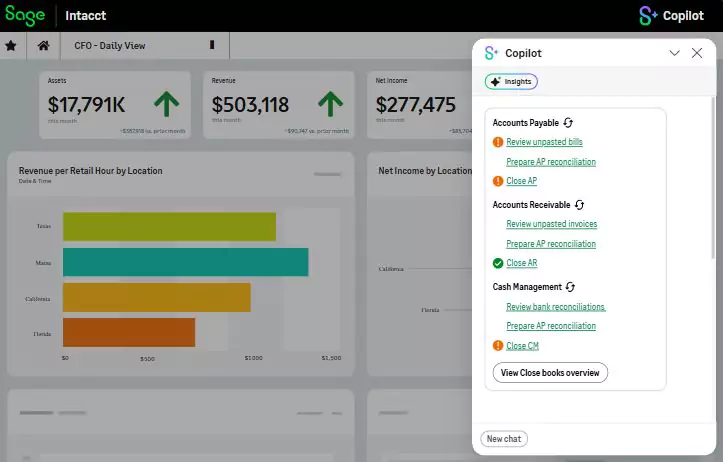
- Sage Copilot: Use natural language to interact with financial data, identify trends, and quickly surface relevant insights.
- AI agents: Automate and support multi-step finance processes, such as reconciliations, close management, and financial analysis.
- Intelligent insights: Identify anomalies, variances, and trends to help finance teams spot issues and understand performance faster.
- Sage Intacct AI Gateway: Securely connect authorized Sage Intacct data with external AI tools and custom applications.
These capabilities help finance teams reduce manual work and spend more time analyzing performance, planning, and supporting strategic decisions.
Sage Intacct modules and features
Sage Intacct has a full suite of modules and tools to handle modern financial management complexities. This includes core financials and advanced capabilities:
- Core financials: General ledger, cash management, accounts receivable, accounts payable, order entry, purchasing, reporting, and dashboards.
- Advanced modules: Multi-entity consolidation, revenue recognition, inventory control, project accounting, fixed assets management.
- Marketplace and API integrations: Integrate via Sage Intacct Marketplace or build custom integrations with open API.
Core financial modules
- General Ledger: Simplify financial management with automation
- Cash Management: Track inflows and outflows
- Accounts Payable/Receivable: Automate invoicing, payments, and collections
- Order Entry and Purchasing: Optimize order processing and control spending
- Reporting and Dashboards: Get real-time insights into finance and operations

Advanced features
- Multi-dimensional reporting and dashboards: Tag transactions to get more detail
- Multi-entity and multi-currency accounting: Automate consolidations and currency conversions
- Dynamic allocations: Distribute costs and revenue across business dimensions
- Fixed assets management: Automate asset lifecycle processes
- Inventory management: Track and control inventory
- Integration options: Sage Marketplace or custom API integrations

Industry-specific Sage Intacct solutions
From automated workflows to dimensional reporting, Sage Intacct is tailored to your industry, instead of a one-size-fits-all approach. Industries served include family office, senior living, construction, distribution, franchise, hospitality, professional services, financial services, software/SaaS, healthcare, and nonprofit.

Sage Intacct vs. competitors
When evaluating Sage Intacct, businesses often compare it with accounting and ERP solutions such as QuickBooks,Acumatica, NetSuite, and Dynamics 365 Business Central. These platforms vary in their focus, from straightforward accounting and finance-first financial management to broader ERP and operational capabilities. The right choice depends on your organization’s size, financial and operational complexity, technology ecosystem, and priorities.
The differences become clearer when you compare each platform’s typical fit and primary focus. The table below provides a high-level view of where Sage Intacct and several commonly evaluated alternatives tend to stand apart.
Two of the most common comparisons are QuickBooks and Acumatica. Here’s a closer look at how those platforms differ from Sage Intacct:
- Sage Intacct vs. QuickBooks: QuickBooks is well suited for small businesses with straightforward accounting needs. Sage Intacct provides more advanced financial reporting, automation, multi-entity management, and scalability for organizations that have outgrown entry-level accounting software.
- Sage Intacct vs. Acumatica: Both are cloud ERP solutions, but their strengths differ. Sage Intacct takes a finance-first approach with deep accounting, reporting, and multi-entity capabilities. Acumatica provides broader operational functionality, including manufacturing, distribution, inventory, and field service.
For organizations prioritizing financial management, automation, and scalability, Sage Intacct is a strong choice. However, businesses with simpler accounting requirements or more operations-heavy ERP needs may find another platform better aligned with their priorities.
Sage Intacct vs. other Sage ERP solutions
Sage offers several accounting and ERP solutions designed for different business requirements. For organizations considering Sage Intacct, the right choice often depends on their size, operational complexity, deployment preferences, and plans for future growth.
- Sage Intacct vs. Sage 50: Sage 50 is designed for small businesses with straightforward accounting needs. Organizations that need multi-entity consolidation, advanced reporting, greater automation, or cloud-based accessibility may consider Sage Intacct as they grow.
- Sage Intacct vs. Sage 100: Sage 100 is a proven ERP solution for small and midsized businesses, with strong accounting, inventory, distribution, and operational capabilities. Sage Intacct may be a better fit for organizations prioritizing cloud-native financial management, multi-entity accounting, advanced automation, and scalability.
- Sage Intacct vs. Sage 300: Sage 300 provides established accounting, inventory, and operational functionality for small and midsized businesses. Organizations looking to move to a cloud-native platform with automated updates, advanced reporting, and streamlined multi-entity management may consider Sage Intacct.
Choosing between Sage solutions is not one-size-fits-all. Evaluating your financial requirements, operational needs, existing technology, budget, and growth plans can help determine which Sage ERP solution is the best fit.
Is Sage Intacct right for my organization?
Sage Intacct is a strong fit for growing organizations with increasingly complex financial needs.
Sage Intacct may be a good fit if you:
- Manage multiple entities, locations, or business units
- Rely heavily on spreadsheets for reporting
- Need advanced dimensional reporting or revenue recognition
- Need to integrate accounting with multiple business applications
- Want scalable, cloud-based financial management
Sage Intacct may not be the best fit if you:
- Have straightforward bookkeeping needs
- Require an ERP centered primarily on deep manufacturing or operational functionality
- Don’t require advanced reporting or multi-entity accounting
- Have a budget better suited to entry-level accounting software
Ultimately, financial complexity is one of the best indicators of whether Sage Intacct is the right fit.
How much does Sage Intacct cost
Sage Intacct uses a subscription-based pricing model, with costs varying based on the number of users and active modules. This flexible approach allows businesses to start with the features they need most and scale up as requirements evolve. For smaller organizations with basic needs, such as five users and a few essential modules, annual costs start at around $20,000. However, pricing can exceed $75,000 annually for larger companies or those with complex needs. For example, SaaS or professional services organizations requiring subscription billing, revenue recognition, and advanced reporting. Implementation fees typically start at $20,000 and vary depending on the scope and complexity of your requirements.
When budgeting for Sage Intacct, it’s important to factor in user access needs and implementation costs, as these significantly impact the overall investment. Sage Intacct’s pricing structure ensures you only pay for what you use, and its flexibility means your system can grow alongside your business. To receive a customized quote tailored to your specific needs and objectives, contact Rand Group today.
How long does it take to implement Sage Intacct
On-premise accounting software and ERP deployments can take 4-6 months or more. In contrast, with Sage Intacct’s cloud architecture, you can go live faster. Parallel configuration and testing reduce downtime during migration. Standardized templates and pre-built integrations speed up setup. As a result, core functionality can be used in weeks, advanced modules in months. Sage Partner-led guidance ensures smooth data migration, training, and workflow optimization.
To learn more, read our Sage Intacct implementation guide.
How to get Sage Intacct
Get started by connecting with an experienced Sage Partner like Rand Group. These trusted advisors will guide you through every step. Additionally, partners provide industry-specific expertise, streamlined implementation, and ongoing support to maximize value.
Choosing the right Sage Intacct Partner
An experienced Sage Partner can help organizations implement Sage Intacct effectively. They provide support in areas such as:
- Needs assessment and planning
- System configuration and setup
- Customization for unique workflows
- Staff training and user support
- Ongoing process optimization
Partner guidance can help organizations achieve a smooth transition. Moreover, it can improve financial operations, and fully leverage Sage Intacct’s capabilities.
Frequently asked questions about Sage Intacct
What is Sage Intacct?
Sage Intacct is a cloud-based financial management and accounting platform designed for growing organizations. It combines core accounting, automation, reporting, multi-entity management, and advanced financial capabilities in one scalable system.
What is Sage Intacct used for?
Sage Intacct is used to manage and automate financial processes such as general ledger, accounts payable, accounts receivable, revenue recognition, expense management, reporting, consolidations, and multi-entity accounting. It also provides real-time financial insights to support better decision-making.
Is Sage Intacct an ERP system?
Yes. Sage Intacct is a cloud-based ERP platform focused primarily on financial management and accounting. Organizations can extend its core financial capabilities with additional modules, integrations, and industry-specific solutions.
Does Sage Intacct use AI?
Yes. Sage Intacct uses AI to automate routine financial work, identify trends and anomalies, and help users gain insights from financial data. AI capabilities include Sage Copilot, AI agents, intelligent automation, and Sage Intacct AI Gateway.
What are the main benefits of Sage Intacct?
The main benefits of Sage Intacct include real-time financial visibility, process automation, scalability, multi-entity management, advanced reporting, integrations, and cloud accessibility. These capabilities help finance teams reduce manual work and manage increasing financial complexity as their organizations grow.
How much does Sage Intacct cost?
Sage Intacct pricing varies based on the number of users, modules, and complexity of the organization. Annual software costs can start around $20,000 for smaller implementations and exceed $75,000 for organizations with more advanced requirements. Implementation costs typically start around $20,000.
How long does Sage Intacct take to implement?
Sage Intacct implementation timelines depend on the organization’s size, requirements, integrations, and modules. Core functionality can often be implemented within weeks, while more complex implementations involving advanced modules and integrations may take several months.
What types of businesses use Sage Intacct?
Sage Intacct is designed for growing organizations that need more sophisticated financial management capabilities. It supports industries including professional services, healthcare, nonprofit, construction, distribution, financial services, software and SaaS, hospitality, franchise, and more.
Is Sage Intacct suitable for multi-entity organizations?
Yes. Sage Intacct provides multi-entity accounting capabilities that simplify consolidations, inter-entity transactions, reporting, and financial management across multiple entities, locations, and business units.
How do you get started with Sage Intacct?
Organizations can get started by working with an experienced Sage Intacct Partner to assess requirements, select modules, plan the implementation, migrate data, configure the system, and train users. A qualified partner can also provide ongoing support and optimization after go-live.
Sage Intacct: The future of financial management
Sage Intacct is more than accounting software, it’s a cloud financial management platform designed to help organizations scale with confidence. The system automates routine accounting tasks, simplifies multi-entity financial management, and provides real-time visibility into financial performance.
Organizations researching the platform often turn to Sage Intacct reviews to better understand how it performs in real-world environments. These reviews frequently highlight the platform’s strong financial reporting, automation capabilities, and scalability for growing businesses.
With modular solutions, industry expertise, and a proven track record for compliance and security, Sage Intacct is built to grow alongside your business. Contact our team to learn how Sage Intacct can streamline processes, improve financial visibility, and support long-term growth.