What is Sage X3? Features, benefits, and who it’s best for

As manufacturers and distributors grow, disconnected systems, manual processes, and limited visibility can make it harder to manage inventory, production, finances, and supply chain operations. Sage X3 is Sage’s enterprise ERP solution designed to unify these critical business functions in a single platform, helping mid-sized and large organizations operate more efficiently and scale with confidence.
In this guide, we’ll answer the question,“What is Sage X3?“, explore its key features and benefits, explain which organizations are the best fit, compare Sage X3 to Sage 100, and discuss how Rand Group partners with xkzero to help organizations evaluate, implement, and optimize Sage X3.
At a glance
Sage X3 is Sage’s enterprise ERP solution designed for mid-sized and large manufacturers, distributors, and other organizations with complex operations. This guide explains what Sage X3 is, its core features and business benefits, how it compares to Sage 100, and when it may be the right fit for your organization. You’ll also learn how Rand Group’s partnership with xkzero helps organizations successfully evaluate, implement, and optimize Sage X3.
What is Sage X3?
Sage X3 is Sage’s enterprise ERP system, originally developed as Adonix X3, that combines financial management, manufacturing, supply chain management, inventory control, purchasing, sales, and reporting into a single business management platform.
Sage X3 helps organizations manage finance, manufacturing, inventory, purchasing, sales, and supply chain processes in one ERP platform, reducing reliance on disconnected spreadsheets, legacy tools, or department-specific systems.
Designed primarily for manufacturers, distributors, and product-based organizations, Sage X3 helps businesses automate processes, improve operational efficiency, and make better decisions with real-time business insights.
Key characteristics include:
- Enterprise-grade ERP platform
- Cloud or on-premises deployment
- Multi-company and multi-site management
- Multi-currency and multi-language support
- Advanced manufacturing and supply chain functionality
- Flexible workflows and configurable business processes
- Open architecture for integrations and customization
As organizations expand into new markets, add facilities, or increase operational complexity, Sage X3 provides the scalability needed to support continued growth without replacing core business systems.

Need help choosing the right ERP?
Sage X3 may be a strong fit for some growing manufacturers and distributors, but it is not the only option. Rand Group can help you compare Sage X3 with other ERP platforms, including Sage 100, Sage Intacct, Microsoft Dynamics 365 Business Central, Dynamics 365 Finance & Supply Chain Management, and NetSuite, to determine which solution best supports your business requirements and long-term growth plans.
What does Sage X3 do?
Sage X3 connects business functions across finance, operations, manufacturing, inventory, purchasing, and sales so organizations can work from a single source of truth.
Financial management
Finance teams can manage accounting across multiple entities while maintaining visibility into organizational performance.
Key capabilities include:
- General ledger
- Accounts payable and accounts receivable
- Cash management
- Budgeting and forecasting
- Fixed assets
- Financial reporting
- Multi-company consolidation
- Multi-currency accounting
- Global tax management
These capabilities help finance leaders streamline month-end close, improve reporting accuracy, and support growing organizations operating across multiple business units or countries.
Supply chain management
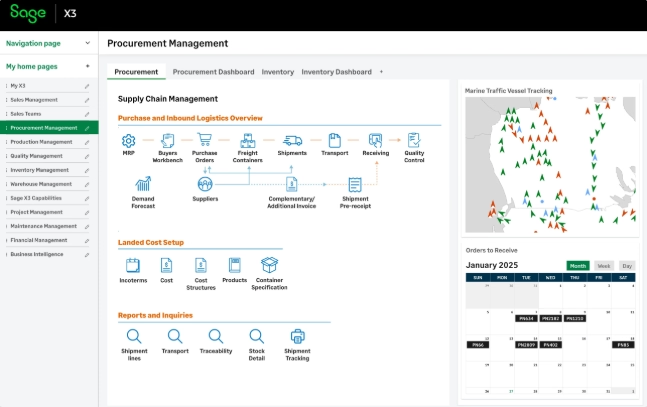
Sage X3 gives organizations greater control over purchasing, inventory, warehouse operations, and order fulfillment.
Capabilities include:
- Purchasing and procurement
- Inventory management
- Warehouse management
- Sales order management
- Vendor management
- Demand planning
- Replenishment planning
- Shipment tracking
Improved visibility across the supply chain enables organizations to reduce stock shortages, optimize inventory levels, and improve customer service.

Manufacturing
Manufacturing organizations benefit from robust production management capabilities designed to support both discrete and process manufacturing environments.
Key functionality includes:
- Bills of materials (BOM)
- Production planning
- Work orders
- Material requirements planning (MRP)
- Shop floor control
- Quality management
- Batch and lot traceability
- Production scheduling
- Cost tracking
By connecting production planning and financial management, manufacturers gain better insight into production costs, inventory consumption, and operational performance.

Sales and customer management
Sage X3 supports the entire order-to-cash process.
Capabilities include:
- Quotes
- Sales orders
- Customer pricing
- Contracts
- Customer service
- Returns management
- CRM integrations
Connecting sales and operations helps improve order accuracy while providing customer service teams with greater visibility into inventory availability and order status.
Reporting and analytics
Executives need timely information to make informed decisions. Sage X3 includes reporting and dashboard capabilities that help organizations monitor:
- Financial performance
- Inventory levels
- Manufacturing KPIs
- Sales performance
- Purchasing metrics
- Operational trends
Role-based dashboards allow stakeholders across finance, operations, and executive leadership to access the information most relevant to their responsibilities.
Key features of Sage X3
Sage X3 combines enterprise functionality with flexibility to support organizations as they grow.
Core features include:
- Multi-company management
- Multi-site operations
- Multi-currency accounting
- Multi-language support
- Cloud or on-premises deployment
- Financial management
- Inventory and warehouse management
- Purchasing and procurement
- Production planning and scheduling
- Batch and lot traceability
- Workflow automation
- Business intelligence dashboards
- Role-based security
- Open APIs and third-party integrations
- Mobile accessibility
Together, these capabilities allow organizations to standardize business processes while adapting the system to their operational requirements.

Who is Sage X3 best for?
While many ERP solutions serve small businesses, Sage X3 is designed for organizations with more complex operational and financial requirements.
It is particularly well suited for:
Manufacturing
- Industrial manufacturing
- Food and beverage
- Chemicals
- Medical device manufacturing
- Consumer products
- Industrial equipment
Distribution
- Wholesale distributors
- Industrial suppliers
- Importers and exporters
- Specialty distributors
Growing organizations that:
- Operate multiple companies or business units
- Have multiple warehouses or manufacturing facilities
- Conduct international business
- Manage complex inventory
- Require advanced manufacturing planning
- Need stronger financial visibility
- Have outgrown entry-level ERP software
Organizations experiencing rapid growth often find that manual reporting, disconnected systems, and spreadsheet-based processes become increasingly difficult to manage. Sage X3 provides a more integrated platform capable of supporting long-term expansion.
Should you compare Sage X3 alternatives?
Sage X3 can be a strong fit for manufacturers and distributors that need advanced inventory, production, supply chain, and multi-site capabilities. However, ERP selection should not begin and end with one platform. The right system depends on your operational complexity, reporting requirements, growth plans, technology strategy, implementation budget, and internal resources.
Organizations evaluating Sage X3 may also want to compare alternatives such as Microsoft Dynamics 365 Finance & Supply Chain Management, Oracle NetSuite, Sage Intacct, Sage 100, or Microsoft Dynamics 365 Business Central depending on their needs.
As a multi-platform ERP provider, Rand Group can help your organization evaluate Sage X3 alongside other leading ERP systems. If Sage X3 is the right fit, Rand Group can support the project through our partnership with xkzero. If another ERP better aligns with your business requirements, we can help you evaluate, implement, and support that path as well.
Benefits of Sage X3
Beyond its robust functionality, Sage X3 helps organizations improve efficiency, increase visibility, and support long-term growth.
- Improve operational visibility: Connect finance, manufacturing, inventory, and supply chain data in one system to make faster, more informed business decisions.
- Streamline financial management: Automate accounting processes, simplify multi-company reporting, and reduce the time spent on month-end close and financial consolidation.
- Optimize inventory and warehouse operations: Gain greater inventory visibility, improve stock accuracy, and streamline purchasing and fulfillment.
- Increase manufacturing efficiency: Coordinate production planning, inventory, purchasing, and quality management to improve resource utilization and operational performance.
- Support global growth: Manage multiple companies, currencies, languages, and country-specific tax requirements within a single ERP platform.
- Scale operations confidently: Adapt to acquisitions, new facilities, international expansion, and increasing operational complexity without outgrowing your ERP.
Sage X3 vs. Sage 100
Both Sage X3 and Sage 100 are powerful ERP solutions within the Sage portfolio, but they’re designed for different stages of business growth. Sage 100 continues to be an excellent fit for many small and mid-sized manufacturers and distributors, offering robust financial management, inventory control, and operational capabilities. As organizations expand into multiple entities, global operations, or more complex manufacturing and supply chain processes, Sage X3 provides the advanced functionality and scalability needed to support that growth.
The comparison below highlights some of the key differences between the two platforms.
Many manufacturers and distributors successfully use Sage 100 for years. However, as organizations expand internationally, increase operational complexity, or require more advanced manufacturing and financial capabilities, they may outgrow Sage 100. In these situations, a more robust Sage ERP solution, such as Sage X3 or Sage Intacct, may be a better long-term fit.
Signs you’ve outgrown your current ERP
If your organization is experiencing any of the following challenges, it may be time to evaluate whether an enterprise ERP like Sage X3 is the right next step.
Common signs include:
- Managing multiple legal entities with manual consolidations
- Expanding into international markets
- Growing manufacturing complexity
- Increasing warehouse and inventory requirements
- Heavy reliance on spreadsheets for reporting
- Limited visibility into operational performance
- Slow month-end close processes
- Difficulty integrating business systems
- Existing ERP no longer supports business growth
An ERP assessment can help determine whether optimizing your current system or moving to a more scalable platform will better support your long-term objectives.
How much does Sage X3 cost?
Sage X3 pricing varies based on each organization’s unique business requirements and implementation scope. Factors that influence the overall investment include:
- Number of users
- Deployment model (cloud or on-premises)
- Required modules and functionality
- Number of legal entities or business locations
- Data migration complexity
- Third-party integrations
- Customizations and workflow requirements
- User training and change management
- Ongoing support and optimization services
Rather than viewing Sage X3 as a one-time software purchase, organizations should evaluate the total cost of ownership, including software licensing, implementation services, data migration, integrations, training, and ongoing support. An experienced implementation partner can help assess your business requirements, recommend the appropriate solution, and provide a tailored estimate based on your organization’s operational complexity and long-term growth goals.

Evaluating Sage X3?
If your organization is considering Sage X3, Rand Group can help you assess whether the platform is the right fit for your financial, manufacturing, inventory, and supply chain requirements. Through our partnership with xkzero, we provide access to Sage X3 expertise while helping you compare the platform against your business needs, implementation goals, and long-term ERP strategy.
Rand Group + xkzero: Your trusted Sage X3 implementation partner
Choosing an ERP platform is only part of a successful digital transformation. Selecting the right implementation partner is equally important. For organizations evaluating Sage X3, Rand Group partners with xkzero, a leading Sage X3 consulting firm, to deliver implementation, consulting, optimization, and ongoing support services for Sage X3 customers.
This partnership allows organizations to benefit from Rand Group’s decades of ERP consulting experience alongside xkzero’s deep specialization in Sage X3. Together, we help organizations evaluate business requirements, plan implementations, integrate business systems, optimize business processes, and support long-term ERP success.
Organizations working with Rand Group gain access to expertise in:
- ERP software evaluation
- Business process consulting
- Sage X3 implementations through our partnership with xkzero
- Integrations and data migration
- Reporting and analytics
- User training
- Ongoing support and optimization
Whether you’re evaluating Sage X3 for the first time or planning to modernize an existing ERP environment, our team can help you identify the solution that best aligns with your operational needs and long-term business goals.
Sage X3 frequently asked questions
What is Sage X3 used for?
Sage X3 is an enterprise resource planning (ERP) system used to manage financial operations, manufacturing, inventory, supply chain, purchasing, sales, and reporting within a single integrated platform. It is designed to help growing organizations improve operational efficiency and gain better visibility across the business.
Is Sage X3 cloud-based?
Yes. Sage X3 can be deployed in the cloud or on-premises, allowing organizations to choose the deployment model that best fits their IT strategy, security requirements, and business needs.
What industries use Sage X3?
Sage X3 is commonly used by manufacturers, distributors, food and beverage companies, chemical manufacturers, industrial suppliers, medical device companies, and other organizations with complex supply chain and manufacturing operations.
What is the difference between Sage X3 and Sage 100?
Sage 100 is typically best suited for small to mid-sized organizations with less complex operational requirements, while Sage X3 is designed for mid-sized and enterprise organizations that require advanced manufacturing, supply chain management, global financial capabilities, and support for multiple companies and international operations.
What are the top Sage X3 alternatives?
Top Sage X3 alternatives include Microsoft Dynamics 365 Finance & Supply Chain Management, Oracle NetSuite, Sage Intacct, Sage 100, and Microsoft Dynamics 365 Business Central. The best fit depends on your manufacturing complexity, supply chain needs, financial reporting requirements, cloud strategy, budget, and long-term growth plans.
Is Sage X3 good for manufacturing?
Yes. Sage X3 includes advanced manufacturing capabilities such as bills of materials (BOM), production planning, work orders, material requirements planning (MRP), quality management, and batch and lot traceability, making it a strong choice for many manufacturers.
Can Sage X3 manage multiple companies?
Yes. Sage X3 supports multi-company, multi-site, multi-currency, and multi-language operations, making it well suited for organizations with multiple legal entities or international operations.
How much does Sage X3 cost?
Sage X3 pricing varies depending on factors such as the number of users, deployment model, implementation scope, required modules, integrations, and ongoing support needs. An experienced implementation partner can help evaluate your requirements and develop a solution tailored to your organization’s goals and budget.
How long does a Sage X3 implementation take?
Implementation timelines vary based on business complexity, data migration requirements, integrations, and project scope. While smaller projects may be completed in several months, larger enterprise implementations typically require additional planning, testing, and user training.
Can Sage X3 integrate with other business applications?
Yes. Sage X3 supports integrations with many third-party applications, including CRM systems, warehouse management systems, eCommerce platforms, payroll solutions, business intelligence tools, and other operational software through APIs and integration technologies.
How do I know if Sage X3 is right for my business?
If your organization has outgrown entry-level ERP software, operates multiple companies, manages complex manufacturing or distribution processes, or requires stronger financial visibility and scalability, Sage X3 may be a good fit. Working with an experienced Sage partner can help you evaluate your requirements and determine whether Sage X3 aligns with your long-term business objectives.
Ready to learn more about Sage X3?
Sage X3 provides manufacturers, distributors, and other growing organizations with a powerful ERP platform for managing financial operations, manufacturing, inventory, and supply chain processes from a single system. Its scalability, flexibility, and enterprise capabilities make it a strong option for organizations that have outgrown entry-level ERP software and need technology that can support long-term growth.
Rand Group can help you evaluate Sage X3 alongside other ERP platforms and determine which solution best fits your organization. If Sage X3 is the right choice, we can support the project through our partnership with xkzero. If another ERP is a better fit, our team can help you plan, implement, and support that path as well. Contact our team to discuss your ERP goals and determine whether Sage X3 is the right fit for your organization.