Sage Intacct fixed assets: Managing depreciation and asset lifecycles

Managing fixed assets manually may seem manageable at first, but as organizations grow, spreadsheets and disconnected systems often create more problems than they solve. Finance teams are expected to close faster, improve reporting accuracy, maintain audit readiness, and provide real-time visibility into company assets. Yet many organizations still rely on manual depreciation schedules and fragmented asset tracking processes that increase risk and consume valuable time.
The Sage Intacct fixed assets module helps organizations modernize fixed asset management. It automates the full asset lifecycle within the Sage Intacct cloud financial management platform, including acquisition, depreciation, transfers, and disposal. By integrating fixed asset management directly into the ERP, organizations can improve accuracy, streamline reporting, and reduce the burden of manual accounting processes.
For growing businesses with multiple entities, locations, or departments, Sage Intacct fixed assets delivers the visibility and automation needed to support scalable financial operations.
What is Sage Intacct fixed assets?
Sage Intacct fixed assets is an advanced module within the Sage Intacct ecosystem designed to help organizations automate and simplify fixed asset management. The module extends Sage Intacct’s core financial capabilities by providing centralized asset tracking, automated depreciation, and lifecycle management for both depreciating and non-depreciating assets.
Because the module integrates directly with Purchasing, Accounts Payable, General Ledger, and multi-entity accounting, organizations can reduce duplicate data entry and maintain more accurate financial records across the business.
Instead of relying on disconnected spreadsheets, finance teams gain access to a centralized asset register that stores detailed information about each asset, including:
- Asset location
- Warranty status
- Maintenance history
- Insurance details
- Asset condition
- Department or project assignment
This centralized visibility helps organizations improve operational decision-making while strengthening compliance, reporting accuracy, and audit readiness.

Sage Intacct’s fixed asset module key features
Sage Intacct’s fixed asset module helps organizations simplify and automate asset management while improving financial visibility and reporting accuracy. With the module’s capabilities, finance teams can reduce manual work, improve compliance, and gain better insight into asset performance across the organization.
Centralized asset management
One of the biggest advantages of Sage Intacct fixed assets is the ability to manage all assets from a single source of truth. Many organizations struggle with inconsistent records spread across spreadsheets, locations, or departments. Sage Intacct centralizes asset information into one comprehensive register, making it easier to track and manage assets throughout the organization.
Finance teams can monitor:
- Asset location and movement
- Maintenance schedules
- Warranty information
- Insurance status
- Asset condition
- Assigned departments or projects
For organizations operating across multiple entities or locations, this visibility becomes especially valuable. Sage Intacct dimensions allow businesses to categorize and report on assets by department, entity, project, or location, providing granular insights into asset utilization and costs.

Unlock deeper financial visibility with Sage Intacct dimensions
Sage Intacct Dimensions help organizations analyze performance from every angle by allowing users to group, filter, sort, and report on financial data in real time, all within Sage Intacct. Download our data sheet to learn how Sage Intacct Dimensions can improve reporting, visibility, and decision-making across your organization.
Automated depreciation
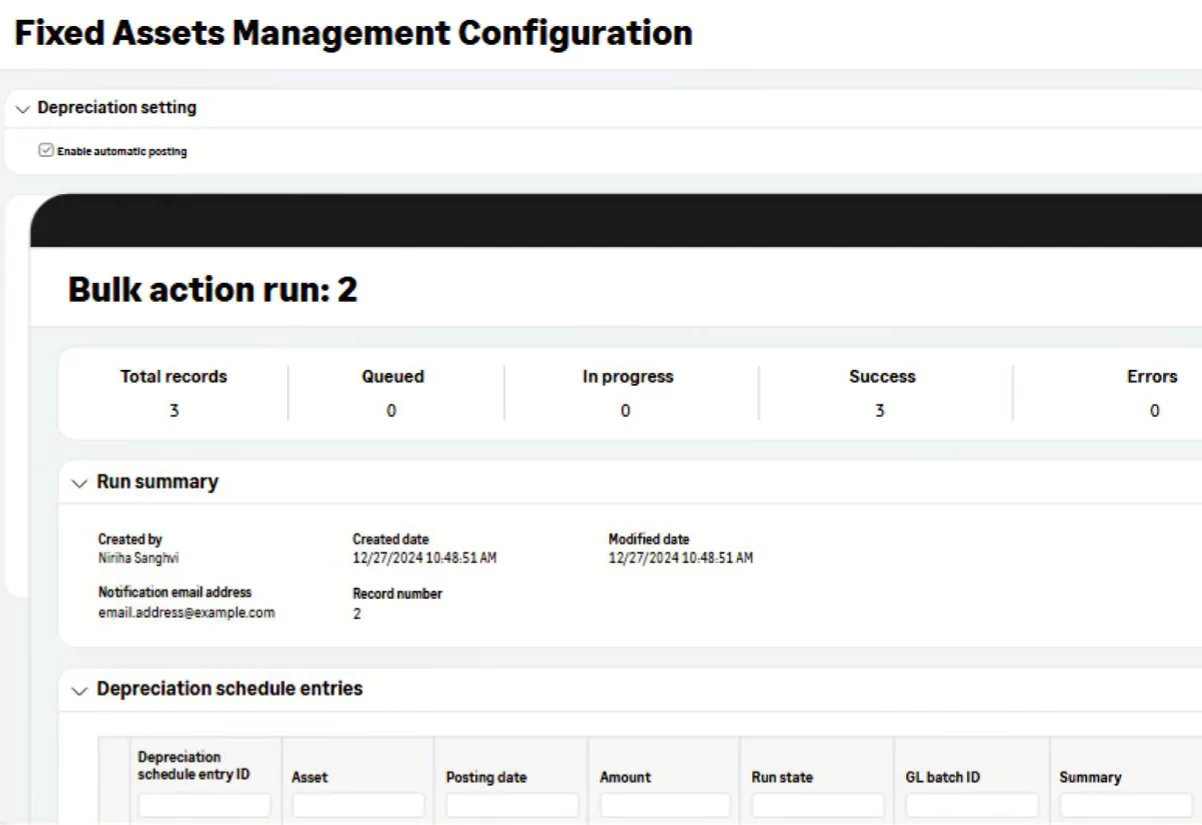
Manual depreciation calculations can create significant inefficiencies during month-end and year-end close processes. Sage Intacct fixed assets automates depreciation calculations and journal entries, reducing both manual effort and the risk of errors.
The module supports more than 50 depreciation methods, including:
- Straight-line depreciation
- MACRS
- Declining balance
- Reducing balance
- Custom depreciation formulas
By automating journal entries and depreciation processes, finance teams can accelerate close cycles and focus more on strategic financial analysis rather than repetitive administrative work.
Multi-book accounting and compliance
Organizations often need separate depreciation schedules for financial reporting, tax reporting, and regulatory compliance. Managing multiple books manually can quickly become complex and difficult to maintain accurately.
Sage Intacct fixed assets supports multi-book accounting, allowing businesses to maintain separate depreciation books for:
- GAAP reporting
- IFRS reporting
- Tax accounting
- Internal management reporting
This functionality improves audit readiness and helps organizations maintain compliance without requiring duplicate systems or manual adjustments.
Simplified acquisition and disposal
Asset acquisition and disposal processes can also create unnecessary manual work when systems are disconnected.
In our experience, this integration is most valuable when organizations define clear capitalization policies, asset categories, approval workflows, and reporting dimensions before enabling automated asset creation.
Sage Intacct fixed assets simplifies acquisition by automatically generating asset records from Accounts Payable bills or Purchasing transactions. This integration reduces duplicate entry and ensures asset data is captured accurately from the beginning.
The module also streamlines asset disposal processes by supporting:
- Full disposals
- Partial disposals
- Mass disposals
- Asset transfers
Automatic gain and loss calculations help finance teams complete disposals more efficiently while maintaining accurate accounting records.

Real-time reporting and faster close
One of the most valuable benefits of integrated fixed asset management is real-time visibility into financial data.
Sage Intacct fixed assets enables finance teams to:
- Reconcile net book value more easily
- Monitor depreciation expenses in real time
- Improve forecasting and capital planning
- Accelerate month-end and year-end close processes
Instead of spending hours reconciling spreadsheets, organizations gain direct access to accurate asset reporting within the ERP environment. This real-time visibility helps leadership teams make more informed decisions about capital investments, operational efficiency, and long-term planning.
Benefits of Sage Intacct fixed assets for finance teams
While the features of Sage Intacct fixed assets are powerful, the real value comes from the operational and financial outcomes organizations can achieve.
- Reduced manual work – Finance teams often spend unnecessary hours maintaining spreadsheets, updating depreciation schedules, and reconciling asset records. Automating these processes allows accounting teams to reduce repetitive tasks and focus on higher-value activities like financial analysis and strategic planning.
- Improved accuracy – Manual asset management increases the likelihood of data entry mistakes, inconsistent records, and reporting errors. By centralizing asset data and automating calculations, Sage Intacct helps organizations improve the consistency and accuracy of financial reporting.
- Enhanced visibility – For organizations managing multiple locations or legal entities, tracking assets across the business can become difficult without a centralized system. Sage Intacct fixed assets provides real-time visibility across entities and departments, helping organizations improve accountability and asset utilization.
- Supports scalable growth – As businesses grow, manual processes that once worked often become unsustainable. Integrated fixed asset management supports scalability by providing standardized processes, centralized reporting, and automation that can grow alongside the organization.
- Enables better decision-making – Access to accurate, real-time asset data improves planning and operational visibility. With access to real-time asset data, leadership teams can make more informed strategic decisions.
In similar Sage Intacct optimization projects, organizations have achieved measurable improvements such as:
0 %
reduction in manual processing time
0 %
faster month-end close
0 %
improvement in data accuracy
Industries that commonly benefit from Sage Intacct fixed assets include:
- Multi-location organizations
- Construction and project-based businesses
- Healthcare organizations
- Nonprofits managing grants and equipment
- Professional services firms
Why integrating fixed assets within your ERP matters
Many organizations still manage fixed assets in spreadsheets or standalone systems disconnected from their ERP. As businesses grow, this often leads to duplicate data entry, reconciliation issues, delayed reporting, increased audit risk, and limited visibility into asset performance.
Integrating fixed asset management directly within Sage Intacct helps eliminate these challenges by connecting financial and operational data in one system. Organizations can automate depreciation, streamline journal entries, enhance reporting reliability, and reduce manual work during month-end close.
However, organizations with very small asset counts may not require a dedicated fixed asset module.
Signs it’s time to upgrade your fixed asset process
Many organizations continue using manual asset management processes long after they have outgrown them.
You may benefit from Sage Intacct fixed assets if:
- You manage fixed assets in spreadsheets
- Depreciation calculations are manual
- Month-end close takes too long
- Audit preparation is difficult or time-consuming
- Multiple entities maintain separate asset records
- Asset reporting lacks visibility or accuracy
- Your finance team spends excessive time on reconciliations
- You need stronger reporting and compliance controls
If these challenges sound familiar, it may be time to modernize your fixed asset management processes.
FAQ: Sage Intacct fixed assets
What is Sage Intacct fixed assets?
Sage Intacct fixed assets is an advanced cloud-based asset management module within Sage Intacct that helps organizations manage the complete lifecycle of fixed assets. The module automates asset acquisition, depreciation, transfers, tracking, maintenance, and disposal while integrating directly with Sage Intacct financials.
How does Sage Intacct fixed assets automate depreciation?
Sage Intacct fixed assets automates depreciation calculations and journal entries using more than 50 depreciation methods, including straight-line, MACRS, declining balance, and custom formulas. This helps organizations reduce manual accounting work, improve accuracy, and accelerate month-end close processes.
Does Sage Intacct fixed assets support multi-book accounting?
Yes. Sage Intacct fixed assets supports multi-book accounting for GAAP, IFRS, tax reporting, and internal reporting requirements. Organizations can maintain multiple depreciation schedules without relying on spreadsheets or manual adjustments.
Can Sage Intacct fixed assets integrate with Accounts Payable and Purchasing?
Yes. Sage Intacct fixed assets integrates directly with Accounts Payable and Purchasing, allowing organizations to automatically create asset records from AP bills and purchasing transactions. This reduces duplicate data entry and improves financial accuracy.
How does Sage Intacct fixed assets improve asset tracking?
The module provides a centralized asset register where organizations can track asset location, condition, maintenance history, warranties, insurance details, and department or project assignments. This improves visibility and reporting across entities and locations.
Is Sage Intacct fixed assets a good solution for multi-entity organizations?
Yes. Sage Intacct fixed assets is especially beneficial for growing and multi-entity organizations that need centralized asset visibility, automated depreciation, and scalable financial reporting processes across departments, business units, or locations.
What are the benefits of integrating fixed assets directly within Sage Intacct?
Integrating fixed asset management within Sage Intacct helps organizations eliminate disconnected spreadsheets and manual processes. Benefits include automated journal entries, real-time reporting, improved compliance, reduced reconciliation work, and faster month-end close cycles.
How can Rand Group help organizations optimize Sage Intacct fixed assets?

Ready to optimize Sage Intacct with advanced modules?
Rand Group helps organizations implement and optimize advanced Sage Intacct modules like Sage Intacct fixed assets to improve automation, reporting, and financial visibility. From implementation to ongoing support, our Sage experts help businesses build more scalable and efficient finance operations. Connect with a Sage expert to learn how Sage Intacct advanced modules can support your business growth.
How Rand Group helps organizations optimize Sage Intacct
Technology alone does not guarantee operational improvement. Successful ERP optimization requires the right implementation strategy, process alignment, and ongoing support.
Our Sage experts work closely with organizations to help maximize the value of Sage Intacct by identifying opportunities to improve financial operations through automation, process optimization, and scalable system design. We take a strategic approach that aligns technology with each organization’s operational requirements, reporting goals, and long-term growth plans.
As a trusted Sage partner, we provide:
- Sage Intacct implementation services
- Fixed asset module deployment and optimization
- Multi-entity accounting expertise
- Finance transformation consulting
- Reporting and dashboard customization
- Integration support
- User training and ongoing support
Every organization has unique financial processes, compliance requirements, and scalability goals. Our team helps businesses evaluate which Sage Intacct modules best support their current operations while positioning them for future growth.
For organizations expanding their Sage Intacct environment, partnering with an experienced implementation team can make the difference between simply deploying new functionality and achieving meaningful operational transformation. This approach to modernization is reflected in our work with Club Greenwood.
By leveraging Sage Intacct and the expertise of our team, Club Greenwood modernized its financial management processes, enhanced reporting capabilities, and supported long-term strategic growth. Replacing manual workflows with a more integrated and automated system provided greater visibility into operations, improved efficiency, and streamlined day-to-day financial management.
Next steps
Manual fixed asset management processes create unnecessary inefficiencies, reporting challenges, and compliance risks for growing organizations. Sage Intacct’s fixed assets module helps finance teams automate depreciation, centralize asset tracking, improve reporting accuracy, and gain real-time visibility across the business.
If your organization is considering adding Sage Intacct fixed assets or looking to optimize your current Sage Intacct environment, we can help you assess your needs, streamline implementation, and maximize the value of your ERP investment. Contact our team today to learn more about Sage Intacct’s advanced modules.