Sage Intacct Lending Management: Manage the complete loan lifecycle

Managing a growing loan portfolio can become complex when balances, interest, payments, billing, and reporting are spread across multiple systems. Sage Intacct Lending Management brings these processes together, enabling lenders to manage the complete loan lifecycle from origination to payoff within Sage Intacct.
Available in the United States for revolving and non-revolving loans, Lending Management automates key processes such as interest calculations, amortization schedules, borrower statements, and payments while integrating lending activity with core accounting workflows. In this blog, we’ll explore its key capabilities, benefits, and implementation considerations.
At a glance
Sage Intacct Lending Management helps organizations manage the complete loan lifecycle—from origination through payoff—within Sage Intacct. Key capabilities include:
- Support for revolving and non-revolving loans
- Automated interest calculations and amortization schedules
- Borrower billing, statements, payments, and overpayments
- Management of fees, adjustments, write-offs, and payoffs
- A dedicated lending subledger with portfolio reporting
- Integration with Accounts Payable, Order Entry, Accounts Receivable, and the General Ledger
- Greater automation, financial visibility, and audit readiness
What is Sage Intacct?
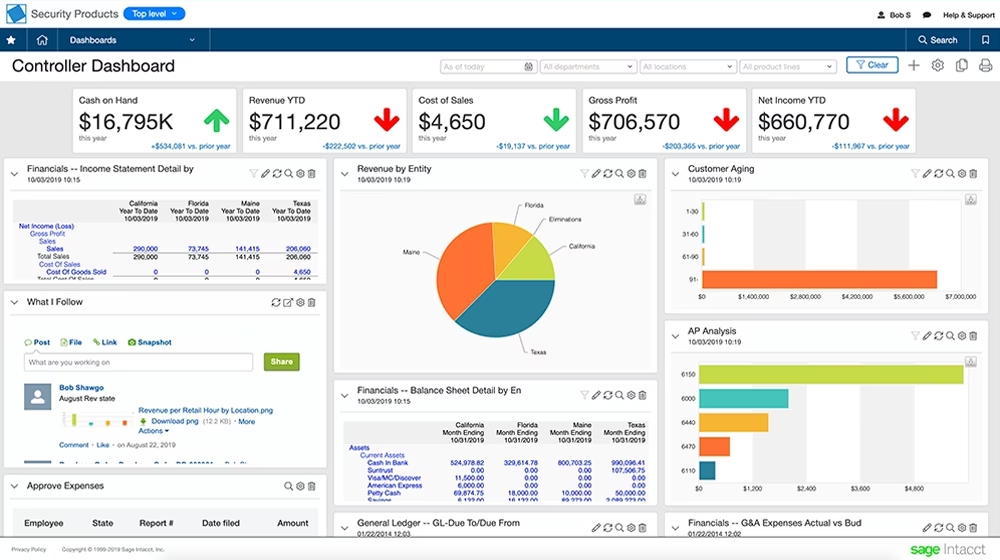
Sage Intacct is a cloud-based ERP and financial management platform designed to automate accounting processes and give organizations real-time visibility into financial performance. Its core capabilities include General Ledger, Accounts Payable, Accounts Receivable, cash management, reporting, dashboards, and dimensional accounting.
Unlike traditional ERP systems that require organizations to implement a large suite of functionality at once, Sage Intacct has a modular architecture. Businesses can establish their core financial foundation and add specialized applications as their operational and financial requirements evolve.
This flexibility is particularly valuable for growing organizations. Instead of managing increasingly complex processes through spreadsheets or disconnected systems, businesses can extend Sage Intacct with capabilities designed for specific financial workflows.
Sage Intacct Lending Management extends that approach to organizations that originate and manage loans.

Considering Sage Intacct for your business?
Discover how Sage Intacct can help your organization automate financial processes, improve visibility, and scale with confidence. Connect with Rand Group’s Sage Intacct experts to explore your requirements and see if Sage Intacct is the right fit for your business.
What is Sage Intacct Lending Management?
Sage Intacct Lending Management is a native Sage Intacct application that enables organizations to manage the complete loan lifecycle, from origination through payoff. It combines loan servicing with a dedicated lending subledger and connected accounting workflows, helping finance teams reduce manual processes and maintain accurate loan information.
Lending Management supports both revolving and non-revolving loan instruments, with capabilities to:
- Manage loan terms and disbursements
- Calculate interest and generate amortization schedules
- Process payments, fees, and adjustments
- Generate borrower statements
- Manage write-offs and loan payoffs
- Track lending activity in a dedicated subledger
Because Lending Management operates within the Sage Intacct financial ecosystem, it connects lending transactions with Accounts Payable, Order Entry, Accounts Receivable, and the General Ledger. These integrations reduce duplicate data entry, streamline accounting workflows, and provide a more complete financial record of lending activity.
Sage Intacct Lending Management is most relevant for organizations that originate, service, or manage loans and need lending activity connected with accounting. It may be especially useful when loan details are tracked in spreadsheets, interest calculations are handled manually, borrower statements require extra effort, or lending data must be reconciled separately from the general ledger.

How Sage Intacct Lending Management works
Sage Intacct Lending Management supports the loan lifecycle from initial configuration and funding through ongoing servicing and final payoff. Here’s how the process works.
1. Configure lending operations
Before creating loans, organizations configure the foundational elements that determine how lending transactions are managed and reported. Finance teams can define:
- Loan types to support different lending products
- Interest rates used to calculate interest
- Account categories to organize loan products and support portfolio reporting
- Fee types for charges associated with loans
- GL accounts to determine how lending transactions flow into financial reporting
Careful configuration is important because these decisions affect day-to-day processing, portfolio analysis, and financial reporting.
2. Create and fund loans
Once the lending environment is configured, users can create individual loan accounts. Each loan record can include:
- Borrower information
- Loan amount and terms
- Interest rate
- Amortization details
- Disbursement instructions
- Statement preferences
Loan funds can be disbursed directly to the borrower or to a designated third party. Connecting loan creation and funding with Sage Intacct’s financial workflows also provides finance teams with a clearer view of the operational loan and its accounting impact.
3. Generate amortization schedules and calculate interest
For amortized loans, Sage Intacct Lending Management generates amortization schedules and automates interest calculations, reducing the need for manual tracking.
When changes to principal require amortization, users can preview the revised schedule before applying it. Depending on the situation, organizations can:
- Maintain the existing payment amount while reducing the number of remaining payments
- Maintain the number of payments while reducing the payment amount
- Review previous amortization schedules through the loan history
This provides greater visibility into how principal changes affect future payments while preserving a history of previous schedules.
4. Automate borrower billing and statements
Sage Intacct Lending Management helps streamline recurring borrower communications and billing. Organizations can:
- Calculate interest
- Generate loan statements
- Email statements directly to borrowers
- Connect lending activity with related billing and accounting workflows
By automating these processes, lenders can reduce the administrative effort associated with recurring billing while avoiding the need to recreate lending information in separate accounting systems.
5. Process payments, overpayments, and fees
Lending Management provides flexibility for handling different payment scenarios. For non-amortized loans, payments can be automatically allocated between principal and interest, with the ability to adjust calculated amounts when necessary.
For amortized loans, overpayments can be handled in different ways:
- Apply the overpayment toward future scheduled payments
- Apply the overpayment to principal and reamortize the loan
- Receive full or partial payments against loan fees
These capabilities help lenders accommodate real-world scenarios such as early payments and additional principal payments without relying on manual workarounds.
6. Manage adjustments, write-offs, and loan payoffs
Not every loan transaction follows the normal payment schedule. Lending Management provides tools for managing exceptions and changes throughout the loan lifecycle, including:
- Principal adjustments: Increase the loan’s principal balance and distribute additional funds to the borrower or a designated third party.
- Reamortization: Generate a revised amortization schedule after eligible principal adjustments.
- Fee adjustments: Add applicable charges to a loan.
- Write-offs: Process partial or full write-offs of principal, interest, fees, or a combination of balances.
- Loan payoffs: Process the borrower’s final payment and close out the remaining obligation.
Once a payoff is posted, additional interest is no longer calculated, and the subsequent statement becomes the final statement for the loan.
7. Gain real-time visibility with an integrated lending subledger
Sage Intacct Lending Management maintains detailed lending activity in a dedicated subledger within the Sage Intacct environment. Instead of tracking loan details separately and periodically reconciling them with accounting records, finance teams can access lending and financial information in a connected system.
Organizations can review:
- Loan transaction histories
- Current and previous amortization schedules
- Lending subledger activity
- Rollforward balances
- Loan products grouped by account category
This centralized visibility can help finance teams reduce reconciliation effort, investigate balances more efficiently, improve portfolio reporting, and maintain a stronger audit trail of lending activity.
How Lending Management integrates with Sage Intacct financials
The value of Lending Management extends beyond maintaining individual loan records. The application connects lending activity with several of Sage Intacct’s core financial workflows.
- Accounts Payable: Lending Management interacts with Accounts Payable as part of loan disbursement. This connects the funding of a loan with the organization’s accounting processes rather than requiring the finance team to record the activity separately.
- Order Entry: Lending Management synchronizes with Order Entry to support borrower invoicing. This creates a more automated connection between loan activity and the transactions used to bill customers.
- Accounts Receivable: Order Entry transactions can flow automatically into Accounts Receivable, providing finance teams with visibility into amounts billed and owed by borrowers.
- General Ledger: Transactions ultimately connect with the General Ledger, helping organizations maintain consistent accounting records and financial reporting.
Together, these connections reduce the number of handoffs required between lending operations and accounting. Instead of treating loan management as an isolated operational process, organizations can build a more connected workflow from the underlying loan transaction through financial reporting.
Reporting and portfolio visibility
Sage Intacct Lending Management gives finance teams greater visibility into individual loans and the overall portfolio. Users can access:
- Amortization schedules
- Lending subledger activity
- Loan transaction histories
- Balance rollforwards
- Loan products grouped by account category
These reporting capabilities make it easier to analyze portfolio activity, investigate balances, and access lending data without manually combining information from multiple systems.
Benefits of Sage Intacct Lending Management
For organizations that currently depend on spreadsheets or disconnected lending and accounting processes, Lending Management can provide several significant advantages.
- Reduce manual loan administration. Automated interest calculations, amortization schedules, statements, and connected financial transactions can reduce repetitive work and dependence on spreadsheets.
- Improve financial accuracy. Connecting lending activity with Sage Intacct’s financial applications can reduce duplicate data entry and the errors that can occur when information is manually transferred between systems.
- Gain better portfolio visibility. A dedicated lending subledger, loan histories, schedules, and reporting give finance teams more immediate access to lending information.
- Simplify borrower servicing. Payments, overpayments, fees, statements, adjustments, write-offs, and payoffs can be managed through a connected lending workflow.
- Strengthen audit readiness. Detailed loan histories and subledger records help organizations maintain visibility into the transactions and changes affecting loan balances.
- Build scalable processes. Standardized loan types, rates, account categories, fees, and workflows can help organizations establish repeatable processes as their loan portfolios grow.
Who should consider Sage Intacct Lending Management?
Sage Intacct Lending Management may be a good fit for organizations that originate or service loans and want lending operations connected with financial management. Examples may include private lenders, investment firms, nonprofit loan programs, community development organizations, member-based organizations, financing programs, or other businesses that manage borrower balances, interest, statements, payments, and loan accounting.
Consider Lending Management if your organization:
- Manages multiple revolving or non-revolving loans
- Relies on spreadsheets for loan accounting, interest, or amortization
- Maintains lending and accounting data in separate systems
- Wants to automate borrower billing and statements
- Needs better visibility into loan and portfolio performance
- Already uses Sage Intacct and wants to extend its capabilities
Organizations with specialized regulatory, compliance, or servicing requirements should evaluate whether Lending Management supports their specific needs.
Key considerations when implementing Sage Intacct Lending Management
Successful implementation starts with understanding your lending processes before configuring the technology.
Organizations should evaluate their existing loan portfolio, loan products, accounting requirements, and exception scenarios. From there, they can determine how Lending Management should be configured to support those requirements.
Important implementation considerations include:
- Loan types and structures
- Interest rate configurations
- Amortization requirements
- Fee types and associated GL accounts
- Account categories and reporting structures
- Borrower and third-party disbursement processes
- Accounts Payable, Order Entry, Accounts Receivable, and General Ledger workflows
- User permissions and internal controls
- Existing loan data that needs to be migrated
- Statement and borrower communication requirements
- Financial and portfolio reporting needs
Data migration deserves particular attention. Loan balances, borrower records, interest calculations, amortization schedules, fees, historical transactions, and payoff information should be reviewed carefully before go-live. Inaccurate starting data can affect borrower statements, subledger balances, reporting, and downstream accounting.
Testing is equally important. Organizations should validate common transactions as well as exceptions, including regular payments, partial payments, overpayments, principal adjustments, fees, reamortization, write-offs, and payoffs.
Finally, users should be trained not only on how to process routine transactions but also on how Lending Management affects downstream accounting and reporting.
Sage Intacct requires organizations to subscribe to applications before configuring them, and Sage’s current configuration documentation includes Lending Management among the applications that can be configured. As a result, organizations should incorporate subscription, configuration, implementation, and training requirements into their deployment plan.
Choosing the right Sage Intacct partner can help you navigate these decisions, align Lending Management with your financial processes, and get greater value from your investment.

Choose your Sage Intacct partner with confidence
A successful Lending Management implementation requires the right configuration of loan products, accounting workflows, reporting, and controls. Talk to Rand Group’s Sage Intacct experts about evaluating, implementing, or optimizing the solution.
Partner with Rand Group for Sage Intacct Lending Management
The effectiveness of Sage Intacct Lending Management depends on more than enabling the application. Loan structures, accounting rules, workflows, integrations, reporting, data, and controls must work together.
That’s where an experienced Sage Intacct partner can help. Rand Group is a top North American Sage partner with a team that includes CPAs, Sage-certified professionals, technology consultants, and experienced industry professionals. Our team combines accounting expertise with technology and business process knowledge to help organizations design Sage Intacct environments around the way their businesses operate.
For organizations evaluating Sage Intacct Lending Management, we can help with:
- Business requirements and solution assessment
- Lending workflow design
- Sage Intacct configuration
- Accounting process design
- Data migration planning
- Integration requirements
- Financial and portfolio reporting
- End-to-end testing
- User training
- Ongoing Sage Intacct support and optimization
Our goal is not simply to configure software. We work with organizations to understand their financial processes and build solutions that support efficiency, visibility, control, and future growth.
Already using Sage Intacct? We can also assess your existing environment and identify opportunities to improve configuration, reporting, automation, integrations, and user workflows.
Frequently asked questions about Sage Intacct Lending Management
What is Sage Intacct Lending Management?
Sage Intacct Lending Management is a native Sage Intacct application for managing loans throughout their lifecycle, from origination and funding through payments and payoff. It includes capabilities for interest calculations, amortization, borrower statements, payments, fees, adjustments, reporting, and lending subledger management.
What types of loans does Sage Intacct Lending Management support?
Sage Intacct Lending Management supports both revolving and non-revolving loan instruments. It also provides functionality for amortized and non-amortized loan structures, allowing organizations to manage different lending products within the Sage Intacct environment.
Does Sage Intacct Lending Management calculate interest automatically?
Yes. Sage Intacct Lending Management can automatically calculate interest as part of loan servicing and statement generation. This reduces the need for finance teams to perform recurring interest calculations manually.
Can Sage Intacct Lending Management create amortization schedules?
Yes. Lending Management can generate amortization schedules for applicable loans. It also supports reamortization when events such as principal adjustments or overpayments change the loan balance. Users can preview the revised schedule before applying it.
How does Sage Intacct Lending Management handle overpayments?
For applicable amortized loans, organizations can apply an overpayment toward future payments on the existing amortization schedule or apply the amount to principal and reamortize the loan. When reamortizing, users can preview the resulting payment schedule before proceeding.
Can Sage Intacct Lending Management generate borrower statements?
Yes. Sage Intacct Lending Management can calculate interest, generate loan statements, and email statements directly to borrowers. This helps automate recurring borrower communications while keeping statement activity connected with the loan record.
Does Sage Intacct Lending Management integrate with Sage Intacct accounting?
Yes. Lending Management works with other Sage Intacct financial applications, including Accounts Payable, Order Entry, Accounts Receivable, and the General Ledger. These connections help organizations reduce duplicate processes and maintain lending and accounting activity in a more integrated financial environment.
What reporting is available in Sage Intacct Lending Management?
Lending Management provides reporting and analysis around areas such as amortization schedules, lending subledger activity, loan transaction histories, and balance rollforwards. Organizations can also group loan products into account categories to support more focused portfolio reporting.
Is Sage Intacct Lending Management available in the United States?
Yes. Sage announced Lending Management for the United States as part of Sage Intacct 2026 Release 3. The application enables organizations to manage the loan lifecycle from origination through payoff for revolving and non-revolving loan instruments.
Do I need to subscribe to Sage Intacct Lending Management separately?
Yes. Lending Management is an application within Sage Intacct that must be subscribed to before it can be configured. Organizations should evaluate licensing and implementation requirements with Sage or their Sage Intacct partner.
How do I implement Sage Intacct Lending Management?
Implementation typically begins with evaluating your loan products, accounting requirements, interest and amortization structures, fees, reporting, integrations, and existing data. The system can then be configured, tested, and deployed around those requirements. Working with an experienced Sage Intacct partner such as Rand Group can help align Lending Management with your broader accounting processes and reporting needs.
Is Sage Intacct Lending Management a full loan origination system?
Sage Intacct Lending Management helps organizations manage loan setup, funding, servicing, accounting, payments, statements, and payoff activity within Sage Intacct. Organizations that need specialized application intake, underwriting, borrower portals, collateral tracking, compliance workflows, or document management should evaluate whether additional systems or integrations are required.
Bring lending and financial management together with Sage Intacct
Sage Intacct Lending Management brings loan servicing and financial accounting together, helping organizations automate interest calculations, amortization, payments, borrower statements, and other lending processes while improving portfolio visibility.
Effective configuration is key to getting the most from the solution. Rand Group can help you evaluate, implement, support, and optimize Sage Intacct Lending Management as part of a connected financial management strategy. Contact our Sage Intacct team to get started.