Sage Intacct for SaaS companies: Subscription billing, revenue recognition, and SaaS metrics

Recurring revenue is a key strength of the software-as-a-service (SaaS) business model, but growth can quickly introduce financial complexity. As customer and contract volumes increase, finance teams must manage subscription billing, renewals, usage charges, deferred revenue, revenue recognition, and SaaS-specific metrics.
These processes often span CRM platforms, spreadsheets, billing applications, and accounting systems, making it difficult to maintain accurate data and efficient workflows. Processes that worked for a smaller customer base may become increasingly difficult to scale as subscription models and contract terms become more complex.
Sage Intacct for SaaS companies provides a cloud financial management platform designed to automate subscription billing and revenue recognition while improving financial visibility. For SaaS CFOs, controllers, and finance teams, it can provide a scalable foundation connecting contracts, billing, accounting, reporting, and the metrics needed to understand business performance.
At a glance
- Sage Intacct for SaaS companies provides a scalable financial platform for managing subscription billing, revenue recognition, reporting, and SaaS metrics.
- Flexible billing capabilities support recurring, usage-based, tiered, and other subscription models as SaaS businesses grow.
- Automated revenue recognition and deferred revenue management can reduce reliance on spreadsheets and support ASC 606 requirements.
- Real-time dashboards and dimensional reporting provide greater visibility into ARR, MRR, churn, retention, CAC, and other SaaS KPIs.
- Integrations can connect Sage Intacct with CRM, billing, and other business systems to create more efficient financial workflows.
- An experienced Sage Intacct implementation partner can help align the platform with your accounting requirements, integrations, reporting needs, and long-term growth strategy.
What is Sage Intacct?
Sage Intacct is a cloud-based financial management platform that helps growing organizations automate accounting, improve reporting, and gain greater visibility into financial performance.
Core capabilities include:
- General ledger and financial reporting
- Accounts payable and accounts receivable
- Cash management
- Multi-entity consolidation
- Real-time dashboards and dimensional reporting
- Integrations with CRM and other business applications
For SaaS and subscription-based companies, Sage Intacct also supports subscription billing, contract management, revenue recognition, and SaaS metrics. These capabilities help finance teams reduce manual processes and build a financial foundation that can scale as the business grows.


Discover what Sage Intacct can do for your growing business
See how Sage Intacct can help automate financial processes, improve visibility, and build a scalable foundation for growth. Contact us to discuss your requirements and explore whether Sage Intacct is the right fit for your business.
Why SaaS companies need specialized financial management
SaaS accounting differs from traditional transaction-based accounting because the timing of a customer contract, invoice, payment, and revenue recognition may all be different.
A SaaS business may need to account for:
- Monthly, annual, and multi-year subscriptions
- Annual prepayments
- User- or seat-based pricing
- Usage-based billing
- Tiered pricing and minimum commitments
- Upgrades and downgrades
- Renewals and cancellations
- Professional services or implementation fees
- Contract modifications
- Deferred and unbilled revenue
The challenge becomes more significant as customer and contract volume grows.
For example, consider a customer that signs a 12-month software subscription and pays the entire annual fee upfront. The SaaS provider may issue the invoice and receive cash at the beginning of the contract, while recognizing subscription revenue over the period in which the service is provided.
This creates an important distinction:
Contract value → billing → cash collection → deferred revenue → recognized revenue
When finance teams attempt to manage these processes across spreadsheets and disconnected applications, month-end close and financial reporting can become increasingly time-consuming. Sage Intacct provides SaaS accounting software designed to connect these processes and establish greater consistency as the business scales.
How Sage Intacct supports SaaS subscription accounting
Sage Intacct provides capabilities specifically applicable to subscription and SaaS businesses, including contract management, flexible billing, revenue recognition, SaaS metrics, financial reporting, and integration with other business applications. Sage specifically positions the platform for SaaS companies from early-stage businesses through growth-stage organizations with increasingly complex financial requirements.
A key advantage is the ability to connect information across the customer financial lifecycle.
Instead of treating each invoice as an isolated accounting transaction, finance teams can establish processes around the underlying customer contract and connect:
Customer and CRM data → contracts → billing → revenue recognition → general ledger → financial reporting and SaaS metrics
Creating this structured financial foundation can reduce reliance on manual processes while providing finance and management teams with more timely information.
Subscription billing in Sage Intacct
SaaS pricing has evolved far beyond a single monthly subscription fee. Many companies combine several pricing and billing models as their products mature.
Sage Intacct subscription billing can support scenarios including:
- Recurring subscription billing
- User-based pricing
- Usage-based billing
- Tiered pricing
- Minimum commitments and overages
- Different billing frequencies and payment terms
- Renewals
- Subscription changes
- Project-based billing
Sage Intacct supports a wide range of subscription, usage, and project billing scenarios. For growth-stage SaaS organizations, Sage also highlights support for usage-based, user-based, tiered, minimum, and overage billing models.
This flexibility becomes particularly important as SaaS companies introduce new packaging or monetization strategies.
From our implementation experience: Subscription changes are often more complicated than they initially appear. Defining how upgrades, downgrades, renewals, cancellations, and contract amendments should affect billing and accounting before configuration can help prevent exceptions from becoming manual workarounds later.
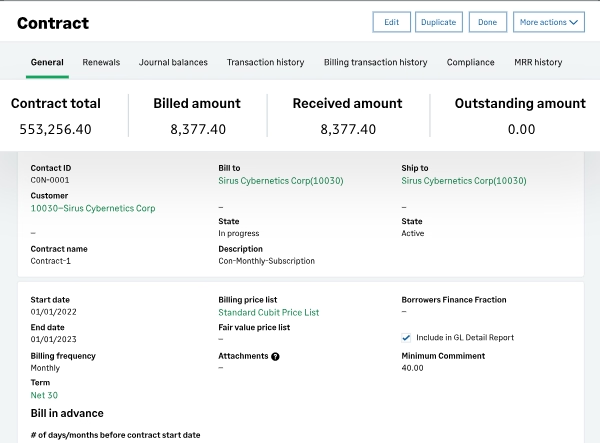
The initial sale is only the beginning of the SaaS customer lifecycle. As customer relationships evolve, finance teams need reliable processes for managing:
- Upgrades and downgrades
- Renewals and cancellations
- Pricing or subscription changes
- Contract amendments and other modifications
Automating billing workflows can reduce manual calculations, improve consistency, and help finance teams manage growing transaction volumes. But effective automation starts with clearly defined business processes.
Before configuring Sage Intacct, SaaS companies should determine their pricing structures, billing triggers, contract-change processes, system responsibilities, and exception-handling requirements.
Sage Intacct revenue recognition for SaaS companies
Revenue recognition is another area where SaaS finance can quickly become complex.
Under ASC 606, revenue is recognized as the organization satisfies the performance obligations associated with a customer contract. For SaaS businesses, those obligations can include ongoing software access as well as services such as onboarding, implementation, support, or training.
Sage Intacct provides revenue recognition functionality designed to support ASC 606 and IFRS 15 requirements. The platform can automate revenue recognition and help manage deferred revenue across SaaS contracts.
This is particularly valuable because billing and revenue recognition do not necessarily happen simultaneously.
A SaaS company might:
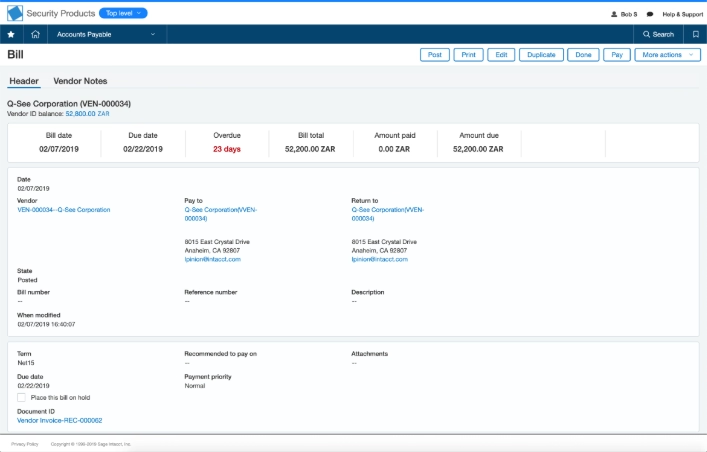
- Sign a 12-month customer contract.
- Invoice the entire annual amount upfront.
- Collect payment.
- Record the appropriate amount as deferred revenue.
- Recognize revenue as contractual performance obligations are satisfied.
Automating these processes can reduce the spreadsheet-based schedules and manual calculations that become increasingly difficult to manage at scale.
Sage Intacct can also support more complex revenue scenarios, including multiple revenue streams and forecasting deferred and recognized revenue across unbilled, billed, and paid amounts.
Software does not, however, replace an organization’s accounting judgment. SaaS companies still need clearly defined revenue policies, performance obligations, contract structures, controls, and reporting requirements. Those requirements should be understood before the system is configured.
Improving deferred revenue and financial visibility
For SaaS finance leaders, knowing how much revenue has been recognized is only one part of the picture.
They also need visibility into questions such as:
- What has been contracted?
- What has been billed?
- What remains unbilled?
- How much revenue is deferred?
- What revenue has been recognized?
- What revenue is expected in future periods?
- How are renewals and contract changes affecting forecasts?
Connecting contract, billing, and revenue information gives controllers and CFOs a more complete view of financial performance and can support forecasting, month-end reporting, audit preparation, cash planning, and board reporting.
SaaS metrics and KPIs in Sage Intacct
Traditional financial statements remain essential, but SaaS executives and investors also rely on operational metrics to understand the health and efficiency of the recurring-revenue model.
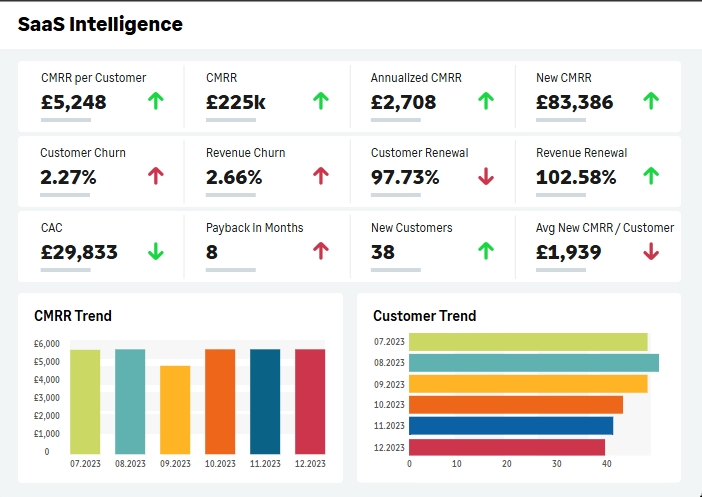
Sage Intacct supports real-time SaaS metrics and subscription analytics including MRR, ARR, NDR, churn, CAC, cash flow, bookings, renewals, and other measures.
Important metrics can include:
- Monthly recurring revenue (MRR): recurring revenue normalized to a monthly amount.
- Annual recurring revenue (ARR): recurring revenue expressed on an annual basis.
- Committed monthly recurring revenue (CMRR): a forward-looking view that can account for contracted changes to recurring revenue.
- Churn: customers or recurring revenue lost during a period.
- Net dollar retention (NDR): the change in recurring revenue from an existing customer base after expansion and contraction.
- Customer acquisition cost (CAC): the cost associated with acquiring customers.
- Customer lifetime value (CLTV/LTV): the expected economic value of the customer relationship.
- CAC payback: how long it takes to recover customer acquisition costs.
- Renewals: an important indicator of recurring-revenue stability.
- Cash flow: essential for evaluating the organization’s ability to finance continued growth.
Sage Intacct SaaS Intelligence provides dashboards and analytics that help finance leaders monitor recurring revenue and the operational drivers behind SaaS performance. Sage is also expanding these capabilities with SaaS Intelligence 2.0, announced in May 2026, which introduces enhanced AI-powered insights for forecasting, cohort analysis, customer segmentation, and ARR and MRR tracking. Interactive dashboards are designed to make it easier to identify churn, retention, and expansion trends. As of August 2026, Sage Intelligence 2.0 is available through Sage’s Early Adopter program in the U.S. and select other markets rather than as a generally available release.
Dimensional reporting adds context
Sage Intacct’s dimensional reporting helps SaaS companies analyze financial performance without creating an increasingly complex chart of accounts. Finance teams can categorize and evaluate data using dimensions such as:
- Customer
- Product or service
- Department
- Location
- Entity
- Other relevant business segments
This gives leaders greater context behind the numbers and helps answer important questions:
- Where is growth coming from?
- Which products, customers, or business units are most profitable?
- Where are costs increasing?
- Which areas require management attention?
The goal is more meaningful financial insight to support better decisions.
Connecting Sage Intacct to the SaaS technology stack
SaaS financial management rarely happens within a single application. Customer and financial data may flow across several systems:
- CRM: Sales opportunities and customer information
- Product systems: Usage and consumption data
- Billing systems: Subscription and invoice activity
- Sage Intacct: Accounting, revenue recognition, and financial reporting
Without effective integration, teams may spend significant time re-entering data, reconciling systems, and resolving inconsistencies. Sage Intacct integrates with Salesforce to help connect sales and financial processes and support a more streamlined quote-to-cash workflow.
An integrated process can create a more connected flow:
Opportunity → customer → contract → billing → revenue recognition → financial reporting
Effective integration goes beyond moving data between applications. SaaS companies should clearly define which system owns customer, pricing, contract, usage, billing, and financial data and establish appropriate controls around how that information moves between systems.
From our implementation experience: One of the most important integration decisions is establishing system ownership. When CRM, billing, and financial applications maintain overlapping versions of customer, contract, or pricing data, we often see teams spend unnecessary time reconciling discrepancies between systems. Defining ownership and data flows during solution design can help prevent those issues from becoming embedded in day-to-day financial processes.
What can SaaS companies gain from Sage Intacct?
For growing SaaS companies, the value of Sage Intacct extends beyond automating individual accounting tasks. Connecting contracts, billing, revenue recognition, reporting, and operational data can help finance teams build more scalable processes and gain greater visibility as the business grows.
Depending on current processes and implementation scope, SaaS organizations can target improvements such as:
- Faster financial close by reducing manual calculations and reconciliations
- Less spreadsheet dependency for billing and revenue recognition
- Greater revenue visibility across billed, unbilled, deferred, and recognized revenue
- More efficient subscription management as customer and contract volumes increase
- Better SaaS KPI reporting for ARR, MRR, churn, retention, and other performance measures
- More connected financial operations through CRM, billing, and other system integrations
- Stronger reporting and analysis using real-time dashboards and dimensions
The specific results will depend on each company’s financial model, processes, integrations, and implementation strategy. The goal is to create a financial environment that can scale without adding the same level of manual effort as complexity increases.
When should a SaaS company consider Sage Intacct?
Company size alone does not determine when it is time to adopt a more sophisticated financial management platform. Complexity is often a better indicator.
Consider Sage Intacct when:
- Subscription billing requires substantial manual effort.
- Revenue recognition depends heavily on spreadsheets.
- Finance spends too much time reconciling disconnected systems.
- The company needs better ARR, MRR, churn, retention, or CAC reporting.
- Month-end close is becoming increasingly difficult.
- Multiple entities or geographies complicate reporting.
- CRM, billing, and accounting systems need closer integration.
- Leadership or investors require more sophisticated forecasting and reporting.
- The organization has outgrown entry-level accounting software.
Once the need for a more scalable financial platform is clear, the next consideration is equally important: choosing the right Sage Intacct implementation partner to align the technology with your processes, requirements, and growth strategy.

Choose the right ERP implementation partner
The right implementation partner can make the difference between simply deploying new software and building a financial platform that delivers long-term value. Discover the seven key criteria to consider when evaluating an ERP implementation partner.
Trust Rand Group for Sage Intacct implementations and ongoing solution support
Selecting software is only one component of building a scalable SaaS financial environment. The system must also reflect the organization’s contracts, accounting policies, billing models, integrations, reporting requirements, controls, and long-term growth strategy.
Rand Group brings extensive Sage experience to this process. We’ve partnered with Sage for more than 30 years and rank in the top 1% of Sage partners.
Our Sage Intacct consultants offer experience that extends beyond system configuration into process design, migration, integration, training, and long-term optimization.
We can assist throughout the technology lifecycle, including:
- Business and accounting requirements
- Solution design
- Sage Intacct implementation
- Data migration
- Application integration
- Reporting and dashboard configuration
- User training and adoption
- Post-go-live optimization and support
For SaaS organizations, this comprehensive approach can help ensure that subscription billing, revenue recognition, reporting, and integrations are designed around the company’s actual financial model rather than simply recreating legacy processes in a new system.
Frequently asked questions about Sage Intacct for SaaS companies
Is Sage Intacct good for SaaS companies?
Yes. Sage Intacct provides financial management capabilities specifically relevant to SaaS and subscription companies, including flexible subscription billing, revenue recognition, SaaS metrics, dimensional reporting, and integrations. Sage offers solutions for SaaS businesses at different stages of growth.
Does Sage Intacct support subscription billing?
Yes. Sage Intacct supports more than 300 subscription, usage, and project billing scenarios, including user-based, usage-based, tiered, minimum, and overage models.
Does Sage Intacct support ASC 606 revenue recognition?
Yes. Sage Intacct provides automated revenue recognition capabilities designed to support ASC 606 and IFRS 15 requirements. Organizations still need appropriate accounting policies, controls, and system configuration.
Can Sage Intacct track ARR and MRR?
Yes. Sage Intacct’s SaaS metrics capabilities include ARR, MRR, CMRR, churn, NDR, CAC, renewals, cash flow, and other metrics used by subscription businesses.
What is the difference between subscription billing and revenue recognition?
Subscription billing determines when and how a customer is invoiced. Revenue recognition determines when revenue is recorded in the financial statements as contractual performance obligations are satisfied. For SaaS companies, these dates frequently differ.
Can Sage Intacct integrate with Salesforce?
Yes. Sage Intacct supports integration with Salesforce, enabling customer and sales information to connect with downstream financial processes and supporting a more integrated quote-to-cash workflow.
When should a SaaS company move to Sage Intacct?
A SaaS company should consider Sage Intacct when financial complexity begins exceeding the capabilities of its current systems. Common indicators include manual subscription billing, spreadsheet-based revenue recognition, limited SaaS KPI reporting, multiple entities, increasingly difficult closes, and disconnected CRM and accounting systems.
Why partner with Rand Group for Sage Intacct?
Rand Group combines more than 30 years of Sage experience with implementation, integration, migration, training, optimization, and support capabilities. Rand Group ranks among the top 1% of Sage partners and reports more than 1,000 successful implementations.
Build a scalable financial foundation for SaaS growth
As SaaS companies grow, subscription billing, revenue recognition, integrations, and SaaS metrics can become increasingly difficult to manage through spreadsheets and disconnected systems. Sage Intacct provides a scalable financial platform to automate these processes and improve financial and operational visibility.
Successful implementation is just as important as the technology itself. With decades of Sage experience, Rand Group can help SaaS companies evaluate, implement, integrate, and optimize Sage Intacct to build a financial foundation that supports continued growth. Contact our team today to discuss your SaaS financial management needs and discover how Sage Intacct can support your business.