Sage BusinessVision end of life: What users need to know

Sage has announced the end of life of Sage BusinessVision, giving organizations that still rely on the accounting and ERP software a firm deadline for planning their next move. All editions of Sage BusinessVision are scheduled to reach end of life on December 31, 2026.
After that date, Sage will no longer provide software updates, fixes, security patches, or technical support for BusinessVision. While the software may continue to operate, organizations that remain on BusinessVision will face increasing compatibility, security, payroll, and operational risks.
For current BusinessVision users, now is the time to understand what end of life means, assess existing requirements, and determine which accounting or ERP solution provides the best path forward.
BusinessVision end of life at-a-glance
Sage BusinessVision reaches end of life on December 31, 2026. After this date, Sage will no longer provide software updates, fixes, security patches, or technical support. BusinessVision may continue to operate, but maintaining an unsupported system can create increasing risks. Current users should begin evaluating their data, integrations, business processes, and future ERP requirements now to determine the right migration path.
What is Sage BusinessVision?
Sage BusinessVision is an on-premises accounting and enterprise resource planning (ERP) solution designed primarily for small and midsized businesses. Organizations have used BusinessVision to bring financial management and day-to-day operational processes together within one system.
Depending on the edition and configuration, Sage BusinessVision provides functionality for areas including:
- General ledger
- Accounts payable and accounts receivable
- Inventory management
- Order entry
- Purchase orders
- Payroll
- Reporting
- Point of sale
- Manufacturing
BusinessVision has been available in multiple editions designed to accommodate different levels of business complexity.
For long-time users, however, BusinessVision may represent much more than accounting software. Years of financial data, reports, integrations, customizations, workflows, and business processes may depend on the system. These dependencies are important considerations when developing a migration strategy.

When is Sage BusinessVision end of life?
Sage BusinessVision reaches end of life on December 31, 2026. Sage’s announcement applies to all editions of BusinessVision.
After December 31, Sage will no longer provide:
- Software updates
- Software fixes
- Security patches
- Technical support
Sage has also outlined the final BusinessVision updates leading up to retirement:
- January 2026: Payroll update for BusinessVision 2023
- July 2026: Final payroll update
- November/December 2026: Final year-end update for T4/T5018 reporting
- December 31, 2026: Official BusinessVision end-of-life date
After December 31, there will be no further Sage-provided payroll calculations, compliance updates, or software updates.
The deadline is particularly important for organizations using BusinessVision for payroll or relying on integrations and customizations. These businesses may require additional time to evaluate a replacement, prepare data, test integrations, and implement a new system.
What happens if you continue using Sage BusinessVision after end of life?
Sage BusinessVision will not necessarily stop working on January 1, 2027. Sage states that customers can continue using the software at their discretion. However, continuing to rely on an unsupported system introduces risks that can increase over time.
Organizations should consider several areas.
- Security risks: Without future security patches, newly identified vulnerabilities will no longer be addressed through Sage updates.
- Payroll and compliance: Sage will no longer provide payroll calculations or compliance updates after the final 2026 updates.
- Technology compatibility: BusinessVision may continue running on supported operating systems, but future changes to operating systems, hardware, integrations, and other technologies could eventually create compatibility problems.
- Technical support: Sage-provided technical support ends after December 31, 2026, leaving businesses with fewer options when software issues occur.
Remaining on BusinessVision temporarily may be necessary for some organizations, but it should be part of a deliberate transition strategy rather than a long-term plan.
What should Sage BusinessVision users do before December 31, 2026?
A successful migration starts with understanding how BusinessVision supports the organization today. Before selecting a replacement, document the processes, data, and systems that will need to be considered during migration.
BusinessVision users should:
- Identify the BusinessVision modules and functionality currently in use.
- Document critical accounting and operational workflows.
- Inventory integrations, customizations, reports, and third-party applications.
- Determine which historical data needs to remain accessible or migrate.
- Review payroll, reporting, and compliance requirements.
- Identify manual processes and current system limitations.
- Define future requirements for reporting, automation, integrations, scalability, and cloud access.
Data planning is especially important. Sage recommends that organizations evaluate their data requirements and understand what information can be exported or migrated before choosing a new system.
In Rand Group’s experience, integrations, custom reports, historical data, and payroll requirements are often among the areas that require the most planning during an ERP migration.
Instead of focusing solely on recreating the existing BusinessVision environment, consider what the business will need from its accounting or ERP platform over the next several years.
Sage BusinessVision migration options
There is no single replacement that will be right for every Sage BusinessVision user. Company size, industry, operational complexity, integrations, reporting requirements, growth plans, and deployment preferences should all influence the decision.
Staying within the Sage ecosystem
For organizations that want to remain within the Sage ecosystem, BusinessVision end of life provides an opportunity to evaluate which Sage solution best aligns with their current operations and future goals. Rather than looking for a one-to-one replacement, businesses should consider how their financial, reporting, inventory, manufacturing, and technology requirements have evolved since BusinessVision was originally implemented.
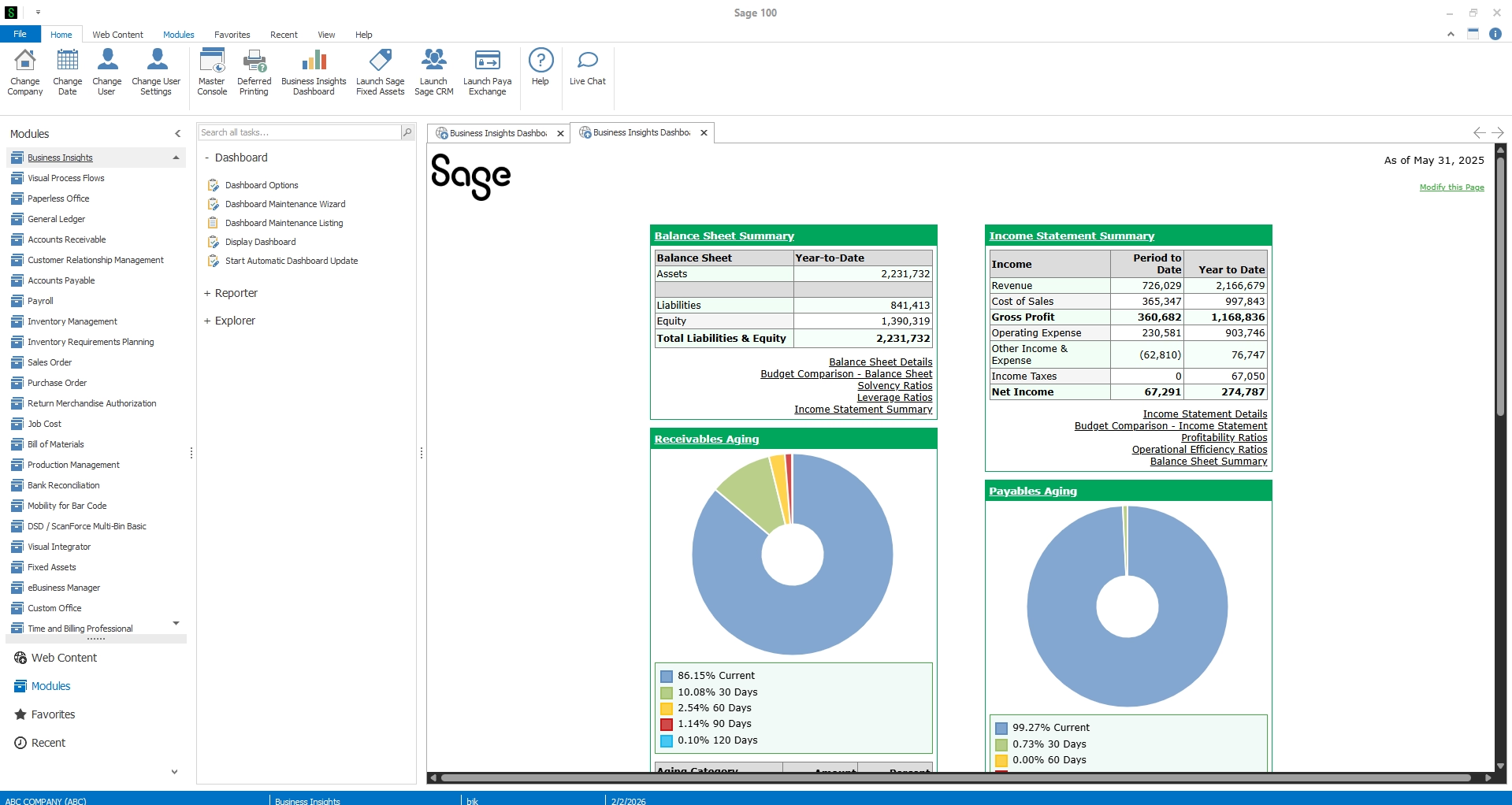
Rand Group supports several Sage solutions that address different levels of financial and operational complexity. Sage 100, Sage Intacct, and Sage X3 each provide a different path forward depending on the organization’s financial priorities and plans for growth.
Sage 100: A natural next step for manufacturers and distributors
For BusinessVision users who rely heavily on inventory, distribution, or manufacturing functionality, Sage 100 can provide a practical next step within the Sage ecosystem. Designed for small and midsized businesses, Sage 100 combines financial management with inventory, purchasing, sales order processing, distribution, and light manufacturing capabilities.
For manufacturers and distributors that have outgrown BusinessVision but do not require a highly complex enterprise ERP, Sage 100 can provide greater operational functionality while keeping the organization within the Sage product family.
Sage Intacct: A finance-forward move to the cloud
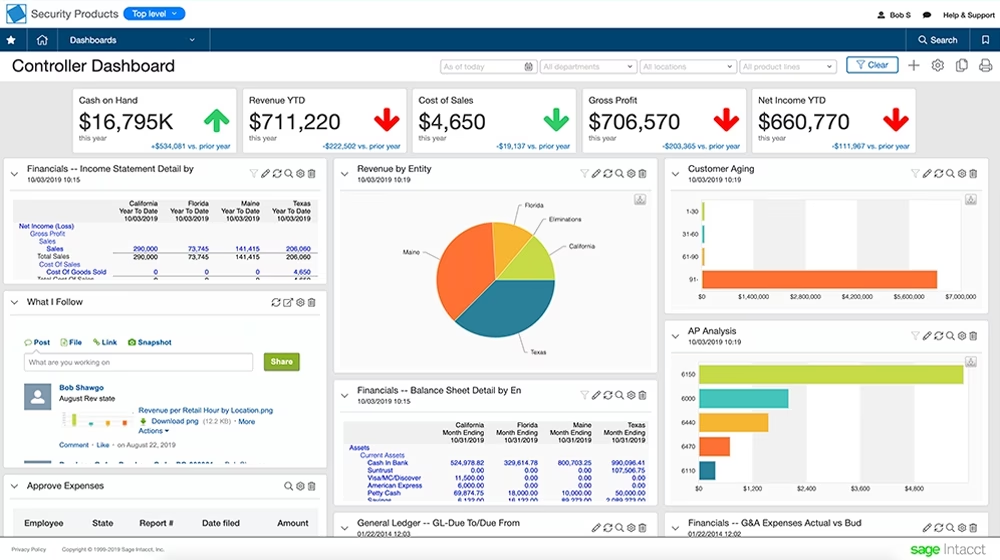
For organizations focused on modernizing finance, Sage Intacct provides a powerful cloud-native financial management platform designed to improve automation, reporting, visibility, and scalability. Its capabilities include dimensional reporting, dashboards, multi-entity accounting, accounts payable automation, and other tools that can help finance teams reduce manual work and gain deeper insight into performance.
Sage Intacct can be particularly compelling for BusinessVision users whose primary priorities are moving financial management to the cloud, automating accounting processes, strengthening reporting, and supporting growing financial complexity without maintaining on-premises ERP infrastructure.
Sage X3: ERP for complex manufacturing and distribution
Organizations with more sophisticated manufacturing, distribution, or supply chain requirements may need to move beyond the capabilities of a traditional small or midsized business ERP. Sage X3 is designed for product-centric organizations with complex operational requirements, including discrete, process, and mixed-mode manufacturing.
Sage X3 brings financial management together with production planning, inventory, purchasing, warehousing, quality management, costing, supply chain, and multi-site operations. For BusinessVision users that have grown into more complex manufacturing or distribution environments, Sage X3 provides a path to manage broader financial and operational requirements on a scalable ERP platform.

The right Sage migration path ultimately depends on where the organization is headed. Evaluating these needs before selecting a replacement can help ensure the move from BusinessVision supports the business well beyond the 2026 end-of-life deadline.
Evaluating other ERP options
BusinessVision end of life can also provide an opportunity to consider whether remaining within the Sage ecosystem is the best long-term strategy. Rather than simply recreating the existing system, organizations can evaluate ERP platforms that provide broader cloud, automation, integration, and scalability capabilities.
Two options to consider include:
- Microsoft Dynamics 365 Business Central: A cloud ERP designed for small and midsized organizations that connects financial management with sales, purchasing, inventory, projects, and operations. Business Central may be particularly relevant for organizations already invested in the Microsoft ecosystem or looking to connect ERP processes with Microsoft 365 and the Power Platform.
- Oracle NetSuite: A unified cloud ERP platform that combines financial management with capabilities for inventory, order management, reporting, and multi-entity operations. NetSuite may be a strong option for growing organizations seeking to manage increasingly complex financial and operational requirements on a scalable cloud platform.
The right choice depends on more than which platform offers the closest match to existing BusinessVision functionality. Organizations should consider their current challenges, future growth plans, industry requirements, technology strategy, and opportunities to improve processes before selecting a replacement.
How to choose a replacement for Sage BusinessVision
Before comparing ERP products, establish what the organization actually needs from its next system.
Consider questions such as:
- Which BusinessVision capabilities are essential to current operations?
- Where are teams relying on spreadsheets, manual processes, or workarounds?
- Which integrations and customizations need to be replaced or redesigned?
- How much historical BusinessVision data needs to remain accessible?
- Does the organization want to remain on-premises or move to the cloud?
- Are multi-entity, multi-location, inventory, manufacturing, or industry-specific capabilities required?
- What reporting and automation capabilities are currently missing?
- How is the organization expected to grow over the next five to ten years?
A migration does not have to recreate the way the business operates today. BusinessVision end of life can provide an opportunity to simplify processes, eliminate outdated customizations, improve reporting, and build a technology environment that better supports future growth.

Find the right path beyond Sage BusinessVision
Not sure what should replace Sage BusinessVision? Rand Group can help you compare ERP options, understand the differences between platforms, and determine which solution best fits your financial and operational needs. Talk to a Rand Group ERP expert to explore your options and start building a migration strategy.
Partner with Rand Group for your Sage BusinessVision migration
Choosing what comes after BusinessVision requires both an understanding of ERP technology and a clear view of the organization’s financial and operational requirements.
Rand Group works across multiple ERP ecosystems, allowing our consultants to help organizations evaluate their options without assuming that one platform is right for every BusinessVision user. Our team includes experienced accounting, technology, and industry professionals with expertise across Sage, Microsoft Dynamics 365, and Oracle NetSuite solutions.
Rand Group can help organizations:
- Assess their existing BusinessVision environment and business processes
- Define functional and technical requirements
- Evaluate Sage and other ERP platforms
- Identify data, integration, and customization requirements
- Develop a migration and implementation roadmap
- Implement, integrate, optimize, and support the selected ERP solution
With experience across ERP selection, implementation, integration, and ongoing support, Rand Group can guide BusinessVision users through each stage of the transition and provide a consistent partner well beyond go-live.
Key takeaways
- Sage BusinessVision reaches end of life on December 31, 2026.
- Sage will discontinue software updates, fixes, security patches, and technical support.
- The July 2026 payroll update is the final payroll update, with a final year-end update planned for T4/T5018 reporting.
- BusinessVision may continue running after end of life, but compatibility and security risks can increase over time.
- BusinessVision users that want to remain within the Sage ecosystem can evaluate Sage 100, Sage Intacct, or Sage X3 based on their financial, manufacturing, and operational needs.
- End of life is also an opportunity to evaluate whether a different ERP platform better supports your organization's future needs.
Frequently asked questions about Sage BusinessVision end of life
When is Sage BusinessVision end of life?
Sage BusinessVision reaches end of life on December 31, 2026. The retirement applies to all editions of BusinessVision.
Is Sage BusinessVision being discontinued?
Yes. Sage is retiring all editions of Sage BusinessVision effective December 31, 2026. After that date, Sage will no longer provide software updates, fixes, security patches, or technical support.
Will Sage BusinessVision still work after December 31, 2026?
BusinessVision may continue running after its end-of-life date on supported operating systems. However, Sage will no longer provide updates or support, and compatibility and security risks can increase as operating systems and other technologies evolve.
Will Sage BusinessVision payroll work in 2027?
Sage’s July 2026 payroll update is the final payroll update for BusinessVision, followed by a final year-end update planned for T4/T5018 reporting. After December 31, 2026, Sage will no longer provide payroll calculations or compliance updates for BusinessVision. Organizations using BusinessVision payroll should account for this deadline when planning their transition.
What is replacing Sage BusinessVision?
There is no single replacement for Sage BusinessVision. Depending on business needs, organizations can evaluate other ERP and financial management solutions, including Sage Intacct, Sage 100, Sage X3, Microsoft Dynamics 365 Business Central, and Oracle NetSuite.
When should I start planning a Sage BusinessVision migration?
Organizations still using BusinessVision should begin planning their migration now. Starting before the December 31, 2026 end-of-life date provides more time to document requirements, evaluate solutions, prepare data, address integrations, test the new environment, and train users before BusinessVision becomes unsupported.
Plan your next step beyond Sage BusinessVision
With Sage BusinessVision end of life approaching, organizations should begin planning their transition before support ends on December 31, 2026. Starting early provides more flexibility to compare ERP options, prepare data, and complete the migration on a manageable timeline.
Rand Group can help you navigate the transition from BusinessVision and implement the right solution for your financial and operational needs. Contact us to start planning your Sage BusinessVision migration.