Sage Intacct implementation for hospitality: A guide to multi-location accounting and financial reporting

As hospitality organizations grow, financial complexity often outpaces their accounting systems. Adding new hotels, restaurants, entertainment venues, golf clubs, casinos, resorts, or other hospitality locations can leave finance teams managing month-end close in spreadsheets, manually consolidating financials, and struggling to gain timely visibility into business performance.
A Sage Intacct implementation for hospitality businesses provides more than a cloud accounting platform. It creates a scalable financial foundation for hospitality financial management. By designing the right financial structure, integrating operational systems, and standardizing reporting, organizations can automate manual processes, improve financial visibility, and support future growth.
In this guide, we’ll cover the key components of a successful Sage Intacct implementation, common pitfalls to avoid, and best practices for building a scalable financial management environment.
At a glance
- Who this guide is for – Hospitality finance leaders evaluating or implementing Sage Intacct, including hotel groups, restaurant organizations, resorts, entertainment venues, and other multi-location businesses.
- Typical implementation timeline – Many Sage Intacct hospitality implementations take 8 to 16 weeks, depending on the number of entities, integrations, reporting requirements, and organizational complexity.
- Typical implementation cost – Sage Intacct hospitality implementations commonly range from $25,000 to $150,000, depending on scope, integrations, reporting, data migration, and training needs.
- Primary implementation goals – Automate multi-entity accounting, improve financial reporting, integrate operational systems, and support future growth.
- Common implementation challenges – Designing the financial structure, integrating operational systems, migrating data, and standardizing reporting.
- Expected outcomes – Faster closes, improved financial visibility, automated workflows, and scalable multi-location accounting.
- Why hospitality organizations choose Sage Intacct
- Is Sage Intacct right for your hospitality organization?
- Common accounting challenges before implementing Sage Intacct
- What does a Sage Intacct implementation for hospitality include?
- Sage Intacct implementation best practices for the hospitality industry
- Common Sage Intacct implementation mistakes
- How long does a Sage Intacct implementation for hospitality take?
- How much does a Sage Intacct implementation for hospitality cost?
- Why hospitality organizations partner with Rand Group for Sage Intacct
- FAQs
Why hospitality organizations choose Sage Intacct
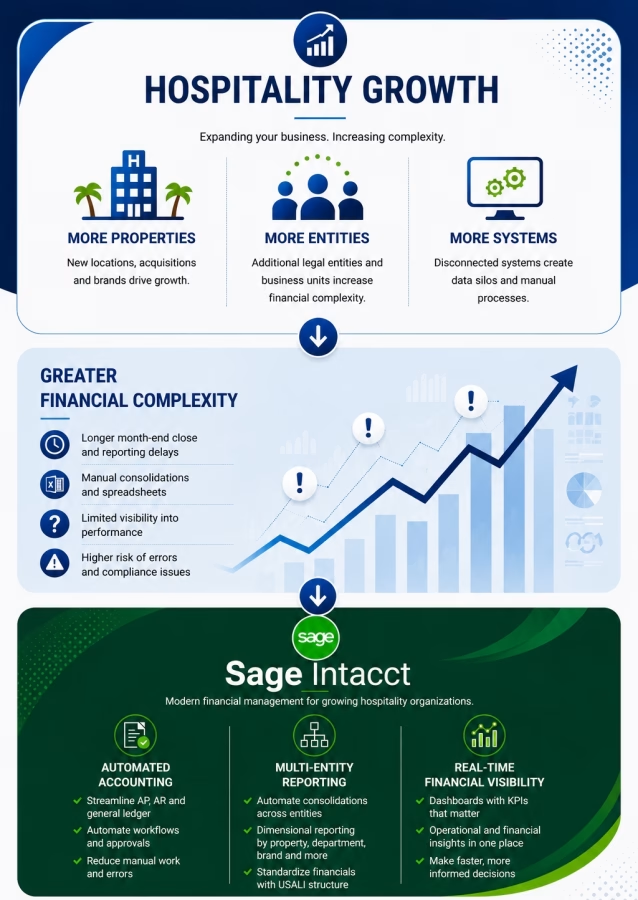
Hospitality organizations generate thousands of financial transactions every day while relying on multiple systems to manage reservations, point-of-sale activity, payroll, purchasing, inventory, and guest services. As organizations grow through new locations or acquisitions, maintaining consistent financial reporting becomes increasingly difficult.
Sage Intacct helps hospitality organizations centralize financial management while supporting the complexity of multi-property operations. As a cloud-based hospitality ERP and financial management platform, Sage Intacct helps organizations connect accounting with operational data across multiple locations.
Organizations commonly choose Sage Intacct because it helps them:
- Scale across multiple hotels, restaurants, resorts, or entertainment venues
- Automate multi-entity consolidations
- Improve financial visibility with real-time dashboards
- Streamline accounts payable and other accounting workflows
- Support acquisitions and organizational growth
- Deliver flexible dimensional reporting without creating an overly complex chart of accounts
The result is faster month-end close, more consistent reporting across locations, and better visibility into financial performance.

Learn how Sage Intacct can support your hospitality organization
Whether you’re evaluating cloud ERP or planning a Sage Intacct implementation, our hospitality ERP experts can help you determine the right approach for your organization. We’ll assess your financial processes, reporting requirements, and growth goals to help you build a scalable foundation for long-term success.
Is Sage Intacct right for your hospitality organization?
Sage Intacct is designed for hospitality organizations that have outgrown entry-level accounting software or need greater visibility across multiple entities, locations, or brands. It is especially well suited for:
- Hotel groups managing multiple properties, brands, or ownership entities
- Restaurant organizations operating multiple locations, franchise networks, or commissaries
- Resort operators requiring consolidated financial reporting across lodging, dining, golf, spa, and other revenue centers
- Entertainment and attraction businesses managing multiple venues, ticketing, food and beverage, and retail operations
- Hospitality management companies overseeing accounting and financial reporting for multiple owners or properties
- Franchise organizations that need standardized financial reporting across corporate and franchise locations
- Growing hospitality businesses planning acquisitions, new locations, or expansion into additional markets
Common accounting challenges before implementing Sage Intacct
As hospitality organizations grow, legacy accounting systems often struggle to keep pace with increasing operational and financial complexity. If your organization is experiencing any of the following challenges, it may be time to consider a Sage Intacct implementation.
- Disconnected business systems – Property Management Systems (PMS), POS, payroll, banking, procurement, and accounting systems don’t communicate effectively, forcing finance teams to manually reconcile data and delaying financial reporting.
- Manual multi-entity consolidations – Adding new venues or legal entities has turned month-end close into a spreadsheet-driven process with manual intercompany eliminations, inconsistent reporting, and time-consuming consolidations.
- Limited operational visibility – Finance and operations lack a complete view of key hospitality KPIs like RevPAR, ADR, occupancy, labor costs, and department profitability because financial and operational data remain siloed.
- Inconsistent financial structures – Growth through acquisitions or new locations has resulted in multiple charts of accounts and reporting standards, making it difficult to compare performance across entities and produce consistent financial reports.
If these challenges sound familiar, a Sage Intacct implementation can help automate multi-entity accounting, standardize financial reporting, integrate operational systems, and provide the visibility needed to support continued growth. The most successful implementations begin with thoughtful planning around financial structure, reporting, and integrations to create a scalable foundation for the future.

What does a Sage Intacct implementation for hospitality include?
A successful Sage Intacct hospitality implementation is about more than deploying new software. It requires a structured implementation methodology that aligns the platform with your financial processes, operational workflows, and long-term business goals.
At Rand Group, our implementation methodology is designed to reduce risk, improve user adoption, and create a scalable financial foundation that supports future growth.
1. Pre-configuration
We begin by reviewing your financial processes, reporting requirements, and operational workflows to design a Sage Intacct solution that supports your business today and scales for future growth.
2. Configuration
Sage Intacct is configured in a dedicated test environment, including multi-entity structures, dimensions, workflows, user roles, and automation, allowing configurations to be refined before go-live.
3. Data migration
Financial data is migrated into the test environment, validated for accuracy, and refined before production to help ensure clean, reliable reporting from day one.
4. Training and testing
Your implementation team receives hands-on training and completes structured testing to validate business processes while building confidence in the new system.
5. Production cutover
After final testing, we complete production cutover, migrate validated data, finalize configurations, and support your team through a successful go-live and ongoing optimization.
While every implementation is different, the most important decisions are made early in the project. A well-designed financial structure, reporting framework, and integration strategy create the foundation for scalable multi-location accounting and more meaningful hospitality financial reporting.
Sage Intacct implementation best practices for the hospitality industry
While every Sage Intacct implementation follows a structured methodology, hospitality organizations have unique accounting and operational requirements that require additional planning. From multi-entity structures and USALI reporting to PMS integrations and property-level financial visibility, the decisions made during implementation have a lasting impact on scalability and reporting.
The following implementation best practices highlight the key areas hospitality organizations should prioritize to build a financial management platform that supports both current operations and future growth.
1. Design the right multi-entity structure
A scalable entity structure is the foundation of a successful hospitality implementation. It should support today’s organization while allowing for future acquisitions, new operations, and organizational changes.
A typical structure may include:
- Holding companies
- Individual hotel or restaurant entities
- Management companies
- Shared service organizations
- Multiple brands or concepts
Implementation should also define intercompany transactions, shared expenses, and management fees upfront to automate consolidations and simplify month-end close.
Benefits include:
- Automated consolidations
- Simplified intercompany accounting
- Consistent financial reporting
- Faster month-end close
- Scalability for future growth
2. Configure a USALI-based financial structure
For hotel organizations, implementation is an ideal time to align financial reporting with the Uniform System of Accounts for the Lodging Industry (USALI).
Rather than expanding the general ledger, Sage Intacct uses dimensions to organize financial data.
Common dimensions include:
- Property
- Department
- Brand
- Region
- Cost center
Benefits include:
- Cleaner chart of accounts
- Flexible financial reporting
- Department-level profitability
- Easier onboarding of new locations
- Better executive reporting
3. Integrate operational systems
Connecting operational systems creates a single source of truth for financial reporting while reducing manual data entry.
Common integrations include:
- Property Management Systems (PMS)
- Restaurant POS systems
- Payroll and workforce management
- Banking platforms
- Procurement and inventory systems
- Expense management software
- Budgeting and planning applications
- CRM and loyalty platforms
- Revenue management systems
Integrating these systems allows finance leaders to analyze operational and financial performance in one place.
4. Automate accounts payable
Accounts payable is often one of the first processes hospitality organizations modernize.
A Sage Intacct implementation can streamline:
- Invoice processing
- Approval workflows
- Vendor management
- Electronic payments
- Shared service accounting
Benefits include:
- Faster approvals
- Less manual data entry
- Better visibility into liabilities
- Stronger audit trails
- Improved cash flow management
5. Migrate financial data strategically
A successful implementation starts with clean, accurate data, not simply moving everything from a legacy system.
Common migration components include:
- General ledger balances
- Open AP and AR transactions
- Vendor and customer records
- Fixed assets
- Budgets and forecasts
- Historical financial balances
Before go-live, validate financial reports, trial balances, and account balances to ensure reporting accuracy from day one.
6. Configure dashboards around hospitality KPIs
One of the greatest advantages of Sage Intacct is the ability to combine operational and financial KPIs in a single dashboard. Finance leaders can design executive dashboards that provide actionable insights instead of recreating legacy reports.
Common dashboards include:
- Executive financial dashboards
- Consolidated financial statements
- Property and department P&Ls
- Budget vs. actual reporting
- Cash flow reporting
- Rolling forecasts
- Multi-property performance comparisons
Because Sage Intacct uses dimensional accounting, reports can be filtered by property, department, region, brand, or cost center without maintaining multiple versions.
Hospitality KPIs every finance team should monitor
The most valuable KPIs depend on your hospitality business model. Hotel groups often prioritize metrics like RevPAR, ADR, and occupancy, while restaurants, resorts, country clubs, and entertainment venues may focus more heavily on labor costs, food costs, department profitability, cash flow, and overall operating performance. A well-designed Sage Intacct hospitality implementation should make it easy to monitor the metrics that matter most to your organization through real-time dashboards and integrated financial reporting.
7. Plan for adoption before go-live
A successful Sage Intacct implementation for hospitality doesn’t end with system configuration. Success depends on preparing users to adopt new processes with confidence.
Before go-live, organizations should focus on:
- Role-based training for accounting teams, property managers, executives, and approvers
- User acceptance testing (UAT) using real-world hospitality scenarios
- Report and dashboard validation to ensure financial and operational reporting meets business requirements
- Security and permissions reviews to confirm users have appropriate system access
- Go-live readiness planning, including final data validation and integration testing
Go-live should be viewed as the beginning of continuous improvement, not the end of the project. As users become more familiar with Sage Intacct, organizations can continue optimizing workflows, dashboards, and reporting to maximize long-term value.
Common Sage Intacct implementation mistakes
Even with the right software, implementation decisions can impact long-term success. Avoid these common pitfalls to maximize the value of your investment.
- Recreating the legacy ERP – Use implementation as an opportunity to simplify processes instead of rebuilding outdated workflows.
- Skipping USALI planning – Standardizing your financial structure early makes reporting more consistent across properties.
- Ignoring dimensional accounting – Dimensions provide far greater reporting flexibility than expanding your chart of accounts.
- Migrating poor-quality data – Clean vendor records, inactive accounts, and outdated financial data before go-live.
- Underestimating integrations – Identify and test PMS, POS, payroll, banking, and other integrations early in the project.
- Not involving operations – Finance, property managers, and operational leaders should all help define reporting and workflow requirements.
- Providing limited user training – Role-based training improves adoption and helps users take full advantage of Sage Intacct.
- Waiting until go-live to build reports – Define dashboards and KPIs during implementation so decision-makers have meaningful insights from day one.
How long does a Sage Intacct implementation for hospitality take?
A Sage Intacct implementation for hospitality typically takes 8 to 16 weeks, depending on the complexity of your organization, financial processes, and implementation scope.
Key factors that influence the timeline include:
- Number of legal entities
- Existing accounting processes
- Third-party integrations
- Data migration requirements
- Reporting and dashboard needs
- Workflow automation
- User training and change management
While organizations with standard requirements may be able to implement more quickly, projects involving multi-entity accounting, extensive integrations, or complex data migration typically require additional time. Working with an experienced implementation partner helps establish realistic timelines, reduce implementation risk, and ensure your Sage Intacct environment is configured to support long-term growth.
How much does a Sage Intacct implementation for hospitality cost?
The cost of a Sage Intacct implementation for hospitality typically ranges from $25,000 to $150,000, depending on your organization’s size, operational complexity, and implementation scope.
Common factors that influence implementation costs include:
- Number of entities and users
- Sage Intacct modules and functionality
- PMS, POS, payroll, banking, and other integrations
- Data migration scope and complexity
- Dashboard and reporting requirements
- Workflow automation
- Training and change management
- Ongoing optimization and support
Organizations with standard accounting requirements and minimal customization typically fall toward the lower end of the range, while multi-entity hospitality groups with extensive integrations, complex workflows, and advanced reporting needs require a larger implementation investment.
While implementation represents a one-time investment, it’s important to focus on long-term value rather than the lowest upfront cost. A well-planned implementation helps automate manual accounting processes, improve reporting accuracy, accelerate month-end close, and create a scalable financial foundation that supports future growth. Choosing an experienced implementation partner also reduces the risk of costly rework, helping ensure your Sage Intacct environment is configured correctly from the start.

Plan your Sage Intacct investment with confidence
Understand the factors that influence Sage Intacct pricing, including licensing, modules, implementation services, integrations, and ongoing support. Our pricing guide helps hospitality organizations budget for a successful ERP project.
Why hospitality organizations choose Rand Group
Choosing the right implementation partner is just as important as selecting the right ERP.
Hospitality organizations have unique financial and operational requirements, from multi-entity accounting and USALI reporting to PMS integrations and property-level financial visibility. Working with a partner that understands these challenges helps reduce implementation risk and accelerate time to value.
For more than 35 years, Rand Group has helped organizations modernize financial management through ERP consulting, implementation, optimization, and support. As one of North America’s leading Sage partners, we help hospitality organizations build scalable financial environments that support both today’s operations and tomorrow’s growth.
Our Sage Intacct services for the hospitality industry include:
- Sage Intacct implementation and deployment
- ERP evaluation and software selection
- Multi-entity accounting configuration
- PMS, POS, payroll, and third-party integrations
- Dimensional accounting and executive reporting
- Accounts payable automation
- Data migration and validation
- User training and change management
- Ongoing optimization and managed support
Whether you’re implementing Sage Intacct for the first time or expanding an existing environment, our consultants help ensure your solution is designed for long-term success.
Frequently asked questions
Is Sage Intacct a good fit for hospitality organizations?
Yes. Sage Intacct is designed for organizations that need multi-entity accounting, automated consolidations, dimensional reporting, and integrations with hospitality systems such as PMS, POS, payroll, and banking platforms.
How does Sage Intacct support multi-location hospitality businesses?
Sage Intacct enables organizations to manage multiple entities, locations, and business units within a single cloud platform while automating consolidations and providing consolidated and property-level financial reporting.
What is USALI, and why is it important?
The Uniform System of Accounts for the Lodging Industry (USALI) is the hospitality standard for financial reporting. A USALI-based structure helps organizations standardize reporting and compare performance across properties.
Can Sage Intacct integrate with property management systems (PMS)?
Yes. Sage Intacct’s open API architecture supports integrations with many property management systems, reducing manual data entry and improving financial visibility.
Can Sage Intacct integrate with restaurant POS systems?
Yes. Sage Intacct can integrate with many POS solutions to automate the flow of sales, payment, inventory, and other operational data into financial reporting.
What reports can Sage Intacct generate for hospitality organizations?
Organizations can create consolidated financial statements, property and department P&Ls, budget-to-actual reports, cash flow statements, executive dashboards, and KPI reports using dimensional accounting.
How does Sage Intacct automate multi-entity accounting?
Sage Intacct automates intercompany transactions, consolidations, and financial reporting, reducing manual spreadsheet work and helping finance teams close the books faster.
How long does a Sage Intacct implementation take?
Timelines vary based on the number of entities, integrations, reporting requirements, and data migration complexity. Your implementation partner can develop a project plan based on your organization’s needs.
How much does a Sage Intacct implementation cost?
Costs vary depending on implementation scope, users, modules, integrations, reporting requirements, data migration, and training. A discovery process with an implementation partner provides the most accurate estimate.
Why should I work with a Sage Intacct implementation partner?
An experienced implementation partner can help design your financial structure, configure multi-entity accounting, integrate operational systems, migrate data, train users, and optimize reporting—helping you maximize the long-term value of your Sage Intacct investment.
Conclusion
A successful Sage Intacct implementation is about more than replacing accounting software. It’s an opportunity to create a scalable hospitality ERP platform that supports growth, improves reporting, and gives leadership better visibility across every property.
By designing the right multi-entity structure, leveraging dimensional accounting, integrating operational systems, and automating key financial processes, hospitality organizations can streamline financial management, accelerate month-end close, and gain the real-time insights needed to support growth. With the guidance of an experienced implementation partner, Sage Intacct provides a scalable financial foundation for multi-location operations, acquisitions, and long-term success.
Ready to implement Sage Intacct for your hospitality organization? Contact Rand Group today to schedule a consultation with our Sage Intacct experts and discuss your implementation strategy.