NetSuite
Top 11 reasons to migrate from Dynamics GP to NetSuite

If your organization is currently using Microsoft Dynamics GP, you’re likely evaluating what comes next.
With Microsoft shifting focus to newer platforms, many businesses are choosing to migrate from Dynamics GP to a modern, cloud-based ERP system that can better support growth, automation, and real-time visibility.
While there are multiple paths forward, this guide focuses specifically on why many organizations evaluate NetSuite and the advantages they gain by making the move.
Why companies are moving away from Dynamics GP
Dynamics GP has been a reliable ERP system for decades, but several factors are driving organizations to plan their next move.
1. End of life timeline is now defined
Microsoft has officially announced the end of life for Dynamics GP, with key milestones already underway.
- New license sales are ending
- Product enhancements, regulatory updates, and support will end December 31, 2029
- Security updates will fully end April 30, 2031
This means that while GP won’t “shut off,” it will gradually become:
- Less secure
- More difficult to maintain
- Increasingly outdated compared to modern ERP platforms
Learn more about the full timeline and what it means in or blog on Dynamics GP end of life.
2. Shift toward cloud-first ERP
Microsoft, and the broader ERP market, has moved toward cloud-native solutions that provide:
- Automatic updates
- Real-time data access
- Lower infrastructure costs
Legacy, on-premise systems like GP struggle to keep up with these expectations.
3. Increasing maintenance and risk
As support phases out, businesses may face:
- Higher IT costs
- Fewer skilled GP resources
- Greater compliance and security risks
Organizations that plan early can avoid disruption and transition on their own timeline.
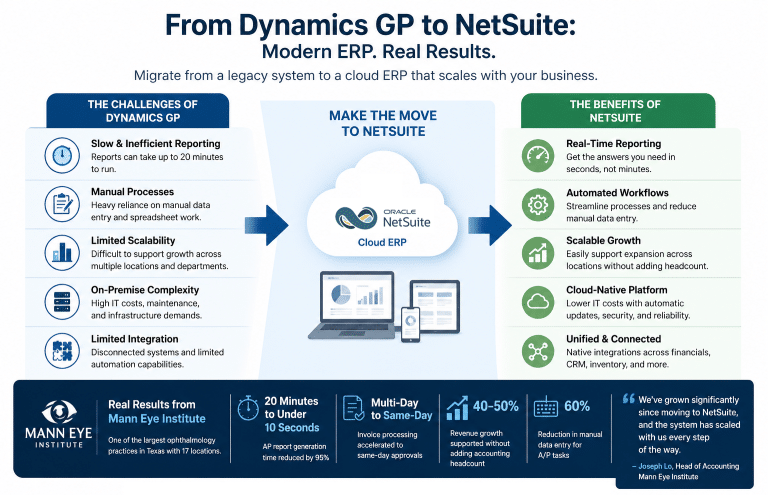
11 Reasons to migrate from Dynamics GP to NetSuite
1. True cloud ERP
NetSuite is a native cloud solution, meaning there’s no need for on-premise infrastructure or manual upgrades. Your team can access the system from anywhere, enabling remote work and reducing IT overhead.
2. Improved financial management and visibility
NetSuite provides real-time financial insights, automated workflows, and customizable reporting. Finance teams can:
- Close books faster
- Reduce manual entry
- Gain immediate visibility into performance
3. Advanced inventory and supply chain management
With real-time inventory tracking and automated replenishment, NetSuite helps businesses:
- Optimize inventory levels
- Reduce carrying costs
- Improve fulfillment accuracy
4. Built-In CRM for a unified customer view
Unlike Dynamics GP, NetSuite includes a fully integrated CRM system. This allows you to manage:
- Customer data
- Sales pipelines
- Marketing campaigns
—all in one platform.
5. Integrated eCommerce capabilities
NetSuite enables businesses to unify ERP and eCommerce, creating a seamless connection between:
- Online sales
- Inventory
- Financials
6. Modern revenue recognition
For companies with subscriptions or complex billing, NetSuite provides advanced revenue recognition tools that ensure compliance and accuracy.
7. Flexible customization without heavy development
With NetSuite’s SuiteCloud platform, businesses can customize workflows, fields, and reports without extensive coding or IT dependency.
8. Future-proof platform with continuous innovation
As ERP technology evolves, having a platform with a clear roadmap is critical.
NetSuite offers:
- Regular system updates
- Ongoing innovation
- A long-term cloud-first strategy

NetSuite vs. Dynamics GP Comparison Guide
Download our free whitepaper for an in-depth comparison of the two products including features, capabilities, deployment options, and benefits, so you can gain valuable insights and information to aid your decision-making process. Additionally, we will review key aspects such as pricing, customization, scalability, integration, and more, so you can effectively evaluate these two systems.
9. Real-time reporting and dashboards
NetSuite’s dashboards provide immediate access to key metrics, enabling faster, data-driven decision-making across your organization.
10. Industry-specific solutions
NetSuite offers pre-configured solutions (SuiteSuccess) tailored to industries like:
11. Comprehensive and connected business platform
NetSuite brings together financials, CRM, inventory, and operations into a single system, eliminating data silos and improving efficiency.
Real-World Example: How Mann Eye Institute scaled with NetSuite
Many organizations don’t just replace Dynamics GP—they use the transition as an opportunity to modernize and scale.
Mann Eye Institute, one of the largest ophthalmology practices in Texas with 17 locations, faced growing challenges with Dynamics GP. Reporting was slow, workflows were manual, and the system struggled to support expansion.
After migrating to NetSuite, the impact was immediate and measurable:
- AP report generation reduced from 20 minutes to under 10 seconds
- Invoice processing improved from multi-day cycles to same-day approvals
- 40–50% revenue growth supported without adding accounting headcount
- 60% reduction in manual data entry for AP tasks
With a lean accounting team, these efficiencies allowed Mann Eye to shift focus from manual processes to strategic growth.
“We’ve grown significantly since moving to NetSuite, and the system has scaled with us every step of the way.”
— Joseph Lo, Head of Accounting, Mann Eye Institute
By moving from Dynamics GP to NetSuite, Mann Eye gained:
- Faster, more reliable reporting
- Automated financial workflows
- A scalable system to support continued expansion
Read the full case study.
A quick note on other ERP options
While organizations that are on Dynamics GP often evaluate NetSuite, it’s not the only path forward.
Many businesses prefer to remain within the Microsoft ecosystem by transitioning to:
- Dynamics 365 Business Central, often suited for small to mid-sized organizations
- Dynamics 365 Finance & Operations, designed for larger, more complex enterprises
Each platform has its strengths depending on your business size, operational complexity, and long-term goals.
Learn more about your migration options.
Make the move from Dynamics GP to NetSuite
Migrating from Dynamics GP is more than a system change, it’s an opportunity to modernize your operations and position your business for long-term success.
NetSuite provides the flexibility, visibility, and scalability that modern organizations need to compete and grow.
As both a NetSuite and Microsoft partner, Rand Group helps businesses evaluate their options and successfully transition to the right ERP platform.
Learn more about our NetSuite implementation services. and contact our team to discuss your migration.
Frequently Asked Questions about Dynamics GP to NetSuite migration
Is Microsoft Dynamics GP being discontinued?
Yes. Microsoft has officially announced the end of life for Dynamics GP.
New sales of Dynamics GP are being phased out. Product enhancements, regulatory updates, and technical support will end on December 31, 2029. Security updates will end on April 30, 2031.
While Dynamics GP will not shut down immediately, it will no longer receive updates or long-term support, making it increasingly difficult to maintain over time.
Learn more in our blog Is Microsoft Dynamics GP being discontinued?
Is NetSuite better than Dynamics GP?
Rather than being “better,” NetSuite is designed for modern cloud-based operations. It offers capabilities that align more closely with today’s business needs compared to legacy systems like Dynamics GP.
How long does it take to migrate from Dynamics GP to NetSuite?
Timelines vary depending on complexity, but most implementations are 3-6 months. More complex or multi-entity organizations can take longer.
How much does it cost to migrate from Dynamics GP to NetSuite?
On average, the implementation cost when migrating from Dynamics GP to NetSuite ranges between $25,000 and $300,000 depending on various factor such as the complexities of your organization, the number of companies involved, customizations, and integrations. This does not include the cost of the NetSuite subscription, which will vary based on the bundles and modules you require.
What should I consider before migrating from Dynamics GP?
Before migrating, organizations should evaluate their current system limitations, business growth plans, integration requirements, budget, and internal resources.
Planning early and working with an experienced ERP partner can help ensure a smoother transition and better long-term outcomes.