Sage Intacct for financial services: Modern financial management for growing firms

Financial services firms need accurate accounting, timely reporting, and strong financial controls. As organizations add entities, funds, investments, and new lines of business, spreadsheets and disconnected accounting systems can make financial management increasingly complex.
Sage Intacct for financial services provides a cloud-native financial management platform that helps firms streamline multi-entity accounting, automate financial processes, improve reporting, and strengthen controls. With dimensional reporting, dashboards, configurable workflows, and integration capabilities, Sage Intacct gives growing financial services organizations a more scalable foundation for managing financial operations.
For private equity firms, wealth and asset managers, family offices, lenders, fintech companies, and other financial services organizations, Sage Intacct can reduce accounting complexity while giving finance teams greater visibility into the business.
At a glance: Sage Intacct for financial services
Sage Intacct is a cloud-native financial management platform that helps financial services firms automate accounting, manage multiple entities, improve financial reporting, and strengthen financial controls. Its multi-entity capabilities, dimensional general ledger, customizable dashboards, automated workflows, audit trails, and integration capabilities make it particularly well suited for growing organizations that have outgrown spreadsheets, entry-level accounting software, or disconnected financial systems.
Why financial services firms need more from their accounting software
Financial services organizations often manage financial structures that become increasingly complex as the business grows. A firm may operate multiple legal entities, funds, management companies, portfolio companies, offices, or business units, each with its own transactions and reporting requirements.
That complexity can create significant work for finance teams, particularly when financial information is spread across multiple accounting systems and spreadsheets.
Common challenges include:
- Complex entity and ownership structures
- High volumes of intercompany activity
- Manual financial consolidations
- Multiple currencies or reporting requirements
- Lengthy month-end close processes
- Spreadsheet-dependent financial reporting
- Limited visibility across entities
- Disconnected financial and operational systems
- Increasing audit and compliance requirements
- Difficulty maintaining consistent approval and access controls
These challenges become harder to manage as an organization expands. Adding another entity should not require finance teams to create another disconnected accounting environment, build additional spreadsheets, or significantly increase manual reconciliation. Modern financial services accounting software can provide a more scalable approach.
Sage Intacct brings accounting, reporting, automation, and financial controls together within one cloud financial management environment. This allows finance teams to establish consistent processes while maintaining the flexibility needed to manage complex organizational structures.
Signs your financial services firm may need a more scalable accounting platform
As financial services firms grow, accounting processes that once worked can become difficult to scale. Common signs your organization may have outgrown its current system include:
- Consolidations rely heavily on spreadsheets.
- New entities create significant additional accounting work.
- Intercompany reconciliations slow the financial close.
- Leadership lacks visibility across entities or funds.
- Finance spends more time assembling reports than analyzing results.
These challenges can signal the need for a financial management platform that can better support increasing complexity and growth.
How Sage Intacct supports financial services firms
Sage Intacct provides a broad financial management foundation that can support private equity, investment management, wealth management, family offices, lending organizations, fintech companies, and other financial services firms.
Core capabilities include:
- General ledger
- Accounts payable and accounts receivable
- Cash management
- Multi-entity accounting and consolidation
- Intercompany accounting
- Dimensional reporting
- Financial dashboards
- Budgeting and planning
- Revenue recognition
- Spend management
- Approval workflows
- Financial controls
- Integrations and APIs
Importantly, Sage Intacct does not have to replace every application within a financial services firm’s technology environment. Specialized portfolio management, investment management, CRM, payroll, lending, and other operational applications can continue serving their intended purposes while Sage Intacct provides the financial management foundation.
This approach gives organizations the flexibility to build a connected technology environment around their specific operational and financial requirements.

Why growing financial services companies choose Sage Intacct
As financial services firms grow, spreadsheets and disconnected accounting systems can make it harder to manage multiple entities, gain timely financial insights, and scale efficiently. Discover how Sage Intacct helps growing firms automate financial processes, strengthen reporting, and gain greater visibility into performance. Download our eBook to learn why growing financial services companies are choosing Sage Intacct.
Simplify accounting across complex financial structures
Financial services organizations frequently operate more than one legal entity. A private equity firm, for example, may need to account for management companies, investment entities, portfolio companies, and other organizational structures.
Managing each entity in a separate accounting environment creates additional work whenever finance teams need to enter transactions, reconcile activity, or produce consolidated reporting.
Sage Intacct multi-entity accounting allows organizations to manage entities within a shared financial environment while maintaining entity-specific requirements.
Finance teams can:
- Manage multiple entities from a single system
- Automate multi-entity consolidations
- View financial results at the individual or consolidated level
- Establish consistent financial processes across entities
- Add new entities as the organization grows
- Manage multiple currencies and global operations where required
Rather than waiting until the end of the reporting process to assemble information from disconnected systems, finance leaders can gain a more complete view of financial performance across the organization.
Automate intercompany accounting
Intercompany accounting can create another significant source of complexity. When transactions occur between related entities, finance teams must maintain accurate due-to and due-from balances, record the appropriate entries, reconcile activity, and account for transactions during consolidation. Manual processes increase both workload and the opportunity for errors.
Sage Intacct helps streamline intercompany accounting with capabilities such as:
- Centralized inter-entity transaction setup
- Self-balancing transactions
- Automated intercompany entries
- Due-to and due-from account management
- Greater transaction traceability
- Automated consolidation processes
Automating these processes can reduce repetitive journal entries and reconciliations while helping finance teams maintain more consistent intercompany records.
Master inter-entity transactions with Sage Intacct
Unlock practical insights, best practices, and tips for managing intercompany transactions accurately. Explore our resources and see how Sage Intacct can simplify multi-entity accounting.
Automate everyday financial processes
The benefits of automation extend beyond multi-entity accounting. Sage Intacct helps streamline core financial processes including:
- General ledger management
- Accounts payable
- Accounts receivable
- Cash management
- Bank reconciliation
- Purchasing and spend management
- Revenue recognition
- Financial close activities
Configurable workflows can route transactions and approvals to the appropriate people while reducing reliance on emails, spreadsheets, and other manual processes.
The objective is not simply to process transactions faster. Automation gives finance professionals more time to analyze financial performance, investigate exceptions, and support strategic decision-making.
Support lending and financial lifecycle management
For organizations involved in lending, Sage Intacct can also extend beyond traditional accounting through lending management capabilities.
Depending on an organization’s requirements, Sage Intacct can help support activities throughout the lending lifecycle, providing greater connectivity between lending activity and the financial information behind it.
This can be particularly relevant for specialty lenders and other financial services organizations that want to reduce the separation between operational lending processes and financial management.

Turn financial data into meaningful reporting and insights
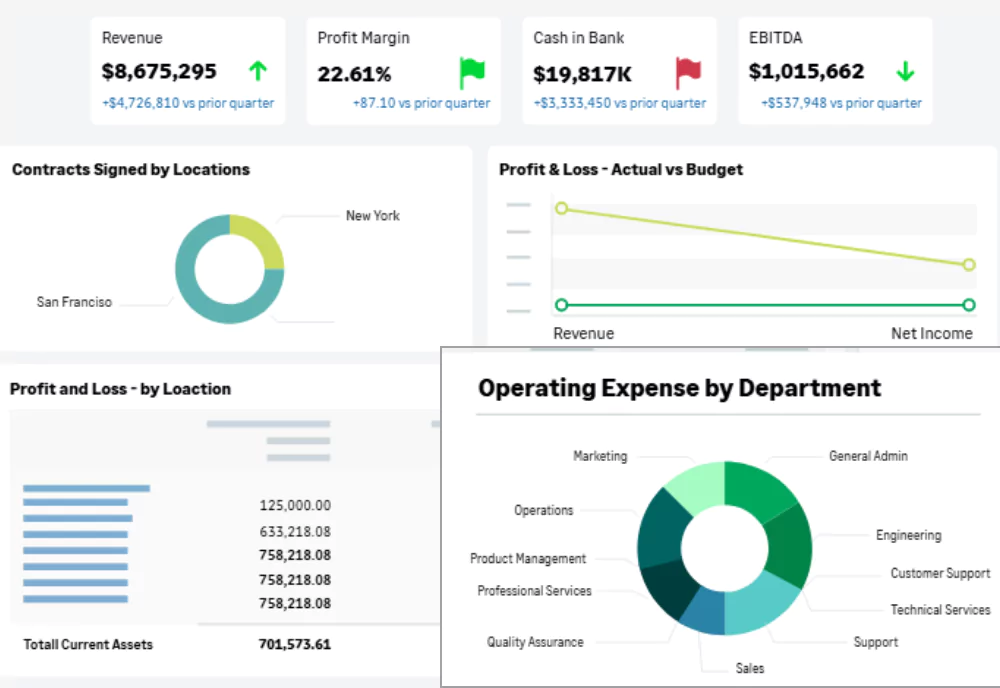
Accurate accounting is only part of effective financial management. Finance leaders also need to turn accounting data into useful information for executives, investors, managers, and other stakeholders. Sage Intacct provides multidimensional financial reporting and analytics that help financial services firms understand performance from different perspectives.
- Excel-based financial reporting: Financial services firms can continue using familiar Excel-based reports and financial models while maintaining a stronger connection to Sage Intacct data. This reduces the manual extraction, reformatting, reconciliation, and data entry often required to keep spreadsheets current, while allowing teams to maintain established board reports, financial models, and other Excel-based reporting processes.
- Dimensional financial reporting: Sage Intacct Dimensions add business context to transactions without requiring a separate general ledger account for every reporting combination. Financial services firms can analyze results by entity, fund, department, location, project, customer, vendor, investment category, or other organization-specific dimensions. Finance teams can then filter, group, and compare financial information while maintaining a more manageable chart of accounts.
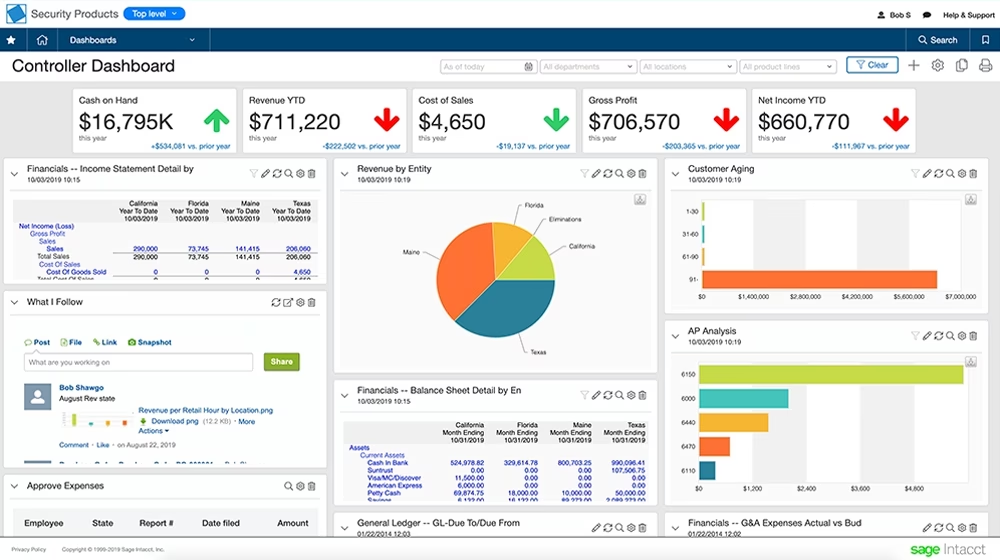
- Customizable dashboards and KPIs: Sage Intacct dashboards can provide different stakeholders with financial information relevant to their roles. CFOs can monitor consolidated performance, while controllers and other leaders can track cash position, budget versus actuals, entity performance, accounts payable and receivable, financial trends, and other KPIs. Drill-down capabilities make it easy to move from high-level results to the underlying transaction details.
Strengthen financial controls and audit readiness
Financial services firms handle sensitive financial information and operate in an environment where accountability, traceability, and financial governance matter. Sage Intacct helps organizations establish more consistent financial processes while maintaining visibility into financial activity.
- Role-based access and approvals: Sage Intacct allows organizations to define who can access financial information and perform specific activities. Configurable permissions and approval workflows can help support segregation of duties, standardize transaction processes, reduce reliance on informal email approvals, and maintain more consistent financial controls.
- Clear financial audit trails: Transaction histories, supporting documentation, drill-down capabilities, and audit trails make it easier to trace transactions, identify who completed or approved an activity, investigate discrepancies, and support internal and external audits. These capabilities can improve audit readiness as the organization grows.
- Intelligent financial controls: Sage Intacct can help finance teams identify unusual journal entries and other activity that may require additional review. Financial Assurance capabilities evaluate transactions against historical patterns and materiality thresholds, helping teams prioritize exceptions that warrant investigation rather than manually reviewing every transaction.
Connect Sage Intacct with your financial services technology environment
Financial services firms rarely operate from a single business application. A firm’s technology environment may include systems dedicated to investments, portfolio management, lending, customer relationships, payroll, planning, payments, expenses, or other specialized functions.
Sage Intacct provides APIs and integration capabilities that allow financial information to move between systems instead of relying entirely on duplicate entry or manual file transfers.
Depending on an organization’s technology environment, Sage Intacct can integrate with:
- CRM platforms
- Investment and portfolio management systems
- Banking and payment applications
- Payroll and HR systems
- Expense management platforms
- Lending applications
- Budgeting and planning tools
- Data and analytics platforms
- Other specialized financial services applications
A connected approach allows Sage Intacct to serve as the financial system of record while specialized applications continue supporting industry-specific processes. For growing firms, this can provide greater flexibility than trying to force every operational requirement into a single application.
Which financial services firms can benefit from Sage Intacct?
There is no single financial management platform that is right for every financial services organization. Sage Intacct is particularly relevant for growing firms that need sophisticated accounting, reporting, automation, and controls without maintaining a highly customized on-premises ERP environment.
- Private equity: Multi-entity structures, portfolio-company reporting, intercompany activity, consolidations.
- Wealth and asset management: Financial accounting alongside portfolio/investment systems.
- Family offices: Complex entity, trust, investment, and operating-company structures.
- Specialty lenders: Connect lending activity with accounting and financial reporting.
- Fintech: Scale accounting as transactions, products, entities, and revenue models grow.
Client success: B-29 Investments transforms multi-entity financial management
B-29 Investments, a private equity firm managing more than 20 companies, partnered with Rand Group to replace manual, disconnected accounting processes with Sage Intacct. The new cloud financial management environment helped B-29:
- Centralize accounting across more than 20 companies
- Automate intercompany transactions
- Simplify multi-entity financial management
- Improve financial reporting and visibility
- Save more than two hours of work each day
As Renee Davis, Corporate Controller at B-29 Investments, shared:
“Honestly, everything is easier to accomplish in Sage Intacct.”

Ready to modernize financial management with Sage Intacct?
Your financial management system should support your organization’s complexity, reporting requirements, and growth. Rand Group’s Sage Intacct experts can help you evaluate your current processes and determine how Sage Intacct can improve multi-entity accounting, financial reporting, automation, and controls. Talk to a Rand Group Sage Intacct expert to explore the right approach for your financial services firm.
Partner with Rand Group for Sage Intacct
Successful financial management transformation requires more than selecting the right software. Sage Intacct must be configured around your organization’s entity structure, reporting requirements, financial processes, controls, and technology environment.
Rand Group’s Sage Intacct consultants work with financial services firms to:
- Consult on and design multi-entity structures, dimensions, and financial workflows
- Streamline intercompany accounting and consolidations
- Configure financial reports, dashboards, approvals, and controls
- Migrate data and integrate Sage Intacct with other business applications
- Train users and provide ongoing optimization and support
With experience supporting investment and wealth management organizations, family offices, and other businesses with complex financial structures, Rand Group can help you implement and optimize Sage Intacct around your organization’s requirements and long-term growth.
Key takeaways
- Simplify multi-entity accounting: Manage multiple entities, funds, subsidiaries, or business units from one financial management platform.
- Automate financial processes: Reduce manual work across consolidations, intercompany accounting, accounts payable, accounts receivable, cash management, and other finance workflows.
- Improve financial reporting: Use dimensions, dashboards, and drill-down reporting to analyze financial performance without creating an overly complex chart of accounts.
- Strengthen financial controls: Role-based permissions, approval workflows, audit trails, and intelligent controls provide greater oversight of financial activity.
- Connect your technology environment: Integrate Sage Intacct with CRM, payroll, investment management, and other specialized financial services applications.
Frequently asked questions about Sage Intacct for financial services
What is Sage Intacct for financial services?
Sage Intacct is a cloud-native financial management platform that helps financial services firms manage accounting, multiple entities, consolidations, financial reporting, automation, and internal controls. It can provide the financial system of record while integrating with specialized investment, lending, CRM, payroll, and other industry applications.
Is Sage Intacct good for financial services firms?
Yes. Sage Intacct is particularly well suited for growing financial services firms that need multi-entity accounting, flexible financial reporting, workflow automation, integrations, and strong financial controls. Private equity firms, wealth and asset managers, family offices, lenders, fintech companies, and other financial services organizations can use the platform to create a more scalable financial management environment.
What types of financial services firms use Sage Intacct?
Sage Intacct can support private equity and investment firms, wealth and asset management companies, family offices, lending and specialty finance organizations, fintech companies, insurance organizations, and other financial services businesses. The appropriate configuration and modules depend on the organization’s accounting, reporting, operational, and integration requirements.
Can Sage Intacct manage multiple entities and funds?
Sage Intacct provides multi-entity financial management capabilities that allow organizations to manage and consolidate financial information across multiple legal entities, subsidiaries, business units, and other structures. Dimensions can also be configured to support reporting by relevant business drivers, including funds where appropriate. Organizations that require specialized fund administration or portfolio management capabilities may integrate Sage Intacct with dedicated industry applications.
How does Sage Intacct support financial reporting?
Sage Intacct provides multidimensional financial reporting, customizable dashboards, financial statements, drill-down capabilities, and Excel-based reporting options. Dimensions allow finance teams to analyze financial information by entity, department, location, fund, project, or other business characteristics without creating an excessively complex chart of accounts.
How does Sage Intacct help financial services firms strengthen internal controls?
Sage Intacct supports stronger financial controls through role-based permissions, configurable approval workflows, segregation of duties, transaction histories, audit trails, supporting documentation, and intelligent financial controls. These capabilities can help organizations establish consistent processes, improve traceability, and strengthen audit readiness.
Can Sage Intacct integrate with investment and financial services software?
Yes. Sage Intacct provides APIs and integration capabilities that allow it to connect with CRM, payroll, investment management, portfolio management, banking, payments, lending, planning, analytics, and other business applications. This allows firms to maintain specialized operational systems while using Sage Intacct as a centralized financial management platform.
How long does a Sage Intacct implementation take?
The timeline for a Sage Intacct implementation depends on factors such as organizational complexity, number of entities, data migration requirements, integrations, reporting needs, and the scope of configuration. Rand Group works with organizations to evaluate these requirements, establish an implementation plan, configure and test the system, migrate data, train users, and prepare for go-live.
Build a stronger financial foundation with Sage Intacct
As financial services firms grow, increasing entity, reporting, integration, and control requirements can expose the limitations of spreadsheets and disconnected accounting systems. Sage Intacct provides a scalable financial management platform that brings multi-entity accounting, reporting, automation, and financial controls together.
Choosing the right solution is only the beginning. Your financial processes, entity structure, reporting needs, and technology environment should shape how Sage Intacct is implemented. Rand Group’s Sage Intacct consultants can help you evaluate these requirements, implement and integrate the platform, and optimize it as your organization grows. Connect with our team to explore how Sage Intacct can support your financial services firm.