Should you use an RFP to select an ERP system?

Selecting a new ERP system is a major business decision, and many organizations turn to an ERP request for proposal (RFP) to compare vendors and reduce risk. An ERP RFP can help document requirements, evaluate solutions, and support formal procurement processes. However, not every organization needs one. A focused evaluation built around critical business requirements, real-world demonstrations, and implementation expertise can provide more meaningful insight without unnecessary complexity.
At Rand Group, we’ve helped organizations evaluate and implement ERP systems for more than 20 years. Our experience has shown that a thorough ERP selection process is essential. A lengthy RFP is not. Successful selection depends on asking the right questions and validating the answers against your business priorities. Skipping a formal RFP doesn’t mean skipping due diligence. A successful ERP selection still requires documented requirements, consistent vendor evaluations, and validation of critical business processes.
At a glance
An ERP request for proposal (RFP) is not necessary for every ERP selection. Formal RFPs are particularly useful when procurement policies, complex requirements, or governance processes require documented vendor evaluations. Other organizations can use prioritized requirements, structured demonstrations, cost comparisons, and implementation partner assessments to make informed ERP decisions without issuing a lengthy RFP.
What is an ERP RFP, and what purpose does it serve?
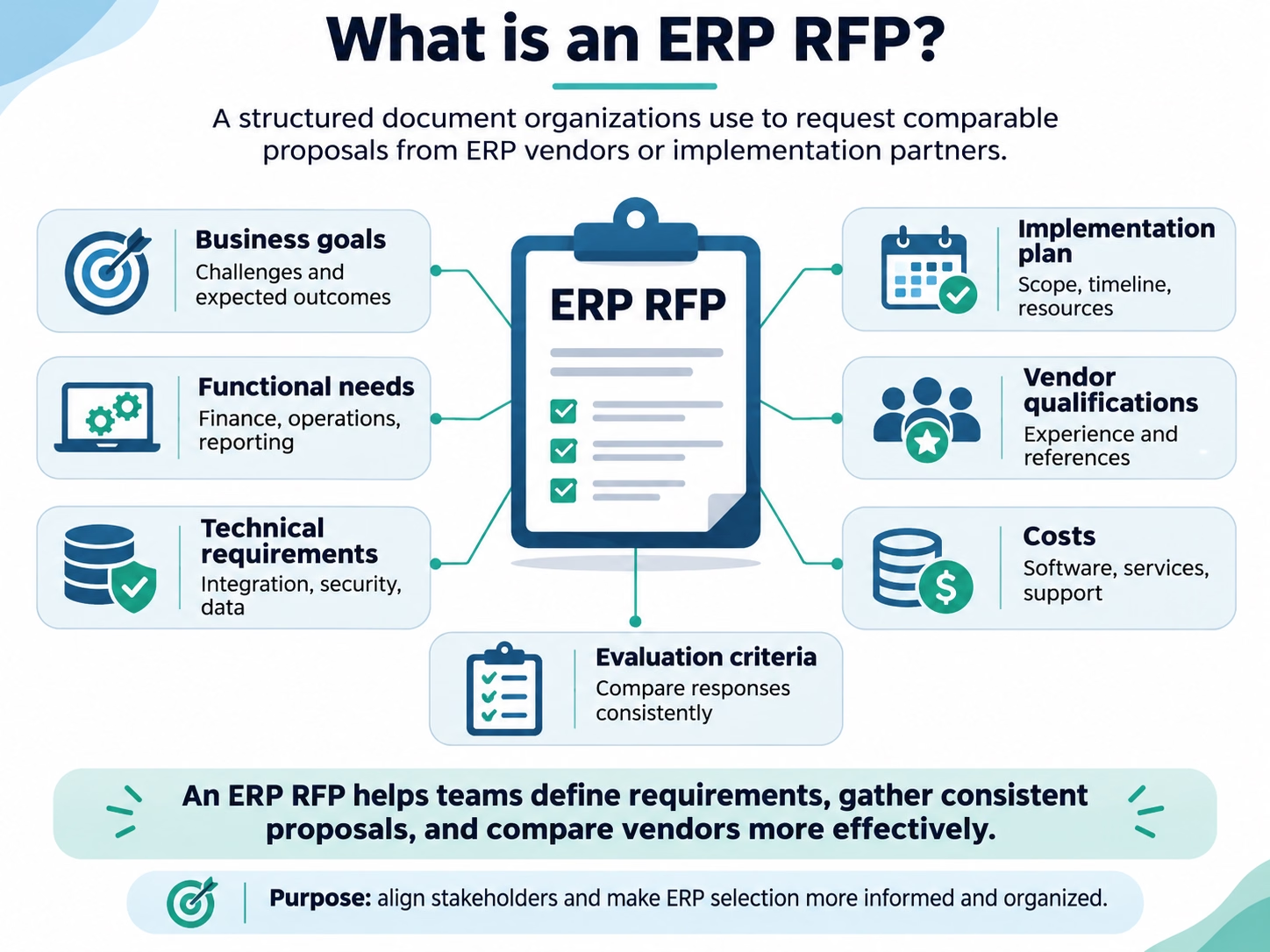
An ERP request for proposal (RFP) is a formal document an organization sends to prospective software vendors or implementation partners to gather information about proposed solutions, capabilities, costs, and implementation approaches.
A typical ERP RFP includes:
- Business objectives: The challenges the organization wants to solve and the outcomes it expects.
- Functional requirements: The financial, operational, and reporting capabilities the ERP must support.
- Technical requirements: Integration, security, data management, and infrastructure expectations.
- Implementation expectations: Project scope, methodology, timelines, and resource requirements.
- Vendor qualifications: Relevant experience, industry expertise, and customer references.
- Costs: Software licensing, implementation services, integrations, and ongoing support.
- Evaluation criteria: How the organization will compare competing proposals.
The goal is to create a consistent process in which vendors respond to the same requirements, allowing decision-makers to compare their options. An RFP can also encourage internal discussions about business needs. However, the value often comes from the requirements discovery process itself, not necessarily from producing and distributing a lengthy document.
What are the advantages and disadvantages of using an ERP RFP?
An ERP RFP provides structure and documentation, but developing requirements, coordinating stakeholders, and evaluating responses can demand significant time from your internal team.
Whether a formal RFP is the right approach depends on your organization’s complexity, procurement obligations, internal resources, and ability to evaluate ERP solutions effectively.
For example, a publicly funded institution may need a formal RFP to meet procurement requirements. A growing distributor replacing an outdated accounting system may gain more useful information from focused discovery sessions, targeted demonstrations, and detailed discussions with implementation partners.
Why a lengthy ERP RFP does not always lead to a better decision
A detailed RFP may appear to reduce risk by asking vendors to address every possible requirement. However, several common problems can make it harder for buyers to identify the ERP solution that best fits their business.
At Rand Group, we encourage businesses to identify their most important requirements early and use those priorities to guide vendor demonstrations, technical discussions, and implementation planning. This helps decision-makers uncover potential gaps that may not be obvious in written proposals.
More requirements do not always mean better ERP selection
One of the biggest weaknesses of a traditional ERP RFP is that it can treat a long list of software capabilities as a measure of how suitable a system is. Consider a manufacturing company evaluating a new ERP system. Its three biggest challenges are inaccurate inventory records, inefficient production scheduling, and a lengthy financial close.
The company develops an RFP containing 300 requirements, including those critical processes and many smaller preferences related to reporting layouts, user interfaces, and administrative functionality.
During evaluation, one ERP system meets 95% of the requirements but struggles with production scheduling. Another meets 85% but handles the company’s three most important processes effectively. Which system is the better fit?
The second option may deliver more business value, despite meeting fewer total requirements. An ERP system that meets 95% of your requirements is not necessarily a better choice than one that meets 85%. What matters is which requirements it satisfies.
This is why ERP selection criteria and requirements prioritization should focus on business-critical processes rather than the total number of supported features.
Written vendor responses do not always reflect how the software works
An RFP often asks vendors whether their solution supports a specific capability. The response may be a simple yes, no, or partially supported. However, a yes does not necessarily mean the functionality will work the way your organization expects.
For example, two ERP systems may both support automated purchasing approvals. One may include the functionality through standard configuration. The other may require an additional application, custom development, or changes to the company’s approval process.
Both vendors could answer yes, but the cost, effort, and long-term maintenance requirements may differ significantly. A demonstration built around your actual workflows can reveal important differences in usability, process efficiency, integration requirements, and operational fit that may be difficult to identify through written answers.
Extensive RFPs can slow down the ERP selection process
Creating an ERP RFP requires time and coordination across departments. Finance, operations, IT, and other stakeholders must document their requirements. Leadership must review and approve the document. Vendors need time to prepare responses, and the selection team must evaluate proposals and resolve differences.
The process may also involve multiple rounds of questions, clarifications, and scoring discussions before demonstrations even begin. While the organization completes these steps, employees may continue working with disconnected systems, manual spreadsheets, inaccurate reporting, or inefficient approval processes.
A thorough evaluation is worth the investment, but unnecessary steps can delay the benefits of a new ERP system.
RFP scoring can create a false sense of objectivity
Many ERP RFPs use numerical scoring to compare vendor responses. Scoring can be useful, but the results are only as meaningful as the criteria behind them.
For example, a system might receive high scores for reporting flexibility, user interface preferences, and dozens of administrative features while failing to meet a critical inventory management requirement.
Even a weighted scoring model can produce misleading results when decision-makers do not clearly separate essential requirements from optional functionality. A better approach is to identify non-negotiable requirements first. If an ERP system cannot support a process that is essential to your business, a high overall score should not outweigh that limitation. Weighted scoring should support your decision, not make it for you.

Make a more informed ERP software decision
Choosing the right ERP system starts with understanding what matters most to your business. Download Rand Group’s Top 10 ERP software selection checklist to learn the key considerations that can help you evaluate your options and make a confident decision.
How is AI changing the ERP RFP process?
Generative AI introduces another consideration for organizations evaluating ERP software. AI tools can quickly produce detailed requirements lists, generate questions, draft vendor responses, and summarize large amounts of information. These capabilities can reduce administrative work, but they do not automatically improve the quality of an ERP decision.
AI makes it easier to generate extensive ERP RFPs
Organizations can use generative AI to create an RFP based on their industry, company size, and general business requirements. Within minutes, a selection team can have a document containing hundreds of questions covering finance, inventory, manufacturing, reporting, security, and other areas.
The challenge is that AI-generated requirements may reflect common industry needs rather than the organization’s actual processes.
For example, an AI-generated manufacturing RFP might include extensive questions about production capabilities that are irrelevant to the company’s operations while overlooking a specialized scheduling or inventory process that is essential to its success.
Without proper review, the organization may end up evaluating software against requirements that do not reflect its priorities.
AI-generated responses can create more documentation without more insight
The concern becomes greater when AI supports every stage of the RFP process. A buyer uses AI to generate hundreds of questions. Vendors use AI to help draft responses. The buyer then uses AI to summarize and score the completed proposals.
The result may be an impressive amount of documentation without a corresponding improvement in understanding. AI-generated responses can also sound complete and persuasive while leaving important questions unanswered.
Can the ERP support the required process without customization? What additional applications are needed? How much will implementation cost? What are the risks? Those questions still require evidence, technical validation, and meaningful discussions with experienced professionals.
AI has made it easier to produce longer ERP RFPs, but it has not made those documents inherently more valuable. When buyers and vendors rely heavily on AI-generated questions, responses, and scoring, they risk emphasizing documentation over meaningful evaluation. The value still comes from validating critical requirements, understanding implementation risks, and determining how well each ERP system supports actual business processes.
When should your organization use an ERP RFP?
Despite these limitations, there are circumstances where issuing a formal ERP RFP is the right approach.
An RFP is particularly valuable when:
- Formal procurement rules apply. Government organizations, public institutions, and businesses with established purchasing policies may require competitive bidding and documented evaluations.
- The organization has complex requirements. Multi-entity, international, or highly specialized operations may need detailed technical and functional documentation.
- Multiple stakeholders require formal approval. Large organizations may need a consistent evaluation record for procurement teams, executives, and governing boards.
- Significant integrations or regulatory considerations exist. Detailed requirements can help identify risks related to data, security, compliance, and connected systems.
- The project involves extensive implementation services. A formal proposal can help buyers compare implementation scope, resources, responsibilities, costs, and contractual expectations.
Even in these situations, the RFP should focus on requirements that affect the organization’s decision. An RFP with 50 well-defined, prioritized questions may be more useful than one containing 500 questions of varying importance.
What should you do instead of a traditional ERP RFP?
For organizations that do not require formal procurement, a focused ERP selection process can provide rigorous due diligence without the administrative burden of a lengthy RFP.

Define your business challenges
Start by identifying the financial and operational problems driving your ERP search. These might include lengthy month-end closes, inaccurate inventory records, disconnected systems, or inefficient approval processes. Establish clear business objectives and define what improvement should look like. This gives your selection team a common understanding of what the new ERP system needs to accomplish.

Prioritize critical ERP requirements
Bring together stakeholders from finance, operations, IT, and other departments to identify essential capabilities. Separate must-have requirements from desirable features, and give the highest priority to processes that directly affect business performance. This helps prevent minor functionality from carrying the same weight as critical operational needs.

Shortlist suitable ERP solutions
Narrow your options to ERP systems that align with your industry, business complexity, technical requirements, and budget. Consider how well each solution supports your current operations and future growth plans. A focused shortlist allows your team to spend more time evaluating the strongest candidates instead of reviewing numerous systems that may not be suitable.

Validate workflows through demonstrations
Ask vendors to demonstrate how their ERP solutions handle your actual business processes, such as order fulfillment, production planning, financial reporting, or purchasing approvals. Use consistent scenarios to compare solutions and identify where additional configuration, customization, or third-party applications may be required. These demonstrations provide practical insight that written RFP responses may not reveal.

Evaluate implementation partners and costs
Assess each implementation partner’s industry experience, technical expertise, project approach, and ongoing support capabilities. Compare the total cost of ownership, including licensing, implementation, integrations, data migration, training, and maintenance. Understanding these factors helps your organization identify potential risks and avoid unexpected costs after selecting a solution.

Confirm your decision before committing
Before making a final selection, verify that the preferred ERP system meets your critical requirements. Review the proposed implementation scope, validate technical assumptions, check customer references, and document any remaining gaps or risks. This final evaluation helps ensure your decision reflects business fit, implementation feasibility, and long-term value.
ERP selection criteria: What matters more than the number of requirements?
Whether you use an RFP or a more focused evaluation, your ERP selection criteria should help you determine how well each solution supports your business.
The following areas deserve careful consideration:
Evaluate each area based on evidence gathered through demonstrations, technical discussions, reference checks, and commercial proposals.

Not sure if your organization needs an ERP RFP?
Every ERP selection project is different. Rand Group can help you determine the right evaluation approach, prioritize business-critical requirements, and compare ERP solutions without unnecessary complexity.
Take the complexity out of ERP selection with Rand Group
Selecting ERP software requires more than understanding which features are available. It takes experience evaluating business processes, identifying technical requirements, and understanding what implementation will involve.
Rand Group has helped organizations evaluate, implement, and support business technology solutions since 2003. With more than 20 years of experience and a 90% client retention rate, our team brings both technical knowledge and practical business experience to ERP selection projects.
As a partner with expertise across Microsoft Dynamics 365, Oracle NetSuite, and Sage solutions, we help organizations evaluate their options based on business needs rather than focusing on a single software publisher.
Our ERP software selection consulting services help organizations:
- Assess current business processes and identify opportunities for improvement.
- Define and prioritize functional, technical, and operational requirements.
- Compare ERP solutions based on business fit and long-term needs.
- Evaluate implementation complexity, costs, and potential risks.
- Build a selection process that supports informed decision-making.
Our team includes professionals with backgrounds in accounting, finance, operations, and technology. This combination helps us look beyond individual software features and understand how ERP decisions affect the broader organization.
Customer success story: Helping Conquest select the right ERP solution
Conquest Completion Services, an oilfield services company, needed a modern ERP system to replace disconnected financial and operational processes. After evaluating SAP, Oracle, and Microsoft solutions, Conquest partnered with Rand Group to select and implement Microsoft Dynamics 365 Finance & Operations and Dynamics 365 Field Service.
The implementation was completed on time and on budget, delivering significant improvements:
- 70% faster purchase order approvals, reducing approval times from 10 to 3 days.
- Improved cash flow, reducing days sales outstanding from 15–20 days to just 3 days.
- Greater financial visibility, with near-real-time reporting replacing lengthy reporting processes.
“We have always felt like a top priority when working with Rand Group’s team and have the utmost confidence in their industry and technical knowledge.” — Christa Curette, VP of Engineering & Technology, Conquest Completion Services
Key takeaways
- A lengthy ERP RFP is not always necessary. Organizations can conduct a thorough ERP selection process without issuing hundreds of questions to vendors.
- Requirements discovery matters more than document length. Understanding your business challenges and critical workflows provides a stronger foundation for evaluation.
- Written responses have limitations. Real-world demonstrations and technical validation help identify differences that vendor questionnaires may overlook.
- AI-generated RFPs still require human judgment. More questions, responses, and automated scoring do not automatically lead to better decisions.
- Formal RFPs remain valuable in certain situations. Complex implementations, procurement policies, and governance requirements may justify a structured RFP.
- The right ERP decision focuses on business outcomes. Functional fit, implementation risk, total cost, and partner expertise matter more than the number of features a system supports.
Frequently asked questions about ERP RFPs
Do you need an RFP to select an ERP system?
No, an RFP is not required for every ERP selection. Organizations without formal procurement obligations can evaluate ERP systems through requirements discovery, competitive demonstrations, technical validation, cost comparisons, and reference checks. However, organizations with mandatory procurement rules or highly complex requirements may benefit from a formal RFP.
What should be included in an ERP RFP?
An ERP RFP should include business objectives, prioritized functional requirements, technical and integration needs, implementation expectations, vendor qualifications, project timelines, costs, and evaluation criteria. Focus on requirements that will influence your decision rather than including every possible software feature.
What is the difference between an ERP RFP and an RFI?
An ERP request for information (RFI) is typically used early in the software selection process to gather general information about potential ERP solutions, vendor capabilities, and available services. It helps organizations understand their options and narrow their shortlist.
An ERP request for proposal (RFP) is more detailed and typically asks shortlisted vendors to propose specific solutions, implementation approaches, timelines, and costs based on defined business requirements.
Organizations that are still exploring ERP options may benefit from starting with an RFI before deciding whether a formal RFP is necessary.
What are the disadvantages of using an RFP for ERP selection?
An ERP RFP can extend the selection timeline, require significant internal effort, and place too much attention on secondary software features. Written vendor responses may also fail to explain how functionality works or what implementation requires. These limitations can make it harder to identify the ERP solution that best supports critical business processes.
When is an ERP RFP necessary?
An ERP RFP may be necessary when procurement policies require competitive bidding or formal documentation. It can also be valuable for large, complex implementations involving multiple entities, specialized requirements, significant integrations, or extensive governance oversight.
How should you evaluate ERP vendors without an RFP?
Evaluate ERP vendors using the same critical business requirements, demonstration scenarios, technical questions, and cost assumptions. Compare each solution’s functional fit, implementation complexity, integrations, scalability, and total cost. Also evaluate implementation partner experience separately from software capabilities.
Can AI help create and evaluate an ERP RFP?
Yes. AI can help draft requirements, organize questions, summarize vendor responses, and identify potential gaps. However, AI-generated information must be reviewed for relevance and accuracy. Buyers should validate critical capabilities through demonstrations, technical discussions, and other evidence rather than relying solely on AI-generated scores or summaries.
Choose the right ERP system, not the longest evaluation process
A thorough ERP selection process doesn’t have to involve hundreds of questions. While formal RFPs serve an important purpose, many organizations can make informed decisions through focused requirements discovery, real-world demonstrations, and careful evaluation of implementation costs and risks. The goal is not to find the ERP system that checks the most boxes, but the one that best supports your business. If you’re preparing to evaluate ERP solutions, contact Rand Group to build a selection process focused on your requirements and long-term goals.