
Financial reporting and analytics solutions
Disconnected financial data, manual reporting processes, and limited visibility into business performance can make it difficult for finance teams to access timely, accurate information. Rand Group helps organizations streamline financial reporting, connect data across business systems, and gain greater visibility into financial performance. With reporting and analytics solutions tailored to your business, your team can reduce manual work, improve reporting accuracy, and gain the insights needed to make more informed financial and strategic decisions.

Turn financial data into actionable business insights
Financial reporting is essential to understanding business performance, but disconnected systems, spreadsheet-based processes, and inconsistent data can make it difficult to access accurate, timely information. Finance teams often spend significant time gathering and reconciling data, preparing reports, and responding to information requests across departments, entities, and business units.
Rand Group helps organizations connect financial data, streamline reporting processes, and improve access to meaningful financial insights. With the right financial reporting and analytics solutions, finance teams can reduce manual reporting work, analyze performance more efficiently, and provide decision-makers with the information they need to understand financial results and guide business strategy.

Improve financial visibility
Gain clearer insight into revenue, expenses, profitability, cash flow, and other key financial metrics across departments, entities, and business units.

Accelerate financial reporting
Streamline financial data collection, report preparation, and distribution to reduce spreadsheet dependency, improve accuracy, and free up time for financial analysis.

Make data-driven business decisions
Analyze financial trends, investigate variances, and monitor performance with more accessible financial information to support timely, data-driven decisions.
Real results with enhanced financial reporting & analytics
hours saved in monthly reporting tasks
faster financial reporting
%
Improvement in data accuracy
Rand Group didn’t just implement a system—they helped us rethink our business processes. The team went beyond a ‘canned solution’ and worked closely with us to develop practical, customized solutions. We now have real-time visibility into our financials and can make data-driven decisions with confidence.
What can financial reporting and analytics software help you manage?
Financial reporting and analytics software connects financial data, reporting tools, and business intelligence capabilities to improve visibility and decision-making. Rand Group helps organizations identify solutions that simplify reporting, improve data accuracy, and provide greater insight into financial performance.
Depending on the platform and configuration, these solutions can help you:
- Automate financial reporting: Streamline the preparation and distribution of financial statements and management reports.
- Create financial dashboards: Monitor KPIs, financial trends, and performance through customizable dashboards.
- Analyze financial performance: Evaluate revenue, expenses, profitability, margins, and other key metrics.
- Compare budgets and actuals: Identify variances between planned and actual financial results.
- Drill into financial data: Explore underlying transactions and records to better understand financial results.
- Report across entities and departments: Analyze performance by company, location, department, or other reporting dimensions.
- Connect financial and operational data: Combine accounting, sales, purchasing, and other business data for more complete insights.
- Standardize financial reporting: Establish consistent reporting structures and metrics to improve accuracy and comparability.


Get more from your financial data with the right reporting tools
Technology solutions for financial reporting and analytics
Microsoft Dynamics 365 Business Central
Gain a clearer view of your finances without adding unnecessary complexity. Microsoft Dynamics 365 Business Central brings financial reporting into the same environment as accounting, sales, purchasing, and inventory, helping small and midsized businesses understand performance across their operations. Built-in financial reports, analysis views, and account-level reporting help teams monitor results and investigate transactions. Organizations seeking more advanced dashboards and visual analytics can extend these capabilities with Microsoft Power BI.
Microsoft Dynamics 365 Finance
Bring consistency and control to enterprise financial reporting. Microsoft Dynamics 365 Finance supports detailed financial statements, reporting hierarchies, and analysis across legal entities, departments, and financial dimensions. Its reporting capabilities help larger organizations manage complex financial structures, standardize reporting, and provide stakeholders with relevant financial information. Integration with Microsoft Power BI and other analytics tools enables organizations to extend reporting with interactive dashboards and deeper analysis.
Oracle NetSuite
Explore financial performance from multiple perspectives in a unified cloud ERP. Oracle NetSuite combines financial reporting, customizable dashboards, saved searches, and SuiteAnalytics to help organizations monitor KPIs and investigate business performance. Finance teams can analyze results across departments, locations, and subsidiaries, with multi-subsidiary capabilities available through NetSuite OneWorld. For organizations that need to combine NetSuite data with information from other systems, NetSuite Analytics Warehouse offers additional analytics and data visualization capabilities.
Sage Intacct
Make detailed financial analysis more accessible to your finance team. Sage Intacct is designed for organizations that need flexible financial reporting across complex accounting structures. Its dimensional reporting capabilities allow finance teams to analyze revenue, expenses, and profitability by entity, department, location, project, and other business dimensions without relying on an extensive chart of accounts. Interactive dashboards, customizable reports, and drill-down capabilities make it particularly valuable for finance-driven organizations seeking deeper financial insights.
Sage 100
Strengthen financial oversight with reporting built around your accounting processes. Sage 100 provides financial statements, general ledger reporting, and operational reports that help organizations monitor financial results and maintain visibility into day-to-day performance. It is a practical option for small and midsized businesses with established accounting processes and straightforward reporting requirements. Organizations that need more sophisticated dashboards, customized analysis, or reporting across multiple data sources can extend Sage 100 with compatible reporting and business intelligence tools.
Microsoft Power BI
Transform financial data into interactive dashboards and actionable insights. Microsoft Power BI connects financial and operational information from ERP and other business systems to help organizations monitor KPIs, analyze trends, and evaluate performance. It is particularly valuable for businesses that need flexible data visualization, detailed financial analysis, and reporting across multiple data sources. With customizable dashboards, drill-down capabilities, and automated data refreshes, finance teams can explore financial results in greater detail and share timely insights with decision-makers.

Case Study

Praxi OP cuts 40 hours from monthly reporting with Sage Intacct
See how Praxi OP partnered with Rand Group to transform its financial reporting and analytics with Sage Intacct. By automating complex financial allocations, creating more than 200 customized financial reports, and implementing role-based dashboards, Praxi OP reduced monthly reporting time by over 40 hours. The organization now has faster access to accurate financial information, greater reporting flexibility, and improved visibility to support informed decision-making across its operations.
"Creating new reports is so much easier now. It’s fast, efficient, and gives me the flexibility to deliver exactly what our stakeholders want to see.”
Extend financial reporting and analytics capabilities with AI agents and apps
Get more value from your financial data with intelligent analytics, flexible reporting tools, and AI-driven insights. From uncovering trends and investigating financial performance to creating reports tailored to your business, these solutions help finance teams access the information they need to make more informed decisions.
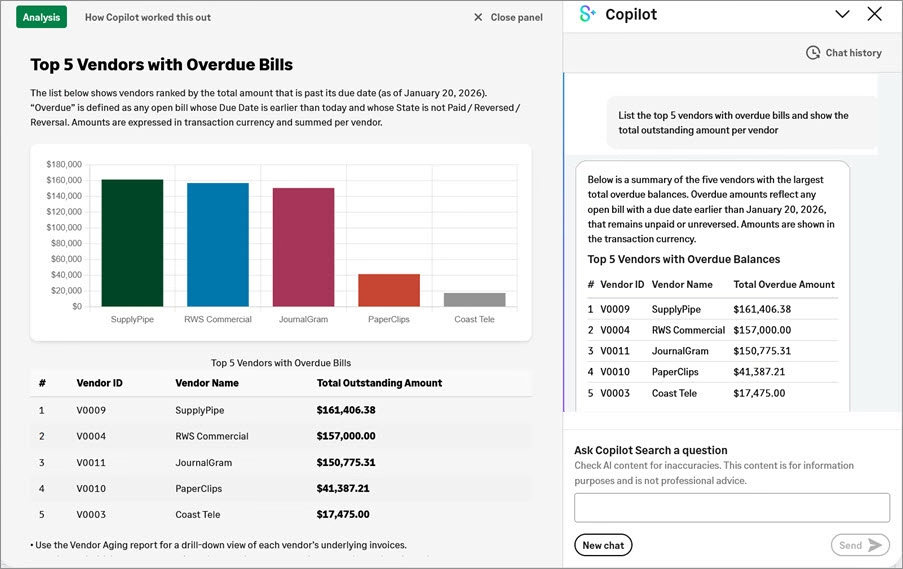
Featured AI Agent
Sage Intacct Finance Intelligence Agent
Turn financial data into actionable insights with AI-powered analysis in Sage Intacct. The Finance Intelligence Agent helps finance teams explore financial performance, investigate trends and variances, and uncover insights using natural-language questions, making it easier to understand financial results and support informed decisions.
- Ask financial questions in natural language to explore business performance.
- Identify financial trends, variances, and areas that may require further investigation.
- Drill into supporting financial information to better understand results and inform decisions.
Sage Intacct Financial Assurance Agent
Improve financial reporting accuracy with AI-powered monitoring in Sage Intacct. The Financial Assurance Agent helps finance teams detect unusual transactions, identify potential accounting issues, and strengthen confidence in the financial data used for reporting and analysis.
Report Layout Extender for Business Central
Customize reports to better meet your business requirements in Microsoft Dynamics 365 Business Central. Report Layout Extender provides additional flexibility for modifying report layouts, helping organizations present financial and operational information in formats that better support their reporting needs.
Explore related financial management solutions
Effective financial reporting provides the insights needed to strengthen financial planning, manage complex accounting structures, and improve day-to-day financial operations. Explore related solutions that help you connect financial data, simplify processes, and gain greater control over financial performance.

Multi-entity accounting & consolidation
Simplify intercompany accounting, financial consolidation, and reporting across multiple entities. Reduce manual processes, improve accuracy, and gain a clearer view of financial performance across your organization.

Accounts payable & receivable automation
Streamline invoice processing, approvals, payments, billing, and collections to reduce manual work, improve financial accuracy, and gain greater visibility into cash flow.

Budgeting & forecasting
Develop more accurate budgets and forecasts with better access to financial data. Connect plans with actual performance, analyze variances, and make more informed decisions as business conditions change.
Why partner with Rand Group?
Financial reporting and accounting expertise
Rand Group understands the reporting challenges finance teams face, from preparing accurate financial statements to analyzing performance across complex business structures. Our team combines accounting knowledge with financial reporting expertise to help organizations improve data accuracy, streamline reporting, and deliver meaningful insights to decision-makers.
Multi-platform ERP and analytics expertise
As a partner for Microsoft, Oracle NetSuite, and Sage, Rand Group brings experience with financial reporting capabilities across leading ERP platforms. We help organizations evaluate built-in reporting tools, business intelligence solutions, and analytics applications to identify the right approach for their financial requirements and existing technology.
Reporting solutions built around your business
Your financial reports should reflect how your organization measures performance and makes decisions. Rand Group helps configure reports, dashboards, financial dimensions, and data connections around your business structure, reporting priorities, and KPIs, making financial information more accessible and useful across your organization.
Long-term partnership and support
Your reporting requirements will change as your organization grows and financial processes evolve. With a 90% client retention rate, Rand Group provides ongoing support, reporting enhancements, and system optimization to help you adapt to new requirements, improve existing reports, and continue getting value from your financial reporting and analytics solutions.
Frequently Asked Questions (FAQs)
How do I know if my business needs financial reporting and analytics software?
Your organization may benefit from financial reporting and analytics software if finance teams spend significant time preparing reports, rely heavily on spreadsheets, or struggle to access accurate financial information. Other signs include inconsistent reporting across departments, limited visibility into financial performance, and difficulty analyzing data from multiple systems. The right solution can help streamline reporting, improve data accuracy, and give decision-makers faster access to meaningful financial insights.
What should I look for when evaluating financial reporting and analytics software?
Look for software that supports your financial reporting requirements, existing ERP system, organizational structure, and data sources. Important capabilities include customizable financial statements, interactive dashboards, KPI tracking, drill-down analysis, and reporting across entities or departments. Consider how easily users can access information, whether the software integrates with your existing systems, and whether its reporting capabilities can accommodate future business growth.
Which ERP software offers the best financial reporting and analytics capabilities?
The best ERP software depends on your organization’s size, financial complexity, and reporting requirements. Microsoft Dynamics 365 Business Central provides integrated financial reporting for growing businesses, while Dynamics 365 Finance supports more complex enterprise reporting. Oracle NetSuite offers customizable dashboards and SuiteAnalytics, and Sage Intacct provides flexible multidimensional financial reporting. Sage 100 and Sage X3 also support financial reporting, with capabilities suited to different accounting and operational requirements. Rand Group can help you compare these platforms based on your specific needs.
Can I improve financial reporting without replacing my existing ERP system?
Yes. Many organizations can improve financial reporting by optimizing their existing ERP configuration, developing customized reports, or integrating additional reporting and business intelligence tools. Solutions such as Microsoft Power BI and compatible third-party reporting applications can extend the capabilities of an existing system. Before considering an ERP replacement, evaluate whether your current platform can support your reporting goals through configuration, integration, or additional applications.
Do I need a separate business intelligence tool, or can my ERP handle financial reporting?
Many ERP systems include financial statements, management reports, dashboards, and basic analytical capabilities that meet standard reporting needs. A separate business intelligence tool may be beneficial if your organization needs to combine data from multiple systems, create advanced visualizations, analyze complex operational metrics, or provide interactive dashboards to different stakeholders. The decision depends on your reporting complexity, available ERP capabilities, and how your teams use financial information.
Can financial reporting software combine data from multiple systems and entities?
Yes. Depending on the platform and available integrations, financial reporting and analytics software can bring together information from multiple legal entities, departments, locations, and business applications. This can help organizations standardize reporting, analyze performance across business units, and reduce manual data consolidation. More advanced solutions can also connect financial data with operational information from CRM, inventory, sales, and other systems. The level of integration and reporting flexibility varies by platform.
How much does financial reporting and analytics software cost?
The cost depends on the software platform, licensing model, number of users, reporting complexity, and integration requirements. Some ERP systems include standard financial reporting capabilities, while advanced dashboards, business intelligence tools, and specialized analytics applications may require additional licenses. Implementation costs can also vary based on data preparation, report customization, system integrations, and training. Rand Group can help you evaluate available options and estimate costs based on your reporting requirements.
How long does it take to implement financial reporting and analytics software?
Implementation timelines depend on your existing systems, data quality, reporting requirements, and the complexity of the solution. Configuring standard financial reports within an existing ERP system may take considerably less time than implementing a business intelligence platform that connects multiple data sources. Projects involving customized dashboards, complex reporting structures, or significant data integration typically require additional planning, development, and testing. Rand Group helps organizations define reporting requirements, establish implementation priorities, and develop a realistic project timeline.
Related Insights

How dashboards and analytics improve NetSuite reporting visibility
Many organizations invest in NetSuite to centralize financial, operational, customer, and transaction data. Yet even after implementation, teams often continue exporting reports to Excel, manually reconciling information, and building offline views to understand performance. The result is a familiar gap: the data exists in NetSuite, but it is not consistently driving timely decisions. This is […]

Dashboards and analytics for Microsoft ERPs — Jet Analytics, Power BI, or both?
As data volumes continue to increase, more and more businesses are graduating from reporting to analytics. Reporting gives businesses and their leaders the ability to answer the question of "what happened." Analytics instead gives them the ability to explore "why did something happen." When we think of analytics and dashboards in the Microsoft ERP space, the two most common names you’ll see are Jet Analytics and Power BI. We will explore each in a bit more detail.

Best Copilot prompts for Dynamics 365 Business Central analysis views
Copilot in Dynamics 365 Business Central analysis views enables users to generate insights using natural language prompts directly within the ERP. Learn how to analyze customer, vendor, sales, and financial data more efficiently without relying on Excel exports. Discover practical use cases, limitations, and strategic considerations for maximizing value.