
AI strategy & roadmap consulting services
Turn AI interest into a clear plan your leadership team can act on. Rand Group helps organizations identify where AI will create real value, prioritize the right use cases, and build a roadmap that connects AI investments to measurable business outcomes across their ERP, CRM, and productivity tools.

Move from AI experiments to a plan that delivers results
Many organizations are already experimenting with artificial intelligence, but turning those efforts into measurable business results can be challenging. Different departments may test AI tools independently, leading to disconnected projects, unclear costs, and limited visibility into results. Without a clear strategy, businesses risk investing in solutions that lack the data, security, or resources needed to succeed.
Rand Group helps organizations move beyond isolated AI experiments by developing a practical AI strategy and roadmap aligned with their business goals. We work with business and technical leaders to assess AI readiness, identify high-value opportunities, and prioritize initiatives based on potential impact, cost, and complexity. The result is an actionable plan with clear ownership, measurable success criteria, and a path to scale AI initiatives that deliver real business value.

Focus on high-value use cases
Identify the AI opportunities that matter most to your business, based on value, feasibility, and readiness rather than hype.

Build alignment across leadership
Give executives, IT, and business teams a shared view of AI goals, priorities, risks, and responsibilities.

Invest with confidence
Connect each AI initiative to clear success measures and a realistic cost model, so you know what to fund first and why.

Not sure where AI fits in your business?
An AI workshop is a fast way to align your leadership team, explore opportunities, and agree on next steps. Rand Group can help you uncover practical use cases and build a starting plan around your goals.
What does an AI strategy engagement help you define?
An AI strategy brings your business goals, data, people, and technology together into one plan. Rand Group evaluates where your organization stands today and helps you decide where AI should go next. Depending on your goals and starting point, an AI strategy engagement can help you:
- Clarify business objectives by linking AI opportunities to specific goals such as faster close, better forecasting, or improved customer service.
- Identify and prioritize use cases by scoring ideas on business value, technical feasibility, data readiness, and risk.
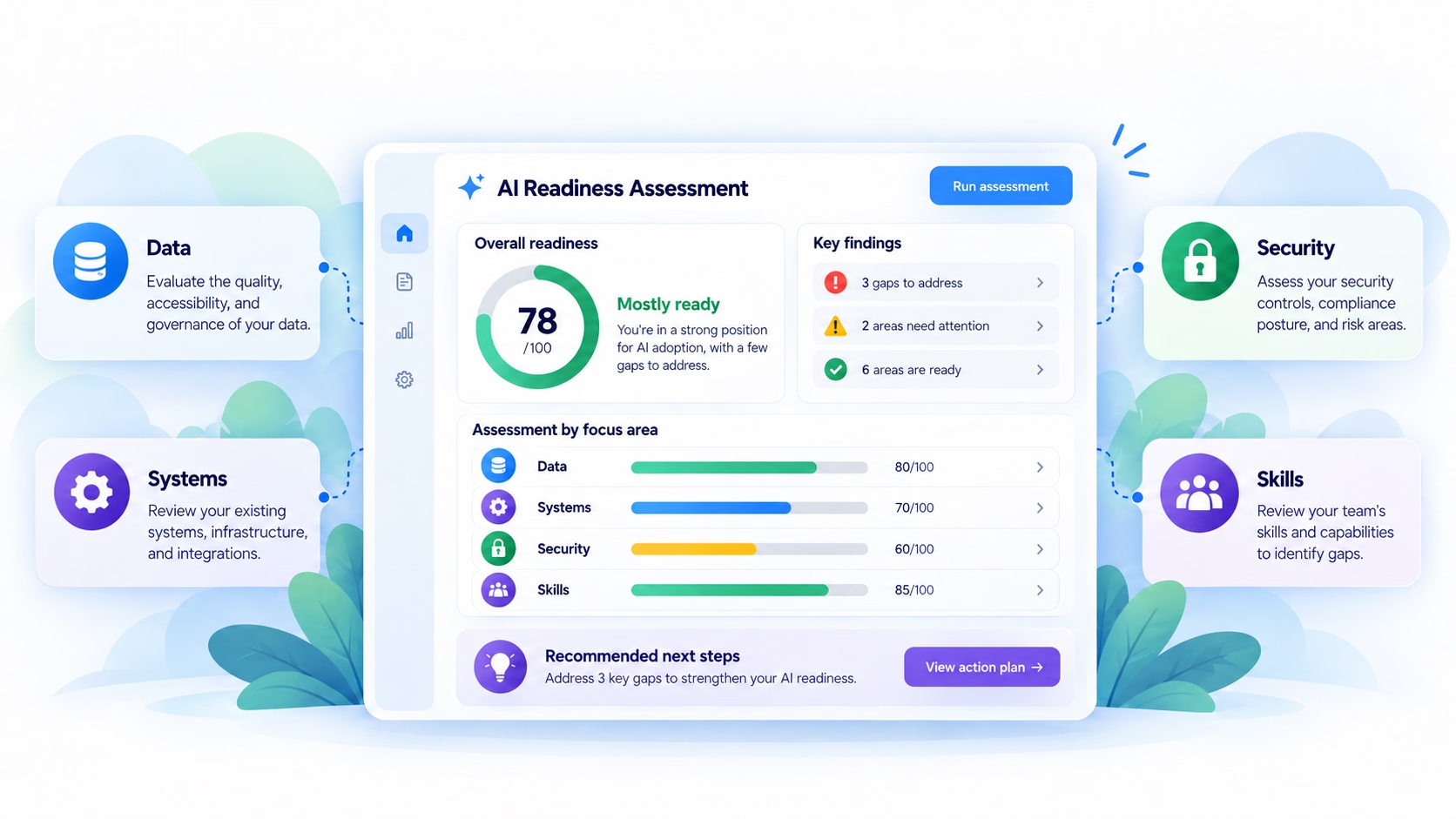
- Assess AI readiness across your data quality, security, permissions, systems, and team skills.
- Evaluate the right AI tools including the AI built into your ERP and CRM, AI assistants, AI agents, and custom solutions.
- Build an ROI-focused business case with expected outcomes, cost considerations, and the measures you will use to track return.
- Apply AI best practices learned from real implementations, so you avoid common pitfalls in data preparation, security, rollout, and adoption.
- Create a phased roadmap that sequences quick wins, pilots, and larger initiatives with clear owners and timelines.

Our AI strategy & roadmap services
Every organization starts its AI journey from a different place. Rand Group offers strategy and roadmap services you can use together or on their own, depending on where you are today and what you need to decide next.
- AI ideation workshops: Bring business and technical leaders together to explore AI possibilities, share concerns, and generate a list of potential use cases. Workshops create early alignment and give your team a common language for AI.
- AI readiness assessment: Review your data, systems, security, and skills to understand what is ready for AI today. The assessment highlights gaps that could limit results or create risk, along with the steps to close them.
- Use case prioritization: Score and rank AI opportunities by value, effort, data readiness, and risk. You leave with a short list of initiatives worth pursuing first, rather than a long list of ideas.
- AI roadmap development: Turn priorities into a phased plan that sequences quick wins, pilots, and larger projects. Each phase includes owners, dependencies, and the success measures used to decide whether to scale.
- ROI and business case: Estimate the return on each priority by weighing expected benefits against licensing, consumption, and implementation costs. A clear view of ROI helps finance and leadership approve AI investments with confidence.
- Implementation best practices: Learn the practices that make AI projects succeed, from preparing data and setting permissions to piloting with a small group and measuring results. Our hands-on experience helps your team avoid common pitfalls and scale AI with confidence.
Some partners seemed like they did not understand who we were as a company, but Rand Group took the time to understand our services and how we work. That made us feel much more comfortable moving forward.
Why partner with Rand Group for AI strategy?
Business-first AI planning
Start with outcomes, not tools. Rand Group grounds every AI recommendation in your goals, processes, and data, so your strategy reflects how your business actually runs.
Cross-platform AI expertise
Plan with the full picture. With expertise across Microsoft, Oracle NetSuite, and Sage, we help you evaluate embedded AI, agents, and custom options within the systems you already use.
Practical, phased roadmaps
Show value early and scale with evidence. Our roadmaps balance quick wins with longer-term initiatives, so momentum builds while risk stays manageable.
Long-term partnership and support
Keep your AI plan current as technology evolves. With a 90% client retention rate, Rand Group supports you from strategy through implementation, adoption, and ongoing optimization.
Frequently Asked Questions (FAQs)
What is an AI strategy?
An AI strategy is a plan that defines how your organization will use AI to reach specific business goals. It covers priority use cases, data and technology requirements, governance, skills, costs, and how success will be measured. A good strategy helps you invest in AI with purpose rather than adopting tools one at a time.
Why does my business need an AI strategy?
Without a strategy, AI adoption tends to happen in silos. Teams test different tools, costs become hard to track, and results are difficult to measure or repeat. A strategy aligns leadership, focuses investment on the highest-value opportunities, and reduces risk as AI use grows.
How do you prioritize AI use cases?
Rand Group scores each opportunity on business value, technical feasibility, data readiness, and risk. High-value, low-effort ideas often become early pilots, while complex initiatives are sequenced later in the roadmap. This approach helps you build momentum and prove value before making larger investments.
Do we need clean data before building an AI strategy?
No, but data readiness should be part of the strategy. AI results depend on the quality, structure, and security of your data. An AI strategy engagement identifies data gaps early, so they can be addressed before they limit results or create risk.
How long does an AI strategy engagement take?
Timelines depend on the size of your organization and the scope of the engagement. A focused workshop can be completed quickly, while a full readiness assessment and roadmap takes longer.
Can you develop an AI strategy across the different business systems we use?
Yes. Rand Group evaluates AI opportunities across your ERP, CRM, productivity tools, and other business applications. We identify where built-in AI capabilities can meet your needs and where integrations or custom solutions would add value. Your roadmap accounts for how these systems share data and support workflows, helping you coordinate AI investments across platforms and avoid disconnected initiatives.
Related Insights

AI adoption challenges: How to overcome resistance and build buy-in
Most organizations now use AI, but far fewer have scaled it across the business. This guide explains common AI adoption challenges, how to address stakeholder objections, and how to build confidence and buy-in in stages.

What are AI agents in Dynamics 365 Contact Center?
AI agents in Dynamics 365 Contact Center help organizations automate customer interactions, improve response times, and support agents in real time. This guide explains how AI agents work, key use cases, available agents, pricing, and how to get started with AI in your contact center.

What is MCP in Dynamics 365? Model Context Protocol explained
Dynamics 365 MCP (Model Context Protocol) enables AI to take action inside ERP systems, not just analyze data. This guide explains how MCP works, key use cases, benefits, and how it fits with Copilot and AI agents. Learn how to apply MCP to automate workflows and improve efficiency across finance and operations.