
Budgeting and forecasting solutions
Move beyond disconnected spreadsheets and time-consuming financial planning processes with budgeting and forecasting solutions that connect financial plans with actual business performance. Rand Group helps organizations streamline budgeting, improve forecasting accuracy, and gain greater visibility into financial performance to support more informed planning and business decisions.

Connect financial planning with business performance
Budgeting and forecasting are essential to financial planning, but disconnected spreadsheets, manual data collection, and inconsistent processes can make it difficult to develop accurate budgets and maintain reliable forecasts. As business conditions change, finance teams may struggle to keep financial plans current and gain a clear understanding of performance against expectations.
Rand Group helps organizations connect budgeting and forecasting with their broader financial management processes. By bringing financial data, planning, and reporting together, businesses can reduce manual work, improve visibility into budget performance, and make more informed decisions based on current financial information.

Improve planning accuracy
Connect budgets and forecasts with actual financial data to develop more reliable plans, identify variances, and maintain accurate financial projections.

Reduce manual budgeting work
Streamline data collection, budget preparation, and revisions to reduce spreadsheet dependency and give finance teams more time for financial analysis and planning.

Make more informed decisions
Compare budgets to actual performance, evaluate financial scenarios, and adjust forecasts to respond to changing business conditions and priorities.
Sage Intacct gives us the flexibility to report by company, location, or department. It is easy enough for non-accountants to drill into invoices and understand what they are responsible for, which makes our managers more accountable and better able to impact the bottom line.
What can budgeting and forecasting software help you manage?
Budgeting and forecasting software helps organizations bring financial planning, data, and reporting together to improve accuracy and reduce manual work. Rand Group helps businesses evaluate their planning processes and financial requirements to identify solutions that support more efficient budgeting, reliable forecasting, and informed decision-making.
Depending on the platform and configuration, budgeting and forecasting solutions can help you:
- Create and manage budgets across departments, entities, locations, and the organization as a whole.
- Connect financial plans with actual performance by using current and historical financial data to inform budgets and forecasts.
- Analyze budget variances by comparing planned and actual results to identify differences, understand financial performance, and adjust plans.
- Build rolling forecasts to regularly update financial projections as business conditions, costs, and revenue expectations change.
- Evaluate financial scenarios by modeling different assumptions and understanding their potential impact on revenue, expenses, cash flow, and profitability.
- Support collaborative planning with structured processes for budget submissions, reviews, revisions, and approvals.
- Improve financial reporting with visibility into budgets, forecasts, and performance across departments, entities, and business units.

Not sure which budgeting and forecasting solution fits your requirements?
Budgeting and forecasting software options
Microsoft Dynamics 365 Business Central
Connect financial budgeting with everyday business performance. Designed for small and midsized businesses, Dynamics 365 Business Central provides general ledger budgeting, budget-to-actual comparisons, and financial reporting within a connected ERP environment. It is well suited for growing organizations that want to manage financial budgets alongside accounting and operations, with the flexibility to integrate specialized planning tools as their forecasting requirements become more complex.
Microsoft Dynamics 365 Finance
Manage complex budgeting and financial planning across your enterprise. Dynamics 365 Finance supports structured budget planning, budget control, and financial reporting across departments, legal entities, and business units. Its advanced budgeting capabilities are particularly valuable for larger organizations that need formal planning workflows, spending controls, and greater oversight of financial commitments across complex operations.
Oracle NetSuite
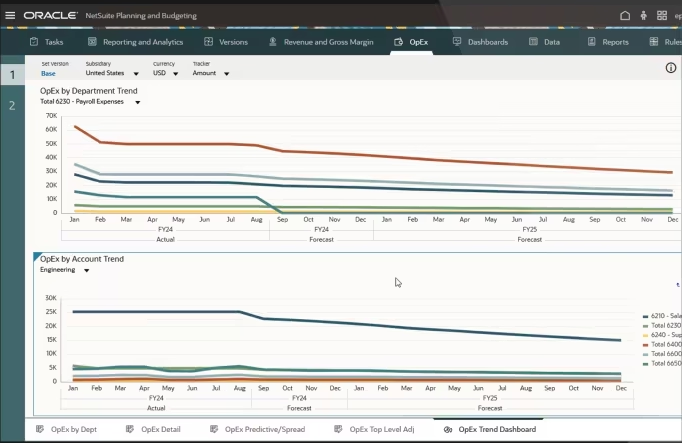
Connect financial planning with a unified cloud ERP environment. NetSuite helps growing and multi-entity organizations manage budgets and evaluate financial performance using connected financial data. With NetSuite Planning and Budgeting, organizations can extend their ERP with financial modeling, scenario analysis, and collaborative planning capabilities, making it a strong option for businesses seeking more sophisticated forecasting across departments, subsidiaries, and business units.
Sage Intacct
Build more flexible financial plans with detailed accounting insights. Sage Intacct supports budgeting, budget-to-actual analysis, and multidimensional financial reporting for organizations with complex financial structures. Finance teams can extend these capabilities with Sage Intacct Planning to support collaborative budgeting, rolling forecasts, and scenario modeling. It is particularly suited for finance-driven organizations that need detailed planning and performance analysis across entities, departments, and other financial dimensions.
Sage 100
Maintain financial budgets within an established accounting environment. Sage 100 provides general ledger budgeting and financial reporting capabilities to help small and midsized businesses establish budgets, compare planned and actual results, and monitor financial performance. It is a practical fit for organizations with straightforward budgeting requirements that want to work within their existing accounting system, with integrated solutions available when more advanced forecasting capabilities are needed.
Sage X3
Align financial budgets with complex manufacturing and distribution operations. Sage X3 combines financial budgeting and cost control with manufacturing, inventory, procurement, and broader operational processes. It is particularly suited for midmarket and larger organizations that need to monitor budgets, track financial commitments, and evaluate costs across multiple companies, sites, or operational activities.

Case Study
Improving financial visibility and planning with Dynamics 365 Business Central
See how a leading cabinetry manufacturer partnered with Rand Group to modernize financial management by migrating from Dynamics GP to Microsoft Dynamics 365 Business Central. By connecting financial and manufacturing processes across three legal entities, automating reporting, and improving access to financial data, the organization gained greater visibility to support budgeting, forecasting, and informed business decisions.
Extend budgeting and forecasting capabilities with AI agents and apps
Go beyond standard software capabilities with AI-powered tools and specialized financial planning apps. Designed to complement leading ERP and financial management platforms, these solutions help finance teams identify potential issues, analyze financial performance, streamline budgeting, and make more informed planning decisions.
Featured AI Agent
Sage Intacct Financial Assurance Agent
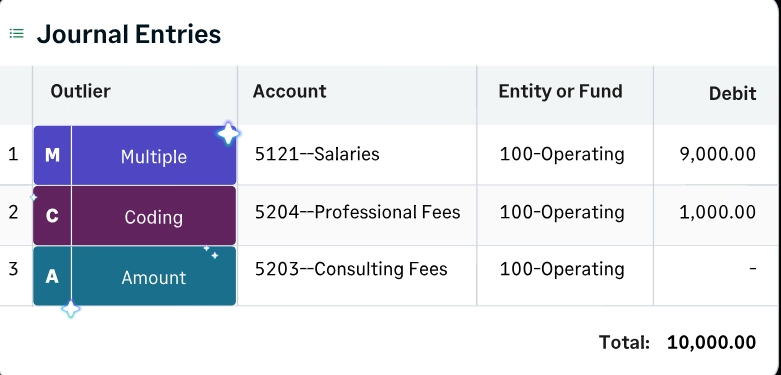
Improve confidence in financial data with AI-powered monitoring and analysis in Sage Intacct. The Financial Assurance Agent helps finance teams identify unusual transactions and potential accounting issues, supporting more reliable financial reporting and informed planning.
- Identify unusual transactions and potential anomalies.
- Surface financial issues that may require review.
- Strengthen confidence in the data used for financial analysis and planning.
Sage Intacct Finance Intelligence Agent
Turn financial data into actionable insights with AI-powered analysis in Sage Intacct. Ask financial questions in natural language, investigate trends and variances, and explore supporting records to better understand business performance and inform forecasting decisions.
Moniroo Budgeting
Simplify budgeting and financial planning in Microsoft Dynamics 365 Business Central. Moniroo Budgeting helps organizations manage budgets, monitor financial performance, and gain greater visibility into spending against planned amounts.
Explore related financial management solutions
Budgeting and forecasting are closely connected to how organizations manage financial operations, consolidate financial data, and monitor cash flow. Explore additional financial management solutions that help streamline accounting processes, improve financial visibility, and support more informed business decisions.

Multi-entity accounting & consolidation
Simplify intercompany accounting, financial consolidation, and reporting across multiple entities. Reduce manual processes, improve accuracy, and gain a clearer view of financial performance across your organization.

Accounts payable & receivable automation
Streamline invoice processing, approvals, payments, billing, and collections to reduce manual work, improve financial accuracy, and gain greater visibility into cash flow.
Financial reporting & analytics
Transform financial data into actionable insights with customizable reports, dashboards, and analytics tools. Improve reporting accuracy, monitor key financial metrics, and gain greater visibility into business performance to support informed decision-making.
Why partner with Rand Group?
Financial planning and accounting expertise
Rand Group understands the challenges finance teams face when managing budgets, forecasts, and financial reporting. Our team combines accounting expertise with an understanding of financial planning processes to help organizations improve budget accuracy, analyze performance, and make more informed financial decisions.
Multi-platform ERP and planning expertise
With expertise across Microsoft, Oracle NetSuite, and Sage, Rand Group helps organizations evaluate budgeting and forecasting solutions based on their financial requirements and existing technology. We understand how different ERP platforms support financial planning and where additional capabilities may be needed to meet more complex requirements.
Solutions aligned with your planning processes
Your budgeting and forecasting software should support how your organization plans and manages its finances. Rand Group helps configure solutions around your budgeting cycles, organizational structures, reporting requirements, and approval workflows to create a more connected and efficient financial planning environment.
Long-term partnership and support
Your financial planning needs will evolve as your business grows. With a 90% client retention rate, Rand Group provides ongoing support, system enhancements, and optimization to help your budgeting and forecasting solutions adapt to changing business requirements and financial goals.
Frequently Asked Questions (FAQs)
How do I know if my business needs budgeting and forecasting software?
Your organization may benefit from budgeting and forecasting software if financial planning relies heavily on spreadsheets, manual data collection, or disconnected systems. Common signs include difficulty consolidating departmental budgets, outdated forecasts, inconsistent financial data, and limited visibility into budget-to-actual performance. The right solution can help finance teams reduce manual work, improve planning accuracy, and make financial decisions using more current information.
What should I look for when evaluating budgeting and forecasting software?
When evaluating budgeting and forecasting software, consider your organization’s planning complexity, financial structure, reporting requirements, and existing technology. Key capabilities to assess include budget-to-actual reporting, rolling forecasts, scenario modeling, departmental collaboration, multi-entity planning, and ERP integration. You should also evaluate ease of use, scalability, implementation requirements, and total cost of ownership to identify a solution that supports your financial planning processes.
Which ERP software offers the best budgeting and forecasting capabilities?
The best ERP software for budgeting and forecasting depends on your organization’s size, planning requirements, and existing systems. Microsoft Dynamics 365 Business Central and Sage 100 support core financial budgeting, while Dynamics 365 Finance provides more structured enterprise budgeting and spending controls. Oracle NetSuite and Sage Intacct offer budgeting capabilities that can be extended with dedicated planning solutions for advanced forecasting and scenario modeling. Sage X3 supports budgeting and cost control across complex financial and operational environments. Rand Group helps organizations compare these options based on their specific requirements.
Can I add advanced budgeting and forecasting capabilities to my existing ERP system?
Yes. Many ERP systems support additional budgeting and forecasting capabilities through integrated applications, specialized planning modules, or third-party solutions. For example, organizations using NetSuite or Sage Intacct can evaluate their respective planning products, while businesses using Dynamics 365 Business Central may benefit from integrated budgeting applications. Rand Group helps assess whether your existing ERP can support your planning goals or whether a different solution would better meet your requirements.
Can budgeting and forecasting software support multiple entities, departments, and locations?
Yes. Many budgeting and forecasting solutions support financial planning across multiple entities, departments, locations, and business units. Depending on the platform, finance teams can create individual budgets, consolidate forecasts, manage different planning assumptions, and compare financial performance across organizational structures. Businesses with complex reporting hierarchies should evaluate how each solution handles financial dimensions, intercompany requirements, currency conversion, and consolidated planning.
Can budgeting and forecasting software replace our Excel-based planning processes?
Budgeting and forecasting software can replace many manual spreadsheet processes by centralizing financial data, automating budget consolidation, and improving collaboration. However, replacing Excel entirely is not always necessary. Some planning solutions offer Excel-based interfaces or integrations that allow finance teams to retain familiar workflows while improving data consistency and version control. The right approach depends on your team’s planning processes, reporting requirements, and preferences.
How much does budgeting and forecasting software cost?
Budgeting and forecasting software costs vary based on the platform, number of users, required capabilities, and implementation complexity. Pricing may include software subscriptions, additional planning modules, integrations, configuration, training, and ongoing support. Organizations should also consider whether their existing ERP includes sufficient budgeting functionality or requires a separate planning solution. Rand Group helps businesses evaluate software requirements and implementation costs to develop a realistic budget.
How long does it take to implement budgeting and forecasting software?
Implementation timelines depend on the software selected, complexity of your budgeting processes, number of departments or entities involved, data integration requirements, and reporting needs. Implementation typically includes requirements gathering, planning model design, system configuration, data integration, testing, and user training. Rand Group helps organizations define their planning requirements, establish realistic timelines, and implement solutions aligned with their financial processes.
Related Insights

Sage Intacct for financial services: Modern financial management for growing firms
Discover how Sage Intacct for financial services helps growing firms simplify multi-entity accounting, automate financial processes, improve reporting, and strengthen financial controls. Explore key capabilities for private equity firms, wealth and asset managers, family offices, lenders, fintech companies, and other financial services organizations.

Financial close and consolidation software: Features, benefits, and implementation
Learn how financial close and consolidation software can streamline reconciliations, automate multi-entity consolidation, improve reporting, and create a faster, more scalable financial close.

Sage Intacct accounts receivable automation: Billing, collections, payments, and cash flow
Sage Intacct accounts receivable automation helps finance teams streamline invoicing, recurring billing, payment processing, and AR reporting while improving visibility into receivables and cash flow. Explore key capabilities, automation opportunities, and how Rand Group can help optimize your AR processes.