NetSuite
 vs SAP Business One: Features, pricing, and key differences

Choosing the right enterprise resource planning (ERP) software is essential for businesses looking to streamline operations, improve financial management, and support growth. Oracle NetSuite and SAP Business One are two leading ERP solutions for small and midsize businesses, offering integrated financial, inventory, purchasing, and sales management capabilities.
While NetSuite provides a cloud-native ERP platform with advanced multi-entity capabilities, SAP Business One offers flexible deployment options, including on-premises and hosted environments. In this guide, we compare NetSuite vs SAP Business One across features, pricing, implementation, and scalability to help you determine which solution best fits your business.
At a glance: NetSuite vs SAP Business One
NetSuite and SAP Business One are comprehensive ERP solutions designed to help businesses manage financial and operational processes. NetSuite stands out for its cloud-native architecture, multi-entity accounting capabilities, and support for international operations, making it particularly attractive to growing and complex organizations. SAP Business One offers strong core financial, inventory, and manufacturing functionality with the flexibility of on-premises or hosted deployment. While both platforms can support small and midsize businesses, the best choice depends on your organization’s financial complexity, operational requirements, technology preferences, budget, and growth plans.
What is Oracle NetSuite?
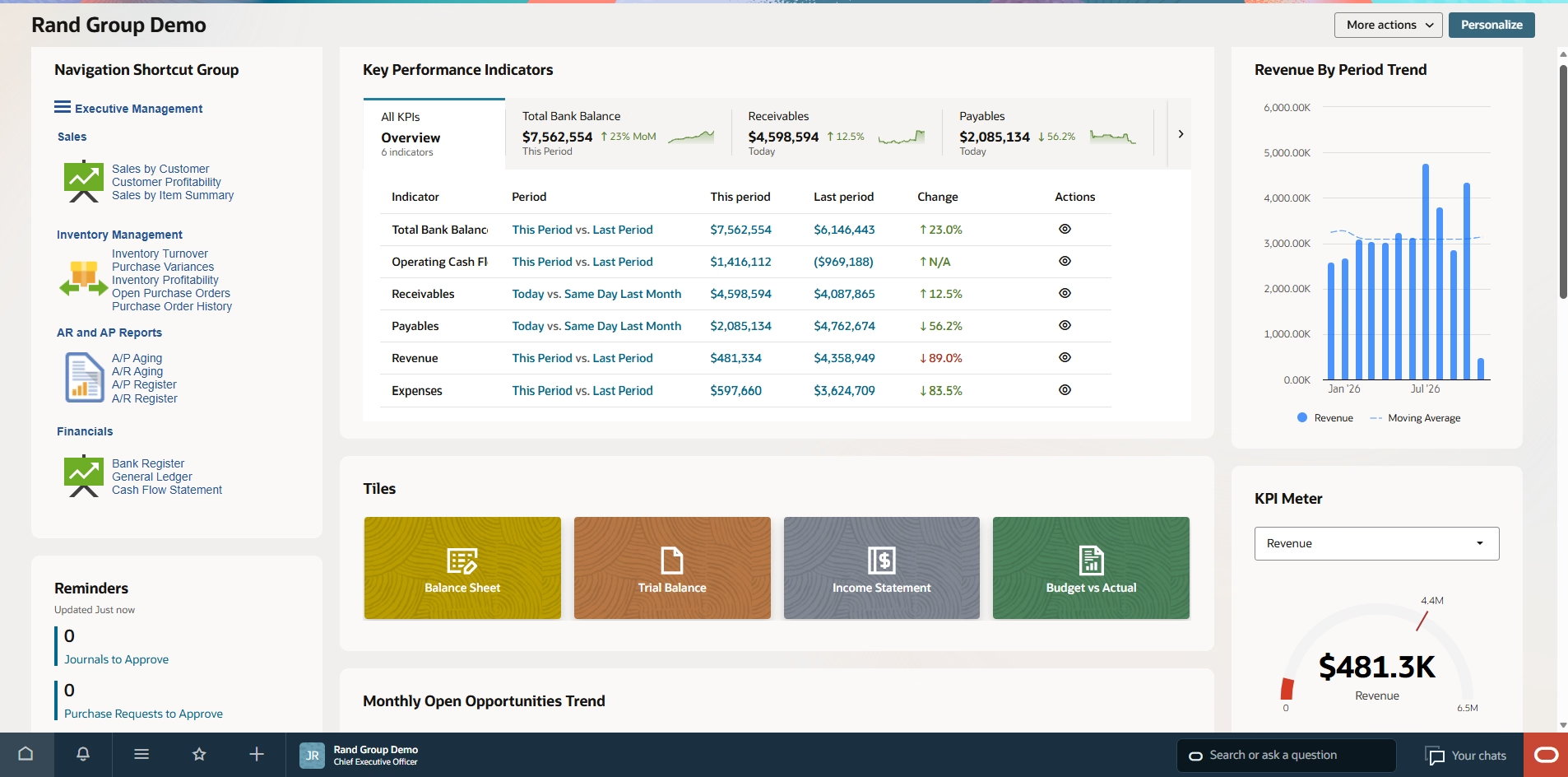
Oracle NetSuite is a cloud-native ERP platform that brings financial management, inventory, purchasing, sales, and other business operations together in a unified system. Designed to support organizations as they grow, NetSuite provides centralized access to business information and tools for automating financial and operational workflows.
NetSuite’s core capabilities include:
- Financial management: Manage general ledger, accounts payable, accounts receivable, budgeting, financial reporting, and other accounting processes.
- Multi-entity accounting: Consolidate financial information across subsidiaries, currencies, and legal entities with NetSuite OneWorld.
- Inventory and supply chain management: Manage inventory levels, purchasing, order fulfillment, and supply chain processes.
- Manufacturing: Support production planning, work orders, bills of materials, and advanced manufacturing processes through available functionality.
- Customer relationship management: Connect customer information, sales opportunities, and transaction history.
- Reporting and analytics: Access role-based dashboards, saved searches, financial reports, and analytics tools.
As a software-as-a-service (SaaS) platform, NetSuite includes vendor-managed infrastructure and regular software updates. It is particularly well suited for growing businesses, multi-entity organizations, and companies seeking to standardize operations across locations.
What is SAP Business One?
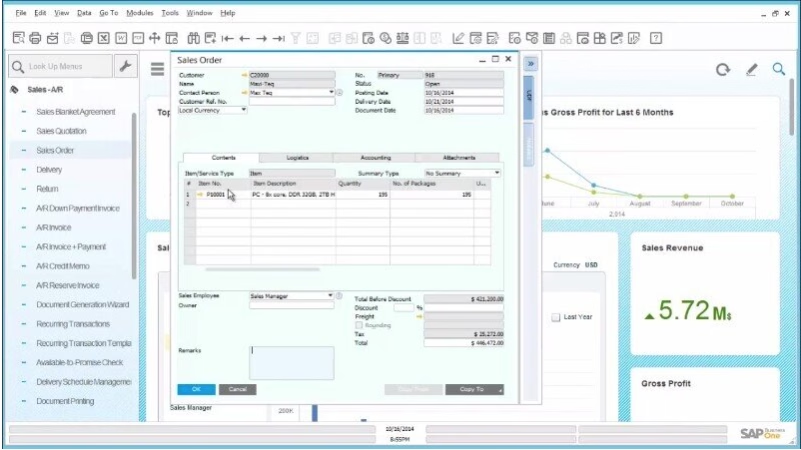
SAP Business One is an ERP solution designed primarily for small and midsize businesses. It provides integrated financial, inventory, sales, purchasing, and operational management capabilities to help organizations replace disconnected systems and improve visibility into business performance.
SAP Business One’s core capabilities include:
- Financial management: Manage general ledger, accounts payable, accounts receivable, banking, budgeting, and financial reporting.
- Inventory management: Track inventory, manage warehouses, and monitor stock movements.
- Purchasing and procurement: Manage vendor relationships, purchase orders, and procurement processes.
- Manufacturing: Support bills of materials, production orders, and material requirements planning (MRP).
- Sales and customer management: Manage customer records, sales opportunities, quotations, and orders.
- Reporting and analytics: Access financial and operational reports, dashboards, and analytical capabilities.
Unlike NetSuite, SAP Business One supports multiple deployment options, including on-premises installations and partner-hosted cloud environments. It also offers an extensive ecosystem of partner-developed extensions for industry-specific requirements.
SAP Business One is often a good fit for small and midsize manufacturers, distributors, and other organizations seeking core ERP functionality with flexibility over their technology infrastructure.
It is important to distinguish SAP Business One from SAP S/4HANA, which is a separate ERP platform designed for more complex enterprise requirements.

Need help choosing the right ERP software?
ERP selection involves more than comparing features and pricing. Rand Group’s software selection experts help businesses evaluate financial, operational, and technology requirements to identify an ERP solution that supports their goals and long-term growth.
NetSuite vs SAP Business One: Key differences at a glance
Although NetSuite and SAP Business One offer many overlapping ERP capabilities, their differences become more apparent when comparing deployment, financial management, customization, and scalability.
These differences influence how each system is implemented, maintained, and expanded as business requirements evolve.
NetSuite vs SAP Business One: Feature-by-feature comparison
When comparing ERP solutions, it is important to look beyond whether a particular feature is available. Businesses should also consider how functionality supports their workflows, whether additional modules or integrations are required, and how easily the system can accommodate future requirements.
Financial management and accounting
Both NetSuite and SAP Business One provide core accounting functionality, including general ledger, accounts payable, accounts receivable, banking, and financial reporting. However, NetSuite offers more extensive native capabilities for organizations managing complex financial structures.
NetSuite financial management capabilities include:
- Multi-entity accounting and financial consolidation through NetSuite OneWorld
- Multi-currency transactions and currency translation
- Intercompany accounting and elimination capabilities
- Automated financial workflows and approval processes
- Financial dashboards and consolidated reporting
- Advanced financial management functionality through additional modules

SAP Business One financial management capabilities include:
- General ledger, accounts payable, and accounts receivable
- Banking and cash management
- Budgeting and financial reporting
- Cost accounting and financial controls
- Multi-company operations with additional consolidation considerations
For businesses operating primarily within a single legal entity, SAP Business One can provide the financial tools needed to manage everyday accounting processes. However, organizations with multiple subsidiaries, international operations, or complex consolidation requirements may benefit from NetSuite’s more extensive multi-entity capabilities.
Inventory, supply chain, and manufacturing
NetSuite and SAP Business One both support inventory-intensive businesses, including manufacturers and distributors. Each platform provides tools for managing inventory, purchasing, production, and order fulfillment.
NetSuite offers:
- Inventory tracking across multiple locations
- Purchasing and order management
- Demand planning and supply chain management
- Bills of materials, work orders, and production management
- Advanced manufacturing capabilities, including WIP and routings
- Warehouse management functionality through available modules
SAP Business One offers:
- Inventory and warehouse management
- Purchasing and supplier management
- Bills of materials and production orders
- Material requirements planning
- Inventory costing and stock tracking
- Manufacturing and distribution extensions through its partner ecosystem
SAP Business One can be particularly attractive to small manufacturers and distributors with established production and inventory workflows. NetSuite offers a broader range of integrated capabilities for organizations requiring more advanced supply chain coordination or managing operations across multiple locations and entities.
The best choice depends on production complexity, inventory requirements, and whether specialized functionality is available natively or requires additional extensions.
CRM and sales management
Both NetSuite and SAP Business One offer customer relationship management (CRM) capabilities that connect sales activities with financial and operational data. However, NetSuite provides more extensive built-in CRM functionality, making it a stronger choice for businesses seeking to manage customer relationships across the entire customer lifecycle.
NetSuite’s integrated CRM capabilities include:
- Sales force automation: Manage leads, opportunities, sales forecasts, and pipeline activities.
- Customer service management: Track support cases, customer interactions, and service requests.
- Marketing automation: Support campaign management, lead nurturing, and marketing activities.
- Unified customer visibility: Connect CRM data with financial transactions, sales orders, inventory, and customer history.
SAP Business One provides core CRM functionality for managing customer records, sales opportunities, quotations, and orders. However, businesses requiring more advanced sales automation, marketing, or customer service capabilities may need additional applications or integrations.
For organizations seeking comprehensive CRM functionality within their ERP system, NetSuite offers an advantage by connecting sales, marketing, customer service, and financial management within a unified platform.

Reporting, analytics, and automation
Access to accurate business information is essential for financial planning, operational decision-making, and performance management.
NetSuite reporting and automation capabilities include:
- Role-based dashboards and key performance indicators
- Saved searches and SuiteAnalytics
- Financial and operational reporting
- Workflow automation through SuiteFlow
- AI-assisted capabilities and automation features available within the platform
SAP Business One reporting and automation capabilities include:
- Standard financial and operational reports
- Dashboards and analytical tools
- Custom queries and reporting
- SAP HANA-based analytics where applicable
- Workflow and automation capabilities supported by built-in tools and extensions
NetSuite’s unified cloud environment can be especially valuable for businesses seeking consistent reporting across multiple departments, locations, and subsidiaries. SAP Business One also provides reporting and analytics capabilities, although organizations may need to consider database configuration, add-ons, and integration requirements.
Customization and integrations
Both NetSuite and SAP Business One offer customization and integration capabilities to help businesses accommodate unique workflows, industry requirements, and existing applications.
NetSuite customization and integration capabilities include:
- SuiteCloud: Extend and customize NetSuite functionality to meet business requirements.
- SuiteScript: Develop custom scripts to automate processes and extend system functionality.
- SuiteFlow: Configure workflows and automate approvals and business processes.
- SuiteApps and APIs: Connect third-party applications and add specialized functionality.
SAP Business One customization and integration capabilities include:
- Software development kit (SDK): Develop custom functionality and extend existing processes.
- APIs and integration tools: Connect SAP Business One with external applications and systems.
- Partner-developed add-ons: Access industry-specific functionality for manufacturing, distribution, and other business needs.
Both platforms provide flexibility, but NetSuite’s unified SuiteCloud environment offers an integrated approach to customization and automation. Businesses should also consider the long-term costs of customizations, integrations, and third-party dependencies, as these can increase maintenance requirements and implementation complexity.
Cloud vs on-premises ERP: Deployment and scalability
One of the most significant differences between NetSuite and SAP Business One is how the software is deployed and maintained.
NetSuite’s cloud-native architecture
NetSuite is delivered exclusively as a cloud-based SaaS platform. Businesses access the system through a web browser, while Oracle NetSuite manages the underlying infrastructure and standard platform updates.
Key benefits of this approach include:
- Reduced infrastructure management: Organizations do not need to maintain their own ERP application servers.
- Regular software updates: NetSuite provides scheduled platform releases, reducing the need for traditional customer-managed upgrades.
- Centralized business information: Financial and operational processes can be managed within a unified environment.
- Support for growth: Businesses can expand across subsidiaries, locations, and international markets without deploying separate ERP instances for each entity.
NetSuite OneWorld is particularly valuable for organizations managing multiple subsidiaries, currencies, and financial reporting requirements.
SAP Business One’s flexible deployment options
SAP Business One offers on-premises and partner-hosted deployment options, allowing businesses to select an infrastructure model that aligns with their operational and technology requirements.
Key considerations include:
- Deployment flexibility: Choose between on-premises infrastructure and hosted cloud environments.
- Infrastructure control: Maintain greater control over system configuration, data hosting, and IT infrastructure.
- Integration requirements: Accommodate existing applications and specialized technology environments.
- Maintenance responsibilities: Account for hosting, security, software upgrades, and ongoing system administration based on the deployment model.
The key difference: NetSuite offers a cloud-native ERP environment with vendor-managed infrastructure and strong multi-entity capabilities, while SAP Business One provides greater deployment flexibility for businesses with specific infrastructure requirements.
NetSuite vs SAP Business One pricing and total cost of ownership
NetSuite and SAP Business One have different pricing models, but the total investment in either platform depends on users, required functionality, implementation complexity, and ongoing services.
Key pricing considerations include:
- NetSuite: Uses subscription-based licensing, with costs influenced by user licenses, ERP modules, multi-entity requirements, implementation, and integrations. The subscription includes cloud infrastructure and standard software updates.
- SAP Business One: Offers licensing arrangements that vary by deployment, with costs for software licenses or subscriptions, hosting, implementation, maintenance, and partner-developed add-ons. On-premises deployments may also require additional IT resources.
When comparing costs, businesses should evaluate the total cost of ownership (TCO) over several years, including licensing, implementation, infrastructure, integrations, maintenance, and support.
While SAP Business One may have lower upfront costs for some smaller deployments, NetSuite’s cloud-native architecture can reduce certain infrastructure and maintenance expenses. Ultimately, the more cost-effective solution depends on your organization’s requirements, operational complexity, and long-term growth plans.

Understand NetSuite pricing and licensing
NetSuite’s modular pricing model allows businesses to select the functionality that fits their needs, but understanding licensing costs can be complex. Download our NetSuite pricing guide to explore subscription costs, add-on modules, service tiers, and real pricing examples to help you plan your ERP investment.
NetSuite vs SAP Business One implementation timelines
Implementing either NetSuite or SAP Business One requires careful planning to ensure the ERP system supports financial and operational processes.
Both platforms can typically be implemented over several months, although timelines vary considerably based on project scope and complexity.
NetSuite implementation considerations
NetSuite offers implementation methodologies such as SuiteSuccess, which uses established processes and industry-focused configurations to help streamline deployment.
Implementation typically includes requirements gathering, system configuration, data migration, integrations, testing, user training, and go-live support.
SAP Business One implementation considerations
SAP Business One implementations are generally delivered through implementation partners and involve similar project stages. Additional considerations may include infrastructure setup, database configuration, hosting decisions, and third-party add-ons.
For either platform, implementation timelines are influenced by:
- Business complexity: The number of entities, locations, users, and business processes involved.
- Data migration: The volume, quality, and complexity of existing financial and operational data.
- Integrations: Connections to CRM, ecommerce, payroll, warehouse, or other applications.
- Customization: Requirements that extend beyond standard ERP functionality.
- Testing and training: The time needed to validate workflows and prepare employees for the new system.
One of the most important steps in ERP implementation is evaluating existing business processes before configuring the new system. Rand Group’s ERP consultants help organizations identify opportunities to standardize workflows, prepare data, and address integration requirements early to reduce implementation risk.
Why we recommend NetSuite for growing businesses
Although SAP Business One is a capable ERP solution for many small and midsize organizations, Rand Group often recommends NetSuite for businesses seeking a cloud-native platform that can support increasingly complex financial and operational requirements.
As an Oracle NetSuite Alliance Partner, Rand Group works with organizations to implement and optimize NetSuite around their business processes and long-term goals.
Several capabilities make NetSuite particularly attractive to growing businesses.
- Unified financial and operational management: NetSuite connects accounting, inventory, purchasing, sales, and other business functions within one platform, reducing reliance on disconnected applications.
- Advanced multi-entity capabilities: NetSuite OneWorld supports consolidated reporting, intercompany accounting, and multi-currency operations, making it particularly valuable for organizations with multiple subsidiaries.
- Cloud-native infrastructure: Vendor-managed hosting and regular software updates help reduce the burden of maintaining traditional ERP infrastructure.
- Scalability for business growth: NetSuite can accommodate expanding operations, new legal entities, additional locations, and evolving reporting requirements.
- Extensive automation and customization: Built-in tools and the SuiteCloud platform allow organizations to streamline workflows, integrate applications, and extend functionality.
- Financial visibility and reporting: Dashboards, saved searches, and consolidated financial reporting help decision-makers access information across the organization.
NetSuite may be particularly well suited for organizations expanding through acquisitions, operating internationally, or looking to standardize financial and operational processes.
However, the best ERP choice ultimately depends on business requirements. Organizations that prioritize on-premises deployment or have relatively straightforward operational needs may find SAP Business One better aligned with their priorities.
Which is better for your business: NetSuite or SAP Business One?
Choosing between NetSuite and SAP Business One depends on your organization’s size, financial complexity, operational requirements, technology preferences, and plans for growth.
Choose NetSuite if your business:
- Operates multiple subsidiaries, legal entities, or international locations.
- Needs consolidated financial reporting and multi-currency management.
- Is expanding through acquisitions or entering new markets.
- Wants a cloud-native ERP platform with vendor-managed updates.
- Requires integrated financial, inventory, sales, and operational management.
- Plans to introduce more advanced automation, reporting, or business processes as it grows.
Consider SAP Business One if your business:
- Is a small or midsize organization with relatively straightforward financial structures.
- Prefers on-premises deployment or greater control over its infrastructure.
- Has manufacturing, distribution, or inventory-focused operations.
- Needs core ERP functionality with specialized industry extensions.
- Values flexibility in deployment and licensing arrangements.
Both platforms can deliver significant operational improvements when properly implemented. The most important consideration is selecting a solution that meets current requirements while providing the flexibility to support future business needs.
Why partner with Rand Group for NetSuite?
Selecting the right ERP software is only the beginning. A successful implementation requires a clear understanding of business processes, financial requirements, integrations, and long-term goals.
As an Oracle NetSuite Alliance Partner, Rand Group helps businesses implement, customize, integrate, and optimize NetSuite to improve financial and operational performance.
Why organizations choose Rand Group:
- Experienced NetSuite consultants: Our team brings specialized NetSuite expertise to help businesses evaluate requirements, configure functionality, and address implementation challenges.
- Financial and operational knowledge: We understand how accounting, inventory, purchasing, reporting, and other business processes work together and help configure NetSuite around those requirements.
- Implementation approaches tailored to your business: From comprehensive ERP implementations to NetSuite Rapid Activation for qualifying organizations, Rand Group offers implementation models optimized for speed, cost, and business complexity.
- Long-term support and optimization: Our relationship extends beyond go-live, with ongoing support, enhancements, integrations, and strategic guidance to help ensure NetSuite continues to meet requirements.
Key takeaways: NetSuite vs SAP Business One
- Both platforms offer comprehensive ERP functionality. NetSuite and SAP Business One provide financial management, inventory, purchasing, sales, and reporting capabilities for small and midsize businesses.
- Deployment is a major differentiator. NetSuite is a cloud-native SaaS solution, while SAP Business One offers on-premises and hosted deployment options.
- NetSuite is particularly strong in multi-entity financial management. NetSuite OneWorld supports consolidated reporting, intercompany accounting, and international operations.
- SAP Business One is a capable solution for SMBs. Its core financial, inventory, and manufacturing functionality makes it a strong option for organizations with less complex financial structures.
- Total cost of ownership matters more than licensing alone. Businesses should evaluate implementation, hosting, integrations, maintenance, and long-term support costs.
- The best ERP depends on your requirements. Financial complexity, operational needs, infrastructure preferences, and growth plans should guide the selection process.
Frequently asked questions about NetSuite vs SAP Business One
What is the main difference between NetSuite and SAP Business One?
The main difference between NetSuite and SAP Business One is their architecture and deployment options. NetSuite is a cloud-native ERP platform with strong multi-entity financial management capabilities. SAP Business One supports on-premises and hosted deployment and provides core financial and operational management functionality primarily for small and midsize businesses.
Is NetSuite better than SAP Business One?
NetSuite may be better for growing businesses with complex financial structures, multiple subsidiaries, or international operations. SAP Business One may be a better fit for smaller organizations that prioritize deployment flexibility and core ERP functionality. The best choice depends on the organization’s financial, operational, and technology requirements.
Which is more expensive, NetSuite or SAP Business One?
Neither platform is consistently more expensive in every scenario. NetSuite uses subscription-based licensing, while SAP Business One offers licensing arrangements that vary by deployment. Total costs depend on users, modules, implementation, hosting, integrations, and ongoing support. Businesses should compare multi-year total cost of ownership rather than software licensing alone.
Is NetSuite or SAP Business One better for manufacturing?
Both NetSuite and SAP Business One support manufacturing operations, including inventory management, bills of materials, and production processes. SAP Business One is well suited for many small manufacturers, while NetSuite offers additional capabilities for complex, multi-location, or multi-entity operations. The better choice depends on production requirements and necessary extensions.
Can SAP Business One support multiple companies?
Yes, SAP Business One can support multiple companies, typically through separate company databases. However, consolidating financial information across those companies may require additional tools or processes. NetSuite OneWorld provides native multi-subsidiary management and consolidated financial reporting within a unified ERP environment.
Is SAP Business One cloud-based?
SAP Business One can be deployed on-premises or in a partner-hosted cloud environment. Unlike NetSuite, it is not exclusively delivered as a cloud-native SaaS platform. Hosting, maintenance, and software upgrade responsibilities depend on the selected deployment model and service arrangements.
How long does it take to implement NetSuite vs SAP Business One?
Both NetSuite and SAP Business One implementations commonly take several months, but timelines depend on business complexity, data migration, integrations, customizations, and user training. Smaller implementations with standard requirements may be completed more quickly, while multi-entity or highly customized projects generally require additional time.
Find the right ERP solution for your business
NetSuite and SAP Business One both offer comprehensive ERP capabilities, but the right choice depends on your financial requirements, operational complexity, and growth plans. SAP Business One provides core financial and operational functionality with flexible deployment options, while NetSuite offers cloud-native ERP with advanced multi-entity management and integrated business processes.
As an Oracle NetSuite Alliance Partner, Rand Group helps businesses evaluate, implement, and optimize NetSuite to improve financial visibility, streamline operations, and support long-term growth. Contact our NetSuite experts to discuss your requirements and determine whether NetSuite is the right solution for your business.