 NetSuite
Oracle NetSuite for oil and gas companies
Oracle NetSuite gives oil and gas companies real-time visibility across financials, projects, assets, inventory, procurement, and reporting—all in one integrated cloud platform. Whether you are managing wells, field operations, joint ventures, equipment, or multi-entity financials, NetSuite connects your data to help you control costs, improve reporting, and make faster decisions. Built to support growing energy businesses, NetSuite provides the flexibility, automation, and operational insight needed to manage complexity and scale with confidence.

Why choose Oracle NetSuite for oil and gas?
Oil and gas companies face constant pressure from price volatility, complex ownership structures, partner reporting demands, field-to-office gaps, and capital-intensive operations. Whether you operate in upstream exploration and production, oilfield services, midstream operations, downstream distribution, or energy investment management, Oracle NetSuite gives companies a unified cloud platform to connect accounting, projects, procurement, inventory, assets, reporting, and field data in one system.
With real-time visibility into costs, entities, wells, equipment, and operations, NetSuite helps oil and gas teams reduce spreadsheet reliance, control spending, support compliance, and make faster decisions from trusted data. Rand Group helps oil and gas companies get more value from NetSuite with industry experience, implementation services, support, integrations, and proven oil and gas solutions for joint interest billing, equipment rentals, AFE workflows, field-to-finance processes, lease operating statements, and long-term system optimization.

Connected ERP, CRM, and operational data
Connect accounting, projects, purchasing, inventory, customer data, reporting, and field activity in one cloud platform. This gives oil and gas teams a clearer view of entities, locations, assets, customers, cost centers, and operational activity without relying on disconnected systems.

Stronger cost control and reporting
Track committed and actual costs by well, AFE, project, asset, department, or entity so finance teams can see where money is going. NetSuite dashboards and Rand Group oil and gas solutions help leaders review performance, spot variances, and make decisions with current data.

Flexible platform for oil and gas processes
Extend NetSuite with workflows, integrations, dashboards, and proven Rand Group solutions for specialized oil and gas requirements. Rand Group supports processes such as JIB, rentals, AFE workflows, lease operating statements, and other industry-specific needs without starting from scratch.
NetSuite + Rand Group oil and gas capabilities
Oracle NetSuite gives oil and gas companies a unified cloud ERP platform to connect accounting, financial management, procurement, inventory, projects, assets, reporting, and controls. Rand Group helps extend that foundation with oil and gas solutions and industry expertise, giving teams better visibility into costs, wells, entities, locations, equipment, and business units from one connected system.
Accounting & financials
General ledger
NetSuite helps oil and gas companies track transactions by well, asset, partner, cost center, and entity. Flexible reporting segments make it easier to connect operational activity to financial results without relying on manual workarounds.
Cash management
NetSuite gives finance teams real-time visibility into receivables, payables, liquidity, and payment activity. This helps oil and gas leaders monitor cash needs and make better decisions around authorization for expenditure (AFE) commitments, vendor payments, and working capital.
Accounts receivable
NetSuite helps automate invoicing and track customer payment activity from one system. Finance teams can manage billing documentation, disputed amounts, and revenue records more efficiently to support stronger cash flow and faster recoveries.
Accounts payable
NetSuite connects field tickets, purchase orders, receipts, vendor invoices, and approvals to help control supplier and contractor spend. Automated matching and approval workflows help reduce duplicate payments, speed processing, and improve spend visibility.
Account reconciliation and close management
NetSuite supports account reconciliation, journal entries, intercompany activity, eliminations, and close workflows in one system. Finance teams can track reconciliation status by entity and asset, reduce manual close work, and keep reporting on schedule.

Project management
Project accounting
NetSuite helps oil and gas companies manage costs for drilling, facilities, maintenance, and other capital-intensive projects. Teams can track project activity, committed costs, vendor charges, and financial performance in one connected system.
Expenditure controls and approvals
NetSuite supports configurable workflows that route project spending, purchase requests, and cost approvals to the right people. This helps teams maintain control over capital spending and create a clear record of review and approval activity.
Budget vs. actual reporting
NetSuite gives leaders visibility into planned, committed, and actual project costs. Oil and gas teams can identify variances earlier, review spending trends, and take action before overruns affect margins.
Cost allocations
NetSuite helps allocate costs across projects, departments, assets, entities, or other reporting segments. This supports more accurate financial reporting and gives teams a clearer view of how costs flow through the business.
Committed cost tracking
NetSuite helps teams monitor approved, pending, and committed costs before they become final expenses. This gives oil and gas leaders better visibility into project spend and helps them manage capital commitments more proactively.

Procurement & supply chain
Purchase order management
NetSuite connects purchase requests, purchase orders, receiving, vendor invoices, and financial records in one system. This helps oil and gas companies improve visibility into supplier spend and tie purchases to projects, locations, cost centers, or assets.
Supplier and contractor management
NetSuite centralizes vendor records, contract details, pricing terms, payment history, and supplier performance data. Procurement teams can use this information to manage contractor relationships, support negotiations, and reduce purchasing risk.
Inventory tracking
NetSuite helps teams monitor critical spares, maintenance supplies, and materials across yards, warehouses, and field locations. Real-time inventory visibility helps reduce stockouts, control excess inventory, and protect uptime.
Demand planning and replenishment
NetSuite supports replenishment planning based on inventory levels, demand trends, and reorder points. This helps oil and gas companies keep needed parts available while reducing unnecessary carrying costs.
Receiving and invoice matching
NetSuite helps match purchase orders, receipts, and vendor invoices before payment. This strengthens purchasing controls, reduces overpayment risk, and helps resolve supplier or contractor billing questions faster.

Asset management
Fixed assets management
NetSuite helps companies manage assets such as rigs, compressors, pipelines, vehicles, facilities, and equipment from acquisition through retirement. Finance teams can generate depreciation schedules, maintain asset records, support lease accounting needs, and improve visibility into asset value over time.
Lease and property tracking
NetSuite can help oil and gas companies track lease, well, prospect, property, and asset details in one system. This gives teams better visibility into financial activity, ownership context, and reporting dimensions tied to oil and gas operations.
Field-to-finance connection
NetSuite connects field activity, purchasing, inventory, projects, and accounting data in one system. This helps reduce rekeying, improve data accuracy, and give finance teams more current operational information.
Equipment cost tracking
NetSuite can help track costs tied to equipment usage, repairs, maintenance supplies, and project activity. This visibility helps teams understand the true cost of operating key assets and make better repair, replace, or redeploy decisions.
Operational performance visibility
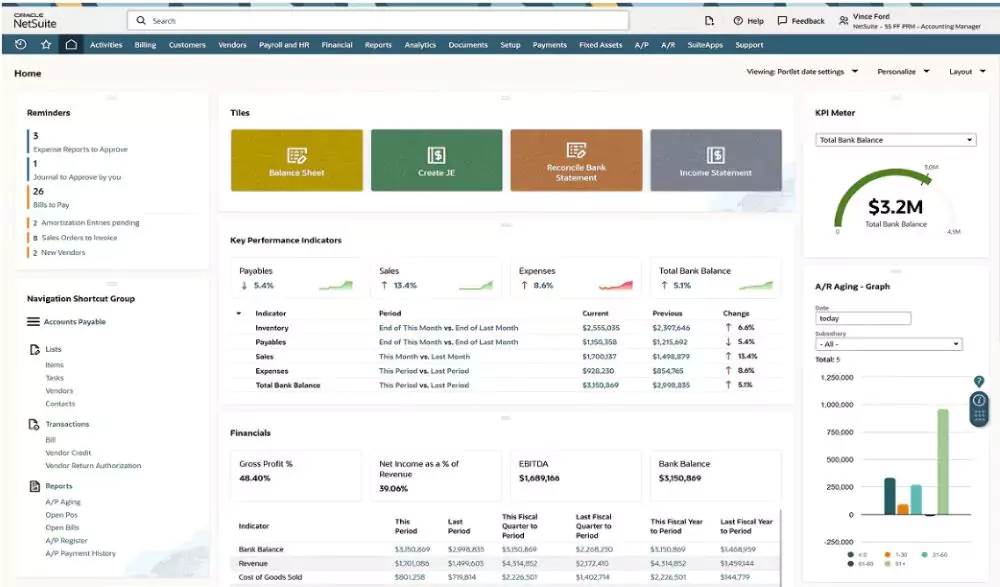
NetSuite dashboards can bring financial, inventory, asset, and project data into one view. Oil and gas leaders can monitor cost trends, asset activity, inventory usage, and operational performance without waiting for manual reports.

Multi-entity management
Multi-entity reporting
NetSuite helps oil and gas companies consolidate reporting across subsidiaries, basins, business units, and joint ventures. Finance teams can reduce manual consolidation work and view performance across the organization from one system.
Intercompany accounting
NetSuite supports intercompany transactions, eliminations, and reporting across related entities. This helps simplify the close process and maintain cleaner financial records as the business grows.
Multi-currency management
NetSuite supports companies that operate across currencies, regions, or international business structures. Finance teams can manage currency conversion, reporting, and consolidation with greater consistency.
Multi-location visibility
NetSuite gives teams visibility across offices, yards, warehouses, field locations, and operating areas. This helps leaders compare performance, monitor inventory, and manage activity across a distributed oil and gas business.
M&A and acquisition readiness
NetSuite supports standardized charts of accounts, workflows, vendor records, and reporting structures. This helps oil and gas companies onboard acquired entities, assets, or locations more efficiently after a transaction.

Reporting & controls
Real-time dashboards
NetSuite provides dashboards and reports that help teams monitor financial, operational, project, and inventory performance. Leaders can review current data instead of waiting for spreadsheet updates or month-end reporting.
Business intelligence and KPIs
NetSuite helps oil and gas companies track key metrics such as cost by well, cost per barrel, working capital, asset uptime, and project performance. These insights help teams identify trends, spot risks, and make better decisions.
Role-based access
NetSuite supports role-based permissions so users only access the data and actions needed for their job. This helps protect sensitive financial and operational data while supporting stronger internal controls.
Audit trails and documentation
NetSuite maintains records of transactions, approvals, user activity, and changes to key data. This helps support internal reviews, partner audits, and financial audit requirements.
Compliance reporting support
NetSuite helps centralize the data needed for tax, regulatory, environmental, and financial reporting. Configurable workflows and reporting tools help teams maintain documentation and improve audit readiness.


Rand Group recognized by Oracle NetSuite for oil and gas industry success
Oracle NetSuite named Rand Group a 2026 Alliance Partner Spotlight Winner in the Energy category for our work with Henry Resources LLC. The recognition highlights our experience helping energy and oil and gas organizations simplify complex accounting, manage multiple entities, and build scalable NetSuite environments around industry-specific requirements.
Case Study
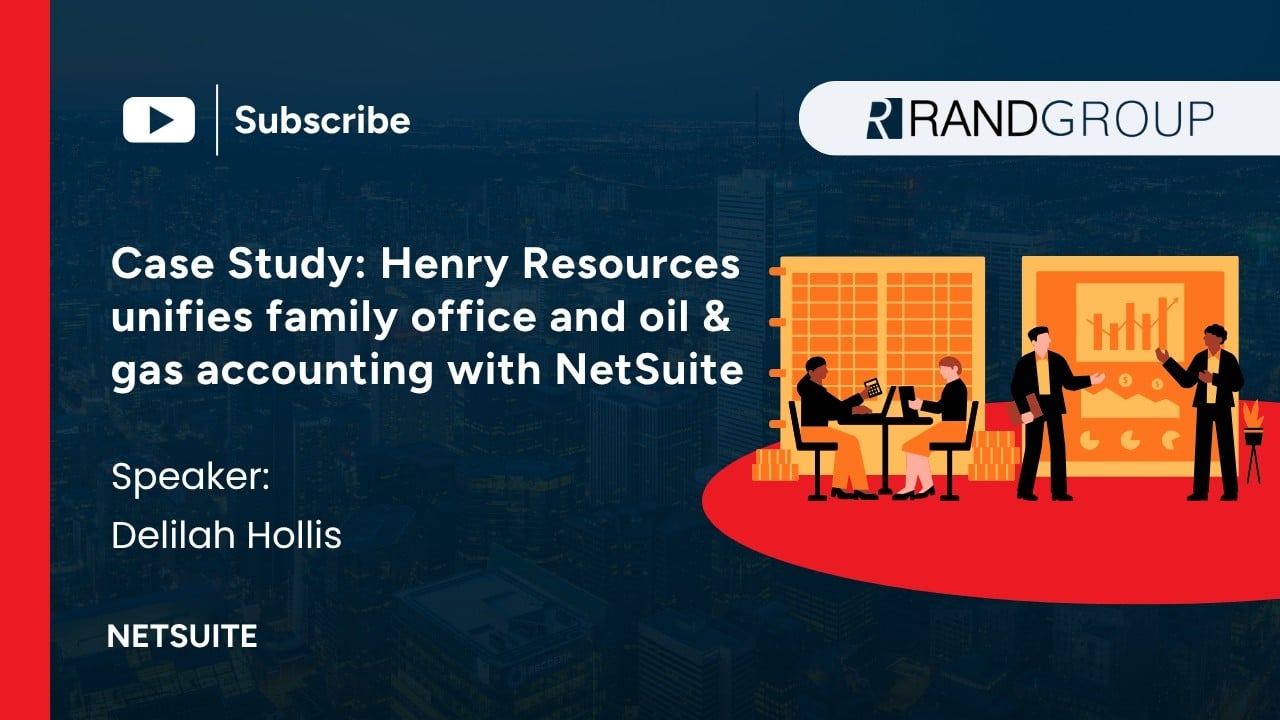
How Henry Resources unified oil and gas accounting on NetSuite
Henry Resources LLC needed to replace fragmented accounting systems and manual processes with one scalable cloud ERP. The firm managed 30 to 40 entities across family office investments and oil and gas interests, but its legacy systems made consolidation, approvals, reporting, and well-level visibility difficult.
Rand Group implemented Oracle NetSuite as a unified ERP platform with core financials, multi-entity reporting, automated consolidation, JIB imports, revenue imports, and custom well-level reporting. Henry Resources now has stronger financial controls, faster reporting, and real-time visibility across its investment and oil and gas operations.
Extend NetSuite for your oil and gas requirements
NetSuite provides a strong cloud ERP foundation for financial management, procurement, inventory, projects, reporting, and controls. For oil and gas companies with more specialized requirements, Rand Group extends NetSuite with proven oil and gas solutions, workflows, integrations, reports, dashboards, and applications built around industry needs.
Our team helps tailor NetSuite for workflows such as joint interest billing, rental management, lease operating statements, AFE approvals, well and lease reporting, field-to-finance integrations, and KPI dashboards. These solutions help address common oil and gas gaps such as ownership allocations, billing delays, rental equipment tracking, well-level profitability reporting, and manual field-to-finance processes without starting from scratch.
Rand Group felt like part of our team, not a group that was there just to get the project done and move on. We wanted to build the environment the right way the first time, and they helped us customize NetSuite for the oil and gas requirements that were important to us.
Automate joint interest billing in NetSuite
Rand Group’s Joint Interest Billing (JIB) solution extends NetSuite to help oil and gas companies manage shared costs, revenues, ownership interests, and partner billing in one system. Built specifically for oil and gas companies using NetSuite, the solution helps operators reduce manual work, improve allocation accuracy, maintain a clear JIB history, and provide joint venture partners with more transparent financial reporting.
What our JIB solution does:
- Flexible allocation decks. Assign owners to multiple decks and connect decks to multiple wells for accurate cost and revenue sharing.
- Owner records in one place. Keep a single, accurate record for each owner, with real-time updates when ownership changes.
- Automated billing cycles. Generate JIB statements with less manual entry, so billing stays timely and accurate.
- Customized statements. Produce billing statements that match each partner’s requirements.
- Full JIB history. Access a complete record of past transactions and allocations to support audits and partner reviews.
Rental management built inside NetSuite
Oil and gas operators need rental equipment to be available, maintained, and billed correctly. Rand Group’s equipment rental solution extends NetSuite to manage rental orders, contracts, equipment availability, maintenance, replacement parts, asset history, and billing in one connected system.
- Rental order and contract management. Build rental orders with forms that pre-populate by equipment type, then turn orders into invoices and set up recurring billing.
- Flexible rate options. Bill by day, month, or other measures such as feet of pipe.
- Asset scheduling and availability. Track equipment in real time and move it on or off rent or standby automatically as orders are created.
- Maintenance scheduling. Set maintenance and calibration schedules, automate servicing reminders, and flag returned equipment for maintenance.
- Asset history and depreciation. Track each asset’s rental history, maintenance records, and depreciation in one place.


Add well-level lease operating reports in NetSuite
Rand Group has built lease operating statement (LOS) functionality inside NetSuite to give oil and gas operators and investors clearer visibility into well-level financial performance. Instead of relying on spreadsheets or separate reporting tools, teams can review gross and net activity by well, lease, prospect, or other reporting segment directly inside NetSuite.
This solution helps connect oil and gas accounting data with the supporting detail leaders need to analyze revenue, expenses, ownership impacts, and asset performance. With lease operating statements built into NetSuite, companies can improve reporting accuracy, reduce manual work, and give stakeholders faster access to the financial visibility they expect.
Oil and gas solutions ready for AI
NetSuite includes AI capabilities that help oil and gas teams find answers faster, reduce manual reporting work, and act on financial and operational data with less delay. Instead of spending hours building spreadsheets, days consolidating data, or weeks waiting for reports, teams can use AI to query NetSuite data, review trends, identify exceptions, and get clearer answers in minutes.
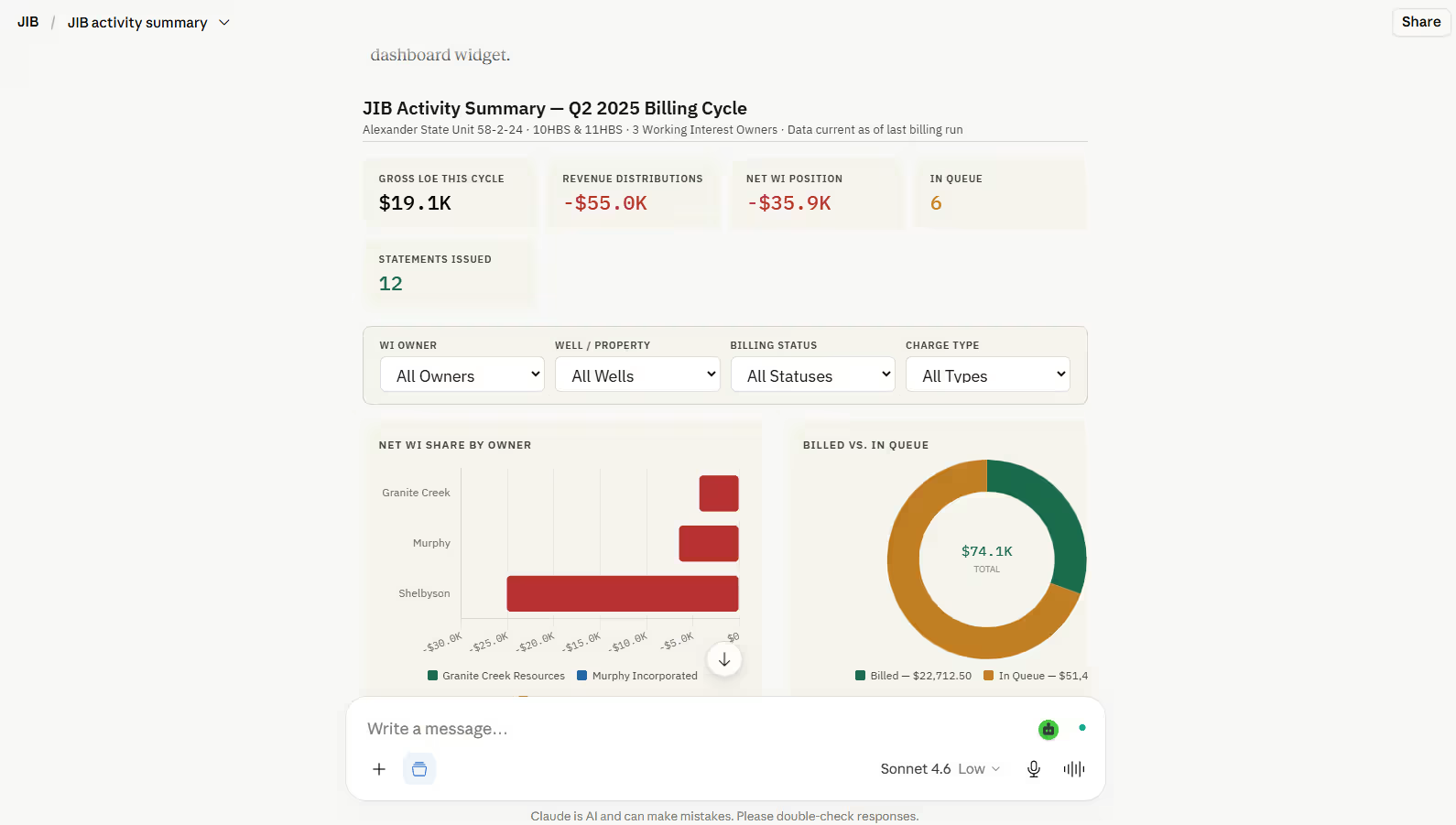
Rand Group’s oil and gas solutions are built inside NetSuite, so data from tools such as Joint Interest Billing and rental management can connect to the same AI-enabled environment as your core NetSuite records. Through the NetSuite Model Context Protocol (MCP), users can query data from Rand Group’s solutions with AI assistants such as Claude or ChatGPT, making it easier to ask questions about joint venture costs, rental activity, billing, and financial performance using plain language.

White Paper
How to choose an ERP solution for your oil & gas business
From fast-changing regulations to fluctuations in international markets, oil and gas businesses need enterprise resource planning (ERP) software that is flexible, efficient, and amenable to an ever-changing landscape. In this whitepaper, our industry experts will walk you through the process of defining ERP requirements, identifying the necessary modules for your business, and finding a partner to implement the solution.
Frequently asked questions (FAQs)
Is NetSuite a good ERP for oil and gas companies?
Yes, NetSuite can be a strong ERP for oil and gas companies that need connected financials, project accounting, procurement, inventory, reporting, and multi-entity visibility. It helps teams manage costs, assets, field activity, and financial data in one cloud-based system.
What oil and gas processes can NetSuite support?
NetSuite can support oil and gas processes such as accounting, financial management, project accounting, procurement, inventory, fixed asset management, multi-entity reporting, and compliance tracking. With Rand Group, NetSuite can also be extended for industry-specific workflows such as JIB, rental management, lease operating statements, AFE approvals, and well-level reporting.
Does NetSuite support joint interest billing?
NetSuite can support joint interest billing with custom functionality built for oil and gas requirements. Rand Group has developed a custom JIB solution inside NetSuite to help companies manage ownership records, allocation decks, billing statements, JIB history, and partner reporting.
Can NetSuite track costs by well, project, or AFE?
Yes, NetSuite can track costs by well, project, AFE, asset, department, entity, or other reporting segment. This gives oil and gas teams better visibility into committed costs, actual costs, budget variances, and profitability across operations.
Can NetSuite support oilfield equipment rentals?
Yes, NetSuite can support oilfield equipment rentals with custom rental management functionality. Rand Group’s equipment rental solution extends NetSuite to manage rental orders, contracts, asset availability, maintenance schedules, billing, asset history, and depreciation in one connected system.
What is Rand Group’s JIB solution for NetSuite?
Rand Group’s JIB solution for NetSuite is a custom oil and gas application that helps operators manage joint interest billing inside NetSuite. It supports owner records, allocation decks, automated billing cycles, customized statements, JIB history, reporting, and audit support.
Can NetSuite create lease operating statements?
Yes, NetSuite can create lease operating statements with custom reporting built around oil and gas needs. Rand Group has built lease operating statement functionality inside NetSuite to help operators and investors review gross and net activity by well, lease, prospect, or other reporting segment.
Can Rand Group customize NetSuite for oil and gas requirements?
Yes, Rand Group can customize NetSuite for oil and gas requirements. Our team can build custom workflows, reports, dashboards, integrations, applications, and industry-specific functionality to support processes that are not available out of the box.
How much does NetSuite for oil and gas cost?
NetSuite pricing for oil and gas companies depends on licensing, users, modules, implementation scope, integrations, data migration, and custom functionality. Rand Group can help estimate the cost based on your business requirements, including JIB, rentals, lease operating statements, reporting, and multi-entity needs.
Why work with Rand Group for NetSuite oil and gas?
Rand Group brings NetSuite expertise, oil and gas industry experience, and custom development capabilities together in one team. We help oil and gas companies implement, optimize, and extend NetSuite for financial management, reporting, JIB, rentals, lease operating statements, integrations, and long-term support.
Why choose Rand Group for NetSuite oil and gas?
Decades of experience
Rand Group has more than 23 years of experience helping oil and gas companies improve financial, operational, and reporting processes. Our team understands the needs of operators, service companies, investors, and family offices across the oil and gas ecosystem.
Proven NetSuite and ERP experience
With 3,000+ successful engagements and more than 1,200 clients, Rand Group brings the experience needed to reduce risk and guide complex ERP projects. We help oil and gas companies implement, customize, and optimize NetSuite around industry-specific needs.
Long-term partnership and support
We don’t just implement and walk away. Our 90% client retention rate reflects our focus on long-term support, system optimization, and continuous improvement as your oil and gas business grows and changes.
Rescue and recovery expertise
60% of Rand Group clients come to us after leaving another partner. Whether you need to recover a struggling implementation, improve a poorly configured system, or extend NetSuite with custom oil and gas functionality, our team can help you get back on track.
Related Insights

Best ERP software for the oil and gas industry
Choosing the best ERP software for the oil and gas industry depends on company size, operations, reporting needs, and system complexity. This guide compares Dynamics 365 Finance & Operations, Dynamics 365 Business Central, Oracle NetSuite ERP, Sage Intacct, and Sage 100 to help oil and gas companies evaluate the right ERP path.

Oil and gas accounting challenges and solutions
Oil and gas accounting requires accurate cost tracking, partner allocations, field data, reporting, and controls. Learn common oil and gas accounting challenges and how ERP, integrations, automation, and industry-specific software capabilities can help solve them.

What is Joint Interest Billing?
Joint Interest Billing (JIB) is a critical process for managing costs and revenues in oil and gas joint ventures. Rand Group’s custom JIB solution for NetSuite simplifies complex cost allocations, improves billing accuracy, and ensures transparency among partners, providing oil and gas companies with a powerful tool to optimize their financial processes.