NetSuite
NetSuite vs Odoo: A side-by-side comparison for growing companies

When evaluating NetSuite vs Odoo, organizations often find themselves comparing two very different ERP philosophies. Both platforms provide accounting, operations, inventory, CRM, and business management capabilities, but they are designed for different types of companies and growth trajectories.
Odoo is known for its affordability, flexibility, and open-source architecture, making it attractive to small and midsized businesses looking for a customizable solution. NetSuite, on the other hand, is a comprehensive cloud ERP platform designed to support growing mid-market and enterprise organizations with advanced financial management, global business capabilities, and built-in scalability.
In this guide, we’ll compare NetSuite vs Odoo across functionality, pricing, customization, and long-term business value to help determine which ERP is the best fit for your organization.
What is NetSuite?
Oracle NetSuite is a cloud-based ERP platform that helps organizations manage financials, operations, inventory, supply chain, CRM, ecommerce, and business analytics from a single unified system.
Unlike point solutions that require multiple integrations, NetSuite provides a centralized platform designed to give business leaders real-time visibility across the organization.
Key NetSuite capabilities include:
- Financial management and accounting
- Multi-entity and multi-subsidiary consolidation
- Revenue recognition and ASC 606 compliance
- Inventory and warehouse management
- Procurement and supply chain management
- CRM and customer management
- Planning and budgeting
- Business intelligence and reporting
NetSuite is particularly well-suited for organizations experiencing rapid growth, managing multiple locations or subsidiaries, operating internationally, or requiring sophisticated financial controls.
Today, more than 43,000 organizations worldwide use NetSuite to manage business operations and support growth.

What is Odoo?
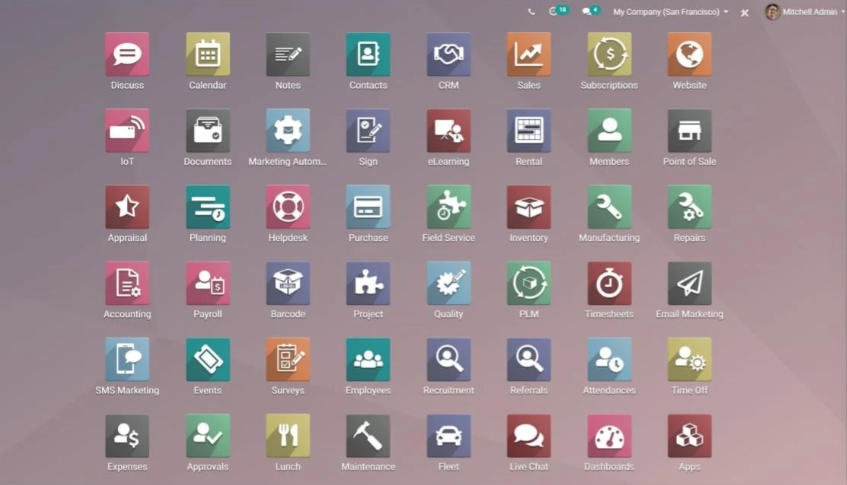
Odoo is an open-source ERP platform built around a modular application framework. Organizations can start with a small number of applications and add functionality over time as business needs evolve.
Odoo’s flexibility is one of its biggest differentiators. Because the platform is open source, businesses can customize workflows, applications, and user experiences to align closely with their operational requirements.
Popular Odoo modules include:
- Accounting
- CRM
- Inventory management
- Manufacturing
- Ecommerce
- Project management
- Human resources
- Marketing automation
For smaller businesses with limited budgets and unique operational requirements, Odoo can provide an attractive entry point into ERP software.
However, the same flexibility that makes Odoo appealing often requires greater technical expertise and ongoing customization management as complexity increases.

Need a more detailed NetSuite vs Odoo comparison?
Our comprehensive buyer’s guide takes a deeper look at the differences between NetSuite and Odoo, including functionality, implementation considerations, long-term costs, and business fit. Download the guide to help make a more informed ERP decision.
NetSuite vs Odoo: Comparison at a glance
NetSuite vs Odoo: Key differences
While both NetSuite and Odoo offer core ERP capabilities, they differ significantly in areas such as financial management, scalability, customization, and long-term business value. Understanding these differences can help organizations identify which platform is better aligned with their operational complexity, growth plans, and resource requirements.
NetSuite AI capabilities
Artificial intelligence has become an increasingly important differentiator in the NetSuite vs Odoo conversation. As companies evaluate ERP systems, they are not only comparing current functionality. They are also evaluating which platform is better positioned to support AI-driven workflows, faster insights, automation, and long-term innovation.
NetSuite has continued to expand AI directly within the ERP experience across financial management, reporting, planning, analytics, and operational workflows. This matters because AI is most useful when it works in the same system where financial, customer, inventory, transaction, and operational data already live.
Key NetSuite AI capabilities include:
- AI-powered anomaly detection and financial insights
- Natural language search and reporting
- Predictive forecasting and planning
- Automated transaction categorization
- Intelligent recommendations for operational efficiency
- AI-driven content generation through NetSuite Text Enhance
- Embedded conversational intelligence and agentic workflows through NetSuite Next
- AI connectivity through the NetSuite AI Connector Service and Model Context Protocol, or MCP
NetSuite Next represents the next stage of NetSuite’s AI strategy. It is designed to bring more conversational, guided, and intelligent experiences into the ERP system so users can search, analyze, summarize, and act on business information more naturally. Rather than requiring users to navigate every workflow manually, NetSuite Next is intended to make AI a more embedded part of how finance, operations, and leadership teams work in NetSuite.
Odoo also supports AI integrations and continues to add emerging AI functionality. However, organizations may need to rely more heavily on third-party tools, custom development, or external integrations to achieve more advanced AI scenarios. For companies looking to make AI part of their long-term ERP strategy, NetSuite’s continued investment in embedded AI, NetSuite Next, and governed AI connectivity can provide a meaningful advantage.
Financial management and accounting
One of the biggest distinctions between NetSuite and Odoo is financial sophistication.
Odoo delivers solid accounting functionality for small and growing businesses. Organizations can manage accounts payable, accounts receivable, general ledger activities, and standard financial reporting without significant challenges.
However, as financial complexity grows, many organizations begin to encounter limitations.
NetSuite was built to support organizations with advanced accounting requirements, including:
- Multi-book accounting
- Multi-entity consolidation
- Automated intercompany transactions
- Revenue recognition
- Advanced financial reporting
- Global tax management
- Audit readiness and compliance
For organizations operating across multiple legal entities, business units, or countries, NetSuite’s financial capabilities often become a significant competitive advantage.
Customization and flexibility
If flexibility is your top priority, Odoo has a clear advantage. Because Odoo is open source, businesses can modify applications, create custom workflows, and tailor the platform to unique business requirements. Organizations with internal development teams often appreciate the freedom to customize nearly every aspect of the system.
NetSuite takes a different approach. While highly configurable through SuiteCloud, workflows, custom fields, and scripting, NetSuite promotes standardized business processes and best practices rather than unlimited customization.
For many growing companies, this approach can reduce long-term complexity by minimizing technical debt and custom code maintenance.
Global operations and scalability
As organizations expand, scalability becomes increasingly important. NetSuite was specifically designed to support growth through:
- Multi-subsidiary operations
- Multi-currency management
- International tax compliance
- Global consolidations
- Enterprise reporting
Businesses can manage hundreds of entities and operations across multiple countries within a single system.
Odoo can support international growth, but organizations often require additional configuration, third-party applications, or custom development to achieve the same level of global functionality.
For businesses planning aggressive expansion, NetSuite typically provides a stronger long-term foundation.
User experience
Odoo is widely praised for its modern and intuitive user interface. Users often find navigation straightforward, resulting in shorter onboarding periods and faster user adoption.
NetSuite’s interface prioritizes functionality and visibility. While dashboards, KPIs, and reporting tools are extremely powerful, new users may experience a steeper learning curve compared to Odoo.
The trade-off is that NetSuite’s complexity often reflects the broader functionality available within the platform.
Implementation and support
Implementation experiences vary significantly between the two systems.
Odoo implementations are often faster and less expensive initially, particularly for organizations deploying only a handful of applications. However, extensive customization can increase implementation complexity and create future maintenance challenges.
NetSuite implementations generally require greater upfront planning but provide a more structured deployment framework supported by Oracle and certified implementation partners, like Rand Group. Organizations that prioritize long-term stability often find this approach beneficial as they scale.
Which industries are a better fit for NetSuite vs Odoo?
Industry fit depends on company size, complexity, growth plans, and internal resources. Odoo is often a strong fit for smaller businesses, startups, ecommerce companies, and organizations with straightforward operations that want flexibility, affordability, and the ability to customize with internal development support.
NetSuite is typically a better fit for growing and mid-market organizations that need advanced financial management, multi-entity reporting, inventory visibility, and stronger scalability. It is commonly used by companies in healthcare, manufacturing, distribution, professional services, technology, nonprofit, and other industries with more complex operational or reporting requirements.
NetSuite vs Odoo pricing comparison
Pricing is frequently one of the first considerations when comparing ERP solutions.
At first glance, Odoo is typically the less expensive option. Its modular pricing model allows businesses to purchase only the applications they need, resulting in lower initial software costs. This makes Odoo particularly attractive to startups and smaller organizations with limited budgets.
NetSuite represents a larger upfront investment. Licensing, implementation, and subscription costs are generally higher than Odoo. However, ERP decisions should be evaluated through the lens of total cost of ownership (TCO) rather than software licensing alone.
When evaluating TCO, organizations should consider:
- Software licensing
- Implementation services
- Custom development
- Ongoing maintenance
- System upgrades
- Integration management
- Internal IT resources
While Odoo often wins on initial affordability. However, organizations evaluating Odoo should also factor in the potential costs of customization, developer resources, and ongoing maintenance when comparing long-term ownership costs.
NetSuite’s higher upfront investment frequently includes functionality that would otherwise require custom development, third-party applications, or additional maintenance efforts.
For growing organizations, the conversation should focus on long-term business value rather than software costs alone.
When should you choose Odoo?
Odoo may be the right choice if:
- Your business is relatively small or early-stage
- Budget is a primary concern
- You have internal development resources
- You require extensive customization
- You want to implement modules gradually over time
- Your financial and operational requirements remain relatively straightforward
For businesses seeking a flexible and cost-effective ERP foundation, Odoo can be a strong starting point.
At Rand Group, we believe the best ERP solution is the one that aligns with your business requirements and long-term goals. As a multi-platform ERP advisor, we’ve worked with organizations across a variety of ERP ecosystems. For businesses with relatively straightforward operational requirements, strong internal technical resources, and a desire for extensive customization, Odoo can be a viable option. However, organizations anticipating significant growth, increasing financial complexity, or global expansion often find that NetSuite provides a stronger long-term foundation.
When should you choose NetSuite?
NetSuite is often the better choice when:
- Revenue has surpassed $20–30 million and continues to grow
- Multiple entities, divisions, or subsidiaries must be managed
- Financial reporting requirements are becoming more complex
- Global operations are expanding
- Executive teams need real-time visibility across the business
- Compliance and audit requirements are increasing
- Scalability is a strategic priority
Organizations that anticipate significant growth frequently choose NetSuite because it can support evolving business complexity without requiring a future ERP replacement.
Why many growing businesses ultimately choose NetSuite
Many organizations select ERP software based on today’s requirements. The challenge is that business complexity rarely stays the same.
As companies grow, they often need to manage increasingly complex financial operations, larger volumes of data, and greater demands for real-time business insights. They also want to leverage AI to improve efficiency and decision-making without adding more manual processes. Organizations frequently need to manage:
- Multiple entities, subsidiaries, or locations
- More complex financial reporting and compliance requirements
- Acquisitions and organizational restructuring
- International operations and multi-currency transactions
- Increasing inventory, supply chain, and operational complexity
NetSuite is designed to support these changes without requiring businesses to stitch together multiple applications or heavily customize their ERP.
At Rand Group, we’ve seen how NetSuite can help organizations scale with confidence. For example, Mann Eye Institute implemented NetSuite to improve operational visibility and support growth initiatives. The result was a more scalable business platform that helped the organization successfully manage 40–50% growth while maintaining efficiency. It’s a common story among growing companies that need an ERP capable of supporting future expansion, not just current requirements.

Not sure which ERP is right for your business?
Whether you’re comparing NetSuite, Odoo, or other ERP platforms, our team can help you navigate the evaluation process with confidence. We’ll assess your business requirements, identify key priorities, and recommend a solution that supports your operational and growth objectives.
NetSuite vs Odoo FAQs
Is NetSuite better than Odoo?
Neither platform is universally better. Odoo is often a strong fit for smaller businesses seeking flexibility and lower upfront costs, while NetSuite is typically better suited for organizations requiring advanced financial management, scalability, and global business capabilities.
What is the biggest difference between NetSuite and Odoo?
The biggest difference is architecture. Odoo is an open-source, highly customizable ERP platform, while NetSuite is a comprehensive cloud ERP with extensive functionality built into a unified system.
Is Odoo cheaper than NetSuite?
Yes. Odoo generally has lower upfront software costs. However, organizations should evaluate long-term total cost of ownership, including customization, maintenance, integrations, and ongoing support.
Can Odoo support large enterprises?
Odoo can support larger organizations, but companies with complex accounting, global operations, and multi-entity reporting requirements often find NetSuite better equipped to manage enterprise-scale complexity.
Who should use NetSuite?
NetSuite is ideal for growing mid-market organizations, multi-location businesses, manufacturers, distributors, ecommerce companies, healthcare organizations, and businesses preparing for significant growth.
What should I consider before choosing between NetSuite and Odoo?
Beyond functionality and cost, organizations should evaluate scalability, implementation requirements, customization needs, reporting capabilities, and long-term total cost of ownership. Partnering with an experienced ERP consulting firm can help you assess these factors and make a more informed decision.
Partner with Rand Group for software selection and implementation
Choosing between NetSuite and Odoo involves more than comparing features and pricing. Organizations must evaluate their current business processes, growth objectives, reporting requirements, and long-term technology strategy to determine which ERP platform will best support their future needs.
Working with an experienced ERP advisor can help simplify both software selection and implementation. From evaluating business requirements and developing a technology roadmap to configuring systems, optimizing workflows, and supporting user adoption, the right partner can help organizations make more informed decisions and maximize long-term value.
As a multi-platform ERP consulting firm, we help organizations evaluate a wide range of business applications. Our recommendations are based on each organization’s operational requirements, growth objectives, and long-term technology strategy, not on a single software platform.
As a NetSuite Alliance Partner, we bring deep expertise in NetSuite implementations and optimization. Our consultants help organizations across diverse industries improve visibility, streamline operations, and support long-term growth through ERP selection, implementation, training, and post-go-live support.
Final thoughts
When comparing NetSuite vs Odoo, both platforms offer strong ERP capabilities, but they are designed to address different business needs. Odoo provides an affordable, flexible, and highly customizable solution that can be a good fit for smaller organizations with straightforward requirements. NetSuite, on the other hand, is built to support growing organizations that need advanced financial management, enterprise-grade functionality, and a scalable platform capable of handling increasing operational complexity.
The right ERP decision should be based not only on where your business is today, but where you expect it to be in the next three to five years. If you’re evaluating NetSuite vs Odoo and want expert guidance on selecting the best-fit solution for your organization, contact us. Our ERP specialists can help you assess your requirements, evaluate your options, and develop an implementation strategy that supports your long-term business goals.