NetSuite
NetSuite vs Salesforce: Unified ERP & CRM vs standalone CRM

As businesses scale, one CRM comparison comes up again and again: NetSuite vs Salesforce. Both are leading cloud-based solutions, both include CRM capabilities, and both are trusted by businesses around the world. However, while they appear similar on the surface, NetSuite and Salesforce are built for very different purposes.
The key distinction is this: NetSuite is a unified business platform that includes CRM as part of a full ERP suite, while Salesforce is a standalone, best-in-class CRM. Understanding that difference is critical to choosing the right solution for your business today, and for where you plan to grow.
In this article, we’ll break down NetSuite vs Salesforce from a CRM-focused perspective, compare their capabilities, and help you determine which platform best supports your long-term business strategy.
What is NetSuite CRM?
NetSuite CRM is part of the broader NetSuite cloud ERP platform, designed to manage the entire customer lifecycle, from lead to cash, within a single system. Rather than functioning as a standalone CRM, NetSuite CRM is embedded directly into the same database that manages financials, order processing, inventory, and billing.
Core NetSuite CRM capabilities include:
- Lead, prospect, and opportunity management
- Account and contact management
- Sales forecasting and pipeline visibility
- Quotes, sales orders, renewals, and upsells
- Activity tracking and customer interaction history
Because CRM is native to the NetSuite platform, sales teams have real-time visibility into customer financial data, including open orders, invoices, payment history, and lifetime value. This eliminates the need for manual handoffs between sales and accounting and reduces data silos across departments.
NetSuite CRM is especially well-suited for growing businesses that want CRM tightly connected to revenue, fulfillment, and finance, rather than operating as a separate system.
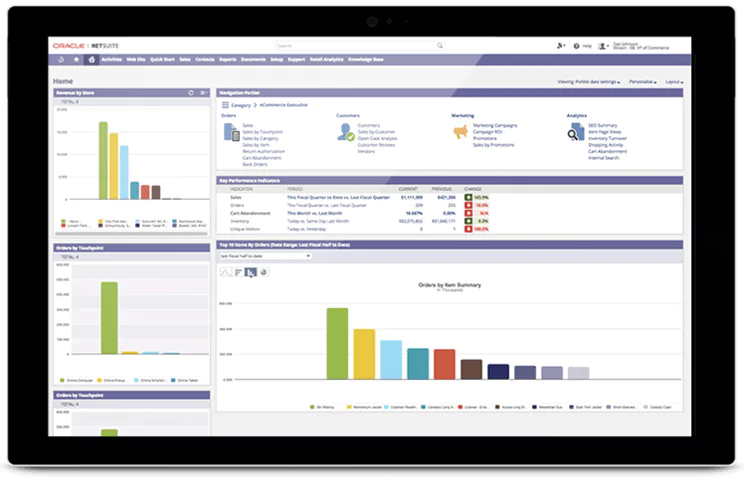
NetSuite CRM: A unified platform for sales and growth
NetSuite CRM helps organizations manage the entire customer lifecycle, from lead to renewal, within a single, integrated platform. With real-time visibility into customer interactions, sales activity, and financial data, teams can forecast more accurately, identify upsell opportunities, and make faster, more informed decisions. Learn more about NetSuite CRM in this product overview.
What is Salesforce?
Salesforce is widely recognized as a best-in-class standalone CRM platform. It is designed specifically to help sales, marketing, and service teams manage customer relationships and drive pipeline growth.
Salesforce CRM capabilities include:
- Lead and opportunity management
- Sales automation and workflow tools
- Activity tracking and task management
- Customizable dashboards and reports
- A large ecosystem of third-party applications via AppExchange
Salesforce excels at providing deep CRM functionality, especially for organizations with complex sales processes or advanced marketing needs. However, Salesforce does not include ERP or accounting functionality, which means financials, billing, inventory, and fulfillment must be managed in separate systems and integrated as needed. As a result, Salesforce is often one piece of a broader application stack rather than a single system of record.
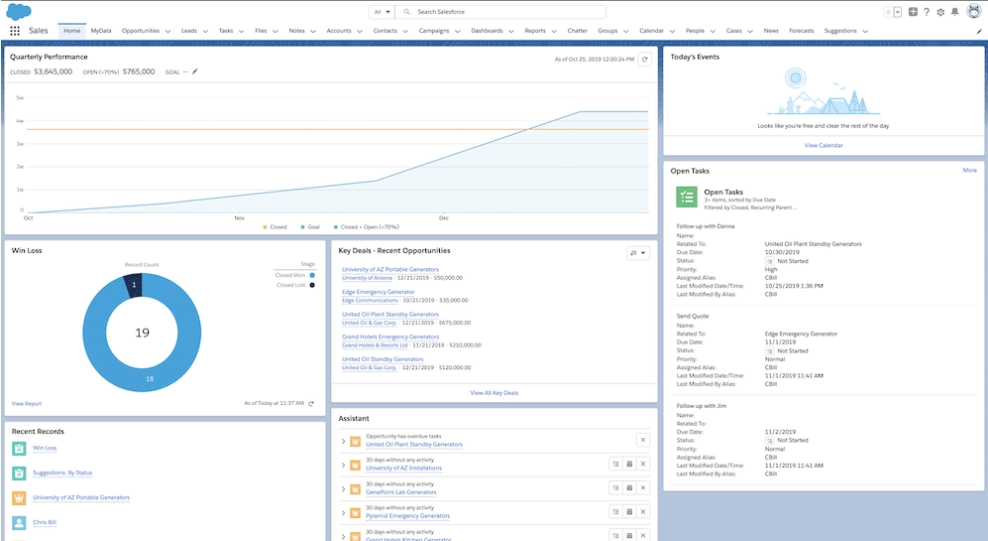
Core difference: Unified platform vs standalone
The fundamental difference in the NetSuite vs Salesforce comparison is architectural.
NetSuite CRM is part of a unified platform. Sales, finance, operations, and leadership all work from the same customer record and the same real-time data. When a deal closes, it flows seamlessly into order management, billing, and revenue reporting without requiring integrations or duplicate data entry.
Salesforce, on the other hand, is a standalone system. While it offers robust CRM functionality, it relies on integrations to connect with ERP, accounting, and operational systems. This can introduce complexity, data latency, and reconciliation challenges as organizations scale.
For companies focused on long-term growth and operational efficiency, this distinction often becomes a deciding factor.
NetSuite vs Salesforce: CRM feature comparison
NetSuite is a full cloud ERP platform that manages financials, inventory, order management, and operations in addition to CRM. While those ERP capabilities are a key differentiator, the table below compares NetSuite CRM and Salesforce CRM strictly from a CRM perspective, not full ERP functionality.
Why many growing companies choose NetSuite CRM
As companies scale, CRM requirements expand beyond pipeline tracking. Leadership teams need to understand how customers affect revenue, fulfillment, cash flow, and profitability.
NetSuite CRM supports this by offering:
- A single source of truth for customer data
- Real-time visibility into orders, invoices, and revenue
- Fewer systems to manage and reconcile
- Strong alignment between sales, finance, and operations
Industries that commonly benefit from NetSuite CRM include:
- Manufacturing
- Distribution and wholesale
- Ecommerce
- Subscription and recurring revenue businesses
For these organizations, CRM is not just about closing deals, it’s about managing the full customer lifecycle efficiently and profitably.
When Salesforce may be a better fit
Salesforce may be a strong choice for organizations that:
- Only need a standalone CRM
- Have no plans to consolidate ERP or accounting systems
- Require very advanced sales automation or marketing tools
Salesforce excels in environments where CRM is the primary system of focus and operational processes are managed separately. However, as organizations grow, many find that maintaining disconnected systems becomes more challenging and costly over time.
CRM pricing considerations: NetSuite vs Salesforce
Pricing is an important part of any CRM selection, but it’s important to look beyond base license fees alone. NetSuite pricing reflects access to a full ERP platform that includes financials, operations, and other core business functionality in addition to CRM, while Salesforce pricing represents the cost of a standalone CRM. Because of this difference, comparing total NetSuite costs directly to Salesforce costs is not a true CRM-to-CRM comparison and can be misleading without understanding what each platform includes.
NetSuite CRM is licensed as an add-on module within the NetSuite platform. Organizations typically pay a monthly base subscription for the CRM module, along with a per-user, per-month fee that scales based on company size and user count. NetSuite pricing is designed to scale as organizations grow without relying on a large number of separate feature add-ons.
Salesforce pricing is also tiered on a per-user basis and often starts lower at the entry level. However, costs can increase quickly as organizations move into higher tiers or add advanced CRM features, automation, analytics, or third-party applications to support more complex requirements.
When evaluating CRM pricing, organizations should consider total cost of ownership, including add-on features, reporting capabilities, integrations, and ongoing administration. Because NetSuite CRM runs on the same platform as NetSuite ERP, many reporting, workflow, and platform-wide tools are already included, reducing the need to license or integrate additional systems as CRM requirements expand.

NetSuite pricing guide: Understanding modules, licensing, and costs
NetSuite uses a modular subscription licensing model that allows organizations to configure the platform based on their specific needs. This guide explains how NetSuite pricing works, which add-on modules are available, and how to choose the right service tier, using real-world pricing examples to help you plan with confidence.
FAQs: NetSuite vs Salesforce
What is the main difference between NetSuite and Salesforce?
NetSuite is a unified ERP platform that includes CRM, while Salesforce is a standalone CRM. NetSuite connects sales directly to financial and operational data, while Salesforce requires integrations for a full business view.
How robust is NetSuite CRM compared to Salesforce?
Salesforce offers deeper CRM-specific features, but NetSuite CRM provides stronger end-to-end visibility across the customer lifecycle, which is often more valuable for growing businesses and decision-makers.
Does NetSuite CRM include sales automation?
Yes. NetSuite CRM includes sales automation, forecasting, activity tracking, and workflow tools, all tied directly to operational data.
Can NetSuite be integrated with Salesforce?
Yes, NetSuite can be integrated with Salesforce to sync key data such as customers, contacts, opportunities, orders, and invoices. Many organizations choose this approach when they want to keep Salesforce as their CRM while using NetSuite for ERP and financial management. That said, integrations add complexity and ongoing maintenance, which is why it’s important to design them carefully. Our NetSuite team helps organizations plan, implement, and optimize NetSuite–Salesforce integrations to ensure data accuracy, reliable workflows, and long-term scalability while minimizing operational overhead.
Is NetSuite CRM included with NetSuite ERP?
NetSuite CRM is a native module within the NetSuite ERP platform, meaning it runs on the same system and shares the same database, workflows, and reporting. However, it is not automatically included for free in every NetSuite subscription. NetSuite CRM is typically licensed as an add-on module, with pricing based on factors such as company size, user count, selected modules, and implementation scope. The benefit is that NetSuite CRM is fully integrated from day one, providing seamless visibility across sales, finance, fulfillment, and customer data without the need for separate systems or integrations.
Partner with Rand Group for NetSuite CRM
Choosing NetSuite is only part of the equation. Successful CRM and ERP outcomes depend on working with the right implementation partner. We are a NetSuite Alliance Partner with deep experience helping organizations implement, optimize, and scale NetSuite CRM and ERP solutions. Our NetSuite services include:
- NetSuite CRM and ERP implementations – Our NetSuite experts deliver end-to-end implementations that unify sales, finance, and operations on a single, scalable platform.
- CRM process design and optimization – We design and optimize NetSuite CRM processes to align with how your teams sell, forecast, and manage customers as the business grows.
- NetSuite customization and automation – We use native NetSuite customization and automation tools to streamline workflows, reduce manual effort, and improve data accuracy.
- Reporting and dashboard development – We build role-based NetSuite dashboards and reports that provide real-time visibility into pipeline, revenue, and business performance.
- Ongoing NetSuite support and optimization – Our team provides ongoing NetSuite support and optimization to help organizations adapt, enhance functionality, and maximize long-term value.
We work closely with clients to ensure NetSuite CRM aligns with their sales processes, operational workflows, and long-term growth goals, delivering measurable value beyond go-live.
Final thoughts: NetSuite vs Salesforce
When comparing NetSuite vs Salesforce, the right choice depends on how you view CRM within your organization. Salesforce is a powerful standalone CRM, but NetSuite delivers CRM as part of a unified business platform designed for scale.
For organizations that want a single system to manage customers, revenue, and operations, NetSuite provides a clear advantage. If you’re considering NetSuite CRM or evaluating whether it’s time to move beyond a standalone CRM, our team can help you make the right decision and implement NetSuite with confidence. Contact us today to start a project.