NetSuite
Oracle NetSuite accounting software: Features, capabilities, and more

Growing organizations often reach a point where spreadsheets, entry-level accounting systems, and disconnected financial tools can no longer keep pace with reporting, automation, controls, and operational complexity. As finance teams manage more transactions, entities, users, and business processes, maintaining accurate financial information can require increasing amounts of manual work.
NetSuite helps address that complexity by connecting financial management with the broader business processes that drive financial results. In this guide, we explore NetSuite accounting software, its key features and benefits, how much it costs, how it differs from basic accounting systems, and what to consider when implementing the platform.
NetSuite accounting software at a glance
NetSuite accounting software is a cloud-based financial management solution designed for growing organizations that need more than basic accounting tools. It brings core accounting, cash management, financial reporting, automation, compliance, and multi-entity capabilities into one connected system. As part of the broader NetSuite ERP platform, it can also connect financial management with inventory, orders, CRM, projects, ecommerce, and other business operations, giving organizations greater visibility and control as they scale.
What is NetSuite accounting software?
NetSuite accounting software is the financial management foundation of the broader NetSuite ERP platform. It centralizes general ledger, accounts payable, accounts receivable, cash management, financial reporting, and other accounting processes while connecting financial data with operational activity across the organization. Because NetSuite is cloud-based, authorized teams can access current financial data from anywhere with an internet connection, making it easier to track performance, close the books faster, and stay compliant with standards like GAAP and ASC 606.
NetSuite goes beyond basic accounting by connecting financials with the rest of your business. It integrates with operations such as inventory, order management, and customer data, giving you a complete view of your organization. The platform also uses automation and AI to reduce manual work and improve accuracy. Many organizations choose NetSuite accounting software because of its strong reputation and positive reviews, especially as they grow and need a more scalable and connected solution.
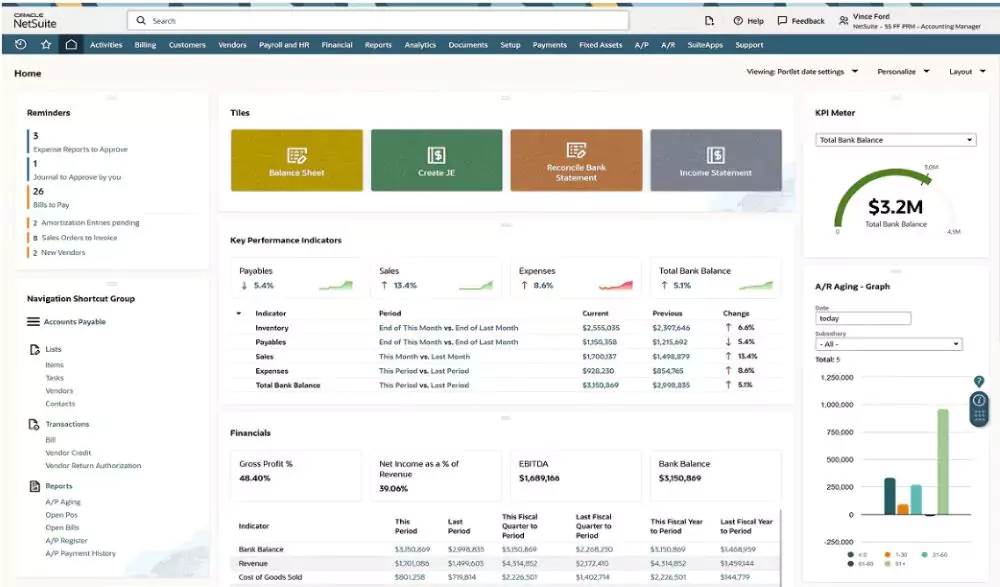
Benefits of NetSuite accounting software
NetSuite accounting software helps businesses improve financial accuracy, automate manual processes, and gain greater visibility as they grow. By bringing financial and operational data into one connected platform, finance teams can work more efficiently and make more informed decisions.
- Improve accuracy by reducing duplicate data entry, manual calculations, and reliance on spreadsheets
- Gain financial visibility with dashboards, role-based reporting, and current financial and operational data
- Accelerate the financial close with automated processes, reconciliations, and greater control over financial data
- Automate accounting processes to reduce manual work and operational overhead
- Strengthen compliance with support for revenue recognition, depreciation, audit trails, and other financial requirements
- Support growth and complexity with scalable multi-entity and multi-currency capabilities

See NetSuite accounting software in action
A personalized demo of NetSuite accounting software shows how it can streamline your financial processes and improve visibility across your business. See how NetSuite cloud accounting software can fit your workflows and support your growth.
NetSuite accounting software features and capabilities
NetSuite accounting software provides a broad set of features and capabilities to manage financial operations in one system. The platform connects accounting, cash flow, compliance, and reporting to give businesses real-time visibility and control. These capabilities help organizations automate processes, reduce errors, and scale financial operations as they grow.
Core accounting capabilities
At the core of Oracle NetSuite accounting software is a centralized system for managing day-to-day financial operations. It consolidates core accounting functions in one system, improving accuracy, visibility, and efficiency. Finance teams can automate key processes, reduce manual work, and gain real-time insight into financial data.
- General ledger: Manage your financial data with a flexible and customizable ledger that supports multiple account structures, reporting segments, and real-time visibility. Built-in audit trails and detailed reporting help ensure accuracy and support compliance.
- Accounts receivable: Automate invoicing, payment processing, and collections to improve cash flow and reduce manual effort. NetSuite helps shorten the credit-to-cash cycle while improving customer experience and visibility into outstanding balances.
- Accounts payable: Streamline vendor payments with automated workflows, approval processes, and payment scheduling. This helps reduce errors, avoid late fees, take advantage of early payment discounts, and improve overall cash management.
- Account reconciliation: Automate reconciliation across bank accounts, credit cards, prepaid expenses, fixed assets, and intercompany transactions. Centralized tracking, approvals, and sign-offs provide clear visibility and help ensure accurate financial reporting.

Financial management and cash flow
Managing cash flow and financial performance becomes easier with NetSuite accounting software. This platform helps finance teams manage cash flow, improve visibility, and close the books faster. Organizations gain real-time insight into cash positions, transactions, and financial performance, helping teams make informed decisions, improve liquidity, and reduce delays caused by manual processes.
- Cash management: Gain a complete, real-time view of cash flow, bank accounts, and liquidity across your organization. Monitor balances, track movements, and make more informed financial decisions with up-to-date data.
- Close management: Accelerate the financial close by automating manual tasks such as journal entries, reconciliations, variance analysis, and intercompany transactions, reducing time and improving accuracy.
- Payment management: Manage customer payments across multiple channels, including recurring billing, online payments, and point-of-sale transactions. Improve collections, reduce days sales outstanding, and gain better visibility into incoming cash.
- Financial reporting and analytics: Create financial reports, dashboards, and role-based views using current financial and operational data to monitor performance, analyze trends, and support decision-making.

Compliance and control
NetSuite accounting software helps organizations maintain strong financial controls and stay compliant with evolving regulations. It centralizes tax, asset, and financial data in one system, reducing risk and improving accuracy. Built-in automation and reporting make it easier to apply consistent rules and maintain audit readiness.
- Tax management: Manage domestic and global tax requirements in one system with real-time reporting and detailed transaction-level visibility. Support multiple tax types, including GST, VAT, and sales tax, across subsidiaries while improving accuracy and compliance.
- Fixed assets management: Track and manage the full lifecycle of assets, from acquisition to disposal, without relying on spreadsheets. Automate depreciation, maintain accurate records across locations, and improve visibility into asset performance and value.

Grant management
For organizations managing funding, NetSuite ERP accounting software provides built-in grant management capabilities. These capabilities help organizations track, manage, and report on funding with greater accuracy and control. With NetSuite, businesses can centralize grant data in one system, giving teams real-time visibility into award status, allocations, spending, and deadlines.
With NetSuite, organizations can oversee the full grant lifecycle from award to closeout while automating reporting and improving compliance. This helps reduce manual tracking, improve transparency, and ensure funds are used effectively across programs and initiatives.

NetSuite functionality beyond accounting
While NetSuite accounting software is a powerful financial management tool, it is part of a broader ERP platform that supports operations across the entire business. NetSuite connects accounting with other key functions, allowing organizations to manage data, processes, and reporting in one system instead of using multiple disconnected tools.
Because NetSuite accounting software is part of a broader cloud ERP platform, teams across finance, sales, operations, and HR can work from connected business data. This unified approach improves visibility, reduces manual work, and supports better decision-making across the organization.
Additional NetSuite features and capabilities include:
- Customer management: Manage leads, opportunities, and customer interactions with NetSuite CRM to improve sales visibility and performance
- Order and inventory management: Track inventory, manage orders, and streamline fulfillment across locations with real-time data
- Warehouse management: Optimize warehouse operations with real-time inventory tracking, picking, packing, and shipping processes
- Manufacturing: Plan and manage production, work orders, and bill of materials to improve efficiency and control costs
- Project management: Plan, execute, and track projects using SuiteProjects, including resource management, time tracking, and billing
- Human resources and payroll: Manage employee data, payroll, and performance with SuitePeople to support workforce operations
- Ecommerce: Run B2B and B2C ecommerce operations with SuiteCommerce, connecting orders, inventory, and customer data
- Service operations: Schedule, dispatch, and manage field teams with NetSuite Field Service Management and real-time visibility into service activities
- Reporting and analytics: Build reports and dashboards with SuiteAnalytics using real-time data across the business

How much does NetSuite accounting software cost?
NetSuite accounting software uses a subscription-based pricing model that is tailored to your business. Pricing is not fixed or publicly listed because it depends on how your system is configured, including the number of users, modules, and overall complexity. As a cloud-based accounting system, it is typically billed annually and designed to scale as your business grows.
The total cost of NetSuite accounting software is made up of several components. You start with a core system and add functionality based on your needs. There is also a one-time implementation cost for setup, configuration, and data migration. This flexible model allows you to control both cost and capabilities over time.
- Base package (suite): The foundation of NetSuite accounting software, including core ERP and accounting functionality based on your industry and business needs
- User licenses: Named-user pricing where each employee accessing the system requires a license, with options for full users and limited-access users
- Add-on modules: Additional features such as advanced financials, fixed assets, warehouse management, and billing that expand system capabilities
- Service tier: Defines system capacity, including number of users, storage, and transaction volume, with higher tiers available for growing organizations
To learn more, read our NetSuite pricing blog.

How to get NetSuite accounting software
There are two main ways to get NetSuite accounting software. You can work directly with Oracle NetSuite or partner with a certified NetSuite Alliance Partner. Both options provide access to NetSuite cloud accounting software, but the experience and level of support can differ based on your needs.
Working directly with Oracle NetSuite typically involves using their internal teams to set up and configure the system. This approach can be a good fit for businesses with simple requirements that plan to use standard functionality. However, it often focuses on out-of-the-box setup, with less flexibility for customization or process alignment.
Partnering with a NetSuite Alliance Partner provides a more tailored approach to NetSuite accounting software. These partners help design the system around your business processes, industry needs, and long-term goals. They also provide guidance during implementation, training, and ongoing support. While this option may require a higher initial investment, it often leads to better adoption, stronger system performance, and greater long-term value.
Implementing NetSuite accounting software with the right partner
Implementing NetSuite accounting software is a key step in improving financial processes and supporting long-term growth. A successful implementation requires more than just setup. It involves understanding your business, aligning the system to your workflows, and ensuring your team is prepared to use it effectively. Choosing the right partner helps reduce risk and ensures your NetSuite cloud accounting software delivers value from day one.
Rand Group is a certified NetSuite Alliance Partner with deep experience in ERP and financial system implementations. Our team takes a consultative approach to NetSuite accounting software, focusing on your business goals, processes, and industry requirements. We guide you through every phase, from planning and configuration to training and ongoing support, so your system is built to scale with your organization.
Why choose Rand Group for your NetSuite accounting software implementation?
- Expert guidance: Work with experienced consultants who help you select the right modules and design the system around your business needs
- Structured implementation approach: Follow a proven process that reduces disruption and keeps your project on track
- Seamless integrations: Connect NetSuite with your other systems to ensure accurate data flow and real-time visibility
- Tailored configuration: Align NetSuite accounting software to your processes instead of forcing your business to adapt to the system
- Ongoing support: Receive continued support, optimization, and guidance as your business evolves
Partnering with Rand Group ensures your NetSuite accounting software is implemented correctly and positioned for long-term success. To learn more, read our NetSuite implementation guide.
Key takeaways
- NetSuite accounting software is built for organizations that need more than basic accounting tools, combining financial management with broader ERP capabilities.
- Core capabilities include general ledger, accounts payable, accounts receivable, reconciliation, cash management, close management, tax management, and fixed assets.
- Automation helps finance teams reduce manual work, improve accuracy, accelerate financial processes, and gain greater visibility into financial performance.
- NetSuite can support increasingly complex organizations with multi-entity, multi-currency, reporting, and broader operational capabilities.
- NetSuite pricing varies by organization based on factors such as the core suite, users, modules, service tier, and implementation requirements.
- The implementation partner matters. Experienced NetSuite consultants can help align the platform with your financial processes, integrations, reporting requirements, and long-term growth plans.
NetSuite accounting software FAQs
What is NetSuite accounting software?
NetSuite accounting software is a cloud-based financial management solution that helps organizations manage accounting, reporting, cash flow, compliance, and other financial processes in one system. It is part of the broader NetSuite ERP platform, allowing financial data to connect with areas such as inventory, order management, CRM, projects, and ecommerce.
What accounting features does NetSuite include?
NetSuite accounting software includes general ledger, accounts payable, accounts receivable, account reconciliation, cash management, financial close, payment management, tax management, fixed asset management, and financial reporting capabilities. Additional modules and functionality can be added based on an organization’s requirements.
Is NetSuite an accounting software or an ERP system?
NetSuite is a cloud ERP system that includes comprehensive accounting and financial management capabilities. Unlike standalone accounting software, NetSuite can connect financial management with inventory, orders, CRM, projects, ecommerce, manufacturing, warehouse management, and other business processes within a broader platform.
Who is NetSuite accounting software best for?
NetSuite accounting software is generally best suited for growing and complex organizations that have outgrown basic accounting systems or disconnected financial processes. It can be particularly valuable for organizations managing multiple entities, currencies, locations, revenue streams, or operational processes that need to connect with financial management.
Is NetSuite accounting software cloud-based?
Yes. NetSuite accounting software is cloud-based, allowing authorized users to access financial information through an internet connection without maintaining traditional on-premise ERP infrastructure. The cloud model also supports organizations with distributed teams, multiple locations, and growing operations.
Can NetSuite support multiple companies and currencies?
Yes. NetSuite supports multi-entity and multi-currency financial management, making it suitable for organizations operating across subsidiaries, business units, and geographic regions. These capabilities can help centralize financial information and simplify reporting across increasingly complex organizations.
How much does NetSuite accounting software cost?
NetSuite accounting software pricing varies based on the organization’s configuration, including the core suite, number and type of users, additional modules, service tier, and implementation requirements. Because NetSuite is configured around individual business requirements, organizations typically need a tailored quote to determine their total investment.
How do I implement NetSuite accounting software?
NetSuite accounting software can be implemented directly through Oracle NetSuite or with a certified NetSuite Alliance Partner. An experienced implementation partner can help assess requirements, configure the system, migrate data, integrate other applications, train users, and provide ongoing optimization and support.
Is NetSuite accounting software right for your business?
NetSuite accounting software can be a strong fit for growing organizations that have outgrown basic accounting systems, rely on disconnected financial processes, or need greater visibility across multiple entities, currencies, and business operations. Its combination of financial management, automation, reporting, and broader ERP capabilities allows organizations to manage increasing complexity within one connected platform.
Choosing the right accounting software depends on your processes, requirements, and long-term growth plans. If you are evaluating NetSuite accounting software, Rand Group’s NetSuite experts can help you assess your needs, determine the right capabilities, and plan an implementation that supports your organization. Contact us to schedule a demo or speak with a NetSuite expert.