Top ERP for food and beverage manufacturers

Food and beverage manufacturers face unique challenges such as strict compliance requirements, volatile supply chains, tight margins, and evolving consumer preferences. To remain competitive, organizations must operate with agility, accuracy, and efficiency. Enterprise Resource Planning (ERP) software is a crucial enabler of this transformation, helping food and beverage manufacturers streamline operations, improve traceability, maintain compliance, and scale effectively.
As food and beverage operations grow, many manufacturers begin to encounter challenges with disconnected systems, limited inventory visibility, inconsistent reporting, and manual production processes. These inefficiencies can make it difficult to scale operations, respond quickly to supply chain disruptions, or maintain the level of traceability and quality control the industry requires. ERP becomes more than a back-office financial system — it becomes the operational foundation for managing production, inventory, quality, compliance, warehousing, and supply chain performance in a centralized environment.
In this blog, we highlight the top ERP systems designed to address the specialized needs of food and beverage manufacturers. Whether you’re a global enterprise or a mid-sized operation, the right ERP can help you improve operational visibility, support regulatory requirements, optimize production planning, and create a more scalable foundation for long-term growth.
Why food and beverage manufacturers need ERP
Unlike many other industries, food and beverage manufacturers operate in an environment where traceability, compliance, inventory accuracy, and quality control directly impact operational performance and customer trust. Managing perishable inventory, recipe variations, retailer requirements, recalls, and supply chain disruptions can quickly become difficult when critical data lives across disconnected systems or manual spreadsheets.
As operations grow, many manufacturers begin to experience challenges with production visibility, forecasting accuracy, reporting consistency, and process standardization across departments or facilities. ERP helps address these challenges by centralizing operational and financial data into a single system, giving organizations better visibility into inventory, production, purchasing, quality management, and supply chain performance.
The right ERP is not just an operational tool; it’s a strategic investment that helps food and beverage manufacturers improve efficiency, support compliance initiatives, and create a scalable foundation for long-term growth.
An ERP system tailored for food and beverage manufacturers can:
- Enhance traceability with batch and lot tracking to support faster recalls and audit readiness
- Support compliance with FDA, USDA, FSMA, HACCP, and other industry regulations
- Provide recipe and formula management with real-time cost visibility and production control
- Improve demand planning and reduce waste through better inventory optimization
- Integrate quality management directly into production workflows
- Improve reporting accuracy and operational visibility across departments
- Support EDI, labeling, warehouse automation, and retailer compliance requirements
- Help standardize processes as organizations scale operations or expand locations
Successful ERP implementations also help organizations move beyond reactive decision-making. Many manufacturers find that after implementation, the biggest improvements come not just from automation, but from having more consistent processes, cleaner reporting, and better visibility into operational performance across the business.
How to choose the right ERP for your food and beverage business
Choosing the right ERP platform requires more than comparing features or pricing. Food and beverage manufacturers should evaluate how well a system aligns with their operational complexity, compliance requirements, production processes, and long-term growth plans.
For example, smaller manufacturers focused on improving financial visibility and inventory management may benefit from a flexible mid-market platform like Business Central with YAVEON. Larger organizations managing multiple facilities, international operations, or complex compliance requirements often require a more robust enterprise solution such as Dynamics 365 Finance & Operations.
Manufacturers should also consider factors such as:
- Process manufacturing requirements
- Lot traceability and compliance needs
- Integration requirements for EDI, warehousing, or ecommerce
- Reporting and analytics maturity
- Scalability for future growth or acquisitions
- Internal resources available for implementation and support
One common mistake organizations make is selecting ERP software based primarily on short-term costs instead of long-term operational fit. The most successful ERP projects typically start with clearly defined business goals, standardized processes, and a realistic understanding of implementation and adoption requirements.
Top ERP for food and beverage manufacturers
Microsoft Dynamics 365 Finance & Operations (D365 F&O)
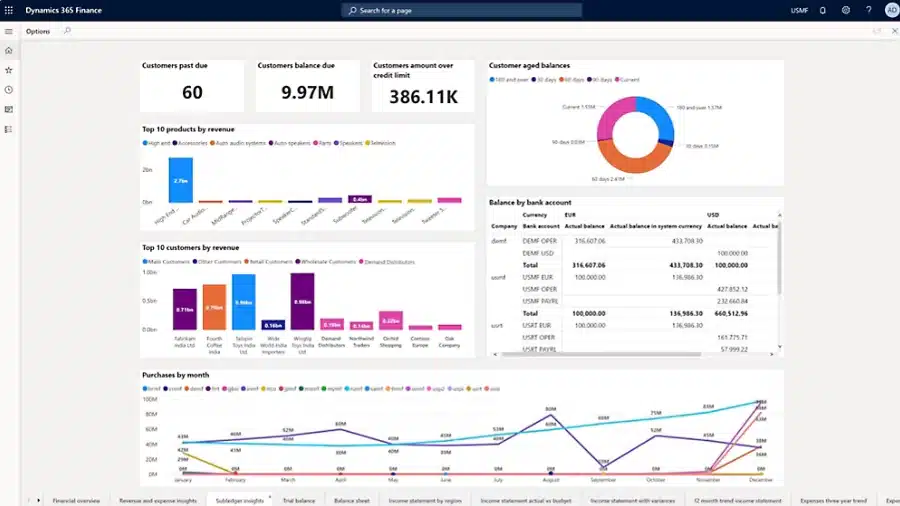
Microsoft Dynamics 365 Finance & Operations (F&O) is Microsoft’s flagship ERP for global enterprises and large-scale manufacturers. For food and beverage organizations, D365 F&O delivers end-to-end functionality that goes far beyond basic financials and inventory. Its process manufacturing capabilities are particularly valuable, supporting recipe and formula management, co-products and by-products, batch orders, and shelf-life tracking. This allows manufacturers to maintain strict control over production, helping improve consistency, traceability, and operational visibility across facilities.
Finance & Operations also excels in traceability and compliance, which are critical requirements in food and beverage manufacturing. Built-in tools enable forward and backward lot tracing, allergen tracking, and quality testing integrated directly into production workflows. Combined with audit-ready reporting, these capabilities help organizations comply with regulations like FDA, USDA, FSMA, and GFSI while reducing the operational risk associated with recalls or reporting gaps.
One of the platform’s biggest strengths is its ability to support complex and multi-entity operations. With support for multiple entities, currencies, languages, and tax jurisdictions, D365 F&O is often a strong fit for manufacturers managing multiple facilities, international operations, or aggressive growth initiatives. Its integration with Microsoft Power BI also gives leadership teams greater visibility into production, inventory, and financial performance, while AI-powered forecasting tools can help improve demand planning and inventory optimization.
That said, D365 F&O is typically best suited for organizations with the internal resources and operational maturity to support an enterprise ERP implementation. Many manufacturers underestimate the level of process alignment, data governance, and change management required for a successful deployment. In our work with clients, organizations that invest early in workflow standardization, stakeholder involvement, and user training often achieve significantly stronger long-term adoption and reporting outcomes.
Our deep expertise in configuring F&O for food and beverage manufacturers helps clients go beyond a standard ERP implementation. We help organizations align the platform to their operational processes, compliance requirements, and long-term scalability goals, creating a system designed to support both current operations and future growth.
Key Capabilities:
- Advanced financial management with multi-currency, multi-entity support
- Process manufacturing reporting for recipe/formula management, co-/by-product handling, batch orders, and shelf-life tracking
- Compliance and quality management integrated into production workflows
- Supply chain visibility and warehouse management
- Manufacturing execution for both process and discrete production
- AI-driven forecasting and analytics
Benefits:
- Enables seamless global operations
- Improves decision-making through real-time insights
- Scales effectively for complex manufacturing environments
- Supports regulatory compliance and operational visibility
Microsoft Dynamics 365 Business Central
Microsoft Dynamics 365 Business Central (BC) is a cloud-based ERP designed for small to mid-sized organizations looking to improve operational visibility, streamline financial management, and create a more scalable foundation for growth. While Business Central is widely known for its financials, inventory control, and supply chain management capabilities, food and beverage manufacturers often require additional process manufacturing functionality that goes beyond standard discrete manufacturing workflows.
To address these industry-specific requirements, Business Central can be enhanced with YAVEON ProBatch, a specialized solution built for process manufacturing environments. With YAVEON, Business Central gains capabilities such as recipe and formula management, lot and batch traceability, allergen tracking, expiration date monitoring, and compliance reporting. These features are especially important for manufacturers managing perishable inventory, strict food safety requirements, and retailer compliance standards.
For many growing food and beverage manufacturers, Business Central with YAVEON provides a strong balance between functionality, scalability, and implementation accessibility. Organizations that have outgrown QuickBooks, spreadsheets, or disconnected legacy systems often benefit from centralizing production, inventory, purchasing, and financial data within a single platform. Many manufacturers also choose Business Central because of its broad range of ERP capabilities that support finance, inventory management, reporting, and operational visibility in a unified environment.
A strong example of this is Bartek Ingredients, which partnered with Rand Group to implement Dynamics 365 Business Central, Power Apps, and Power BI after relying on paper-based production processes and disconnected operational systems. The implementation helped improve inventory visibility, production scheduling, reporting, and operational traceability while supporting scalable growth. Bartek also reported an 85% reduction in raw material stock-outs and a 50% reduction in production scheduling hours per order.
One advantage of Business Central is its flexibility within the Microsoft ecosystem. Organizations already using Microsoft 365, Teams, Power BI, or the Power Platform can often improve collaboration and reporting visibility across departments by integrating those tools directly with ERP workflows.
That said, successful implementations still require operational alignment and process standardization. One common misconception is that mid-market ERP systems are easier to implement simply because they are smaller in scope. In reality, food and beverage manufacturers still need to address data quality, reporting governance, user adoption, and workflow consistency to achieve strong long-term results.
In our work with manufacturers, we also commonly see the need for additional capabilities such as EDI integrations, advanced labeling, warehouse automation, and quality management workflows. Our team helps organizations extend Business Central to support these operational requirements while avoiding unnecessary complexity or over-customization early in the implementation process. For manufacturers working with large retailers and distributors, EDI for food and beverage manufacturers is often a critical component for streamlining order processing and maintaining trading partner compliance.
Key Capabilities:
- Integrated financial management and reporting
- Recipe and production management
- Supply chain automation and lot traceability
- Extensions and customizations via AppSource
- Cloud or on-premises deployment flexibility
Benefits:
- Cost-effective solution for growing manufacturers
- Familiar Microsoft interface that supports user adoption
- Scales as operations become more complex
- Leverages Microsoft Copilot AI for smarter automation and insights


Scaling beverage manufacturing with D365 Business Central
A strong example of Business Central’s success in food and beverage is this case study from Cirkul case study. Partnering with Rand Group, Cirkul implemented Business Central with YAVEON to modernize operations, integrate supply chain processes, and scale production to meet growing demand. The solution gave them real-time visibility into operations and the agility to expand into new markets.
NetSuite ERP
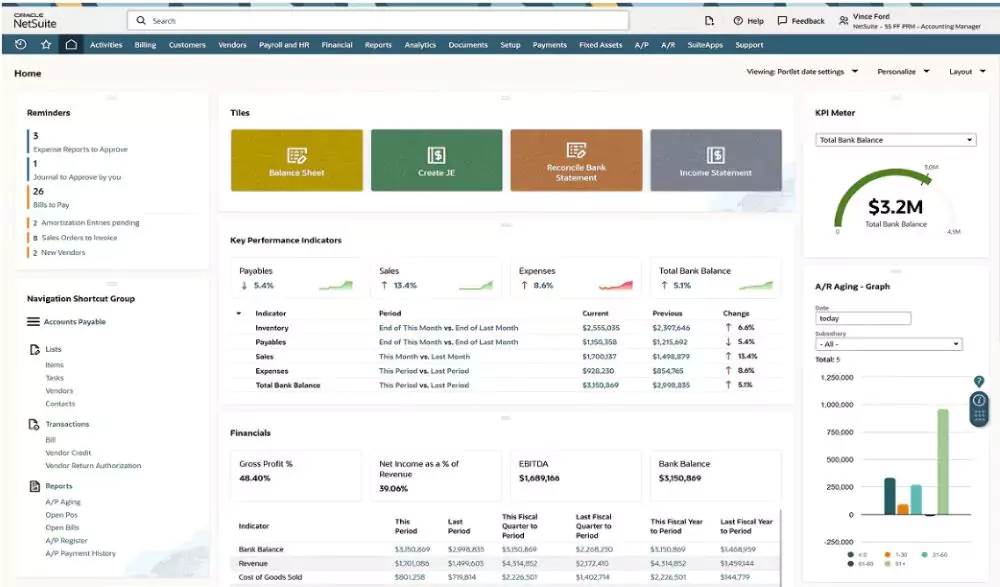
NetSuite ERP is one of the most widely adopted cloud ERP platforms in the food and beverage industry, offering a unified system for managing financials, inventory, supply chain operations, production, warehousing, CRM, and ecommerce. For manufacturers looking to move away from disconnected systems and manual reporting processes, NetSuite can provide significantly better operational visibility across the business.
NetSuite is particularly appealing to growing food and beverage manufacturers because of its cloud-native architecture and scalability. Organizations operating across multiple entities, distribution channels, or geographic regions often benefit from having operational and financial data centralized within a single platform. This helps improve reporting consistency, inventory visibility, and decision-making across departments.
For food and beverage manufacturers, NetSuite offers functionality designed to support process manufacturing environments, including batch management, recipe and formulation management, production scheduling, demand planning, and traceability. These capabilities help organizations better manage inventory levels, production efficiency, and compliance requirements while reducing reliance on spreadsheets or disconnected applications. Many organizations also evaluate NetSuite because of its broad range of ERP capabilities that support finance, supply chain management, reporting, and operational scalability within a unified cloud environment.
One of NetSuite’s strengths is its flexibility, but successful implementations still depend heavily on process alignment and reporting governance. In our work with manufacturers, organizations often underestimate the importance of defining operational workflows and KPI ownership before implementation begins. ERP projects tend to be significantly more successful when reporting standards, inventory processes, and cross-department responsibilities are clearly established early in the project lifecycle.
Customization strategy is another important consideration. While NetSuite offers strong flexibility through modules and integrations, excessive customization can create long-term maintenance and scalability challenges if not carefully governed. Many successful organizations focus first on process standardization and operational consistency before introducing highly customized workflows.
Data migration is also a major factor during ERP implementation. Food and beverage manufacturers frequently discover inconsistencies in inventory records, vendor data, production information, or reporting structures during migration planning. Addressing those issues early can help reduce implementation delays and improve user confidence after go-live.
For organizations pursuing a cloud-first ERP strategy with strong scalability and operational visibility, NetSuite can be an excellent fit, especially for manufacturers balancing growth, operational complexity, and multi-entity management requirements. NetSuite also continues expanding its use of automation and analytics through AI and machine learning capabilities that support forecasting, reporting, and operational insights.
Key Capabilities:
- Multi-subsidiary and multi-currency financial management
- Real-time demand planning and supply chain visibility
- Production scheduling and resource planning
- Compliance and quality management
- Customizable reporting and dashboards
Benefits:
- Cloud-native architecture with global scalability
- Reduces IT overhead with automatic updates
- Provides end-to-end operational transparency
- Flexible platform that supports business growth
ERP for food & beverage manufacturers comparison chart

Trust Rand Group, your expert guide, for your software selection journey
Partner with our expert consultants for an ERP selection engagement. We’ll take the guesswork out of the process by clarifying your requirements, evaluating the options, and recommending the solution that best fits your business, with a truly unbiased perspective.
Common ERP mistakes food & beverage manufacturers make
ERP projects can create significant operational improvements, but there are also common challenges that can impact timelines, adoption, and long-term ROI if not addressed early in the process.
Some of the most common mistakes we see include:
- Underestimating data cleanup requirements – Inaccurate inventory, vendor, or production data can create reporting issues and slow adoption after go-live.
- Choosing software based only on price – Lower-cost systems may not provide the scalability, compliance support, or process manufacturing functionality needed for long-term growth.
- Over-customizing too early – Excessive customization can increase implementation complexity and make future upgrades more difficult to manage.
- Failing to prioritize user adoption – Even strong ERP platforms struggle when organizations do not invest in training, process documentation, and change management.
- Not involving operational stakeholders early – Successful ERP projects typically include input from finance, operations, production, warehousing, and supply chain teams during planning and implementation.
Organizations that approach ERP as a long-term operational strategy rather than just a software deployment initiative are often better positioned to improve visibility, scalability, and overall business performance.
Why Partner with Rand Group for ERP implementation
Selecting the right ERP system is only part of a successful digital transformation initiative. Long-term success depends on how well the platform aligns with operational workflows, reporting requirements, compliance needs, and long-term business goals. For food and beverage manufacturers, ERP implementations also require careful planning around traceability, inventory management, production processes, quality control, and user adoption.
At Rand Group, we help food and beverage manufacturers evaluate, implement, and optimize ERP systems based on real operational requirements, not just software functionality. Our team works closely with organizations to understand current pain points, identify process inefficiencies, and build ERP strategies that support scalability, visibility, and long-term operational improvement.
In our work with manufacturers, we commonly see organizations struggle with disconnected systems, inconsistent reporting, manual processes, and limited inventory visibility before ERP modernization efforts begin. Successful implementations typically involve more than deploying software — they require process alignment, stakeholder involvement, data governance, and change management across the organization.
Our ERP implementation approach is designed to help manufacturers reduce risk, improve adoption, and create a more scalable operational foundation.
Our ERP implementation process includes:
- Current systems and workflow evaluation – We assess existing systems, reporting challenges, operational bottlenecks, and process gaps to ensure the ERP solution aligns with current operations and future growth plans. Learn more about our ERP evaluation and selection services.
- Requirements identification and solution design – Our consultants work with stakeholders to define business requirements and map those needs to the right ERP functionality based on operational goals and industry requirements. Explore our ERP roadmap and planning approach.
- Tailored deployment and integration planning – We help organizations integrate ERP with critical operational systems such as EDI, labeling, warehouse automation, ecommerce platforms, and third-party logistics tools while minimizing unnecessary complexity. This includes support for solutions like EDI 365 for Business Central to help food and beverage manufacturers streamline retailer and distributor communications. Learn more about our Dynamics 365 development services.
- Training and user adoption support – We support user adoption through training, process documentation, and change management planning designed to improve long-term system utilization and operational consistency. Learn more about our Dynamics 365 training services.
- Post-go-live optimization – After implementation, we continue helping organizations refine workflows, reporting structures, dashboards, and operational processes as business needs evolve. Learn more about our Dynamics 365 ERP implementation services.
- Ongoing ERP support and optimization – As operational requirements change, we continue helping organizations maintain system performance, improve reporting visibility, address evolving business needs, and support long-term ERP scalability. Explore our ongoing Microsoft support services.
ERP frequently asked questions for food and beverage manufacturers
What is the best ERP system for food and beverage manufacturers?
The best ERP system for food and beverage manufacturers depends on operational complexity, compliance requirements, production processes, and long-term growth plans. Smaller and mid-sized manufacturers often benefit from flexible ERP platforms like Dynamics 365 Business Central with YAVEON, while larger organizations with multi-site or global operations may require enterprise solutions such as Dynamics 365 Finance & Operations or NetSuite ERP.
Why do food and beverage manufacturers need industry-specific ERP software?
Food and beverage manufacturers need industry-specific ERP software because they must manage challenges such as lot traceability, recipe and formula management, expiration tracking, allergen controls, quality management, and regulatory compliance. Standard ERP systems may not provide the process manufacturing functionality required to support food safety, operational visibility, and retailer compliance requirements.
How long does a food and beverage ERP implementation take?
A food and beverage ERP implementation timeline depends on factors such as company size, operational complexity, integrations, data readiness, and the number of facilities involved. Mid-market ERP implementations can take several months, while enterprise ERP deployments may take a year or longer. Organizations that prioritize process alignment, data cleanup, and user adoption planning often experience smoother implementations and faster ROI.
What are the biggest ERP implementation challenges for food and beverage manufacturers?
The biggest ERP implementation challenges for food and beverage manufacturers typically include poor data quality, inconsistent operational processes, limited user adoption, and integration complexity. Many organizations also underestimate the level of change management, reporting governance, and stakeholder involvement required for a successful ERP deployment.
How can ERP software improve operations for food and beverage manufacturers?
ERP software helps food and beverage manufacturers improve inventory visibility, production planning, traceability, compliance reporting, and operational efficiency by centralizing financial and operational data into a single system. Many manufacturers also use ERP platforms to reduce manual processes, improve forecasting accuracy, standardize workflows, and support long-term scalability across multiple locations or distribution channels.
Next steps
The food and beverage industry requires ERP systems that support compliance, traceability, process manufacturing, and long-term operational scalability. However, the right ERP depends on more than features alone. Manufacturers should evaluate operational complexity, reporting requirements, integration needs, growth plans, and internal readiness for change before selecting a platform.
At Rand Group, we help food and beverage manufacturers evaluate, implement, and optimize ERP systems based on real operational needs and business goals. Whether your organization is considering Dynamics 365 Finance & Operations, Business Central with YAVEON, or NetSuite, our team helps identify the right fit for your manufacturing environment and long-term growth strategy.
From ERP evaluation and implementation to integrations, user adoption, and ongoing support, we help organizations reduce project risk and improve operational visibility. Contact Rand Group to schedule an ERP evaluation or request a tailored product demonstration.