Dynamics 365
 Power Platform
 Dynamics
 Cloud & Productivity
Is Dynamics 365 Sales the same as Dynamics CRM?

When organizations evaluate CRM platforms, one of the most common questions is: What is the difference between Microsoft Dynamics CRM and Dynamics 365 Sales?
While the two platforms share the same foundation, they represent different generations of Microsoft business applications. Dynamics CRM was Microsoft’s traditional on-premises CRM platform, while Dynamics 365 Sales is its modern, cloud-first successor built for scalability, automation, and integration across the Microsoft ecosystem.
In our experience, the biggest difference is not simply cloud versus on-premises deployment. Organizations moving to Dynamics 365 Sales are usually looking for better reporting visibility, improved user adoption, stronger integrations, and a platform that can scale alongside the business.
This blog explores the key differences between Dynamics CRM and Dynamics 365 Sales, including functionality, deployment, integrations, AI capabilities, and what businesses should consider before migrating.
What is Dynamics CRM?
Microsoft Dynamics CRM was Microsoft’s original customer relationship management (CRM) platform, launched in 2003. Designed primarily as an on-premises solution, it helped organizations centralize customer data, manage sales and service processes, and improve visibility across the customer lifecycle. Businesses commonly used Dynamics CRM for sales management, customer service, marketing automation, case management, and reporting.
For many organizations, Dynamics CRM became a critical operational system because it provided a centralized platform for managing customer interactions across departments. In our experience, companies often relied heavily on Dynamics CRM to standardize workflows, improve reporting visibility, and create more consistent sales and service processes.
In 2016, Microsoft introduced Dynamics 365 as the successor to Dynamics CRM, marking a shift toward a modular, cloud-based suite of business applications. Today, Dynamics CRM is no longer available to new customers, and mainstream support has ended.
As Microsoft continues investing in the Dynamics 365 ecosystem, many organizations still running legacy CRM environments are reevaluating whether their current systems can support evolving business requirements. Common concerns often include maintaining older customizations, integrating with newer cloud applications, supporting remote users, and keeping reporting and data governance processes consistent over time.
For many businesses, these challenges become the catalyst for exploring a migration to Dynamics 365 Sales and other modern CRM solutions.


Migrate from Dynamics CRM to Dynamics 365 today
Transform your sales operations with Dynamics 365 Sales. Contact Rand Group today to start your migration from Dynamics CRM and leverage advanced AI and superior integration for business success.
What is Dynamics 365 Sales?
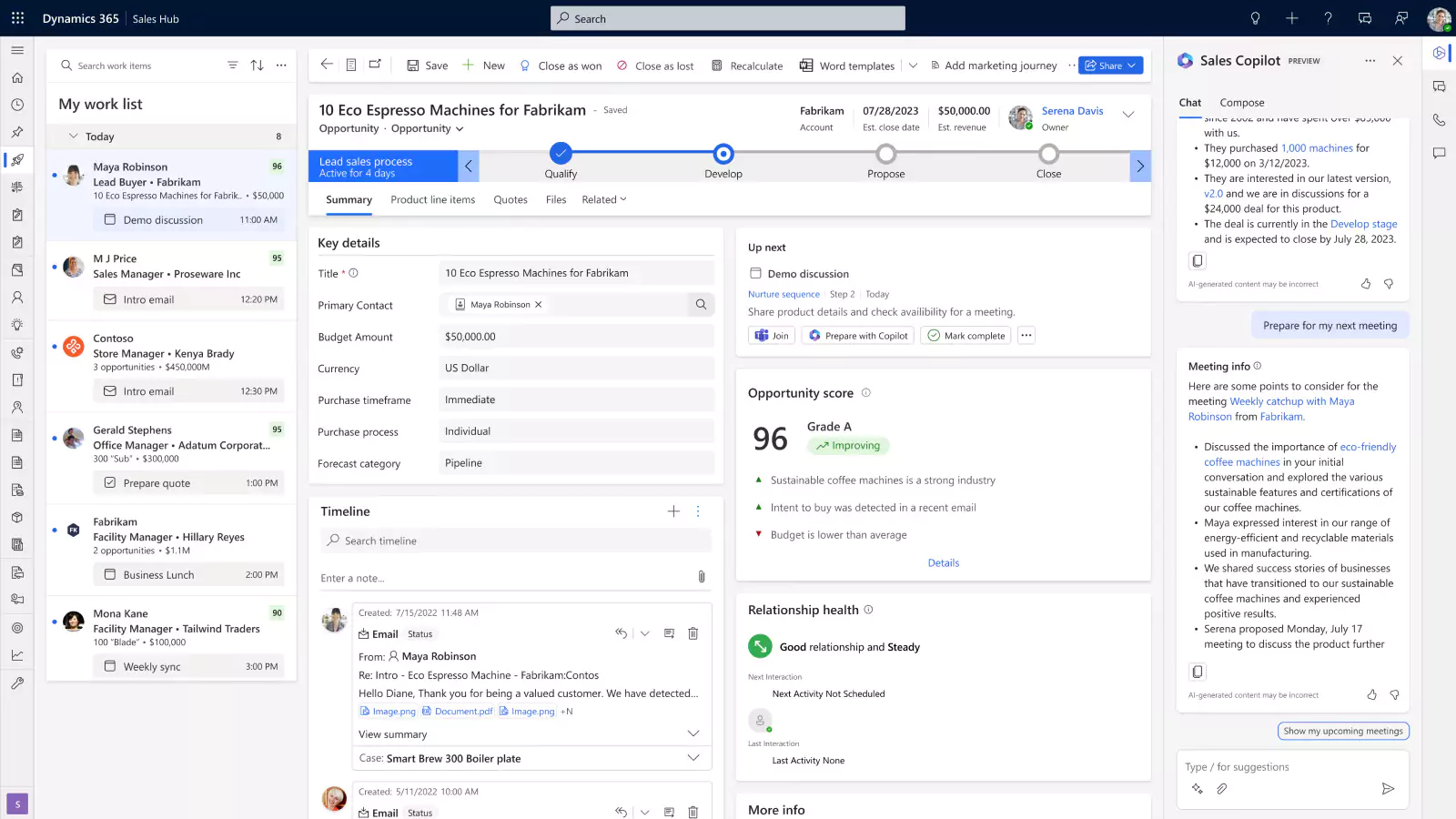
Dynamics 365 Sales is a CRM application within the broader Dynamics 365 suite, designed for sales automation and customer relationship management. Positioned as the successor to legacy Dynamics CRM, it includes many of the same core sales capabilities, such as managing leads, opportunities, quotes, orders, and customer interactions, while introducing a more connected, cloud-first approach to CRM.
The platform helps sales teams streamline processes, improve visibility into pipeline performance, and manage customer relationships more effectively. Key capabilities include lead and opportunity management, sales forecasting, workflow automation, embedded analytics, and integration with tools like LinkedIn Sales Navigator, Microsoft Teams, and Outlook.
In our experience, organizations evaluating Dynamics 365 Sales are often looking beyond basic CRM functionality. Many are trying to improve forecasting accuracy, reduce manual administrative work, create more consistent sales processes, and gain better visibility into sales performance across teams and departments.
Dynamics 365 Sales is primarily designed as a cloud-based solution, though on-premises deployment options are still available. Its cloud-first architecture allows organizations to benefit from streamlined updates, stronger scalability, improved accessibility for remote teams, and easier integration with other Microsoft applications and services.
The platform also introduces advanced AI capabilities through Dynamics 365 Copilot, helping sales teams automate repetitive tasks, surface insights, and improve productivity directly within their daily workflows.
Beyond Dynamics 365 Sales, the broader Dynamics 365 suite includes both ERP and CRM applications that organizations can combine based on operational needs. The CRM applications are part of the Dynamics 365 Customer Engagement platform and include Dynamics 365 Sales, Dynamics 365 Customer Service, Dynamics 365 Customer Insights (previously Dynamics 365 Marketing), Dynamics 365 Field Service, and Dynamics 365 Project Operations.
This modular structure allows businesses to expand functionality over time without replacing existing systems or investing in unnecessary applications upfront. For growing organizations, this flexibility is often one of the biggest advantages. In many CRM modernization projects, businesses are not simply replacing legacy software — they are building a more connected operational environment that supports long-term scalability, reporting visibility, and cross-functional collaboration.
Key differences: Dynamics CRM vs Dynamics 365 Sales
To answer the question: Is Dynamics 365 Sales the same as Dynamics CRM? No, Dynamics CRM is part of the legacy generation of Microsoft’s CRM software, while Dynamics 365 Sales is a next-generation solution within the broader Dynamics 365 ecosystem. Both share the fundamental objective of customer relationship management, but Dynamics 365 Sales offers a more intuitive interface, superior integration options, powerful AI capabilities, and innovative features powered by cloud computing.
In the table below, we provide a clear and concise comparison of the two systems. Whether you’re exploring the cloud-based, modular capabilities of Dynamics 365 Sales or the legacy, on-premises strength of Dynamics CRM, this comparison aims to help you make an informed decision based on your specific requirements.
For many organizations, the decision between maintaining a legacy CRM environment and moving to Dynamics 365 Sales ultimately comes down to long-term scalability, integration requirements, reporting visibility, and ongoing maintainability. While Dynamics CRM may still support core operational needs for some businesses, organizations investing in scalability, automation, and cloud-connected business systems — including the ability to leverage AI with Copilot in Dynamics 365 Sales — often find that Dynamics 365 Sales provides greater flexibility and long-term strategic value.
Common challenges organizations face during CRM modernization
Migrating from Dynamics CRM to Dynamics 365 Sales is not simply a technical upgrade. In many organizations, it also becomes an opportunity to improve reporting visibility, standardize workflows, and reduce inefficiencies across sales and customer service teams.
However, CRM modernization projects often introduce challenges that extend beyond the technology itself. In our experience, organizations are usually balancing legacy processes, historical customizations, data quality concerns, and user adoption requirements at the same time.
Some of the most common challenges businesses encounter during CRM modernization include:
- Outdated or unnecessary customizations: Legacy CRM environments are often heavily customized over time, making upgrades, reporting, and integrations more difficult to manage.
- Inconsistent CRM data and duplicate records: Poor data quality can impact forecasting accuracy, reporting reliability, and user trust in the system.
- Limited integration between systems: Many organizations struggle with disconnected ERP, marketing, customer service, and reporting platforms that create manual work and inconsistent data across teams.
- Weak user adoption and change management planning: Even well-designed CRM platforms can fail to deliver value if users are not properly trained or workflows are not aligned with day-to-day operations.
- Unclear reporting ownership and KPI definitions: Without standardized reporting structures and governance, organizations often face inconsistent dashboards and limited visibility into business performance.
Organizations that experience the smoothest CRM transitions typically spend time upfront aligning business processes, cleaning and validating data, reviewing legacy customizations, and preparing users for the transition. In many cases, long-term success depends just as much on implementation planning and user adoption strategy as the technology itself.
Why should you migrate from Dynamics CRM to Dynamics 365 Sales
Microsoft has transitioned from Dynamics CRM to Dynamics 365 Sales as its modern CRM platform. While some businesses continue operating on legacy CRM environments, many are reassessing whether their current systems can support changing operational requirements, modern integrations, and growing reporting demands.
For many organizations, the decision to migrate is not simply about accessing new features. Older CRM platforms can become increasingly difficult to maintain as businesses expand, especially when teams require real-time reporting, remote accessibility, stronger integrations, and ongoing platform support.
Dynamics 365 Sales provides a more modern CRM environment with cloud-based infrastructure, embedded analytics, AI-powered functionality, and improved scalability. Moving to the platform also gives organizations access to Microsoft’s continued product investments, security enhancements, and regular updates.
Here are some of the main reasons businesses migrate from Dynamics CRM to Dynamics 365 Sales:
- Cloud-based flexibility: Support remote and distributed teams while reducing the overhead associated with maintaining on-premises infrastructure.
- Modernized user experience: Provide teams with a cleaner, more intuitive interface that can improve productivity and encourage stronger adoption.
- Stronger Microsoft ecosystem connectivity: Integrate more effectively with applications like Microsoft Teams, Outlook, Power BI, SharePoint, and other Dynamics 365 solutions.
- Improved reporting visibility: Access real-time dashboards, embedded analytics, and more consistent KPI tracking across departments.
- AI-driven productivity tools: Use Dynamics 365 Copilot to automate repetitive tasks, surface insights, and streamline daily workflows.
- Ongoing platform enhancements: Benefit from regular feature releases, cloud security improvements, and evolving compliance capabilities.
- Scalability for long-term growth: Expand functionality over time by adding additional Dynamics 365 applications and automation tools as operational needs evolve.
Organizations that modernize their CRM environments often see benefits that extend well beyond replacing legacy software. In many cases, the move to Dynamics 365 Sales improves collaboration between departments, reduces manual administrative work, and creates better visibility into customer and operational data.
For example, Rand Group helped Sapphire Gas Solutions to implement Dynamics 365 Sales to replace a disconnected CRM environment that limited visibility across sales, operations, and accounting teams. By integrating Dynamics 365 Sales with Dynamics 365 Business Central, the company created a more unified system for managing customer, project, and financial information while reducing manual processes and improving reporting accuracy. The project helped Sapphire reduce manual data entry by 50% and accelerate sales rep onboarding by 40%.
Migrate to Dynamics 365 Sales with Rand Group
At Rand Group, we help organizations modernize CRM environments with a focus on long-term business success, not just technical migration. Our team works with businesses to evaluate existing CRM challenges, align technology with business processes, and build scalable Dynamics 365 strategies that support future growth.
Successful CRM modernization projects often involve more than replacing legacy software. In many cases, organizations are also improving reporting visibility, standardizing workflows, reducing manual processes, and creating stronger alignment across sales, customer service, and leadership teams.
Our Dynamics 365 Sales migration services include:
- Evaluation and requirements gathering: Assess current CRM challenges, reporting needs, integrations, and operational goals to determine the right migration approach.
- Customization and integrations: Configure and customize Dynamics 365 Sales to support your business processes while building integrations with the rest of your Microsoft ecosystem and third-party applications.
- Data migration and cleanup: Migrate customer data, historical records, and workflows while improving data consistency and reducing duplicate or outdated information.
- Implementation and configuration: Deploy Dynamics 365 Sales using best practices that support scalability, reporting accuracy, and long-term usability.
- Training and post-go-live support: Help teams adapt to the new platform through user training, ongoing support, and continuous optimization after deployment.
Organizations that see the strongest long-term results typically approach CRM migration as both a technology initiative and a process improvement opportunity. Careful planning around adoption, reporting, governance, and system integration often plays a major role in long-term success.
Frequently asked questions about Dynamics CRM vs Dynamics 365 Sales
What is the difference between Dynamics CRM and Dynamics 365 Sales?
Microsoft Dynamics CRM was the original on-premises CRM platform designed to help organizations manage sales, customer service, and marketing processes. Dynamics 365 Sales is the modern, cloud-first successor built within the broader Dynamics 365 ecosystem. While both platforms support core CRM functionality, Dynamics 365 Sales offers enhanced integrations, AI-powered capabilities, improved scalability, and ongoing Microsoft updates.
Why are organizations migrating from Dynamics CRM to Dynamics 365 Sales?
Many organizations are migrating because legacy CRM environments can become difficult to maintain over time. Common drivers include the need for better reporting visibility, stronger integrations, remote accessibility, improved scalability, modern security capabilities, and access to ongoing platform updates. Businesses also often look to reduce manual processes and improve user adoption with a more modern CRM experience.
Can Dynamics 365 Sales integrate with ERP and other business systems?
Yes. Dynamics 365 Sales can integrate with Microsoft ERP platforms such as Dynamics 365 Business Central and Dynamics 365 Finance, along with Power BI, Microsoft Teams, Outlook, SharePoint, and many third-party applications. In many organizations, these integrations help reduce duplicate data entry, improve reporting consistency, and create better visibility across departments.
What are the biggest challenges during a Dynamics CRM migration?
Some of the most common migration challenges include outdated customizations, inconsistent CRM data, duplicate records, weak user adoption, and disconnected business systems. Organizations also frequently underestimate the amount of planning required around reporting structures, governance, and change management. Successful CRM modernization projects typically involve both technical migration and operational process improvement.
Is Dynamics 365 Sales only for large enterprises?
No. Dynamics 365 Sales is used by organizations of many sizes, including growing mid-sized businesses. The modular structure of Dynamics 365 allows companies to scale functionality based on operational needs, user requirements, and long-term growth plans. Many organizations start with core CRM functionality and expand into additional Dynamics 365 applications over time.
Next steps
Dynamics 365 Sales represents more than a technology upgrade from legacy Dynamics CRM. For many organizations, it becomes an opportunity to improve reporting visibility, modernize sales processes, strengthen integrations, and build a more scalable CRM foundation for long-term growth.
Whether you are evaluating a migration from Dynamics CRM or exploring how Dynamics 365 Sales fits into your broader business technology strategy, Rand Group can help you assess operational requirements, reduce migration risk, and plan a CRM environment that supports future scalability and adoption. To learn more about Dynamics 365 Sales migration and modernization strategies, contact Rand Group.