Dynamics 365
 Power Platform
 Dynamics
 Cloud & Productivity
What is Microsoft Dynamics 365 CRM?

As organizations grow, managing customer relationships across sales, marketing, customer service, and operations becomes increasingly difficult without centralized systems and standardized processes. Disconnected data, manual workflows, and inconsistent reporting often create inefficiencies that impact both customer experiences and internal productivity.
Customer Relationship Management (CRM) software helps address these challenges by centralizing customer data, streamlining workflows, and improving operational visibility. However, in our experience, the success of a CRM initiative depends less on the software itself and more on how well the platform aligns with business processes, reporting requirements, user adoption goals, and long-term operational strategy.
One of the most widely adopted CRM platforms on the market is Microsoft Dynamics 365 CRM. As part of the broader Dynamics 365 ecosystem, it combines sales, marketing, customer service, field service, and project management capabilities into a unified cloud platform.
In this blog, we’ll explain what Dynamics 365 CRM is, explore the applications included in the platform, discuss the practical benefits organizations often see after implementation, and highlight key considerations businesses should evaluate before starting a CRM project.
What is Dynamics 365 CRM?
Microsoft Dynamics 365 CRM, also known as Dynamics 365 Customer Engagement, is part of the broader Dynamics 365 suite of business applications designed to help organizations manage sales, marketing, customer service, and other customer-facing operations within a connected platform. Businesses evaluating whether Dynamics 365 is a CRM or ERP often discover that the ecosystem includes both capabilities, with Dynamics 365 CRM specifically focused on relationship management, customer engagement, and operational visibility.
Organizations planning a CRM modernization initiative frequently partner with experienced consultants to support a successful Dynamics 365 CRM implementation and long-term user adoption strategy.
The platform includes applications focused on:
- Sales management
- Customer service
- Marketing automation
- Field service operations
- Project management
- Customer data and analytics
One of the primary advantages of Dynamics 365 CRM is its ability to centralize customer and operational data across departments. In many organizations, sales, service, and marketing teams operate in disconnected systems that create reporting inconsistencies and fragmented customer experiences. Dynamics 365 CRM helps unify these processes into a single environment that supports better collaboration, forecasting, and decision-making.
In our experience, organizations often gain the most value from Dynamics 365 CRM when they use it not just as a contact database, but as a long-term operational platform that improves accountability, reporting consistency, and cross-functional alignment.
Why organizations invest in Dynamics 365 CRM
Many businesses initially explore CRM software because they need better pipeline visibility or improved customer tracking. However, successful CRM initiatives typically expand far beyond sales management.
Across implementations, we commonly see organizations use Dynamics 365 CRM to:
- Improve forecasting accuracy
- Standardize customer-facing processes
- Reduce manual administrative work
- Increase reporting visibility
- Improve lead management
- Support customer retention initiatives
- Enhance cross-department collaboration
- Improve service responsiveness
- Create more reliable operational data
Organizations often underestimate how much operational inconsistency exists before implementing a CRM platform. Different teams may define opportunities, customer statuses, service priorities, or reporting metrics differently, which creates challenges for leadership decision-making.
A properly implemented CRM platform can help create process consistency and improve organizational alignment.
Benefits of Dynamics 365 CRM
Improved customer experiences
Dynamics 365 CRM helps businesses centralize customer information, making it easier for employees to access interaction history, service requests, purchasing behavior, and communication records. Organizations looking to further enhance productivity and customer engagement are increasingly leveraging tools like Microsoft Copilot to assist with sales recommendations, automated summaries, and AI-driven workflows within the Dynamics 365 environment.
This visibility helps teams deliver more personalized and consistent customer experiences.
In our experience, companies often see customer satisfaction improvements when service and sales teams can access the same real-time information instead of relying on disconnected systems or manual updates.
However, organizations should recognize that technology alone does not improve customer experiences. Successful companies typically pair CRM implementation with process improvements, service standards, and user training initiatives.
Better customer insights and reporting
One of the most valuable aspects of Dynamics 365 CRM is the ability to create a centralized view of customer activity.
Leadership teams often use Dynamics 365 CRM reporting and dashboards to improve pipeline visibility, monitor service trends, measure campaign effectiveness, identify customer risks earlier, and create more reliable forecasting processes. Many organizations are also exploring how AI and machine learning solutions can help uncover deeper operational insights, improve forecasting accuracy, and support more proactive decision-making.
That said, reporting success depends heavily on data quality and governance.
A common challenge we see is organizations implementing dashboards before establishing clear KPI ownership or standardized data entry processes. This often leads to inconsistent reporting and reduced trust in the system.
Successful organizations typically define reporting requirements early in the project and establish accountability for maintaining data quality.
Increased productivity through automation
Dynamics 365 CRM includes workflow automation tools that help reduce repetitive administrative work.
Examples include:
- Automated lead routing
- Follow-up reminders
- Case escalation workflows
- Approval processes
- Marketing campaign automation
- Automated customer communications
Automation can significantly improve productivity, but organizations should avoid over-automating too early.
In our experience, businesses achieve better long-term outcomes when they first standardize and simplify their processes before introducing extensive automation.
Improved collaboration across departments
Disconnected systems often create communication gaps between sales, customer service, marketing, finance, and operations teams. Dynamics 365 CRM helps improve collaboration by giving departments access to shared customer information and operational data. This is especially valuable for organizations managing long sales cycles, complex customer relationships, or ongoing service contracts.
One pattern we consistently see is that organizations with strong executive alignment and cross-functional involvement during implementation tend to achieve significantly better adoption rates after go-live.
Scalability and flexibility
Dynamics 365 CRM is designed to support organizations ranging from growing mid-sized businesses to large enterprises. The platform’s modular structure allows companies to start with specific applications and expand over time.
For example, some organizations begin with Dynamics 365 Sales and later add Customer Service, Field Service, or Customer Insights as operational needs evolve. This flexibility can help businesses avoid replacing systems as they scale.
However, scalability also requires long-term planning. Organizations should evaluate future integration requirements, reporting needs, and governance processes early to avoid unnecessary customization later.

Schedule a Dynamics 365 CRM strategy session
Explore how Dynamics 365 CRM can support your organization’s sales, service, reporting, and operational goals. Our team can help evaluate your current processes, identify CRM modernization opportunities, and recommend an implementation approach aligned with your long-term business strategy.
Applications in the Dynamics 365 CRM suite
Dynamics 365 CRM includes several applications designed to support different customer-facing business functions.
Dynamics 365 Sales
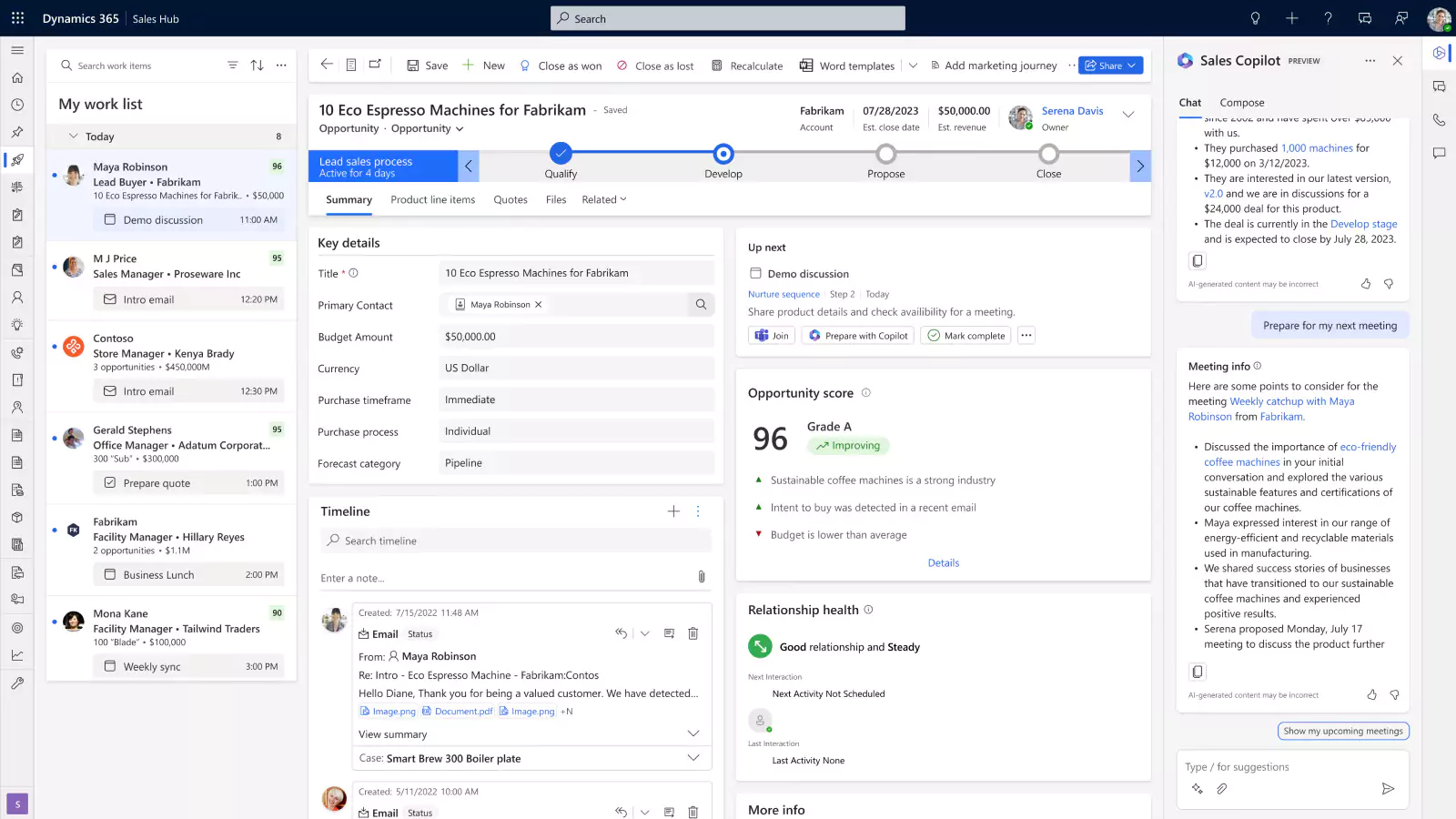
Dynamics 365 Sales helps organizations manage opportunities, customer relationships, forecasting, and sales activities.
The platform integrates with Microsoft 365, LinkedIn, AI-driven recommendations, and reporting tools to help sales teams improve visibility and productivity. Organizations looking to improve forecasting, automate sales activities, and streamline seller productivity are increasingly leveraging AI-powered Copilot capabilities in Dynamics 365 Sales.
In our experience, companies often benefit most from Dynamics 365 Sales when they use it to standardize sales processes and improve pipeline accountability rather than simply replacing spreadsheets.
Organizations that define consistent opportunity stages, forecasting methodologies, and follow-up expectations usually achieve stronger reporting accuracy and better sales visibility.
Dynamics 365 Customer Insights
Formerly known as Dynamics 365 Marketing, Dynamics 365 Customer Insights helps businesses manage customer journeys, marketing campaigns, lead nurturing, segmentation, and engagement analytics.
Successful marketing automation projects require more than campaign tools alone.
A common challenge organizations face is poor data quality or unclear lead ownership between marketing and sales teams. When lead qualification criteria and handoff processes are not clearly defined, marketing automation initiatives often struggle to deliver expected ROI.
Organizations that see the strongest results typically align sales and marketing teams around shared KPIs, lead scoring standards, and reporting goals.
Dynamics 365 Customer Service
Dynamics 365 Customer Service helps organizations manage support requests, omnichannel communications, service cases, and customer issue resolution.
The platform supports:
- Knowledge management
- Case routing
- Service analytics
- AI-powered support tools
- Customer self-service capabilities
- Omnichannel customer engagement
Organizations are also increasingly exploring how AI in Dynamics 365 Customer Service can improve response times, automate service interactions, and create more personalized support experiences.
In our experience, organizations often discover that service consistency and process ownership are just as important as the technology itself.
Companies that invest in service workflows, escalation procedures, employee training, and knowledge documentation typically achieve stronger customer satisfaction improvements.
Dynamics 365 Field Service
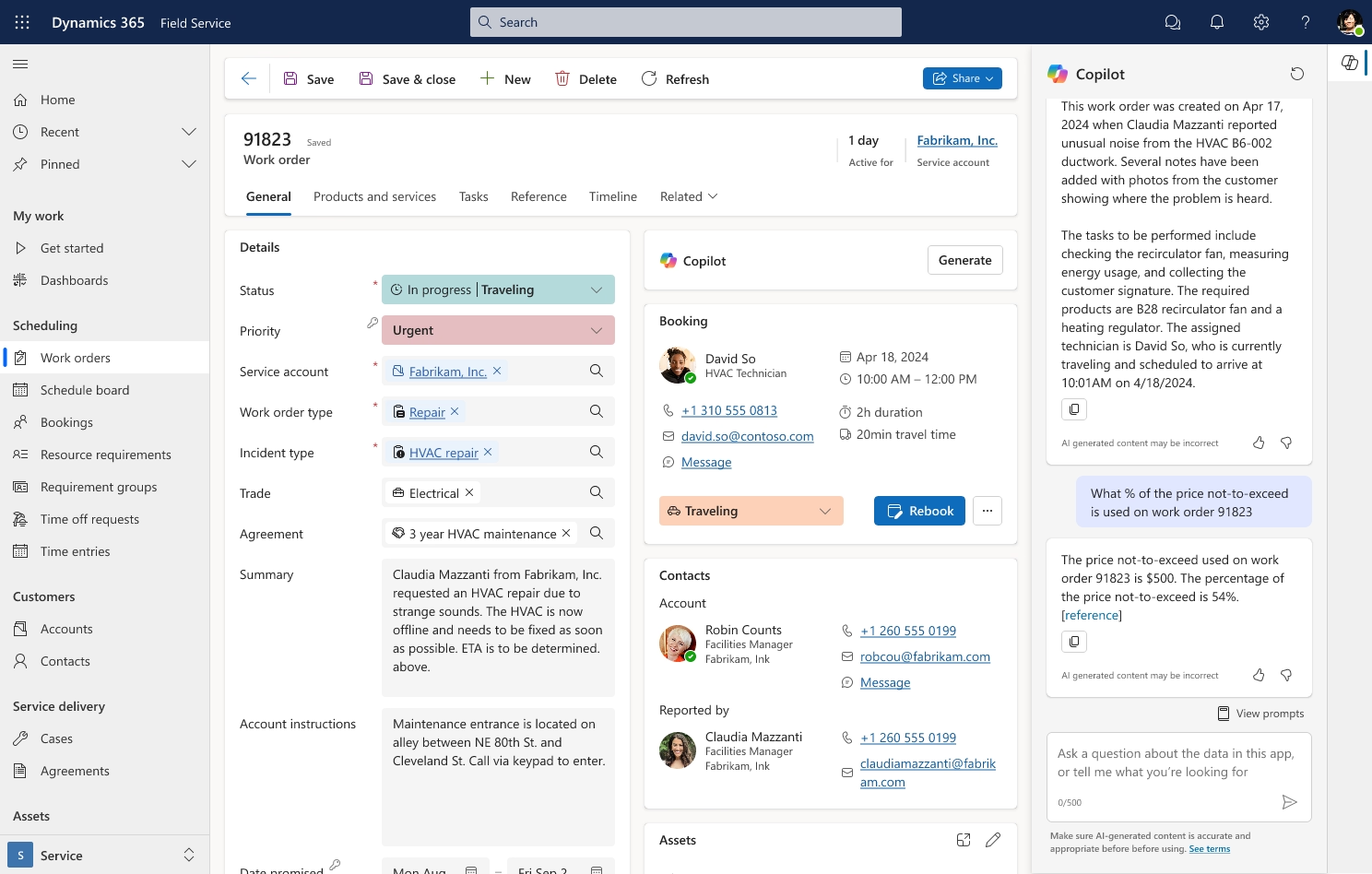
Dynamics 365 Field Service helps organizations manage field technicians, service scheduling, asset management, work orders, and remote service operations.
The solution leverages IoT connectivity, automation, and real-time scheduling tools to improve operational efficiency. Many organizations are also evaluating how AI-powered Copilot in Dynamics 365 Field Service can help improve technician productivity, automate work order management, and support faster issue resolution.
Field service organizations often benefit from:
- Improved scheduling visibility
- Faster response times
- Reduced manual dispatching
- Better technician utilization
- More accurate service reporting
However, successful field service implementations usually require strong integration planning between CRM, ERP, inventory, and mobile systems.
We commonly see organizations underestimate the complexity of mobile adoption, offline access requirements, and scheduling workflow changes.
Dynamics 365 Project Operations
Dynamics 365 Project Operations combines project planning, resource management, financial tracking, and operational reporting into a unified platform.
The solution is especially valuable for service-based organizations managing complex projects, billable resources, or client engagements.
In our experience, organizations often improve profitability visibility and project forecasting accuracy after consolidating project data into a centralized system.
However, companies should carefully evaluate project governance processes, resource planning maturity, and financial reporting requirements before implementation.
Common Dynamics 365 CRM implementation challenges
While Dynamics 365 CRM offers significant benefits, organizations should approach implementation strategically. Some of the most common CRM implementation challenges include:
Poor data quality
Migrating inaccurate or inconsistent customer data into a new CRM platform creates reporting and adoption issues quickly.
Successful organizations typically invest time in:
- Data cleanup
- Duplicate management
- Standardized naming conventions
- Data ownership policies
- Governance processes
Lack of user adoption
One of the most common reasons CRM projects underperform is low user adoption. Employees may resist process changes if they do not understand the value of the system or if workflows feel overly complex.
In our experience, organizations that involve end users early, provide role-specific training, and simplify workflows tend to achieve significantly stronger adoption rates.
Over-customization
Many businesses attempt to replicate every legacy process inside the CRM system. Over-customization can increase implementation costs, complicate upgrades, and create long-term maintenance challenges.
Successful organizations usually focus first on standardizing and optimizing processes before introducing complex customizations.
Weak executive sponsorship
CRM initiatives impact multiple departments and operational processes. Without strong leadership alignment, projects often struggle with prioritization, accountability, and change management.
Organizations that establish executive sponsorship and cross-functional governance teams generally experience smoother implementations.
What successful organizations do differently
Across CRM implementations, several patterns consistently separate successful projects from struggling ones. In our experience, organizations that achieve the strongest long-term outcomes typically focus as much on process alignment and organizational readiness as they do on the technology itself.
Successful organizations typically:
- Define clear business objectives before selecting technology
- Standardize core business processes before introducing automation
- Prioritize user adoption, training, and change management early
- Establish data governance and reporting ownership upfront
- Align sales, service, and marketing teams around shared KPIs
- Limit unnecessary customization that can complicate future scalability
- Plan integrations carefully across ERP, reporting, and operational systems
- Invest in long-term optimization and continuous improvement after go-live
Businesses that treat CRM as an operational transformation initiative rather than simply a software deployment often achieve stronger long-term adoption, reporting consistency, and ROI.
Post-implementation realities organizations should expect
Many organizations assume CRM value is fully realized immediately after go-live. In reality, the post-implementation phase is often where the most meaningful operational improvements begin to emerge.
After implementation, companies commonly experience:
- Improved reporting visibility across departments
- Better forecasting consistency and pipeline accountability
- Stronger operational ownership and process standardization
- More consistent customer interactions and service experiences
- Faster access to customer and operational data
- Improved collaboration between sales, service, and leadership teams
For example, Sapphire Gas Solutions partnered with Rand Group to replace disconnected systems and streamline project-based sales operations using Dynamics 365 Sales integrated with Dynamics 365 Business Central. Following implementation, Sapphire improved data visibility across departments, eliminated many manual spreadsheet-based processes, and significantly reduced onboarding time for new sales representatives—from weeks to days. The organization also improved collaboration between sales, operations, and accounting teams by creating a centralized, real-time view of customer and project information.
However, ongoing optimization is usually necessary.
Organizations often refine dashboards, workflows, security structures, integrations, and reporting processes after users begin working within the system daily. Successful companies typically view CRM as an evolving business platform rather than a one-time IT project.
Implementing Dynamics 365 CRM successfully
Choosing the right implementation strategy can significantly impact the long-term success of a Dynamics 365 CRM initiative.
In our experience, organizations achieve the strongest outcomes when CRM projects are approached as operational transformation initiatives rather than simply software deployments. Success often depends on process alignment, user adoption, reporting strategy, integration planning, and long-term scalability just as much as the technology itself.
Businesses beginning a CRM modernization initiative often benefit from following a structured Dynamics 365 implementation guide and conducting a thorough software evaluation and selection process before deployment begins.
Successful CRM implementations typically require organizations to:
- Define reporting and visibility requirements early
- Standardize workflows before introducing automation
- Plan integrations across business systems
- Establish data governance and ownership
- Prioritize user adoption and change management
- Build scalable processes that support long-term growth
Many businesses also underestimate the importance of post-go-live optimization. In practice, CRM environments often continue evolving after implementation as organizations refine dashboards, automate workflows, improve reporting structures, and adapt processes based on operational feedback.
Why organizations partner with Rand Group
At Rand Group, we help organizations evaluate, implement, customize, and optimize Dynamics 365 CRM solutions based on real operational needs—not just software functionality.
Our team regularly works with organizations to:
- Identify operational bottlenecks and process inefficiencies
- Improve alignment between sales, service, marketing, and operations teams
- Plan integrations across CRM, ERP, and other business systems
- Deliver tailored Dynamics 365 CRM development solutions for specialized business requirements
- Support user adoption, reporting optimization, and long-term scalability
- Provide ongoing Dynamics 365 support services after implementation
As a Microsoft-certified partner with solely U.S.- and Canada-based resources, Rand Group brings decades of experience helping organizations maximize the value of their technology investments. Rand Group was also recognized as a best Microsoft Dynamics 365 CRM partner for 2026, reinforcing our experience across Microsoft Dynamics 365 CRM strategy, implementation, customization, and support. We also maintain a 90% client retention rate, reflecting our long-term focus on client success, operational partnership, and continuous optimization beyond initial implementation.
Rather than approaching CRM as a one-time deployment, we work with organizations to build scalable systems that support long-term visibility, collaboration, customer engagement, and operational growth over time.
Frequently asked questions about Dynamics 365 CRM
What is Microsoft Dynamics 365 CRM used for?
Microsoft Dynamics 365 CRM is used to help organizations manage customer relationships, sales processes, marketing activities, customer service operations, and business reporting within a centralized platform. Businesses often use Dynamics 365 CRM to improve operational visibility, standardize workflows, automate repetitive tasks, and create more consistent customer experiences across departments.
How long does a Dynamics 365 CRM implementation take?
Dynamics 365 CRM implementation timelines vary depending on factors such as company size, application scope, integrations, data migration complexity, customization requirements, and user adoption planning. In our experience, smaller implementations may take a few months, while larger enterprise CRM projects can require significantly longer timelines that include process redesign, testing, training, and post-go-live optimization.
What are the biggest challenges during a Dynamics 365 CRM implementation?
Some of the most common Dynamics 365 CRM implementation challenges include poor data quality, weak user adoption, unclear business processes, lack of executive sponsorship, over-customization, and insufficient integration planning. Organizations that prioritize process alignment, change management, reporting governance, and employee training early in the project lifecycle typically achieve stronger long-term outcomes and user adoption.
What are the benefits of Dynamics 365 CRM for growing businesses?
Dynamics 365 CRM helps growing businesses improve visibility across sales, marketing, customer service, and operations by centralizing customer and operational data within a connected platform. In our experience, organizations often benefit from improved forecasting accuracy, stronger reporting consistency, better collaboration between departments, and increased productivity through workflow automation. The platform’s scalability also allows businesses to expand functionality over time as operational needs evolve.
Next steps
Microsoft Dynamics 365 CRM is more than a customer database—it is a platform that can help organizations improve visibility, standardize processes, strengthen customer experiences, and support long-term operational growth.
However, successful CRM initiatives require more than software implementation alone. Organizations that achieve the strongest outcomes typically invest in process alignment, user adoption, reporting governance, and long-term optimization.
Rand Group helps organizations evaluate, implement, and optimize Dynamics 365 CRM solutions based on real operational needs and business objectives. From strategic planning and system selection to implementation support and post-go-live optimization, our team works alongside clients to help maximize long-term CRM value.
If your organization is evaluating Dynamics 365 CRM or planning a CRM modernization initiative, contact Rand Group to learn how we can help you build a scalable, effective customer engagement strategy.