Sage Intacct Construction implementation: What contractors should know before getting started

A Sage Intacct Construction (CRE) implementation is more than a software upgrade; it’s an opportunity to improve job costing, streamline financial processes, and gain the real-time visibility contractors need to make more informed business decisions. But like any major ERP project, success depends on the work completed before implementation begins.
Whether you’re replacing QuickBooks, a legacy construction accounting system, or another ERP platform, careful planning can reduce implementation risks, improve user adoption, and accelerate your return on investment. From defining reporting requirements and cleaning financial data to planning integrations and selecting the right implementation partner, the decisions you make before deployment have a lasting impact on project success.
In this guide, we’ll explain what to expect during a Sage Intacct Construction implementation, including typical timelines, implementation costs, planning best practices, and the key steps contractors should take before deployment to help your organization prepare for a smoother, more successful project.
At a glance
A successful Sage Intacct Construction implementation requires careful planning before configuration begins. This guide explains what contractors should expect before implementation, including typical implementation timelines, project cost considerations, planning best practices, data preparation, integrations, training, and partner selection. By following these best practices, construction companies can reduce implementation risk, improve user adoption, and maximize the long-term value of their Sage Intacct investment.
What is Sage Intacct Construction?
Sage Intacct Construction (CRE) is a cloud-based financial management solution designed for construction companies. It combines Sage Intacct’s core accounting capabilities with construction-specific features to help contractors manage job costs, improve financial visibility, and support business growth.
Key capabilities include:
- Dimensional accounting for flexible project and financial reporting
- Real-time visibility into job profitability and Work in Progress (WIP)
- Multi-entity financial management
- Integrations with project management, payroll, and field operations software
More than just replacing legacy accounting software, a successful Sage Intacct Construction implementation provides contractors with a scalable financial foundation that improves reporting, streamlines processes, and supports long-term growth.
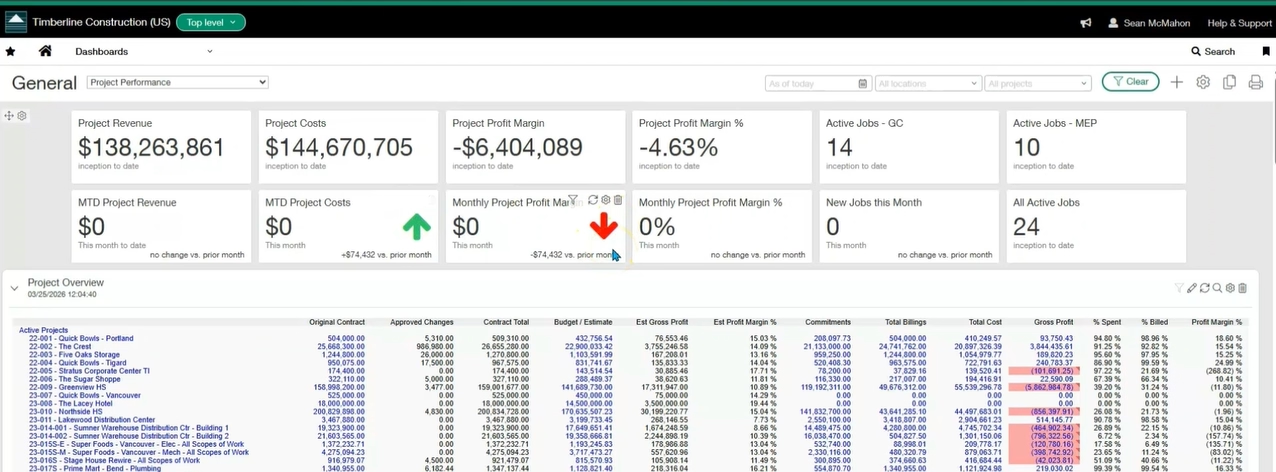

See Sage Intacct Construction in action
Discover how Sage Intacct Construction can help you streamline job costing, improve WIP reporting, automate financial processes, and gain real-time visibility into project performance. Schedule a demo with our Sage experts to see how Sage Intacct can support your unique business needs and long-term growth.
Signs you’re ready for a Sage Intacct Construction implementation
As construction organizations grow, legacy accounting systems often struggle to keep up with increasing project complexity, reporting demands, and multi-entity operations. If you’re experiencing any of the following challenges, it may be time to consider a Sage Intacct Construction implementation:
- Financial reporting relies heavily on spreadsheets.
- Job cost reports are slow or difficult to produce.
- WIP reporting requires manual calculations.
- Multi-entity consolidation is time-consuming.
- Month-end close takes too long.
- Your accounting software limits growth.
- Field and accounting systems are disconnected.
- Executives lack real-time project financial visibility.
If these challenges sound familiar, the good news is they can often be addressed with the right ERP strategy. At Rand Group, we’ve helped construction organizations modernize financial operations, improve reporting, automate manual processes, and gain greater visibility into project performance. Our experience has shown that the most successful implementations begin with thorough planning long before the system is configured. Teams that invest time in reviewing financial processes, cleaning master data, and standardizing job costing typically experience smoother deployments, stronger user adoption, and faster reporting improvements after go-live.
What contractors should prepare before implementation

Define your business and implementation goals
Every successful construction ERP implementation starts with clear business objectives. Focus on the outcomes you want to achieve rather than simply replacing your existing software.
Ask questions such as:
- What are your biggest financial reporting challenges?
- Which manual processes consume the most time?
- What reporting capabilities are missing?
- What are your growth plans over the next three to five years?
Common implementation goals often include:
- Faster month-end close
- Better project profitability reporting
- Improved WIP visibility
- Automated AP approvals
- Better cash flow forecasting
- More accurate job costing
- Real-time executive dashboards
Clearly defined goals help keep your implementation aligned from planning through go-live.
Review and improve existing financial processes
A Sage Intacct construction implementation is an opportunity to improve workflows, not recreate inefficient ones.
Review key processes, including:
- Accounts payable
- Billing
- Revenue recognition
- Job costing
- Purchase orders
- Payroll
- Equipment tracking
- Financial close
Identify manual work, duplicate data entry, paper approvals, and disconnected systems before implementation begins.
Prepare your chart of accounts and dimensional reporting strategy
One of the biggest advantages of Sage Intacct for construction is dimensional accounting.
Instead of creating a complex chart of accounts, Sage Intacct uses dimensions to simplify reporting while providing greater visibility.
Common dimensions include:
- Projects
- Cost codes
- Departments
- Locations
- Entities
- Project managers
- Customers
- Equipment
Why dimensional accounting matters
Dimensions let contractors analyze profitability, costs, and performance across projects, locations, managers, and entities without adding unnecessary GL accounts. Designing this reporting structure early helps support both operational and executive reporting.
Clean and organize your data before migration
Migrating poor-quality data creates problems in your new system.
Before implementation, review:
- Customers
- Vendors
- Jobs
- Employees
- GL accounts
- Cost codes
- Open transactions
Most contractors migrate active records, opening balances, and open transactions—not every historical record. Starting with clean data improves reporting and simplifies implementation.
Identify every system that needs to integrate
Construction companies rely on multiple operational systems to manage projects, field teams, and financials. Before implementation, identify every application that will need to exchange data with your ERP to reduce duplicate entry and improve visibility.
Common construction integrations include:
- Project management (e.g., Procore)
- Construction operations management (e.g., Sage Construction Management)
- Payroll and certified payroll
- Time tracking and field labor reporting
- Equipment and asset management
- Subcontractor and procurement management
- Document management
- Expense management
Planning integrations early helps ensure project costs, labor, commitments, and financial data flow seamlessly between office and field teams, giving stakeholders a more complete view of project performance.
Standardize job costing before implementation
Accurate reporting starts with consistent job structures. If project teams use different cost codes, job numbering conventions, or change order processes, comparing project performance becomes difficult and financial reports become less reliable.
Before implementation, review and standardize:
- Cost codes
- Cost types
- Job numbering
- Project hierarchy
- Change order processes
- Commitment tracking
Establishing consistent job costing standards before your Sage Intacct construction implementation helps improve reporting accuracy, simplify project comparisons, and provide leadership with more reliable insights into project profitability and overall financial performance.
Build your implementation team
ERP implementations require collaboration across the business, not just IT. Including stakeholders early helps ensure reporting requirements, operational workflows, and user adoption needs are represented throughout the implementation.
Include representatives from:
- Executive leadership
- Finance and accounting
- Operations
- Project management
- Payroll
- IT
An executive sponsor helps keep the project aligned, remove roadblocks, and drive user adoption.
Develop a realistic implementation timeline
Every implementation is different, but most Sage Intacct Construction implementations take approximately three to six months, depending on your organization’s size, the number of legal entities, integration requirements, data migration complexity, and overall project scope. Smaller organizations with straightforward accounting requirements may complete implementation more quickly, while larger contractors with multiple entities, custom reporting needs, or extensive integrations often require additional time.
A successful implementation typically follows these phases:
- Envision & Design: Define requirements and future workflows.
- Build: Configure Sage Intacct and integrations.
- Test: Validate processes, reports, and integrations.
- Deploy: Complete final data migration and go live.
- User Adoption: Provide training, support, and ongoing optimization.
When possible, avoid implementing during fiscal year-end, peak construction season, or major organizational changes.
In addition to developing a realistic schedule, organizations should also establish an implementation budget early in the planning process. Costs vary based on factors such as the number of users, legal entities, integrations, data migration requirements, reporting needs, and overall project scope. Budgeting for software licensing, implementation services, training, and ongoing support helps organizations avoid unexpected costs and build a realistic project plan.
Plan for user training and change management
Technology alone doesn’t guarantee success; user adoption does.
Your training plan should include:
- Role-based training
- Hands-on testing
- Documentation
- Practice environments
- Go-live support
Helping users understand both how and why processes are changing improves adoption and long-term success.
Choose an implementation partner with construction expertise
Construction accounting requires specialized knowledge of:
- Job costing
- WIP reporting
- Revenue recognition
- Multi-entity accounting
- Construction integrations
- Project profitability reporting
An experienced Sage Intacct implementation partner like Rand Group understands these complexities and can help apply industry best practices throughout your implementation.
Common Sage Intacct Construction implementation mistakes to avoid
Even well-planned projects can encounter challenges if important preparation steps are overlooked.
Some of the most common implementation mistakes include:
- Migrating inaccurate or duplicate data
- Skipping process reviews before implementation
- Underestimating user training requirements
- Waiting until go-live to test integrations
- Ignoring future reporting requirements
- Excluding operations teams from planning
- Choosing an implementation partner without construction accounting experience
Addressing these issues early helps reduce implementation risk while improving long-term system performance.

Build a stronger foundation for your implementation
A successful ERP implementation starts with careful planning and experienced guidance. Rand Group helps construction companies implement Sage Intacct with best practices that improve financial visibility, streamline operations, and support long-term growth. Contact our team to schedule your Sage Intacct Construction implementation consultation.
Why partner with Rand Group for your Sage Intacct Construction implementation?
Choosing the right implementation partner is just as important as selecting the right ERP platform.
Construction ERP expertise: Rand Group has decades of experience helping organizations modernize finance and operations through ERP strategy, implementation, integrations, and optimization. Our consultants understand the unique financial reporting, job costing, and operational requirements construction organizations face.
Experienced Sage Intacct partner: As a certified Sage Intacct partner, Rand Group helps organizations evaluate business requirements, design scalable financial processes, implement integrations, train users, and optimize reporting to support long-term growth.
End-to-end support: Our team supports organizations throughout the entire ERP lifecycle, from software selection and implementation to post-go-live optimization, user training, and continuous improvement. We make it our goal to help clients maximize the value of their technology investment.
Whether you’re replacing legacy accounting software or preparing for future growth, we can help you develop an implementation strategy that aligns with your business objectives.
Frequently asked questions
How long does a Sage Intacct Construction implementation take?
Implementation timelines vary depending on organizational size, complexity, integrations, and data migration requirements. Most projects follow a phased approach that includes planning, configuration, testing, deployment, and post-go-live optimization.
How much does a Sage Intacct Construction implementation cost?
Implementation costs vary based on the number of users, legal entities, integrations, data migration requirements, and overall project scope. In addition to software licensing, organizations should budget for implementation services, training, and ongoing support. A Sage Intacct implementation partner can provide a customized estimate based on your business requirements.
What should contractors do before implementing Sage Intacct Construction?
Contractors should define business goals, review financial processes, clean data, standardize job costing, identify integrations, build an implementation team, and establish reporting requirements before implementation begins.
What data should be migrated into Sage Intacct?
Most organizations migrate active customers, vendors, jobs, employees, opening balances, open transactions, and other essential financial data rather than every historical transaction.
How does Sage Intacct use dimensional accounting?
Sage Intacct uses dimensions, such as projects, departments, locations, entities, and project managers, to provide flexible reporting without creating an overly complex chart of accounts.
Can Sage Intacct integrate with project management and payroll software?
Yes. Sage Intacct can integrate with many project management, payroll, CRM, banking, document management, expense management, and field operations solutions.
Who should be involved in a Sage Intacct Construction implementation?
Successful implementations typically include executive leadership, finance, accounting, operations, project management, payroll, and IT representatives.
What is the biggest challenge during a construction ERP implementation?
The biggest challenge is often organizational change rather than software configuration. Clear planning, user training, executive sponsorship, and process improvement are critical to long-term success.
How do you choose the right Sage Intacct implementation partner?
Look for a partner with proven Sage Intacct expertise, construction industry experience, implementation methodology, integration capabilities, user training resources, and ongoing support services.
Start planning your Sage Intacct Construction implementation
A successful Sage Intacct Construction implementation starts with careful planning. By defining clear business goals, improving financial processes, organizing your data, and partnering with an experienced implementation team, you can reduce deployment risks, accelerate user adoption, and realize value faster.
Whether you’re evaluating Sage Intacct Construction or preparing for implementation, Rand Group’s ERP consultants can help you assess your readiness, build a practical implementation roadmap, and optimize your financial operations. Contact us today to schedule a Sage Intacct Construction readiness assessment or implementation consultation.