Nursing home accounting software: What to look for beyond resident billing

Managing the finances of a nursing home or skilled nursing facility involves more than tracking resident charges and payments. Complex Medicare and Medicaid reimbursement, rising labor costs, regulatory requirements, and multi-facility operations demand financial management systems that provide greater visibility and control. While resident billing is essential, disconnected accounting, payroll, and clinical systems can create inefficiencies and reporting challenges.
The right nursing home accounting software should streamline financial processes, strengthen internal controls, and improve financial visibility across facilities. In this guide, we explore the essential capabilities to look for beyond resident billing and how to select software that supports your organization’s current needs and future growth.
At a glance: What nursing homes need from accounting software
Nursing home accounting software should do more than manage resident billing and payments. Healthcare organizations need comprehensive financial management capabilities that support regulatory reporting, payroll integration, accounts payable automation, budgeting, and multi-facility accounting. Integration with electronic health records (EHR), resident billing, and workforce management systems is equally important for reducing manual processes and improving financial visibility. By evaluating these capabilities alongside scalability, reporting, and implementation requirements, nursing home operators can select software that helps control costs, improve operational efficiency, and support long-term financial performance.
Why nursing homes need more than resident billing software
Resident billing is essential for managing charges, payments, and reimbursement across Medicare, Medicaid, and private-pay residents. However, nursing homes also need comprehensive accounting software to support broader financial operations, including:
- Payroll and workforce costs: Track labor expenses, overtime, and staffing costs.
- Accounts payable and purchasing: Manage vendor payments, expenses, and approvals.
- Budgeting and financial reporting: Monitor financial performance and plan for future expenses.
- Multi-facility accounting: Consolidate financial information across locations and entities.
- Regulatory reporting: Maintain accurate financial records and supporting documentation.
Resident billing vs. comprehensive accounting software
While some healthcare platforms offer overlapping capabilities, many nursing homes rely on separate systems for billing, clinical documentation, payroll, and accounting. Without integration, these systems can create manual data entry, time-consuming reconciliations, and reporting delays.
Modern nursing home accounting software should connect these financial and operational systems, helping administrators reduce manual work and gain a clearer picture of financial performance across their organization.

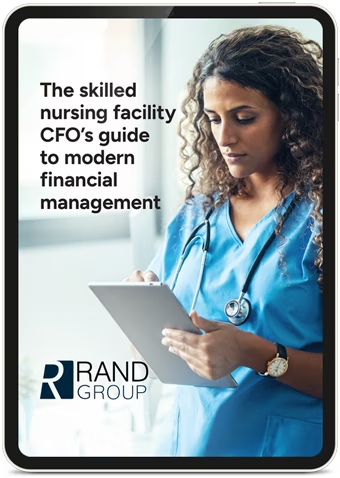
Go beyond resident billing with modern financial management
Managing the financial complexities of a skilled nursing facility requires more than basic accounting and billing tools. Download The Skilled Nursing Facility CFO’s Guide to Modern Financial Management to explore strategies for streamlining financial processes, improving visibility, and strengthening financial performance across your organization.
8 essential features to look for in nursing home accounting software
The best accounting software for nursing homes should address the financial, operational, and regulatory challenges unique to long-term care organizations. While requirements vary based on facility size, ownership structure, and care services, the following eight capabilities are important considerations.
1. Healthcare compliance, data security, and audit readiness
Nursing homes face strict regulatory requirements, making accurate financial records, data security, and audit readiness essential. Accounting software should support applicable HIPAA and HITECH requirements when handling protected health information (PHI), along with financial reporting and internal controls.
Look for software with:
- Role-based access controls: Restrict sensitive financial information based on employee responsibilities.
- Detailed audit trails: Track financial transactions, changes, approvals, and user activity.
- Data security protections: Support encryption, authentication, and appropriate safeguards.
- Financial reporting flexibility: Support Medicare cost reporting and applicable state requirements.
- Document management: Maintain supporting records for transactions, approvals, and audits.
Skilled nursing facilities must also meet specific CMS cost reporting requirements. Accounting software with accurate expense allocation, consistent financial records, and accessible reporting can simplify preparation and improve audit readiness. However, compliance also depends on proper system configuration, policies, and oversight.
2. Integration with EHR, pharmacy, and resident billing systems
Nursing homes rely on multiple applications for clinical care, resident billing, medication management, and financial operations. Integrating these systems can reduce manual data entry, improve accuracy, and provide greater financial visibility.
Important integration capabilities include:
- EHR integration: Connect relevant clinical and operational data with financial reporting.
- Resident billing integration: Synchronize billing, payments, receivables, and revenue information.
- Pharmacy and ancillary service integration: Connect applicable medication, supply, and service-related financial data.
- Automated data synchronization: Reduce duplicate entry and manual spreadsheet imports.
- Reconciliation controls: Identify discrepancies between operational and financial records.
For skilled nursing facilities, integration with specialized reimbursement applications can also improve financial visibility under Medicare’s Patient-Driven Payment Model (PDPM). While clinical and billing systems manage reimbursement workflows, accounting software helps reconcile transactions and analyze revenue.
For example, Rand Group has helped skilled nursing organizations integrate Sage Intacct with PointClickCare to reduce manual processes and improve facility-level financial reporting.
Learn more about Sage Intacct and PointClickCare integration.
3. Payroll integration and workforce cost management
Labor is one of the largest expenses for nursing homes, making accurate workforce cost tracking essential. Accounting software should integrate with payroll, scheduling, and workforce management systems to improve visibility into wages, overtime, benefits, and agency staffing expenses.
Key capabilities include:
- Payroll integration: Transfer payroll expenses and liabilities into the general ledger.
- Department-level cost allocation: Track staffing expenses by facility, department, or cost center.
- Overtime and agency labor reporting: Monitor additional staffing costs and identify trends.
- Budget comparisons: Evaluate actual labor expenses against facility and departmental budgets.
- Labor cost analysis: Track labor costs per resident day and compare expenses across locations.
By connecting payroll, census, and financial data, nursing home operators can better understand staffing costs, compare facility performance, and identify opportunities to improve profitability.

4. Claims, reimbursement, and accounts receivable visibility
Nursing homes manage revenue from Medicare, Medicaid, private-pay residents, and commercial insurance, each with different reimbursement requirements and payment schedules. Accounting software should help finance teams track billed, collected, adjusted, and outstanding revenue across payer sources.
Look for software that supports:
- Payer-level revenue reporting: Analyze revenue by Medicare, Medicaid, private-pay, and other payer categories.
- Accounts receivable aging: Identify outstanding balances and payment delays.
- Reimbursement reconciliation: Compare financial records with billing and payment information.
- Denial and adjustment visibility: Monitor financial trends associated with denied or adjusted claims.
- Cash flow reporting: Understand how reimbursement timing affects available cash.
While specialized revenue cycle management systems handle claims processing and denials, accounting software should integrate with these applications to improve financial visibility. This is especially important as reimbursement programs evolve, including CMS’s Skilled Nursing Facility Value-Based Purchasing Program, which adjusts certain Medicare payments based on facility performance.
5. Multi-entity accounting and consolidated financial reporting
For organizations operating multiple nursing homes or senior care facilities, managing financial information across locations can be challenging. Multi-entity accounting software helps standardize financial processes, reduce manual consolidation, and provide visibility into individual facility performance.
Essential features include:
- Consolidated financial statements: Combine financial results across facilities and legal entities.
- Intercompany accounting: Manage transactions between related entities and automate eliminations.
- Facility-level reporting: Analyze revenue, expenses, and profitability by location.
- Consistent charts of accounts: Standardize financial reporting across the organization.
- Centralized financial oversight: Provide consolidated visibility while maintaining facility-level access.
These capabilities help nursing home operators compare facility performance, identify financial trends, and make informed decisions about resource allocation.

6. Accounts payable automation and purchasing controls
Nursing homes manage recurring expenses for medical supplies, food services, maintenance, equipment, and contracted services. Manual invoice processing and approvals can create inefficiencies, particularly across multiple facilities.
Modern accounting software can streamline accounts payable through:
- Automated invoice capture: Extract invoice information and reduce manual entry.
- Approval workflows: Route invoices based on department, facility, or approval authority.
- Purchase order matching: Compare invoices with purchase orders and receiving records.
- Electronic payments: Support ACH and other payment methods.
- Vendor management: Maintain vendor records, payment details, and documentation.
- Expense visibility: Track spending by facility, department, or expense category.
Centralized AP automation helps organizations reduce administrative work, strengthen purchasing controls, and improve visibility into spending across facilities.
7. Budgeting, forecasting, and cash flow management
Fluctuating reimbursement, occupancy changes, and rising labor costs make financial planning essential for nursing homes. Accounting software with budgeting and forecasting capabilities helps organizations anticipate expenses, evaluate financial scenarios, and manage cash flow.
Important capabilities include:
- Facility-level budgeting: Develop budgets by location, department, and expense category.
- Budget-versus-actual reporting: Identify variances and unexpected expenses.
- Scenario planning: Model changes in occupancy, reimbursement, and staffing costs.
- Cash flow forecasting: Anticipate cash requirements and potential funding gaps.
- Recurring allocations: Distribute shared expenses across facilities or departments.
These tools help finance leaders understand how changing operating conditions affect profitability, adjust spending, and make more informed financial decisions.

8. Financial dashboards, analytics, and operational KPIs
Nursing home administrators need more than traditional financial statements to evaluate facility performance. Accounting software with configurable dashboards should make it easier to track essential metrics, including revenue per resident day, labor costs, occupancy rates, and operating margins across facilities.
Look for reporting capabilities that support:
- Facility-level dashboards: Provide administrators with relevant financial information.
- Consolidated reporting: Give executives visibility across multiple facilities.
- Financial and operational KPIs: Track revenue, expenses, occupancy, and labor costs.
- Drill-down reporting: Investigate transactions and underlying financial details.
- Role-specific access: Deliver appropriate information to executives, controllers, and managers.
By integrating accounting software with operational systems, nursing homes can analyze financial results alongside census and staffing data, improving visibility into costs, performance, and opportunities for improvement.
Accounting software options for nursing homes and senior care organizations
Several modern accounting and ERP platforms can support the financial management needs of nursing homes and long-term care organizations. The right solution depends on your organization’s size, financial complexity, integration requirements, and growth plans.
Options to consider include:
- Sage Intacct: A cloud financial management platform offering multi-entity accounting, dimensional reporting, AP automation, and budgeting. Its reporting and integration capabilities make it particularly well suited for nursing home operators managing multiple facilities.
- Microsoft Dynamics 365 Business Central: An ERP solution that connects financial management, purchasing, budgeting, and reporting. It supports integration with specialized healthcare and workforce applications to streamline business processes.
- Microsoft Dynamics 365 Finance & Operations: An enterprise ERP solution offering advanced financial management, multi-entity consolidation, procurement, budgeting, and supply chain capabilities. It is well suited for larger nursing home operators with complex financial structures, centralized purchasing, and extensive reporting requirements.
- Oracle NetSuite: A cloud ERP platform offering multi-subsidiary accounting, consolidated reporting, financial planning, and automation. It can help growing nursing home organizations centralize financial operations across multiple entities.
While these platforms provide comprehensive financial management capabilities, they do not replace specialized resident billing or clinical systems. Evaluating integration requirements is essential when selecting the right solution.

Not sure which accounting software meets your nursing home's needs?
Every nursing home has different financial management requirements. Rand Group’s software selection experts can help you evaluate your existing systems, identify essential capabilities, and compare solutions based on your operational needs, reporting requirements, and growth plans.
How to choose the right nursing home accounting software
Selecting nursing home accounting software requires evaluating your organization’s current challenges, integration needs, and future growth plans. Consider these three factors when comparing solutions.
Assess your current financial management challenges
Identify manual processes, reporting limitations, and inefficiencies that your current system may be creating. Ask questions such as:
- Does your team spend significant time reconciling data between systems?
- Are month-end close and financial reporting heavily dependent on spreadsheets?
- Can administrators easily access facility-level financial information?
- Does your current software support your budgeting, compliance, and growth requirements?
Evaluate integrations and scalability
Look for software that integrates with your existing resident billing, EHR, payroll, and purchasing systems. The platform should also accommodate additional facilities, users, and reporting requirements as your organization grows.
Consider implementation, support, and total cost of ownership
Beyond software licensing, evaluate implementation, integrations, data migration, training, and ongoing support costs. An experienced implementation partner can help you establish requirements, streamline deployment, and configure the solution around your financial and operational needs.
How Plantation Management Company improved skilled nursing financial management with Rand Group
Plantation Management Company (PMC), which operates 16 skilled nursing facilities and one assisted living facility, partnered with Rand Group to modernize its accounting processes and improve financial reporting.
Rand Group implemented Sage Intacct, consolidated approximately 30 entities, and integrated PointClickCare and UKG to connect financial and operational data.
The results included:
- 50% reduction in accounting input time.
- Approximately 50% faster income statement reporting.
- Improved visibility into facility-level performance and per-patient-day financial metrics.
By automating manual processes and streamlining reporting, PMC gained greater financial visibility across its facilities.
Read the full Plantation Management Company case study to explore the implementation and results.
Why partner with Rand Group for nursing home accounting software?
Rand Group helps nursing homes, skilled nursing facilities, and senior care organizations select, implement, and optimize financial management software. Our approach combines healthcare industry experience with technical and accounting expertise.
- Healthcare and senior living experience: Proven experience helping senior care organizations improve financial reporting, automate processes, and connect healthcare systems.
- Multi-platform expertise: Deep knowledge of Sage, Microsoft Dynamics 365, and Oracle NetSuite to help identify the right solution for your requirements.
- Implementation and integration: Expertise in software configuration, data migration, process improvement, and connecting financial and operational systems.
- Ongoing support and optimization: Long-term assistance to help your accounting software continue to meet requirements as your organization grows.
With experience supporting organizations such as Plantation Management Company and Central Management Company, Rand Group can help you modernize financial operations, improve reporting, and build a more efficient accounting environment.
Key takeaways: Choosing nursing home accounting software
- Resident billing is only one part of financial management. Nursing homes need accounting software that supports financial reporting, budgeting, cash management, and internal controls.
- Integration is essential. Connecting accounting software with EHR, resident billing, payroll, and revenue cycle systems can reduce manual processes and improve data consistency.
- Automation improves efficiency. Capabilities such as AP automation, intercompany accounting, and payroll integration help reduce administrative work and strengthen financial controls.
- Multi-facility reporting supports better decisions. Consolidated financial statements and facility-level analytics provide greater visibility into costs and performance.
- Industry-specific financial metrics matter. Tracking labor cost per resident day, operating margins, occupancy, and reimbursement trends helps leadership identify opportunities for improvement.
- The right implementation partner adds value. Experienced guidance can help nursing homes select, configure, and optimize accounting software that supports their current needs and future growth.
Frequently asked questions about nursing home accounting software
What is nursing home accounting software?
Nursing home accounting software helps long-term care facilities manage financial activities such as general ledger accounting, accounts payable, budgeting, financial reporting, and cash flow. More comprehensive platforms can also support multi-entity accounting, financial automation, and integration with resident billing, payroll, and clinical systems.
What is the difference between nursing home billing software and accounting software?
Nursing home billing software focuses on resident charges, insurance claims, reimbursement, payments, and collections. Accounting software manages the broader financial operations of the organization, including expenses, financial statements, budgeting, and reporting. Integrating both systems helps provide a more complete picture of financial performance.
What features should skilled nursing facilities look for in accounting software?
Skilled nursing facilities should prioritize multi-entity accounting, regulatory reporting support, payroll integration, accounts payable automation, budgeting, and financial dashboards. Integration with EHR, resident billing, and revenue cycle management systems is also important for reducing manual processes and improving financial visibility.
Can nursing home accounting software integrate with EHR systems?
Yes. Many modern accounting platforms can integrate with EHR and resident management applications through APIs, integration platforms, or specialized connectors. These integrations can synchronize relevant billing, operational, and financial information, reducing duplicate entry and improving reporting accuracy. Available integrations depend on the specific applications and implementation requirements.
How does accounting software help nursing homes with regulatory compliance?
Accounting software can support regulatory compliance through audit trails, role-based permissions, financial reporting, document management, and internal controls. These capabilities help organizations maintain accurate records and prepare information for audits and applicable cost reporting requirements. However, compliance also depends on proper system configuration, organizational policies, and established procedures.
What is the best accounting software for nursing homes with multiple locations?
The best accounting software for multi-facility nursing homes depends on the organization’s financial complexity, reporting requirements, and existing technology. Sage Intacct, Microsoft Dynamics 365 Business Central, and Oracle NetSuite are options worth evaluating for multi-entity accounting, consolidated reporting, and financial automation. Organizations should also assess integration capabilities and scalability before selecting a solution.
How much does nursing home accounting software cost?
Nursing home accounting software costs vary based on the platform, number of users, facilities, modules, integrations, and implementation requirements. Organizations should evaluate total cost of ownership, including subscriptions or licenses, configuration, data migration, training, and ongoing support. A requirements assessment can help establish a more accurate budget and identify the most appropriate solution.
Improve financial management across your nursing home operations
Choosing nursing home accounting software involves more than finding a system that processes resident payments. The right financial management platform should help your organization streamline accounting processes, improve reporting, strengthen internal controls, and gain greater visibility into financial performance across facilities.
Rand Group helps nursing homes and senior care organizations evaluate their existing systems, identify opportunities for improvement, and implement accounting and ERP solutions tailored to their requirements. Whether you’re modernizing an outdated platform or connecting financial and operational applications, our experts can help you build a more efficient financial management environment. Contact Rand Group to discuss your accounting software needs and explore the right solution for your organization.