Best multi-entity accounting software and ERP systems for growing businesses

If your finance team is spending more time consolidating spreadsheets than analyzing performance, your accounting software may be holding your business back.
Many organizations start with QuickBooks or other entry-level accounting systems because they’re affordable and easy to use. But as companies grow across multiple entities, locations, or subsidiaries, those systems often struggle to keep up. Manual consolidations, disconnected company files, limited intercompany functionality, and reporting inefficiencies can quickly become major operational challenges.
That’s why many growing businesses move to ERP systems with stronger multi-entity management capabilities. The best multi-entity accounting software helps organizations centralize financial data, automate intercompany transactions, simplify consolidations, and scale with confidence.
In this guide, we’ll review four of the best multi-entity solutions for growing businesses. Plus, we’ll explain the benefits of managing your multi-entity business with an ERP system and how to choose the right ERP platform for long-term growth.
At a glance:
Multi-entity accounting software helps organizations manage financial reporting, consolidations, intercompany transactions, currency, security, and visibility across multiple entities, subsidiaries, or locations. Entry-level accounting systems such as QuickBooks and Xero can work for simple multi-company structures, but growing organizations often need ERP systems such as Sage Intacct, NetSuite, Dynamics 365 Business Central, or Dynamics 365 Finance & Operations to automate consolidations, standardize reporting, and scale with confidence.
There is no single best multi-entity accounting system for every organization. The right choice depends on entity structure, intercompany volume, reporting needs, industry requirements, existing technology ecosystem, budget, and long-term growth plans.
Accounting software vs. ERP: Understanding multi-entity management
Accounting software like QuickBooks and Xero helps small businesses manage core financial tasks such as invoicing, payroll, and reporting. However, these systems can become limiting as organizations grow across multiple entities, subsidiaries, or locations.
ERP systems go beyond accounting by centralizing financial and operational management in one system. Multi-entity ERP solutions help businesses manage multiple legal entities within a shared platform instead of relying on disconnected company files and manual consolidations.
The best multi-entity management solutions should include capabilities such as:
- Consolidated financial reporting
- Automated intercompany transactions
- Standardized or shared chart of accounts
- Multi-currency management
- Role-based security
- Real-time visibility across entities
Many growing organizations eventually outgrow entry-level accounting systems once financial consolidation and intercompany management become too complex to manage manually. While solutions like QuickBooks and Xero are excellent starting points for small businesses, most entry-level accounting software platforms lack the advanced automation, scalability, and centralized visibility that multi-entity organizations need to support long-term growth.

Top 10 ERP software selection checklist
Selecting the best multi-entity accounting software requires careful planning. Download our Top 10 ERP Software Selection Checklist to learn the ten essential steps for evaluating ERP systems and choosing the right solution for your business.
Why multi-entity businesses need more than basic accounting software
Most entry-level accounting platforms are not designed to manage complex multi-entity operations at scale.
- Limited consolidation capabilities – Many businesses using entry-level accounting systems rely heavily on Excel to combine financial data from multiple entities. This often results in manual workarounds, lengthy month-end closes, increased risk of errors, and limited financial visibility.
- Separate company files create operational silos – Most small business accounting systems require separate company files for each entity. While manageable initially, this structure becomes cumbersome as organizations grow.
- Weak intercompany management – Intercompany accounting is one of the biggest pain points for multi-entity organizations. Without advanced automation, teams often manage due-to/due-from transactions manually, increasing reconciliation complexity and audit risk.
- Security and user access challenges – As organizations scale, they need more sophisticated permission structures. Entry-level accounting systems often lack the flexibility to assign granular access by entity, department, or operational role.
- Scalability concerns – Eventually, growing organizations need more than accounting software. They need integrated ERP functionality that connects finance, operations, inventory, reporting, procurement, and business intelligence in a centralized platform.
In our experience, organizations managing more than 5–10 entities often find month-end close cycles increase significantly when relying on disconnected accounting systems. We frequently see organizations reduce month-end close time by 30–50% after implementing centralized ERP consolidation tools.
Best multi-entity accounting software & ERP systems
When evaluating the best multi-entity accounting software, businesses should consider:
- Consolidation capabilities
- Intercompany automation
- Scalability
- Ease of use
- Reporting functionality
- Industry flexibility
- Integration ecosystem
Here are four leading ERP solutions for multi-entity accounting management. The platforms below are included because they are widely used by growing and mid-market organizations for multi-entity financial management and ERP. Each system has different strengths, limitations, and ideal use cases. The goal is not to identify one universal best option, but to help organizations understand how each platform approaches consolidations, intercompany accounting, reporting, scalability, and operational complexity.
Sage Intacct
Sage Intacct is a cloud financial management platform often evaluated by organizations that need stronger reporting, automation, dimensional visibility, and multi-entity accounting than entry-level accounting systems typically provide. It is especially relevant for finance-led organizations that want to improve consolidations, intercompany accounting, and reporting without moving immediately to a broader operational ERP footprint.
What makes Sage Intacct unique:
- Cloud-native financial management platform
- Strong dimensional reporting across entities, departments, locations, projects, customers, and other business dimensions
- Finance-first design for organizations focused on accounting, reporting, approvals, and controls
- Common fit for professional services, nonprofits, healthcare, SaaS, and multi-location organizations
- Automation and dashboards that help finance teams reduce manual reporting work
Sage Intacct multi-entity functionality:
- Multi-entity financial management
- Consolidated financial reporting
- Inter-entity transaction automation
- Automated eliminations
- Multi-currency support
- Role-based permissions
- Dashboards and reporting across entities or locations
Best for:
- Healthcare organizations
- Professional services firms
- Nonprofits
- Multi-location businesses
- Finance-focused organizations
Sage Intacct’s native multi-entity management capabilities make it especially attractive for organizations struggling with manual consolidations. Finance teams can automate eliminations, streamline reporting, and improve visibility across subsidiaries.

Oracle NetSuite
NetSuite is a comprehensive cloud ERP platform designed to support fast-growing organizations with complex operational and financial requirements. For multi-entity organizations, NetSuite OneWorld is the key capability to evaluate. It supports management of multiple subsidiaries, currencies, tax jurisdictions, and reporting structures within one NetSuite environment. This can make NetSuite a strong fit for organizations that need multi-entity financial management alongside broader ERP functionality such as inventory, order management, procurement, revenue recognition, and supply chain management.
What makes NetSuite unique:
- Unified cloud ERP platform that connects financials with operations
- Broad functionality across CRM, inventory, order management, procurement, supply chain, ecommerce, and reporting
- Strong fit for high-growth companies that want to manage multiple business processes in one system
- Commonly evaluated by SaaS, ecommerce, retail, distribution, and global businesses
- Scalable platform for organizations expanding across products, channels, subsidiaries, or countries
NetSuite multi-entity functionality:
- NetSuite OneWorld for multi-subsidiary management
- Global financial consolidation
- Multi-currency support
- Intercompany transaction management
- Subsidiary-specific reporting and permissions
- Revenue recognition across entities
- Consolidated dashboards and reporting
Best for:
- High-growth companies
- Retail and eCommerce businesses
- SaaS organizations
- International enterprises
NetSuite offers strong global financial management capabilities and broad ERP functionality within a unified cloud platform. It is especially effective for organizations operating across multiple countries and currencies.

Microsoft Dynamics 365 Business Central
Microsoft Dynamics 365 Business Central is a highly flexible ERP solution designed for small and mid-sized organizations looking to centralize financial and operational management.
Native Business Central supports multi-company management by allowing organizations to create and manage separate companies within the same environment. Finance teams can consolidate financial data from multiple companies, map accounts for reporting, use dimensions for analysis, and manage company-specific processes while maintaining a familiar Microsoft user experience.
For organizations with straightforward multi-company needs, native Business Central may be enough. Organizations with higher intercompany transaction volume, shared services structures, centralized AP or AR, or more complex multi-entity automation needs may need to evaluate additional functionality such as Binary Stream Multi-Entity Management.
What makes Dynamics 365 Business Central unique:
- Familiar Microsoft user experience
- Native integration with Microsoft 365 tools such as Outlook, Excel, and Teams
- Power BI reporting and Power Platform extensibility
- Flexible ERP functionality for finance, sales, purchasing, inventory, warehouse, service, projects, and manufacturing
- Strong fit for small and midsized organizations already invested in Microsoft technologies
D365 Business Central multi-entity functionality:
- Native multi-company management
- Financial consolidation across companies
- Account mapping for consolidated reporting
- Dimensions for entity, department, location, project, or other reporting needs
- Company-specific processes and permissions
- Power BI visibility across companies
- Optional enhancement with Binary Stream Multi-Entity Management for centralized AP/AR, shared services, intercompany automation, and multi-entity transaction entry
Best for:
- SMBs
- Distribution companies
- Manufacturers
- Professional services organizations
- Microsoft-centric businesses
Business Central offers a familiar user experience for organizations already using Microsoft technologies and provides a strong entry point into ERP adoption.

Enhancing Business Central with Binary Stream
Business Central includes native tools for managing multiple companies and consolidating financial results. This can work well for organizations with a moderate number of entities, relatively straightforward reporting requirements, and manageable intercompany activity.
However, Business Central’s native multi-company structure can become more manual as complexity increases. For example, teams may need to switch between companies, manage intercompany activity across separate records, or rely on additional processes to support shared services and centralized transaction entry.
Binary Stream Multi-Entity Management extends Business Central for organizations with more advanced multi-entity requirements. It is often evaluated when companies need stronger automation, centralized processing, and shared services functionality across multiple entities.
Native Business Central may be a good fit when organizations need:
- Separate company management within Business Central
- Standard financial consolidation
- Account mapping for reporting
- Dimensions and Power BI reporting
- Microsoft 365 integration
- Moderate intercompany activity
Business Central with Binary Stream Multi-Entity Management may be a better fit when organizations need:
- Centralized AP, AR, purchasing, or cash management across entities
- Shared services accounting
- Automated intercompany transactions
- Multi-entity transaction entry from a single company
- Advanced allocations
- More streamlined reporting across a larger entity structure
This combination allows organizations to stay within the Microsoft ecosystem while adding deeper multi-entity automation for more complex finance operations.
Microsoft Dynamics 365 Finance & Operations
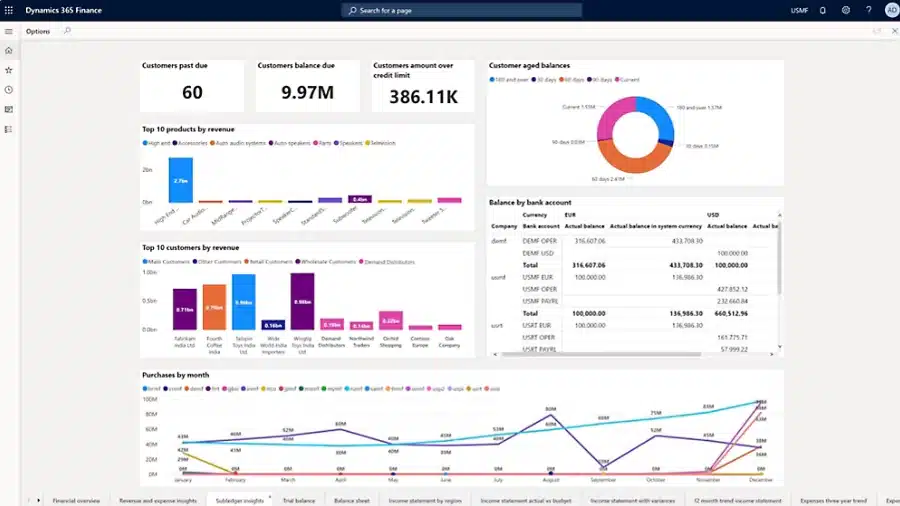
Dynamics 365 Finance & Operations (F&O) is Microsoft’s enterprise ERP platform for organizations with more complex financial, operational, and global requirements. It is typically evaluated by companies that need enterprise-scale finance, supply chain, manufacturing, procurement, compliance, and reporting capabilities.
What makes Dynamics 365 Finance & Operations unique:
- Enterprise-scale ERP platform for large and complex organizations
- Advanced functionality across finance, supply chain, procurement, manufacturing, warehouse management, and compliance
- Deep integration with Microsoft 365, Power Platform, Power BI, and Microsoft Copilot
- Strong fit for global organizations, complex manufacturers, distributors, and companies with high transaction volume
- Extensive configuration and governance capabilities for complex operating models
D365 Finance & Operations multi-entity functionality:
- Advanced legal entity structure
- Global financial management
- Multi-currency support
- Intercompany accounting
- Consolidations and financial reporting
- Enterprise-grade role-based security
- Compliance and audit controls across entities
- Embedded analytics and reporting across global operations
Best for:
- Enterprise organizations
- Global operations
- Complex manufacturers
- Large multi-subsidiary companies
F&O provides enterprise-grade scalability and governance capabilities, making it ideal for organizations managing large volumes of transactions, entities, and operational complexity.
Multi-entity ERP comparison at a glance
Which multi-entity accounting software is right for your business?
The best multi-entity accounting software depends on how your organization is structured, how complex your intercompany activity is, and whether you need finance-first functionality or broader operational ERP capabilities.
How to choose the right multi-entity ERP system
The best multi-entity accounting software depends on your organization’s complexity, growth strategy, and operational requirements.
Evaluate organizational complexity
Consider:
- Number of entities
- International operations
- Shared services structures
- Intercompany transaction volume
Review intercompany transaction volume
Consider how often entities buy from, sell to, allocate costs to, or transfer funds between one another. Organizations with frequent intercompany activity may need stronger automation, due-to/due-from tracking, shared services accounting, and centralized transaction processing.
Assess industry requirements
Different industries require different ERP capabilities. Manufacturers, distributors, healthcare organizations, and professional services firms all have unique operational needs.
Plan for future growth
Your ERP platform should support future acquisitions, expansion, and scalability without requiring another system replacement in a few years.
Consider reporting and compliance requirements
Organizations with complex reporting structures often benefit from advanced consolidation and business intelligence capabilities available in enterprise ERP platforms.
Evaluate native functionality versus add-ons
Some ERP platforms include enough native multi-entity functionality for straightforward consolidation and reporting needs. Others may require add-on solutions to support advanced intercompany automation, shared services, centralized AP/AR, or more complex entity structures. When comparing systems, evaluate both the base platform and any extensions needed to meet your requirements.
Align with your technology ecosystem
Businesses already invested in Microsoft technologies may benefit from Business Central or Dynamics 365 F&O, while others may prioritize cloud-native financial management or broader operational ERP capabilities.
Choosing the right ERP requires balancing current business needs with future scalability. However, it is important to note that enterprise ERP systems may be more functionality than smaller organizations require, especially if they operate only one or two legal entities.

Need help choosing the right ERP?
Selecting the best multi-entity accounting software can be overwhelming, especially when balancing scalability, integrations, reporting, and operational requirements. Our ERP software selection consultants help organizations evaluate vendors, define requirements, and choose the right ERP solution for long-term growth.
Why partner with Rand Group for ERP selection and implementation
Selecting and implementing ERP software is a significant investment. The right implementation partner can help organizations reduce risk, accelerate adoption, and maximize long-term value.
Rand Group brings decades of ERP consulting and implementation experience across Microsoft Dynamics, Sage, and NetSuite solutions.
Our ERP experts help organizations evaluate technology, optimize processes, and implement scalable ERP systems that support long-term growth.
Proven ERP experience across platforms
Because multi-entity requirements vary by business model, industry, and growth stage, Rand Group works across multiple ERP platforms rather than recommending the same system for every organization.
Examples of Rand Group client outcomes include:
- Sage Intacct for finance-led growth: B-29 Investments improved operational efficiency and reporting capabilities by moving to Sage Intacct.
- NetSuite for complex financial structures: Unified Women’s Healthcare optimized its NetSuite environment by restructuring subsidiaries, improving the chart of accounts, simplifying scripts, and automating finance processes.
- Business Central for connected SMB operations: Subs for Pools LLC enhanced operational visibility and financial management processes with Business Central.
- Dynamics 365 Finance & Operations for enterprise-scale transformation: Conquest Completion Services moved from QuickBooks, Excel, and paper-based processes to Dynamics 365 Finance & Operations, improving real-time visibility, inventory control, PO approvals, DSO, and finance team efficiency.
Frequently asked questions
What is the best multi-entity accounting software?
The best multi-entity accounting software depends on business size and complexity. Sage Intacct, NetSuite, Microsoft Dynamics 365 Business Central, and Dynamics 365 Finance & Operations are among the leading ERP platforms for multi-company financial management.
Can QuickBooks manage multiple entities?
Yes, QuickBooks can manage multiple entities through separate company files. However, organizations often encounter limitations with consolidations, intercompany transactions, reporting, and scalability as they grow.
What ERP systems are best for multi-company accounting?
Leading ERP systems for multi-company accounting include Sage Intacct, NetSuite, Business Central, and Dynamics 365 Finance & Operations.
What features should multi-entity accounting software include?
The best multi-entity accounting software should include:
- Consolidated reporting
- Intercompany automation
- Multi-currency support
- Role-based security
- Shared or standardized chart of accounts
- Automated eliminations
What is the difference between accounting software and ERP software?
Accounting software primarily focuses on financial management, while ERP software integrates finance with broader operational processes such as inventory, procurement, manufacturing, reporting, and supply chain management.
Does Business Central support multi-entity accounting?
Yes, Business Central supports multi-entity accounting. However, organizations with advanced intercompany requirements often enhance functionality with solutions like Binary Stream.
Which ERP is best for global multi-entity operations?
NetSuite and Dynamics 365 Finance & Operations are particularly strong options for global organizations managing multiple subsidiaries, currencies, and international reporting requirements.
Final thoughts
Entry-level accounting software can support organizations in the early stages of growth, but managing multiple entities often requires more advanced ERP functionality. A strong multi-entity management solution helps businesses centralize financial management, automate intercompany processes, improve reporting visibility, and scale efficiently.
Whether your organization is evaluating Sage Intacct, NetSuite, Business Central, or Dynamics 365 Finance & Operations, selecting the right ERP platform requires careful planning and industry expertise. We help organizations evaluate, implement, and optimize ERP systems that support long-term growth and operational efficiency. If your business is ready to move beyond disconnected accounting systems and manual consolidations, our team can help you identify the right solution for your needs. Contact our team today to start your software selection journey.