7 reasons why your month-end close is slow and how a modern ERP system can help

Month-end close should provide timely financial insights that help leadership make informed business decisions. But for many organizations, the process is still slowed down by spreadsheets, manual reconciliations, disconnected systems, and inefficient approval workflows.
At Rand Group, we work with finance teams across manufacturing, professional services, healthcare, distribution, and other industries that are facing these exact challenges. In many cases, slow month-end close cycles are symptoms of larger operational issues, including disconnected systems, manual reporting processes, limited visibility, and workflows that no longer scale with the business.
The good news is that these delays are rarely caused by your people. More often, they stem from outdated processes and systems that were never designed for today’s pace of business. That is why organizations looking to speed up month-end close are increasingly investing in modern ERP systems to automate workflows, improve visibility, and streamline financial operations.
7 reasons why your month-end close is slow
In our experience working with finance teams across industries, slow close cycles are typically caused by multiple process inefficiencies that compound over time and limit visibility across the organization. Below are some of the most common reasons organizations struggle with lengthy month-end close cycles and operational inefficiencies within their finance processes.
1. Too many manual processes and spreadsheets
One of the biggest barriers to an efficient financial close is overreliance on manual work.
Many accounting teams still depend heavily on:
- Spreadsheet-based reconciliations
- Manual journal entries
- Repetitive data entry
- Offline approval processes
- Multiple versions of reports shared through email
We often see organizations relying on spreadsheet workarounds because their accounting software cannot support automated workflows or centralized reporting. Over time, these spreadsheet-driven processes become difficult to scale and significantly slow down month-end close. Manual workarounds also create opportunities for errors, version control issues, and delays. Manual work slows down every stage of the close cycle because finance teams spend valuable time collecting, validating, and correcting data instead of analyzing results.
2. Late or incomplete inputs from other departments
Accounting teams often depend on operational data from other departments before they can finalize the close.
Common delays include:
- Late AP invoices
- Missing inventory adjustments
- Delayed expense approvals
- Incomplete payroll data
- Revenue recognition updates arriving late
When departments operate in silos, finance teams lack visibility into where information is delayed or incomplete. The result is a reactive close process where accounting teams spend days chasing information instead of closing the books.
3. Reconciliations take too long
Reconciliations are one of the most time-consuming aspects of the month-end close process. In growing organizations, reconciliation challenges often increase after acquisitions, expansion into multiple entities, or increases in transaction volume. Without automated matching and centralized visibility, finance teams lose hours investigating discrepancies manually.
Finance teams often spend days reconciling:
- Bank accounts
- Credit cards
- Intercompany transactions
- Inventory balances
- Subledgers and general ledger accounts
4. Poor integration between financial systems
Disconnected systems are another major contributor to slow close cycles. Many organizations operate with separate systems for accounting, CRM, inventory, payroll, and purchasing. We frequently see finance teams manually exporting and reconciling data across systems just to complete monthly reporting.
When systems are not integrated, accounting teams often resort to exporting and importing spreadsheets between platforms. This creates duplicate data entry, inconsistent reporting, and reconciliation challenges.
5. Lack of standardized close procedures and ownership
In many organizations, the close process relies heavily on team experience and legacy knowledge. Without standardized procedures, finance teams may struggle with:
- Inconsistent close checklists
- Unclear task ownership
- Missed deadlines
- Duplicate work
- Bottlenecks caused by dependency confusion
When close responsibilities are not clearly defined, the process becomes difficult to scale and nearly impossible to optimize.
6. Excessive review and approval bottlenecks
Approvals are necessary for financial control, but inefficient approval processes can significantly delay close timelines. Common bottlenecks include:
- Email-based approvals
- Waiting on executives to review entries
- Multiple layers of signoff
- Manual document routing
When approvals are handled outside the system, accounting teams often lack visibility into where requests are stuck.
7. Limited automation and visibility into the close process
Many finance teams still manage the month-end close manually through spreadsheets, emails, and disconnected task lists. Lack of visibility creates a reactive close process where issues are discovered too late.
Without centralized visibility, organizations struggle to answer critical questions such as:
- What tasks are complete?
- What tasks are delayed?
- Which reconciliations are outstanding?
- Where are the bottlenecks?
Signs your slow month-end close may be a system problem
If your finance team is consistently struggling to speed up month-end close, your systems may be creating operational bottlenecks.
The seven reasons listed above are common signs that your organization may have outgrown traditional accounting software. As businesses grow, manual processes, disconnected systems, and spreadsheet-based reporting often become increasingly difficult to manage efficiently. What once worked for a smaller organization can quickly limit visibility and financial agility.
Once close delays become recurring, incremental process fixes may not be enough. A modern ERP system can help address the root causes of a slow month-end close by connecting data, automating workflows, and creating greater visibility across the business.

Ready to streamline your month-end close?
Inefficient workflows and manual processes can limit financial performance and visibility. We help organizations optimize financial operations and streamline processes to support greater efficiency and scalability.
How modern ERP systems help fix a slow month-end close
Organizations looking for ways to speed up month-end close are increasingly investing in ERP modernization initiatives because modern ERP platforms provide the automation, visibility, and scalability needed to support more efficient financial operations.
Rather than relying on disconnected spreadsheets and manual workarounds, modern ERP systems help finance teams centralize data, standardize processes, and streamline accounting workflows across the organization.
Automation reduces manual accounting work
Modern ERP systems automate many of the repetitive accounting tasks that slow down financial close, including:
- Recurring journal entries
- Approval workflows
- Account reconciliations
- Intercompany transactions
- Financial consolidations
- Allocations and financial reporting
Automation reduces manual effort while improving consistency and accuracy. By minimizing spreadsheet dependency, organizations can reduce close timelines and improve confidence in their financial data. This allows accounting teams to spend less time on administrative tasks and more time focused on financial analysis and strategic planning.
Integrated systems improve collaboration and visibility
Many organizations struggle with delayed close cycles because financial and operational data is spread across disconnected systems.
Modern ERP platforms centralize financial and operational information into a unified environment, helping improve collaboration and real-time visibility across departments such as:
- Finance
- Operations
- Sales
- Purchasing
- HR
- Inventory management
Integrated systems eliminate data silos and reduce the need for manual data transfers, improving reporting consistency while reducing errors.
With centralized systems and automated workflows, departments can submit and approve information faster, helping finance teams close more efficiently.

Automation improves reconciliation accuracy and efficiency
Reconciliations are often one of the most time-consuming aspects of the month-end close process.
Modern ERP systems include reconciliation tools that automate matching processes and quickly identify exceptions. Instead of manually reviewing every transaction, finance teams can focus only on discrepancies that require attention.
This significantly reduces reconciliation time while improving financial accuracy and strengthening internal controls. By automating high-volume reconciliation activities, organizations can create a faster and more scalable close process.
Standardized workflows create consistency
Without standardized close procedures, finance teams often rely on inconsistent processes and manual coordination to complete month-end tasks.
Modern ERP systems help organizations standardize and automate close management processes through capabilities such as:
- Workflow automation
- Role-based task assignments
- Approval routing
- Audit trails
- Close checklists
These tools create greater accountability and consistency across the accounting function while reducing delays caused by unclear ownership or manual task management. Standardized workflows also improve audit readiness and help finance teams close faster month after month.
Digital approval processes reduce close bottlenecks
Manual approval processes are a common source of delay during month-end close.
Modern ERP platforms streamline approvals through digital workflows and automated routing. Approvers receive notifications in real time, and finance teams can easily track approval status throughout the close cycle.
This reduces delays while maintaining strong internal controls and compliance requirements.
Automated approval workflows also create a more scalable process as organizations grow and financial complexity increases.

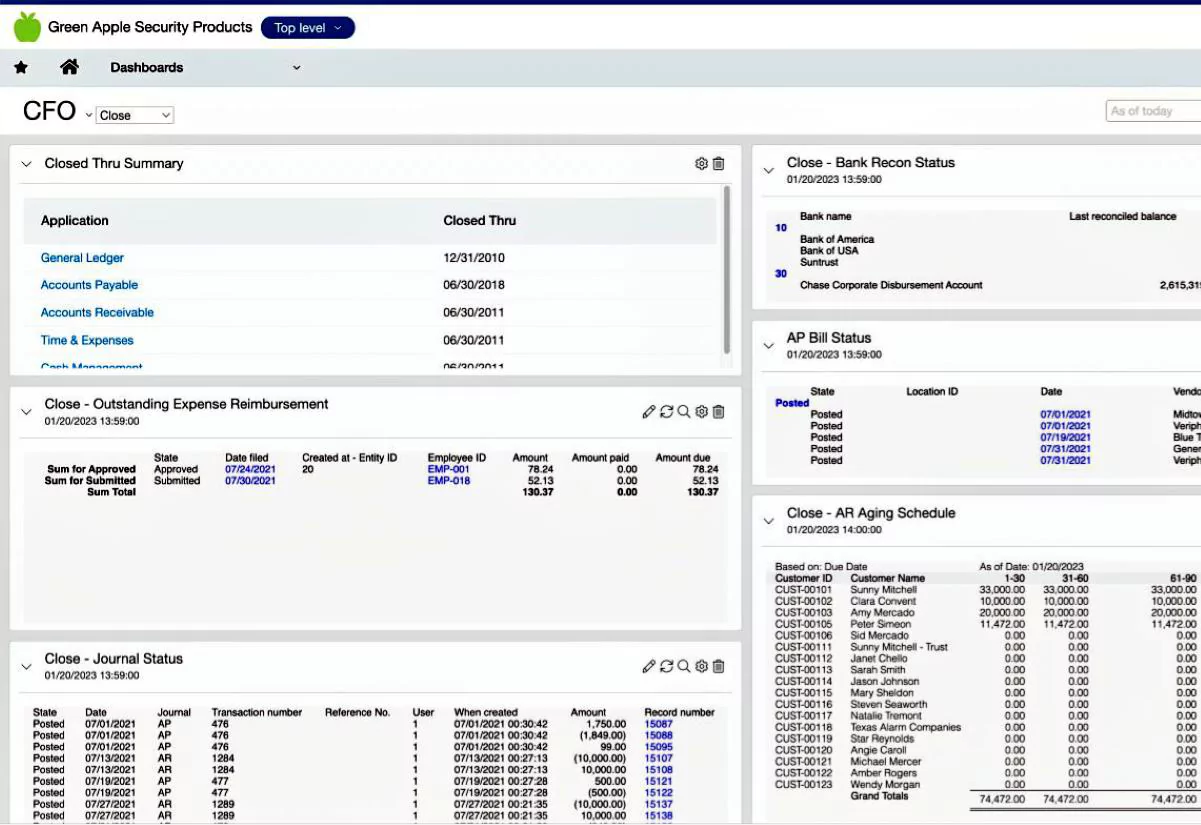
Real-time dashboards improve close visibility
Many finance teams lack real-time visibility into close status, making it difficult to identify delays or bottlenecks before reporting deadlines are impacted.
Modern ERP systems provide centralized dashboards, workflow tracking, and real-time reporting visibility that allow finance leaders to:
- Monitor close progress
- Identify bottlenecks early
- Track outstanding tasks
- Improve accountability across teams
This level of transparency helps organizations create a more predictable, controlled, and efficient financial close process.
Scalability supports business growth
As organizations grow, financial complexity increases through:
- Additional entities
- New business units
- Higher transaction volumes
- Expanded reporting requirements
Modern ERP systems provide scalable infrastructure that allows finance teams to manage growth without dramatically increasing manual workload.
By modernizing financial systems and processes, organizations can build a foundation that supports both operational efficiency and long-term growth.
Real-world ERP modernization experience
Our solution experts have helped organizations across industries modernize financial and operational processes through ERP selection, implementation, integration, reporting, and optimization. These projects show how reducing manual work, connecting systems, and improving reporting visibility can help finance teams close faster and work with greater confidence.
Examples include:
- Little Rock Athletic Club: Reduced month-end close from two weeks to five days after moving to Sage Intacct, while also reducing reconciliation time and improving real-time financial visibility.
- Praxi OP: Cut more than 40 hours from monthly financial reporting and reduced weekly bank reconciliation processing from 45 hours to 6 with Sage Intacct automation and reporting improvements.
- Dairy Products Inc.: Implemented Business Central and integrated it with its commodity trading platform, creating a more controlled accounting and treasury environment with faster close cycles and more reliable reconciliation.
These outcomes show how modern ERP systems can help finance teams reduce manual effort, improve reconciliation accuracy, connect operational and financial data, and create a more predictable month-end close process.
FAQs about why your month-end close is slow
Why is my month-end close taking so long?
Month-end close is often delayed by manual accounting processes, spreadsheet-based reporting, disconnected systems, reconciliation bottlenecks, and inefficient approval workflows. As organizations grow, these challenges become more difficult to manage without automation and centralized financial visibility.
What is considered a good month-end close timeline?
Many organizations aim to complete month-end close within 3–5 business days. Companies relying on manual processes or outdated accounting systems may take 10 days or longer to finalize financial reporting.
How can I speed up month-end close?
Organizations can speed up month-end close by automating reconciliations, reducing spreadsheet dependency, standardizing workflows, improving cross-department collaboration, and implementing modern ERP systems that centralize financial data and reporting.
How does ERP software improve the financial close process?
Modern ERP systems help streamline month-end close by automating workflows, improving real-time visibility into financial data, reducing manual data entry, and simplifying reconciliations, consolidations, and approvals.
What are signs that my company has outgrown its accounting software?
Common signs include:
- Heavy reliance on spreadsheets
- Delayed financial reporting
- Manual reconciliations
- Disconnected business systems
- Limited reporting visibility
- Difficulty managing multiple entities or locations
- Increasingly complex month-end close processes
These challenges often indicate it may be time to evaluate a modern ERP system.
What is the difference between accounting software and ERP?
Accounting software is typically designed to manage basic financial tasks such as accounts payable, accounts receivable, and general ledger reporting. ERP systems provide broader business management capabilities by integrating finance, operations, inventory, purchasing, reporting, and workflow automation into one centralized platform.
How do modern ERP systems help accounting teams?
Modern ERP platforms improve efficiency through automation, centralized data management, standardized workflows, real-time dashboards, and stronger reporting visibility. This helps accounting teams reduce manual work, improve accuracy, and focus more on strategic financial analysis.
How can Rand Group help improve our month-end close process?

Download the ERP software selection checklist
Selecting the right ERP solution starts with asking the right questions. Download our Top 10 ERP Software Selection Checklist to help evaluate business requirements, identify key priorities, and make a more informed ERP decision.
Improve your month-end close with Rand Group
Choosing the right ERP solution is more than a technology decision; it is a business process transformation initiative. Every organization has unique financial processes, reporting requirements, and operational goals. Selecting and optimizing the right ERP platform requires both technical expertise and deep accounting process knowledge.
Rand Group helps organizations evaluate current month-end close challenges, identify automation opportunities, and select or optimize ERP solutions that align with their operational and financial goals. Whether an organization is evaluating new ERP software or optimizing its current environment, our experts can help finance teams modernize processes and reduce manual effort to improve visibility.
We support organizations across multiple ERP platforms, including:
Our product-agnostic approach allows organizations to focus on selecting the solution that best aligns with their operational and financial requirements. Our goal is not simply to implement software, it is to create more efficient, scalable, and strategic financial operations.
Final thoughts
If your organization is struggling with long close cycles, manual reconciliations, and spreadsheet-driven accounting processes, it may be time to modernize your financial systems. Modern ERP technology can help finance teams move beyond reactive accounting processes and focus on delivering insights that drive business performance.
Whether your organization is evaluating ERP software for the first time or looking to optimize an existing system, our ERP and finance experts can help identify process bottlenecks, evaluate automation opportunities, and build a roadmap for a faster, more scalable month-end close process. Contact us today to start building your ERP modernization roadmap.