NetSuite
NetSuite for software and SaaS companies: Streamlining revenue, compliance, and growth

When your board is asking about ARR, churn, and net revenue retention, and your finance team is still reconciling spreadsheets, you have a systems problem. For software and SaaS companies, rapid growth and complex subscription models introduce operational strain that legacy tools simply can’t handle. What worked in the early stages quickly becomes a bottleneck. As these businesses scale, the systems that once worked quickly become barriers to growth.
NetSuite for software and SaaS companies is designed to remove those barriers. As a purpose-built, cloud-based ERP, NetSuite helps recurring revenue businesses streamline billing, automate revenue recognition, maintain compliance with ASC 606 and IFRS 15, and gain real-time visibility into the metrics that matter most, like ARR, churn, and customer retention.
In this article, we’ll explore why modern software and SaaS organizations are turning to NetSuite to unify operations, improve compliance, and support sustainable growth.
The unique challenges of software & SaaS companies
Software and SaaS companies face operational complexity that traditional businesses simply don’t encounter.
Rapid growth and evolving business models
High-growth SaaS companies often pivot pricing strategies, expand into new markets, or introduce new service bundles. One quarter may bring usage-based pricing; the next may introduce tiered subscriptions or hybrid models combining services and licenses.
Without flexible systems, finance teams are left scrambling to manage billing adjustments and revenue schedules manually.
Complex recurring revenue streams
Recurring revenue is the lifeblood of SaaS, but it’s rarely simple. Companies must manage:
- Subscription contracts
- Usage-based billing
- Tiered pricing models
- Contract modifications
- Bundled services and software offerings
Tracking all of this across multiple disconnected systems increases the risk of errors and delays.
ASC 606 and IFRS 15 compliance
Revenue recognition standards like ASC 606 and IFRS 15 require detailed tracking of performance obligations, contract modifications, and revenue allocation. Manual spreadsheets are inefficient and risky. Investors and auditors demand accuracy and transparency.
Demand for real-time SaaS metrics
SaaS executives rely on data to drive decisions. Key performance indicators include:
- Annual Recurring Revenue (ARR)
- Monthly Recurring Revenue (MRR)
- Customer Acquisition Cost (CAC)
- Churn rate
- Net Revenue Retention (NRR)
If reporting requires manual compilation across tools, leadership loses the real-time insight needed to scale strategically.
The limitations of disconnected systems
Many growing SaaS organizations rely on a patchwork of tools:
- QuickBooks for accounting
- A third-party billing system
- Salesforce for CRM
- Spreadsheets for revenue schedules
As transaction volumes increase, these systems struggle to keep up. Manual reconciliations become the norm. Errors multiply. Reporting slows down. This is why modern SaaS companies need a unified, cloud-based ERP platform built specifically for recurring revenue businesses.

Discover how to streamline revenue, compliance, and growth with NetSuite.
Connect with our experienced NetSuite consultants to explore the right strategy for your software or SaaS organization.
NetSuite for software and SaaS companies
NetSuite is a cloud-based ERP solution purpose-built to manage the operational complexity of subscription-driven organizations.
Rather than relying on disconnected tools, NetSuite unifies:
- Financial management
- Subscription billing
- Revenue recognition
- Customer Relationship Management (CRM)
- Reporting and analytics
It is designed to support:
- Subscription-based business models
- Services + software bundles
- Multi-entity and global operations
- Automated compliance processes
From early-stage startups to IPO-ready enterprises, NetSuite scales alongside your business.

Why NetSuite stands out for software & SaaS
At its core, NetSuite delivers what SaaS companies need most: control and visibility.
Here’s what differentiates NetSuite for modern finance teams:
- Native subscription billing and revenue recognition
- Real-time SaaS KPIs and dashboards
- End-to-end quote-to-cash automation
- Scalability for high-growth environments
- AI-driven analytics
- Global consolidation and multi-currency support
This unified approach makes NetSuite not just a financial system, but a centralized growth platform.
Key capabilities for software & SaaS companies
To support subscription-driven growth, NetSuite for software and SaaS companies delivers purpose-built capabilities designed specifically for recurring revenue models. Rather than relying on third-party billing systems or manual workarounds, SaaS organizations gain embedded functionality for their industry all within a single, unified platform. Below are the core capabilities that enable finance and operations teams to scale efficiently while maintaining compliance and visibility.
Advanced Revenue Management (ARM)
Revenue recognition is one of the most complex aspects of SaaS accounting. NetSuite’s Advanced Revenue Management (ARM) module automates compliance with ASC 606 and IFRS 15.
Key features include:
- Automated revenue allocation for multi-element arrangements
- Real-time revenue schedules
- Automated revenue reallocation for contract modifications
- Full audit trails for compliance transparency
- Investor-ready financial reporting
This reduces manual effort and ensures finance teams can close books confidently.
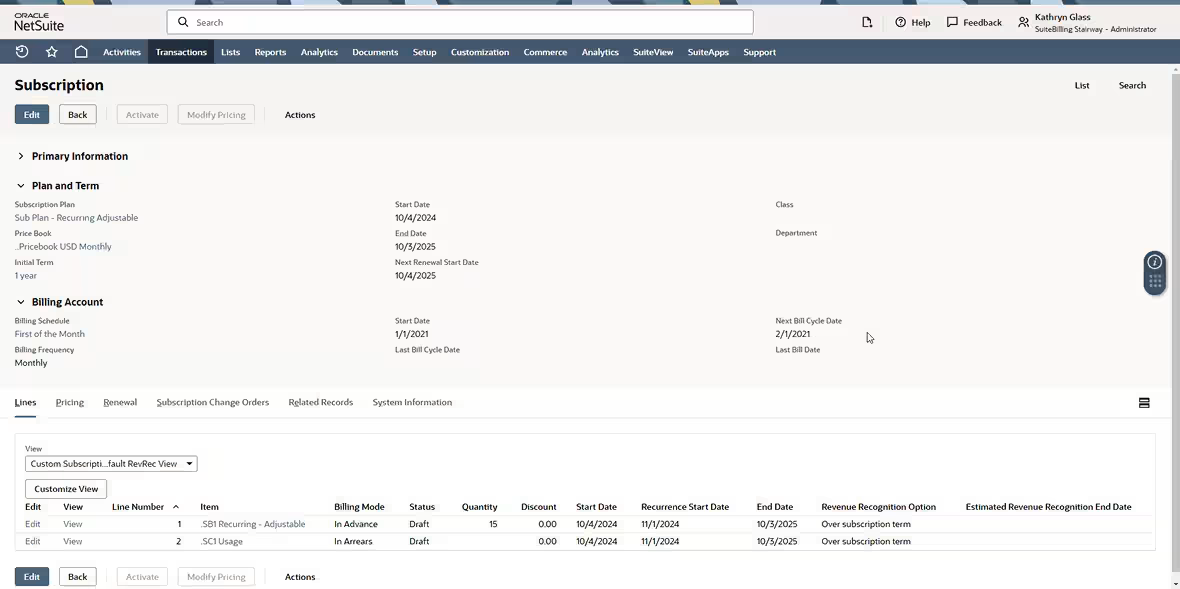
SuiteBilling for subscription management
SuiteBilling allows companies to manage complex subscription models directly within the ERP.
Capabilities include:
- Usage-based billing
- Tiered and volume pricing
- Automated renewals
- Contract amendments
- Recurring invoicing
With billing and financial data unified, companies reduce errors and eliminate the need for separate subscription platforms.
Real-time SaaS metrics & analytics
Data is everything in SaaS. NetSuite provides dashboards that track:
- ARR and MRR
- CAC
- Churn rates
- Net Revenue Retention (NRR)
- Deferred revenue balances
Role-based dashboards ensure executives, finance teams, and department leaders see relevant insights instantly. Built-in forecasting tools help predict revenue trends and support strategic planning.

Order-to-cash automation
Manual quote-to-cash processes slow down growth and introduce risk. NetSuite automates:
- Contract-to-invoice workflows
- Integration with CRM platforms like Salesforce
- Subscription renewals
- Billing amendments
- Payment processing
By reducing manual entry and reconciliation, companies shorten billing cycles and improve cash flow.
Scalability & global expansion
As SaaS businesses scale, entity structures multiply, deferred revenue grows, and manual revenue schedules become unmanageable. NetSuite manages this complexity with:
- Multi-entity consolidation
- Multi-currency transactions
- Intercompany eliminations
- Regional tax compliance
- IPO readiness
This scalability ensures companies don’t outgrow their ERP as they expand.
Benefits of NetSuite for SaaS & Software Companies
- Improved compliance & investor-ready reporting – With automated revenue recognition and audit trails, finance teams gain confidence in compliance. Clean financials support fundraising, board reporting, and IPO preparation.
- Reduced operational bottlenecks – Replacing spreadsheets and disconnected systems eliminates manual reconciliations and duplicate data entry. Standardized processes improve accuracy and speed.
- Increased efficiency across teams – Automated billing workflows and streamlined quote-to-cash processes reduce administrative burden. Finance teams spend less time on manual tasks and more time on strategic initiatives.
- Enhanced visibility & strategic decision-making – Real-time financial dashboards empower leadership to make data-driven decisions. Instead of reactive reporting, companies gain proactive insights.
- Scalable infrastructure for growth – As pricing models evolve and markets expand, NetSuite adapts. Companies can introduce new offerings without rebuilding their financial systems.
FAQ: NetSuite for software & SaaS companies
How does NetSuite help with ASC 606 compliance?
NetSuite’s Advanced Revenue Management automates revenue allocation, recognition schedules, and contract modifications while maintaining detailed audit trails for compliance with ASC 606 and IFRS 15.
Can NetSuite handle usage-based or hybrid billing models?
Yes. SuiteBilling supports usage-based pricing, tiered structures, subscription renewals, and hybrid models combining services and software.
How does NetSuite track SaaS KPIs like ARR and churn?
NetSuite provides real-time dashboards and customizable reports that track recurring revenue metrics, churn, deferred revenue, and retention rates.
Is NetSuite suitable for early-stage SaaS startups?
Yes. NetSuite scales from early-stage growth through IPO. Startups benefit from implementing a system that won’t require replacement as they expand.
Can NetSuite integrate with Salesforce or other CRM systems?
Yes. NetSuite integrates with Salesforce and other CRM platforms to streamline the quote-to-cash process.
How does NetSuite support global SaaS companies?
NetSuite supports multi-entity consolidation, multi-currency management, and regional tax compliance, making it ideal for international operations.
What is the implementation timeline for NetSuite in a SaaS company?
Implementation timelines vary depending on complexity, but structured methodologies like SuiteSuccess help accelerate deployment and reduce risk.

White Paper
Choosing a NetSuite partner? Start with these 6 criteria
The right NetSuite partner can accelerate your ERP success, while the wrong one can slow it down. Download our guide to discover the six most important factors to consider when evaluating NetSuite partners, plus a list of questions to help you confidently choose the best fit for your business.
Why partner with Rand Group for NetSuite?
Implementing NetSuite for software and SaaS companies requires more than technical configuration, it requires deep industry understanding.
Our NetSuite experts offer:
- Extensive experience implementing NetSuite for SaaS and software organizations
- SuiteSuccess for Software methodology
- Accelerated implementation frameworks
- Industry-specific configurations
- Change management and user adoption support
- Ongoing optimization and managed services
We act as a strategic advisor, not just an implementer. Our team focuses on delivering measurable ROI, scalable system architecture, and long-term success. From startup growth phases to enterprise expansion, Rand Group helps software and SaaS companies maximize the value of their NetSuite investment.
Future-proofing your software or SaaS business
The operational complexity of software and SaaS businesses will only continue to grow. New pricing models, regulatory requirements, global expansion, and investor expectations demand systems that are flexible, automated, and scalable.
NetSuite provides a unified ERP platform designed specifically for recurring revenue businesses. By automating billing, streamlining revenue recognition, and delivering real-time analytics, NetSuite empowers organizations to grow with confidence. If your board is asking for clarity and your systems are creating noise, it may be time to modernize your financial infrastructure. Let’s build a foundation that scales as fast as your growth.Contact our team to learn more.