Cost savings from cloud ERP: How much companies really save by moving to the cloud

Organizations across industries are accelerating their move to the cloud, and ERP systems are often at the center of that transformation. But while cloud ERP promises flexibility, scalability, and ongoing innovation, one question consistently drives decision-making: How much do companies actually save by moving ERP to the cloud?
Cloud migration can significantly reduce total cost of ownership (TCO), improve operational efficiency, and deliver measurable long-term financial benefits. At Rand Group, we help clients evaluate Microsoft Dynamics 365, NetSuite, and Sage cloud solutions every day, and we see firsthand how impactful those savings can be. In this blog, we break down what research shows about Cloud ERP ROI, where cost savings come from, and how organizations can calculate the true financial benefits of modernizing their ERP environment.
Real-world cloud ERP savings: What research shows
While every organization’s savings depend on size, complexity, and existing infrastructure, multiple independent studies consistently show that cloud ERP reduces total cost of ownership (TCO) by 30–60% over 5–10 years. The most widely referenced findings include:
- 4.01× higher ROI for cloud ERP vs. on-premise ERP.
- 200% average ROI with an investment payback of ~16 months.
- Up to 40% lower total costs over five years after eliminating hardware, maintenance, and upgrade expenses.
- 66% lower TCO over 10 years for cloud ERP vs. on-premise in distribution-industry comparisons.
- 21% lower overall IT spending and 16% lower IT cost per user for organizations using cloud ERP.
Most organizations save between 30% and 60% overall by moving ERP to the cloud, with ROI commonly exceeding 200% and payback occurring in roughly 12–18 months.
%
ROI
%
Lower TCO
%
Lower IT costs

White Paper:
Justifying the cloud to the C-Suite
There are multiple possibilities when it comes to strategies for migrating to the cloud. It’s important to be armed with the right information if you are approaching your executive team. Download this whitepaper for powerful insights on what to focus on, when presenting a cloud strategy to your management.
Understanding the true cost of on-premise ERP
Before evaluating cost savings from Cloud ERP, organizations need a clear picture of the full baseline cost associated with maintaining an on-premise environment. While on-premise ERP does offer advantages, such as greater control over infrastructure and data governance, these benefits come with substantial and ongoing financial commitments. Traditional ERP systems create cost layers that extend well beyond initial software licensing and touch nearly every part of the IT budget, from infrastructure and maintenance to security and business continuity.
Hardware & infrastructure
On-premise ERP requires maintaining and periodically replacing physical infrastructure, including:
- Servers and server racks.
- Storage systems.
- Networking equipment.
- Backup hardware.
- Redundant systems for high availability.
These costs recur every three to five years as equipment reaches end-of-life or as capacity requirements increase. Costs also accumulate from data center floor space required, the power and cooling to support the environment, and the physical security and access controls to protect it. This makes hardware and infrastructure one of the most significant long-term cost drivers for on-premise ERP.
Software licenses & upgrades
Maintaining on-premise ERP environments involves ongoing software investments such as:
- ERP application and module licenses.
- Annual maintenance and support fees.
- Periodic version upgrades that can be costly and time-consuming.
- Compatibility adjustments for customizations and integrations.
Internal IT labor
Operating an on-premise ERP system requires dedicated IT resources responsible for:
- Server and application monitoring.
- Patch and update management.
- Backup administration.
- Disaster recovery processes.
- Security and vulnerability management.
- Hardware or network troubleshooting.
Hidden and indirect costs
Beyond hardware and labor, organizations often underestimate indirect expenses that significantly impact total cost of ownership, including:
- Downtime and system disruptions caused by hardware failures, network issues, or delayed patches.
- Energy and cooling costs required to run servers 24/7.
- Disaster recovery planning, including redundant facilities and replication tools.
- Security management and compliance audits, which require ongoing investment.
When you add it all up
When all cost categories are considered, on-premise ERP becomes a substantial and continually rising investment. These systems require ongoing capital expenditures, specialized support, and periodic upgrades that can be both disruptive and expensive, making long-term budgeting difficult for many organizations.
While on-premise ERP offers advantages such as greater control and strong local performance, the cost savings from Cloud ERP increasingly outweigh those benefits. Cloud solutions eliminate most hardware and maintenance expenses, shift spending to a predictable subscription model, and deliver continuous innovation without additional upgrade fees. For most businesses, this combination of financial efficiency and operational agility makes cloud migration the more economical and strategic long-term path.
How companies achieve cost savings from cloud ERP
Cloud ERP replaces hardware-intensive, labor-heavy systems with scalable, subscription-based services. The result is not only a more predictable cost model but also substantial operational efficiencies. Modernized cloud systems streamline workflows, automate routine tasks, and provide real-time data access across departments, enabling faster decision-making and improved collaboration. Companies benefit from continuous software updates, enhanced security, and the ability to scale quickly without costly infrastructure investments. All these enhancements contribute to both cost savings and improved overall business performance.
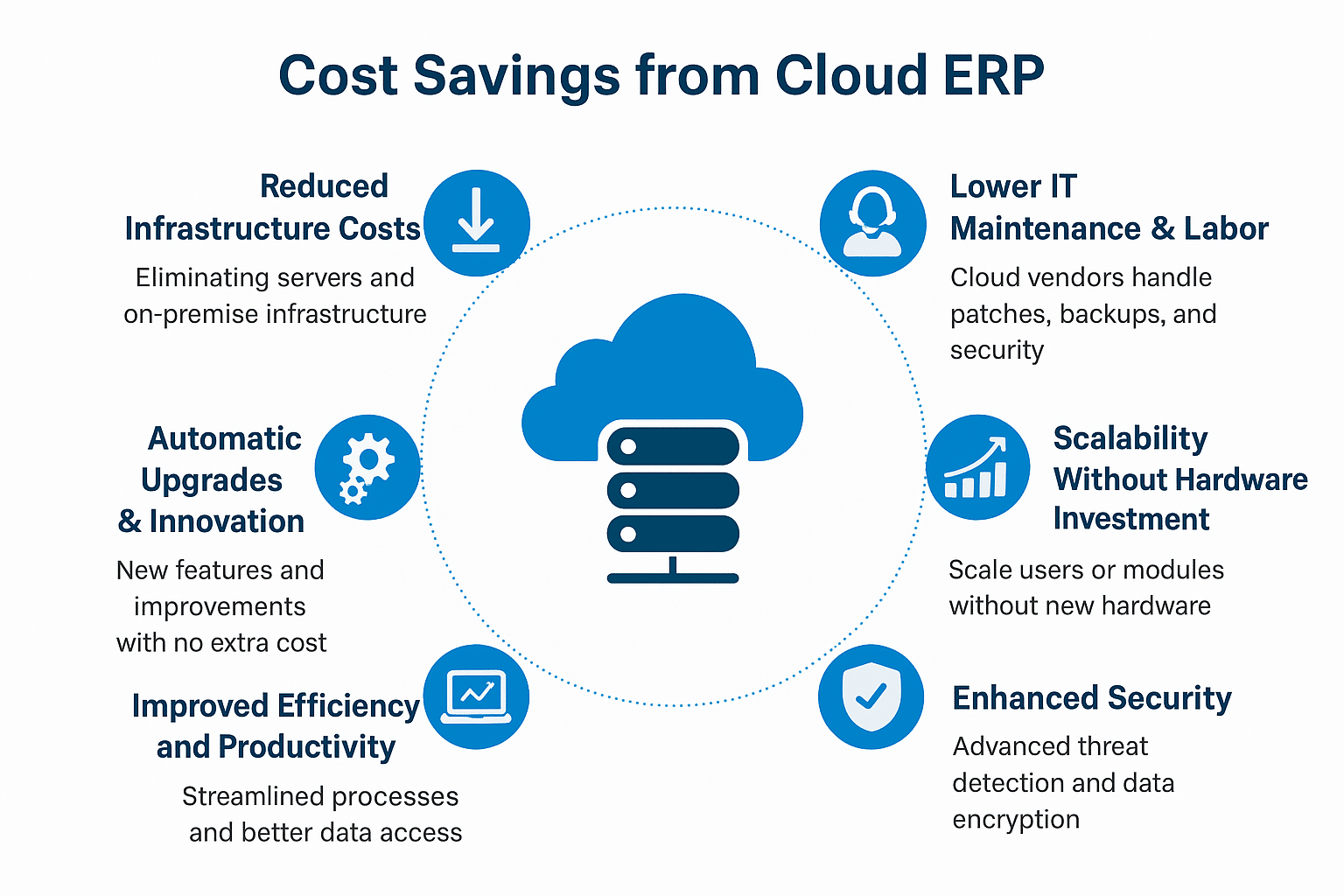
Reduced infrastructure costs
Moving ERP to a cloud environment eliminates the need for servers, storage hardware, network equipment dedicated to ERP, and a physical data center footprint. Backup systems and redundant infrastructure are also handled by the cloud provider. Instead of making large upfront capital expenditures, organizations shift to a flexible operating expense model that aligns costs with actual usage, freeing up resources for other strategic initiatives.
Lower IT maintenance and labor
With cloud ERP, providers take on responsibilities such as applying patches and updates, maintaining servers, managing backups, and overseeing disaster recovery and security monitoring. This allows internal IT teams to focus on higher-value initiatives rather than routine system upkeep, reducing labor costs and increasing operational efficiency.
Automatic upgrades and continuous innovation
Cloud ERP delivers new features and updates automatically, without downtime or additional upgrade fees. Organizations remain current with security enhancements, compliance requirements, and functional improvements without the heavy lift traditionally required for on-premise upgrades. Beyond routine updates, cloud ERP often introduces advanced innovations such as artificial intelligence (AI) for predictive analytics, machine learning to automate complex workflows, and enhanced reporting tools for real-time business insights. Process automation, intelligent dashboards, and AI-driven forecasting allow organizations to optimize operations, improve decision-making, and identify new growth opportunities. This continuous innovation ensures the system evolves with business needs while avoiding costly disruptions, keeping organizations agile and competitive in a rapidly changing market.
Scalability without hardware investment
As businesses grow, cloud ERP scales effortlessly to accommodate additional users, new locations, or expanded modules. Seasonal or rapidly growing companies can increase or decrease system resources based on demand without purchasing additional hardware or performing complex reconfigurations. This flexibility supports growth while keeping costs predictable.
Improved efficiency and productivity
Cloud ERP modernizes workflows by integrating processes across departments, automating repetitive tasks, and providing real-time access to data. Finance, operations, supply chain, and leadership teams can generate insights faster, make more informed decisions, and reduce manual work. These operational improvements translate directly into productivity gains and contribute to significant long-term cost savings.
Enhanced security without added cost
Cloud ERP providers invest heavily in security measures, including advanced threat detection, data encryption, identity management, and compliance certifications. Achieving this level of protection on-premise would require substantial investments in personnel, technology, and ongoing monitoring. By leveraging the cloud, organizations benefit from enterprise-grade security without the prohibitive cost.
Calculating your organization’s cloud ERP savings
To build a strong business case for moving to cloud ERP, organizations should evaluate several key factors, including current infrastructure and maintenance costs, number of ERP users, industry compliance requirements, customizations and integrations, data volume and storage needs, and expected growth or seasonality. A structured total cost of ownership (TCO) analysis helps highlight where savings will occur and how quickly ROI can be realized.
As a simple example, you can estimate annual cloud ERP savings using the following formula:
Annual Cloud ERP savings = (Current on-premise costs – cloud subscription costs) + labor savings + efficiency gains
Where:
- Current on-premise costs include hardware, software licenses, maintenance, upgrades, and IT labor.
- Cloud subscription costs is the total annual cost for the chosen cloud ERP solution.
- Labor savings represents the reduction in IT hours spent on maintenance, upgrades, and support.
- Efficiency gains can be estimated as the value of productivity improvements across departments enabled by modern cloud workflows, automation, and real-time reporting.
Finding the right cloud ERP for your business
Choosing a Cloud ERP solution that aligns with your unique business requirements is critical to maximizing both operational efficiency and cost savings. At Rand Group, we help organizations evaluate and implement leading cloud ERP solutions, including Microsoft Dynamics 365, NetSuite, and Sage Intacct. Each platform offers distinct advantages: Microsoft Dynamics 365 provides scalable, modular architecture with deep integration into Microsoft 365 and Azure, along with automatic updates and robust security features. NetSuite is a built-for-cloud solution that supports rapid deployment, strong financial management, and flexibility for fast-growing or multi-entity organizations. Sage Intacct delivers cloud-native financial management with powerful automation for accounting and reporting, ideal for companies with complex financial processes. By assessing total cost of ownership, business fit, and potential savings, Rand Group helps clients select the solution that delivers the greatest efficiency, scalability, and measurable cost reductions for their operations.

Move to the cloud with Rand Group
Migrating to the right ERP is a critical decision that will transform your business. Our experts simplify this journey, we provide a cloud readiness assessment and a software selection evaluation to guide you every step of the way. Connect with one of our experts today to start your successful move to the cloud.
How Rand Group helps maximize cloud ERP cost savings
Migrating ERP to the cloud is a major decision that impacts both technology and business operations. Rand Group offers end-to-end services to help organizations evaluate, plan, and execute cloud ERP migrations with confidence. Our approach ensures that every step, from assessment to ongoing optimization, delivers measurable value, reduces risk, and maximizes ROI.
Our key services include:
- Cloud readiness assessments
We evaluate your existing systems, infrastructure, and processes to determine the optimal migration path. This helps identify potential challenges, resource requirements, and areas for efficiency improvements. - TCO and ROI modeling
We quantify potential cost reductions, efficiency gains, and long-term financial benefits to build a strong business case for cloud ERP migration. - Migration planning
We develop a detailed roadmap covering timing, resources, risk mitigation, and change management to ensure a smooth, minimally disruptive transition. - ERP implementation
Our team implements cloud-based solutions across Microsoft Dynamics 365, NetSuite, and Sage Intacct, tailoring each system to your organization’s unique business requirements. - Managed services and ongoing optimization
After migration, we provide continuous support, monitoring, and guidance to maintain system performance, implement new features, and improve workflows over time to ensure your organization continues to maximize their software investment.
Next steps
Companies increasingly choose cloud ERP not just for technical benefits, but for the substantial financial advantages it delivers. From reducing infrastructure costs to unlocking greater efficiency and scalability, the cost savings from cloud ERP are clear and compelling. If your organization is considering a move to the cloud, our team can help you quantify the savings and build a tailored migration strategy. Reach out today to connect with a system expert to learn more about our solutions and to schedule and ROI assessment.



Subscribe to our Insights