NetSuite
What are AI agents in NetSuite ERP?

Artificial intelligence is rapidly transforming enterprise software, and ERP systems are no exception. Organizations today expect their platforms to do more than simply store data and automate basic workflows. They need systems that can analyze information, identify trends, and support better decision-making.
This is where AI agents in Oracle NetSuite ERP are beginning to reshape how companies operate. NetSuite is embedding intelligent AI capabilities directly into its platform through AI-powered assistants that help organizations analyze data, detect anomalies, generate insights, and automate tasks across finance and operations. For example, instead of manually investigating why an account balance changed, finance teams can use AI agents to automatically flag unusual fluctuations and generate explanations based on transaction activity and historical patterns.
Unlike traditional rule-based automation, NetSuite AI agents can interpret large datasets, recognize patterns, and interact with users through natural language. These capabilities allow the system to assist with processes such as reconciliation, forecasting, cost analysis, and financial monitoring. As AI capabilities continue to evolve, AI agents in NetSuite ERP represent a shift toward more intelligent, adaptive enterprise systems that help organizations operate faster and more efficiently. This article explores what NetSuite AI agents are, how they work, and how they are transforming key finance processes across the ERP environment.
What are AI agents in NetSuite ERP?
NetSuite AI agents are digital assistants embedded directly within ERP workflows. They automate complex processes, analyze large volumes of financial and operational data, and generate insights that help organizations make faster and more informed decisions.
These AI agents combine technologies such as:
- Machine learning
- Predictive analytics
- Generative AI
- Workflow automation
Together, these capabilities allow NetSuite to move beyond traditional rule-based automation and deliver intelligent, context-aware decision support directly within the ERP system.
At a high level, AI agents in NetSuite can:
- Analyze large financial and operational datasets
- Identify anomalies, patterns, and relationships within transactions (such as unexpected spikes in expenses or unusual changes in account balances)
- Execute tasks autonomously or semi-autonomously
- Interact with users through natural language queries
- Continuously improve accuracy through machine learning
A key design principle behind NetSuite’s AI-powered agents is the concept of human-in-the-loop governance. While AI can analyze data and suggest actions, human users remain responsible for reviewing recommendations and approving final decisions. This ensures transparency, accountability, and trust in AI-driven processes.
Compared to traditional ERP automation, these agents transform NetSuite from a system that simply records transactions into one that actively helps organizations understand and optimize their business operations.
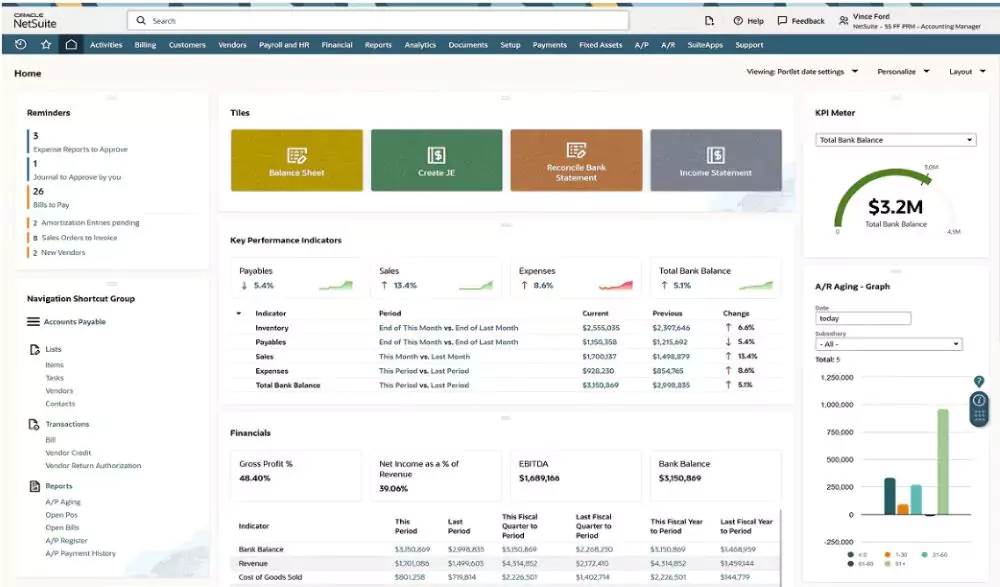
How AI agents transform NetSuite workflows
AI agents in NetSuite combine machine learning, generative AI, and automation to streamline complex financial and operational workflows.
Instead of relying solely on predefined rules or manual analysis, these intelligent assistants continuously evaluate ERP data to detect anomalies, generate insights, and automate repetitive tasks. Common capabilities of NetSuite’s AI agents include:
- Automated workflow execution – AI agents can automate processes such as reconciliation assignments, transaction matching, and financial monitoring, reducing manual intervention across accounting workflows.
- Pattern recognition and anomaly detection – By analyzing historical financial data, AI agents can identify unusual transactions or unexpected changes in account balances, helping organizations detect potential issues earlier (such as duplicate payments, unexpected cost increases, or timing inconsistencies across periods).
- Natural language insights – Generative AI allows NetSuite to produce plain-language explanations for financial fluctuations, forecasts, and operational trends (for example, explaining why gross margin declined in a specific product line or business unit).
- Continuous learning and improvement – As users review AI-generated recommendations, the system improves its models over time, increasing automation accuracy and reliability.
These capabilities enable NetSuite to deliver more proactive and intelligent ERP workflows, allowing finance teams to focus on analysis and strategic decision-making rather than manual data processing.
AI agents and the NetSuite Next vision
NetSuite’s investment in AI agents is part of its broader NetSuite Next strategy, which focuses on embedding intelligence directly into ERP workflows. Rather than treating AI as a separate tool, NetSuite is integrating these capabilities into the core platform to help organizations move from reactive reporting to proactive, insight-driven operations.
In practical terms, this means the system is no longer just recording transactions, it is actively helping users understand what is happening in the business and why. For example, instead of waiting until month-end to identify issues, AI agents can surface unusual transactions during the accounting period, explain potential causes, and highlight areas that may require attention before close.
As NetSuite continues to evolve, these intelligent capabilities will become more deeply embedded across finance, planning, and operational processes, making AI-driven insights a standard part of everyday ERP workflows.

Maximize the value of AI agents in NetSuite
Ready to leverage the latest AI-driven capabilities in NetSuite ERP? Connect with our NetSuite team for expert guidance on enabling, optimizing, and scaling AI agents to improve financial visibility, automate workflows, and drive smarter decision-making across your organization.
AI agents enhancing NetSuite EPM solutions
With the NetSuite 2026.1 release, several solutions within NetSuite Enterprise Performance Management (EPM) now include AI-powered assistants that automate complex financial workflows and improve transparency across planning and reconciliation processes. These AI capabilities are embedded directly into tools finance teams use every day, helping organizations manage reconciliations, forecasts, and cost allocations more efficiently.
AI-powered Account Reconciliation in NetSuite
Account reconciliation is one of the most time-consuming steps in the financial close process. AI agents help streamline this work by automating key setup, matching, and analysis tasks.
Key capabilities include:
- Automated reconciliation setup – AI identifies newly created accounts, assigns them to the appropriate preparers, and applies the correct formats and attributes based on previous cycles.
- AI-powered transaction matching – Machine learning enhances traditional rule-based matching by identifying hidden relationships between transactions and suggesting matches with predictive confidence scoring.
- Generative AI flux analysis – AI automatically detects significant account balance fluctuations and generates plain-language explanations based on financial and operational context (such as identifying changes driven by volume increases, pricing shifts, or one-time transactions).
AI-driven forecasting in NetSuite Planning and Budgeting
Forecasting is essential for financial planning, but traditional models often lack visibility into the factors driving projections. AI capabilities in NetSuite Planning and Budgeting improve forecasting accuracy while providing greater transparency into forecast drivers.
Key capabilities include:
- Multivariate AI forecasting – AI models analyze multiple financial and operational variables simultaneously to generate more accurate projections.
- Explainable forecast drivers – The system provides interpretable insights into the factors influencing forecast outcomes (such as revenue changes tied to seasonality, customer demand, or pricing adjustments).
- Improved planning transparency – Finance teams can better validate assumptions and understand how forecasts are generated.
These AI-powered capabilities help organizations make more informed planning decisions and respond more effectively to changing business conditions.

AI assistants for NetSuite Profitability and Cost Management
Designing and analyzing cost allocation models can be a complex process, particularly for organizations with multiple departments, business units, or cost centers. NetSuite’s new AI assistants within Profitability and Cost Management simplify the creation and analysis of allocation models.
The Model Build Assistant interprets user inputs to automatically generate allocation models and rules, significantly reducing the manual effort required to configure cost allocation frameworks.
Meanwhile, the Allocation Trace Assistant generates natural-language explanations of allocation flows. This helps users understand how costs move across the organization and quickly respond to ad hoc inquiries from finance leaders or business stakeholders.
By simplifying model creation and improving transparency, these AI-powered tools help organizations gain deeper insights into cost structures and profitability drivers.

AI agents across finance operations
Beyond EPM solutions, NetSuite’s AI agents are expanding into other finance workflows to help organizations manage increasingly complex financial operations.
For example, solutions like NetSuite Intelligent Close Manager introduce AI-powered monitoring and automation to the financial close process. By analyzing transaction activity and identifying anomalies throughout the accounting period, these tools help finance teams detect risks earlier and maintain better oversight of close progress.
Similarly, AI-powered document processing capabilities can automate invoice extraction and data entry, reducing manual workloads in accounts payable processes.
Together, these innovations demonstrate how NetSuite AI agents are transforming ERP workflows from reactive processes into proactive, insight-driven systems.

Benefits of AI agents in NetSuite
By embedding AI directly into ERP workflows, NetSuite enables organizations to manage finance operations more efficiently while gaining deeper visibility into business performance.
Key benefits of NetSuite’s AI-powered agents include:
- Faster financial processes – Automated reconciliation, monitoring, and workflow management help accelerate financial close cycles and reduce delays caused by manual tasks.
- Improved financial accuracy – AI-powered anomaly detection helps identify discrepancies earlier, reducing the risk of errors in financial reporting.
- Greater transparency into financial insights – AI-generated narratives and forecasting explanations make complex financial data easier to interpret and communicate across the organization.
- Reduced manual workloads – Automation reduces time spent on administrative tasks such as transaction matching, reconciliation setup, and data analysis.
- More proactive decision-making – Real-time insights allow finance leaders to identify issues earlier and respond more quickly to changing business conditions.
While these AI capabilities are powerful, their effectiveness depends on well-structured data, clearly defined processes, and thoughtful configuration. Organizations that take a strategic approach to implementing AI agents are better positioned to achieve accurate insights and meaningful automation outcomes.
The future of AI agents in Oracle NetSuite ERP
The introduction of AI agents in NetSuite represents just the beginning of a broader transformation in ERP technology. As artificial intelligence continues to evolve, ERP systems will increasingly function as intelligent business platforms capable of analyzing data, recommending actions, and automating complex workflows across the enterprise.
Future innovations may include:
- More autonomous financial workflows
- Expanded generative AI capabilities across reporting and planning
- Deeper integration of predictive analytics into operational processes
Oracle continues to expand AI functionality across NetSuite’s financial management, enterprise performance management, and supply chain solutions, bringing advanced intelligence directly into everyday ERP workflows.
NetSuite AI agents FAQs
What are AI agents in NetSuite?
AI agents in NetSuite are intelligent digital assistants embedded within the ERP system that analyze data, automate workflows, and generate insights to support decision-making across finance and operations.
How do AI agents improve financial processes?
AI agents help automate tasks like reconciliation, transaction matching, and financial monitoring. They can also flag anomalies, such as unexpected changes in account balances, and generate explanations to help teams understand what’s driving those changes.
Are NetSuite AI agents fully autonomous?
No. NetSuite AI agents operate within a human-in-the-loop model. They generate insights and recommendations, but users review and approve actions to maintain accuracy and control.
Do AI agents replace finance or accounting roles?
No. AI agents are designed to reduce manual work and support decision-making, allowing finance teams to focus more on analysis and strategy rather than repetitive tasks.
What do organizations need to get started with AI agents in NetSuite?
Organizations need clean, well-structured data and clearly defined processes. Identifying the right use cases, such as reconciliation or forecasting, is key to getting meaningful results.
How do AI agents relate to NetSuite Next?
AI agents are a core part of NetSuite’s “NetSuite Next” strategy, embedding intelligence directly into ERP workflows to help organizations move from reactive reporting to proactive, insight-driven operations.
How is data security handled with AI agents in NetSuite?
NetSuite AI agents operate within the platform’s existing security framework, following role-based access controls, permissions, and data governance policies already in place. They only access data that users are authorized to view, and all processing occurs within the secure NetSuite environment. This ensures organizations maintain control over sensitive financial and operational data while leveraging AI-driven insights and automation.
Optimize AI in NetSuite with Rand Group
While NetSuite’s AI capabilities introduce powerful new opportunities for automation and insight, organizations often need guidance to successfully implement and optimize these innovations. As a NetSuite Alliance Partner, we help organizations configure and deploy NetSuite solutions to maximize business value.
Our team works with finance leaders to:
- Implement and configure new NetSuite AI capabilities
- Optimize financial workflows and automation processes
- Improve reporting, reconciliation, and planning processes
- Align ERP systems with evolving business needs
Beyond implementation, our NetSuite experts provide ongoing support and optimization services to help organizations continuously improve their ERP environments as new features and innovations are introduced.
Next steps
AI agents in NetSuite represent a major step forward in enterprise software, combining machine learning, generative AI, and ERP data to automate financial workflows, uncover insights faster, and improve decision-making. For organizations looking to modernize their ERP systems, NetSuite AI agents provide a strong foundation for more intelligent, data-driven operations.
To fully realize this value, organizations need the right strategy and optimization approach. Connect with our NetSuite experts to maximize your investment and successfully implement AI-driven solutions tailored to your business.