What is the average ROI of an ERP implementation?

Investing in an enterprise resource planning (ERP) system is one of the most significant technology decisions a business can make. From automating manual processes to unifying finance, operations, and supply-chain data, ERP delivers measurable business value, but how much? Understanding the average return on investment (ROI) of ERP implementation helps organizations set realistic expectations and make informed decisions about their digital transformation. This blog will bring together the most recent ERP ROI statistics from leading research firms to provide a clear, data-backed view of what organizations can expect. Our goal is to help business leaders evaluate whether their ERP investment is delivering the full financial and operational return possible.
Why ROI matters when evaluating ERP software
ROI often turns ERP from an IT project into a strategic business decision. For CFOs, CIOs, and business leaders, ROI answers critical questions:
- How long will it take for the system to pay for itself?
- What operational gains can be quantified in financial terms?
- How does ERP support scalability, flexibility, and visibility?
- How does it mitigate risk often found with legacy systems, manual workflows, and data silos?
In short, ROI provides the language of business value, moving the conversation beyond features and modules into outcomes. ROI focuses on improvements in productivity, cost-structure, decision-making, and growth. Of course, ROI varies significantly depending on organization size, industry, deployment model (cloud vs. on-premise), and how well the project is executed.

White Paper:
Top 10 ERP software selection checklist
Download our full whitepaper for a structured, side-by-side comparison of today’s leading ERP platforms. This comprehensive resource is designed for organizations evaluating their options and preparing to make an informed decision. Our checklist will guide you through the ten essential steps for selecting ERP software, ensuring that you choose the solution that best fits the needs of your business.
The average ROI of ERP implementations
Recent research from independent analysts and vendor-commissioned studies shows that ERP implementations can deliver strong returns, though results vary depending on scope, deployment model, and execution. Here are some key findings we discovered:
- Fast payback and high ROI: Nucleus Research analyzed ERP deployments from 2018–2019 and found that organizations typically recovered their investments in 16 months on average, achieving over 200% ROI.
- Cloud deployments outperform on-premises: In a white-paper analysis of 101 ERP ROI case studies, Nucleus reported that “cloud ERP deployments deliver 4.01 times the ROI of on-premises systems”.
- Time-to-value matters: Panorama Consulting Group emphasizes that go-live should be seen as the start of value realization. Measuring time-to-value (TTV) is critical to understand the true ROI of an ERP implementation.
- Industry averages: According to ZipDo, “the average ROI for ERP projects is around 150%, with payback periods typically between 1–3 years.”
What this means for mid-market and enterprise organizations:
- Typical ROI: ~150% to 400% (1.5× to 4× payback), depending on project scope, deployment model, and execution quality.
- Typical payback period: 12–36 months, with many cloud implementations achieving faster returns.
- Cloud vs. on-premises: Cloud ERP tends to deliver faster payback and higher ROI, thanks to lower upfront costs, quicker implementations, and more frequent innovations.
ERP remains a high-impact investment when approached strategically, and cloud deployments often provide the fastest path to measurable business value.
Key factors that drive ERP ROI
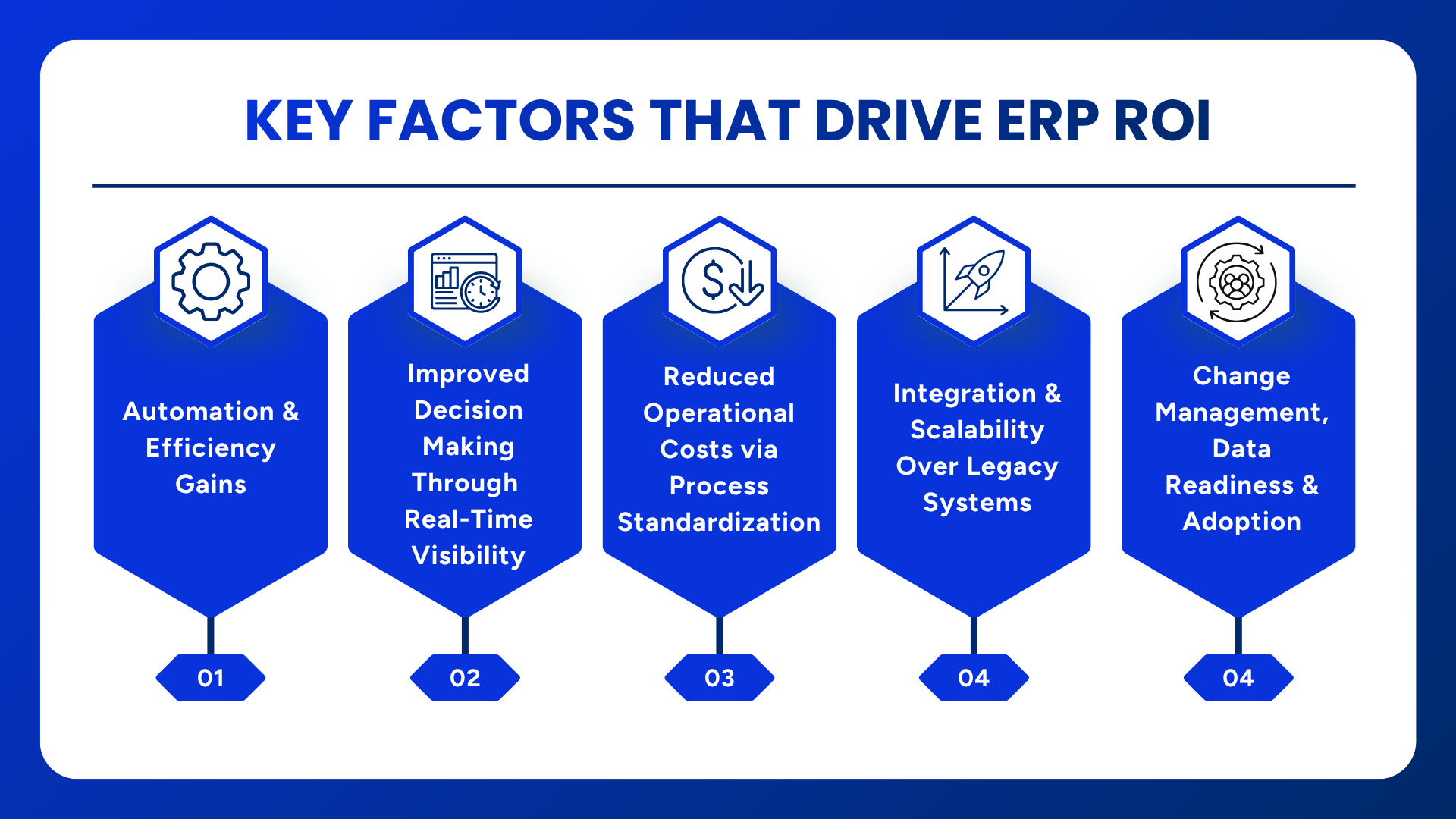
Achieving a strong ROI from ERP isn’t just about choosing the right software, it’s about how the system is implemented, adopted, and aligned with your business goals. In our experience, and across industry research, several common factors consistently separate the highest-performing ERP projects from the rest. Here are some of the key drivers that make the biggest impact:
- Automation & efficiency gains
Reducing manual data entry, spreadsheets, and legacy system manual work arounds saves labor cost and time. With ERP you gain a faster month-end close, order-to-cash cycles, and procurement workflows. - Improved decision-making through real-time visibility
ERP brings data out of silos unifying finance, operations, supply chain, and more. This enables business leaders to act faster with data driven insights. Panorama emphasizes the strategic value of “real-time data, adoption, process improvement.” - Reduced operational costs via process standardization
Consolidating systems and standardizing processes lowers maintenance overheads, reduces the need for customizations, and minimizes errors and rework. Nucleus’s ROI framework indicated ERP provided a lower total cost of ownership and improved productivity. - Integration & scalability over legacy systems
Migrating to a Cloud ERP reduces the need for patching, hardware upgrades, and multiple disparate modules. Nucleus’s analysis found cloud deployments showed 4x the ROI of legacy on-premise solutions. - Change management, data readiness & adoption
Research regularly shows that poor change management and incomplete data readiness degrade ROI significantly. While not always quantified in public reports, this is where an expert implementation makes the difference.
How long does it take to see ROI from ERP?
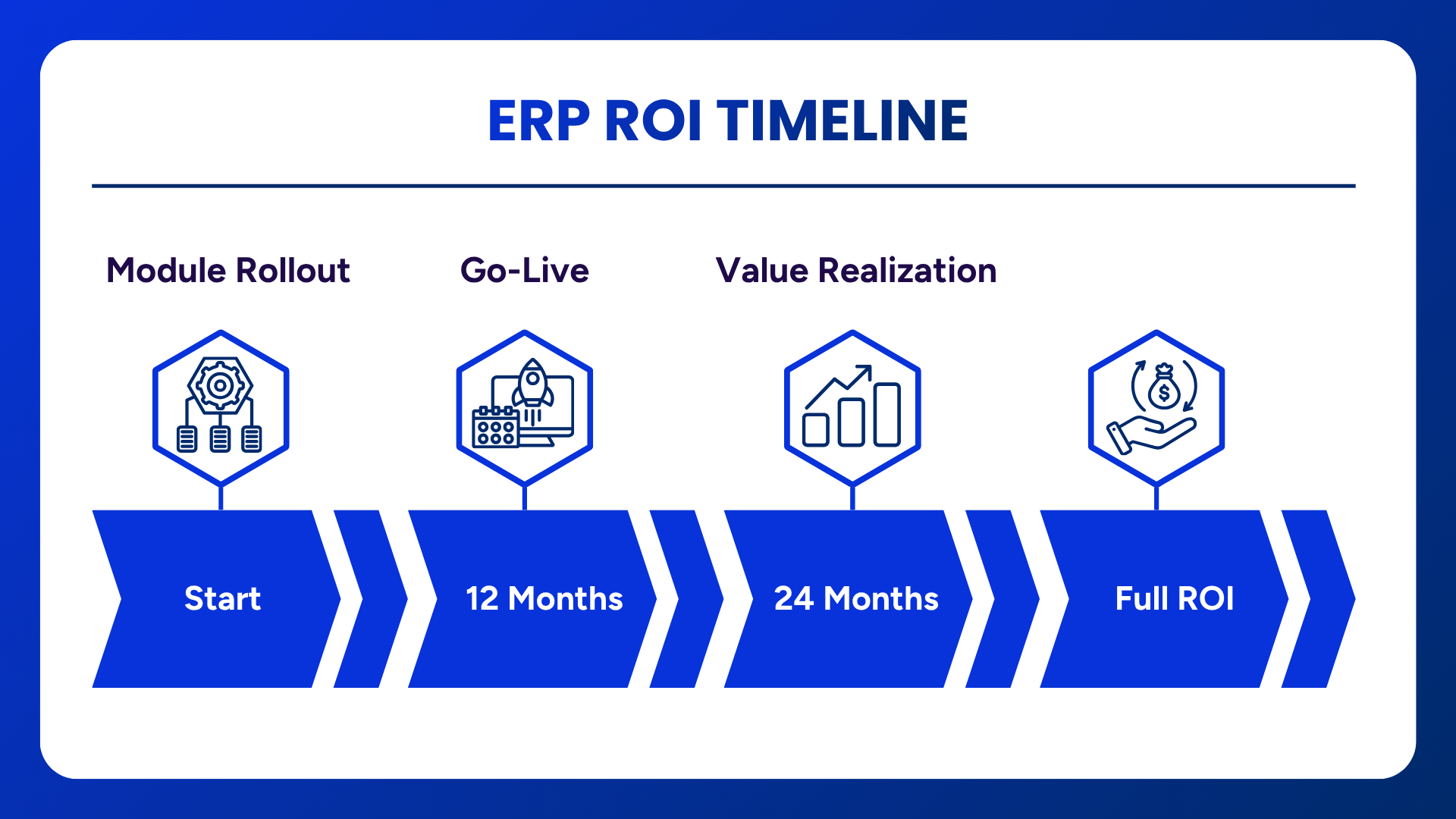
When it comes to ERP implementation, timing matters just as much as the magnitude of return. Most organizations don’t realize the full financial benefits overnight, but the payoff can be substantial once the system is up and running. According to Panorama Consulting Group, the typical ERP payback period ranges from 18 to 36 months, depending on company size, deployment model, and how well the project is managed.
However, businesses implementing Cloud-based solutions tend to see results sooner. A Nucleus Research analysis found that organizations deploying cloud ERP systems “recover costs 2.5 times faster than those using on-premises solutions,” largely due to lower upfront investment and shorter implementation timelines. Similarly, Oracle reports that “the speed of deployment with cloud solutions is commonly delivered on a timeline of weeks to months, while on-premises technology often takes multiple years”, underscoring the financial advantage of modern, subscription-based platforms.
Ultimately, the speed of ROI depends on more than the technology itself. Projects with a clearly defined scope, strong change management, and early user adoption consistently realize value faster. When employees are trained effectively and the solution is implemented with minimal customization, organizations can begin seeing measurable benefits within the first 12 to 24 months after go-live. Partnering with an experienced ERP team like Rand Group ensures the implementation is structured, scalable, and optimized to deliver those results as quickly as possible.
Real-world examples of ERP ROI
ERP investments aren’t just about cost savings, they’re about unlocking agility, improving cash flow, speeding up month-end close, and enabling smarter decision-making. To see how this plays out, let’s look at some real-world examples across industries and platforms.
A Forrester Total Economic Impact (TEI) study of a manufacturing organization using ERP found a 106% ROI over three years, with payback in just 17 months. The study noted:
“We now have better access to data, and all divisions and affiliates speak the same system language,” said the VP of IT. The benefits included productivity improvements of $8.9M and IT infrastructure savings of $3.9M. This shows that ERP isn’t just software, it’s a tool for operational alignment and efficiency.
Cloud ERP has enabled firms to cut time-consuming financial processes. One public case study highlighted a professional services firm that reduced its monthly close by 50%, freeing the finance team to focus on analysis rather than data entry.
“It wasn’t uncommon for the close process to stretch over a month. Now, month-end close is 50% faster on average,” said the company’s Corporate Controller.
Gartner’s 2024 ERP Value Study supports these outcomes, noting that “organizations that modernize ERP environments to a composable, cloud-based architecture realize up to 30% faster time-to-value and 20% higher process efficiency compared with those maintaining legacy core systems.” Gartner further highlights that “ERP investments are increasingly justified by operational agility and decision intelligence, not just cost reduction,” aligning with the real-world results seen in these examples.
Rand Group’s real-world client work illustrates even more dramatic ROI
- Cirkul (beverage manufacturer) replaced a legacy ERP with Microsoft Business Central and reported 20x ROI while cutting month-end close to just one week.
- Conquest Completion Services (oilfield services) implemented Dynamics 365 Finance & Operations and achieved 3x faster PO approvals and reduced A/R and A/P staff from 7 to 2.5.
“With these efficiencies, we streamlined operations and significantly improved key accounting metrics, including reducing DSO from 15–20 days to 3 days,” the CFO noted. - Mann Eye Institute (healthcare) reported a 60% reduction in manual data entry and a 95% reduction in AP report time after implementing NetSuite. This freed staff for more value-added and strategic focused work.
- A senior living company switched to Sage Intacct and was able to manage 50% more entities without adding staff and boosted intercompany transaction efficiency by 97%.
ROI
Faster PO approvals
%
Reduction in manual data entry
How to calculate your organization’s ERP ROI
To estimate your own ERP ROI, start with a simple formula:
ROI = (Net benefit) ÷ (Total cost) × 100
Here’s how to break it down:
-
- Total cost – all the investments required to implement and run your ERP over a defined period (e.g., 3–5 years)
- Software costs – Licensing or subscription fees (cloud or on-prem)
- Implementation & integration – Customizations, data migration, consulting fees
- Training – User onboarding and ongoing learning
- Change management – Communication, process redesign, adoption programs
- Maintenance & support – Technical support, system upgrades, patches
- Net benefit – the value your organization gains from ERP adoption
- Labor savings – Fewer manual tasks, more efficient workflows
- Process efficiencies – Faster approvals, reduced cycle times, streamlined operations
- Lower IT and maintenance costs – Consolidation of legacy systems, reduced downtime
- Error/exception cost reduction – Fewer invoice errors, reduced rework, lower compliance risk
- Faster decision-making – Real-time insights enabling incremental revenue or margin improvement
- Other tangible & intangible benefits – Improved customer satisfaction, scalability for growth, enhanced reporting
Step-by-step:
- Define timeframe (e.g., 3 years).
- Tally all implementation and ongoing costs over the timeframe.
- Estimate benefits (ideally quantifiable) e.g., hours saved × labor cost, reduction in working capital, improved margins, fewer audit adjustments.
- Compute ROI percentage and payback period (time when cumulative benefits = cumulative cost).
- Sensitivity-check: conduct ‘best case’ vs ‘worst case’ scenarios (e.g., slower adoption, more customization, delayed go-live).
- Total cost – all the investments required to implement and run your ERP over a defined period (e.g., 3–5 years)
How Rand Group helps maximize ERP ROI
The upper end of the ROI envelope (250%-400% +) depends on more than technology. It depends on expertise, planning, change-management and long-term alignment.
At Rand Group we bring that value with:
- A proven implementation methodology focused on business outcomes: we don’t just deploy software, we measure what matters (efficiencies, payback period, adoption).
- Cross-platform expertise across Microsoft, NetSuite, and Sage ERP enabling us to provide the best solution to fit your unique business needs.
- Enhanced analytics, custom training, and ongoing optimization. We understand that real ROI doesn’t end at go-live. We help our clients sustain investment savings and grow value.
- Experience across diverse industries such as manufacturing, distribution, and services gives us the insight to benchmark your ROI and focus on metrics your stakeholders care about: cost-to-close, inventory turns, cash-conversion cycle.
If your organization is evaluating an ERP, or hoping to get more value from your current system, We can help you quantify potential returns, build the roadmap and accelerate your payback period.

Are you getting the best ROI for your ERP investment?
Connect with one of our ERP experts today to learn about strategies to accelerate ERP ROI for your organization.
Ready to measure your ERP ROI?
Whether you’re considering a new ERP investment or looking to unlock more value from your existing system, now is the time to take a data-driven approach. At Rand Group, we help businesses benchmark their current processes against industry ROI norms, build tailored cost-benefit models specific to your operations, and identify both quick-win optimizations and long-term strategic levers to maximize value. Our team works with leading platforms like Microsoft Dynamics 365, NetSuite, and Sage to enhance cost savings, improve efficiency, and drive measurable business outcomes. Contact us today to explore your ERP options and discover how we can help your organization accelerate ROI while transforming the way you work.



Subscribe to our Insights