NetSuite
What does a NetSuite consultant do and when do you need one?

NetSuite can be a powerful platform, but getting the most from it depends on how well the system is aligned with the way your business operates.
A NetSuite consultant helps organizations implement, configure, integrate, customize, optimize, and support Oracle NetSuite while connecting business requirements with the right platform capabilities.
Whether you are launching NetSuite, improving an existing environment, resolving reporting or integration issues, or preparing for growth, the right consultant can help you get more value from your investment.
At a glance
A NetSuite consultant helps organizations align NetSuite with their business processes, requirements, and growth goals. From implementation and configuration to integrations, customization, optimization, and ongoing support, consultants provide specialized expertise throughout the ERP lifecycle. This guide explains what NetSuite consultants do, when to engage one, and what to look for when choosing the right consultant or partner.
What is NetSuite?
NetSuite is Oracle’s cloud-based ERP platform designed to help organizations manage financials, inventory, customer relationships, orders, projects, ecommerce, reporting, and other business processes within an integrated system.
Instead of maintaining disconnected systems for accounting, inventory, sales, reporting, and other functions, organizations can use NetSuite to create a centralized source of business information.
Depending on an organization’s requirements, NetSuite capabilities can include:
- Financial management and accounting
- Inventory and warehouse management
- Order management
- Customer relationship management (CRM)
- Manufacturing
- Professional services automation
- Planning and budgeting
- Ecommerce
- Reporting, dashboards, and analytics
- Multi-entity and global financial management
The breadth of the platform is one of NetSuite’s advantages, but it also means organizations have many decisions to make about how the system should be structured.
Every business has different processes, reporting requirements, organizational structures, integrations, and growth objectives. An effective implementation therefore requires more than enabling modules and importing data. NetSuite must be aligned with the organization’s underlying business requirements.
That is one of the primary responsibilities of a NetSuite consultant.
What is a NetSuite consultant?
A NetSuite consultant is a professional who helps organizations translate business requirements into an effective NetSuite solution.
Depending on the engagement, a consultant may help with ERP strategy, implementation, configuration, data migration, integrations, development, reporting, training, optimization, or ongoing support.
Successful NetSuite consulting combines platform expertise with an understanding of business processes.
For example, a finance team might say it needs a new report. Before simply building one, an experienced consultant should determine why the report is necessary, where the underlying data comes from, whether existing processes are capturing the right information, and whether a native NetSuite capability can meet the requirement.
The objective is not simply to make NetSuite perform a requested task. It is to determine the most effective, scalable way to support the business.

Get expert guidance from a NetSuite consultant
The right NetSuite consultant can help align your ERP with your business needs and long-term goals. Contact Rand Group today to learn how our NetSuite experts can help.
What does a NetSuite consultant do?
The responsibilities of a NetSuite consultant vary based on the organization’s needs and where it is in the ERP lifecycle. Some consultants specialize in functional processes, while others focus on technical development, implementation, or ongoing support.

Analyze business processes and requirements
A NetSuite project should begin with an understanding of the business rather than the software.
Consultants work with stakeholders across departments such as accounting, finance, sales, operations, inventory, and IT to document how work is performed today and how it should operate in the future.
This may include identifying:
- Manual and spreadsheet-based processes
- Reporting challenges
- Duplicate data entry
- Approval bottlenecks
- Inefficient workflows
- Opportunities for automation
- Internal control requirements
- Integration dependencies
- Future scalability requirements
A good consultant does not automatically replicate existing processes in NetSuite. Some processes may need to be redesigned before they are automated.
Plan and configure NetSuite
Once requirements have been defined, consultants help translate them into NetSuite configuration.
That can include configuring:
- General ledger and accounting structures
- Subsidiaries and legal entities
- Roles and permissions
- Approval processes
- Workflows
- Custom fields and forms
- Saved Searches
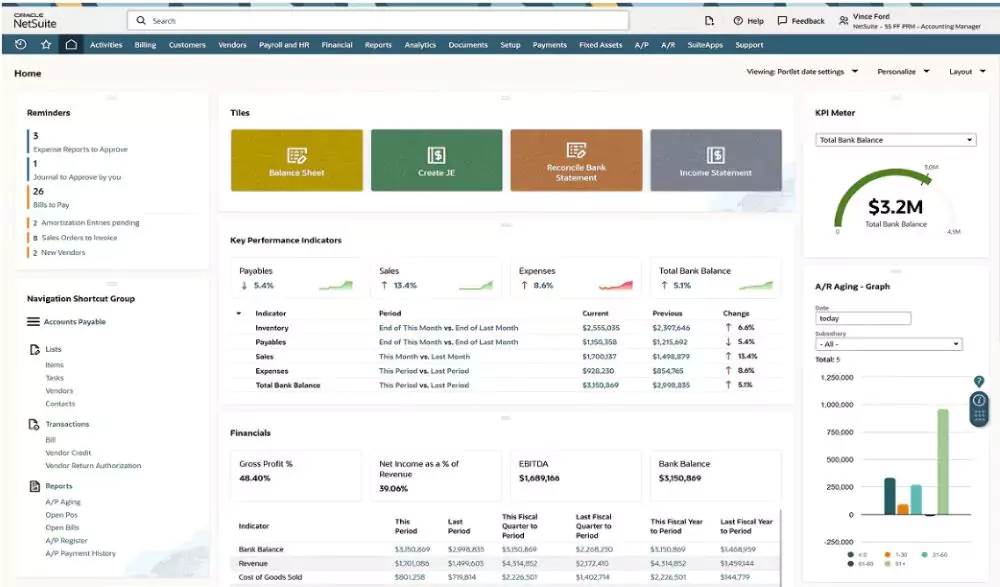
- Dashboards and KPIs
- Financial reporting
- Inventory and operational processes
The goal is to create an environment that supports users today without making the system unnecessarily difficult to maintain tomorrow.
Manage data migration
Moving information from a legacy accounting or ERP platform is one of the most important parts of a NetSuite implementation.
A NetSuite consultant may help identify what should be migrated and then clean, map, transform, import, and validate the data.
Depending on the project, that may include:
- Customers and vendors
- Chart of accounts
- Open transactions
- Inventory
- Fixed assets
- Historical financial information
- Other master and operational records
Data migration is not simply a technical import exercise. Decisions about historical data, account structures, duplicate records, and data quality can have long-term consequences for reporting and operations.
Integrate NetSuite with other applications
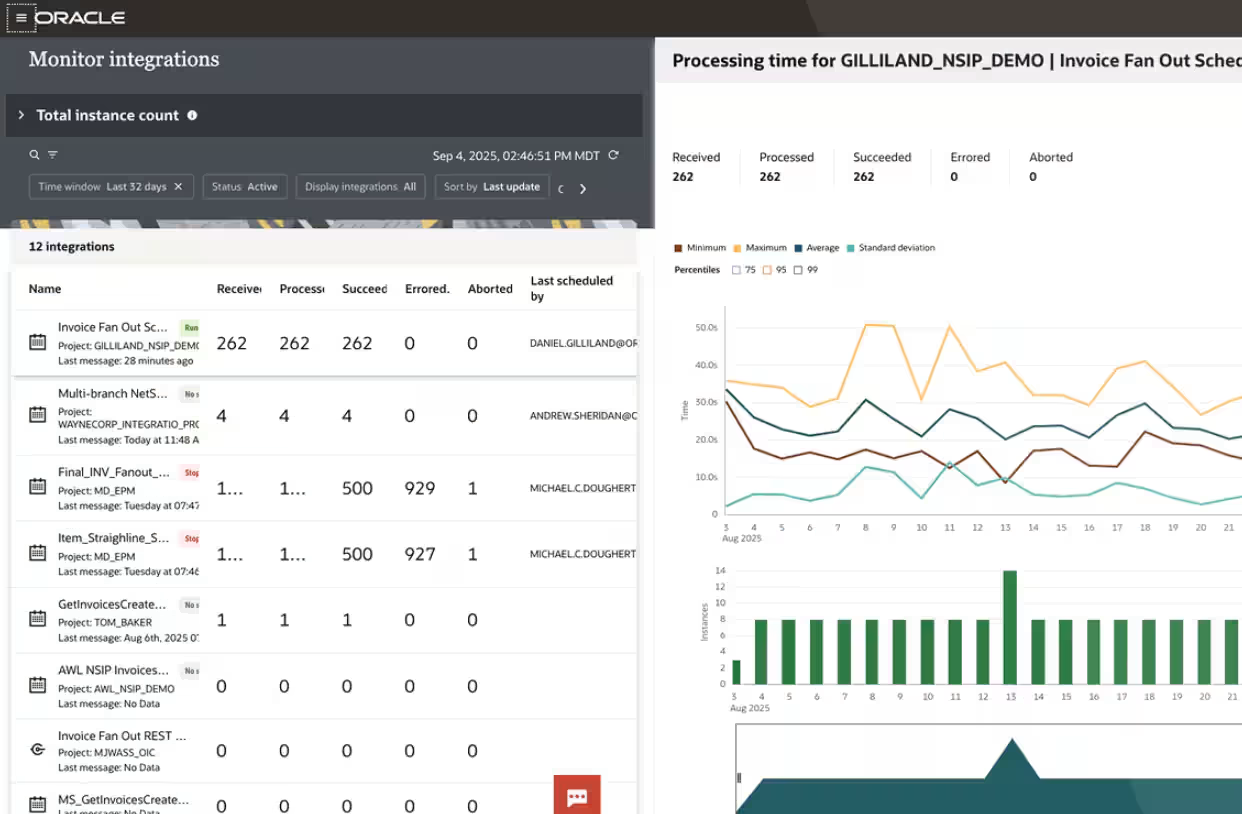
Most organizations do not operate NetSuite in isolation. A consultant may help connect NetSuite with ecommerce platforms, CRM applications, warehouse systems, payment solutions, banking platforms, payroll systems, shipping applications, or specialized industry software.
Integration work requires both technical and business knowledge. Consultants need to understand not only how data moves between systems, but also why it moves, which application should own the data, and what should happen when an exception occurs.
Configure or customize NetSuite
Not every unique business need requires custom code.
An experienced NetSuite consultant can determine whether a need can be addressed using native capabilities such as workflows, forms, records, roles, SuiteAnalytics, or other configuration tools before introducing additional development.
When native functionality is not sufficient, technical NetSuite consultants and developers may extend the platform using technologies such as SuiteScript, SuiteTalk, custom records, and integrations.
Rand Group takes a business-first approach to these decisions. Using native functionality when appropriate can reduce technical debt and simplify future upgrades and support, while targeted customization can add significant value when a genuine business requirement cannot otherwise be met. That balance between native functionality and purposeful customization is especially important when an organization has complex or industry-specific requirements.
Henry Resources provides an example of this balance. The organization needed to replace fragmented accounting systems and manual processes while supporting the specialized requirements of its family office and oil and gas operations. Rand Group helped implement NetSuite while also developing a Joint Interest Billing solution suited to those industry-specific needs. The resulting environment provides automated consolidation, streamlined oil and gas imports, multi-book reporting, and improved visibility across investment operations.
Coordinate testing, training, and go-live
Consultants also help organizations prepare users and systems for deployment.
Their responsibilities may include:
- Building test scenarios
- Supporting user acceptance testing
- Validating integrations
- Reconciling migrated data
- Testing security roles and permissions
- Resolving issues before launch
- Supporting cutover planning
- Delivering role-based training
Training is particularly important because an ERP implementation can technically work as designed and still fail to deliver its expected value if users do not adopt the new processes.
Support and maintain NetSuite after go-live
Go-live is the beginning of ongoing system management, not the end of the NetSuite journey. As users settle into the platform and business requirements evolve, new questions, issues, and enhancement opportunities will emerge.
NetSuite consultants can provide ongoing support for troubleshooting, system administration, reporting, integrations, user requests, enhancements, and NetSuite releases. This gives internal teams access to specialized expertise while helping keep the environment stable and effective.
Provide rescue and recovery for struggling implementations
Not every NetSuite implementation goes according to plan. Delayed timelines, unreliable reporting, broken integrations, excessive customizations, or low user adoption can prevent organizations from realizing the expected value of the platform.
A NetSuite consultant can assess the existing environment, identify root causes, and develop a recovery plan. Depending on the issues, this may involve correcting configurations, simplifying customizations, stabilizing integrations, improving data and reporting, or strengthening user training.
Optimize NetSuite as your business needs evolve
NetSuite requirements rarely remain static. Acquisitions, new subsidiaries or locations, international expansion, new products, and changing business models can introduce processes and requirements that were not part of the original implementation.
A NetSuite consultant can help assess the impact of these changes and determine how the ERP environment should evolve. This may include adding modules, restructuring entities, supporting new operational processes, or extending NetSuite to accommodate greater complexity and transaction volume.
Taking a proactive approach helps ensure NetSuite continues to scale with the organization rather than becoming a constraint on future growth.
What types of NetSuite consultants are there?
“NetSuite consultant” is a broad term. Several types of specialists may participate in an implementation or optimization project.
Functional NetSuite consultants
Functional consultants focus on how business requirements translate into NetSuite.
They commonly work on:
- Accounting and financial processes
- Business process mapping
- Module configuration
- Reporting
- Workflows
- Requirements gathering
- Process optimization
Technical NetSuite consultants and developers
Technical consultants focus on extending and connecting NetSuite.
Their work may include:
- SuiteScript development
- SuiteTalk APIs
- Complex integrations
- Custom applications
- Advanced automation
- Technical troubleshooting
NetSuite implementation consultants and project managers
Implementation consultants coordinate the activities required to successfully deploy NetSuite, including requirements, scope, timelines, testing, migration, communication, and go-live readiness.
NetSuite managed services consultants
Managed services consultants provide ongoing expertise after implementation. They may help troubleshoot issues, make enhancements, improve reporting, support users, manage integrations, and continually optimize the platform.
Complex NetSuite environments often require several of these skill sets, and the roles can sometimes overlap. It is also helpful to understand how a NetSuite consultant differs from two other roles commonly involved in managing and extending the platform: a NetSuite administrator and a NetSuite developer.
NetSuite consultant vs. administrator vs. developer
Companies often use these titles interchangeably, but they are not the same. A NetSuite administrator typically focuses on maintaining the system day to day, a developer handles technical extensions, and a consultant helps connect business requirements with the right mix of process design, configuration, optimization, and technical resources. Understanding the difference can help organizations choose the right support for a specific project or challenge.
For a complex initiative, organizations may benefit from a consulting partner that can provide access to all three disciplines along with project management, data, accounting, and industry expertise.
The right mix of expertise depends on the complexity of your NetSuite environment and the work at hand. While internal administrators can often manage routine system needs, larger projects and specialized challenges may require the broader business, functional, and technical expertise of a NetSuite consultant or consulting team.
When do you need a NetSuite consultant?
Consider working with a NetSuite consultant when:
- You are implementing NetSuite for the first time. A consultant can guide requirements gathering, solution design, configuration, data migration, integrations, testing, training, and go-live.
- Your system no longer fits your business processes. Spreadsheet workarounds, manual data entry, inefficient approvals, and low user adoption may signal that your configuration or processes need to be reevaluated.
- You need complex integrations. Consultants can help connect NetSuite with ecommerce, CRM, warehouse, payment, and other applications while addressing data ownership, reliability, security, and maintainability.
- Reporting is unreliable or overly manual. If teams routinely export and manipulate NetSuite data in spreadsheets, a consultant can evaluate the underlying processes and improve reporting through Saved Searches, SuiteAnalytics, dashboards, KPIs, or better data capture.
- Your environment is overly customized or underperforming. Excessive scripts, broken integrations, inefficient workflows, technical debt, and outdated customizations can limit NetSuite’s value. A consultant can assess the environment and identify opportunities to simplify and optimize it.
- Your organization is growing or changing. Acquisitions, new subsidiaries or locations, international expansion, increased transaction volumes, and new business models may require NetSuite to evolve alongside the business.
- Your internal team needs specialized expertise. External consultants can supplement internal resources for initiatives such as ERP implementations, architectural changes, complex integrations, optimization, or advanced SuiteScript development.
What should you look for in a NetSuite consultant?
Technical certifications and NetSuite experience matter, but they should not be the only evaluation criteria.
Look for a consultant or NetSuite partner that demonstrates:
- Business process expertise. The team should understand why processes work the way they do before changing technology.
- Accounting and financial knowledge. ERP configuration has direct implications for controls, reporting, close processes, and financial visibility. For multi-entity or global organizations, consultants should also understand applicable local accounting and regulatory requirements.
- Industry experience. Familiarity with industry-specific requirements can reduce risk and improve solution design.
- Geographic expertise and availability. For multi-location or global organizations, look for consultants who understand the requirements of the regions where you operate and can effectively support teams across relevant geographies and time zones.
- Technical depth. Complex projects may require architecture, integrations, SuiteCloud development, and specialized data expertise.
- A configure-first mindset. Custom development should solve a meaningful business requirement rather than compensate for poor process design.
- Lifecycle support. The provider should be able to help beyond implementation as business needs evolve.
- Demonstrated client results. Relevant case studies provide stronger evidence than generalized claims of expertise.

Find the right NetSuite partner
Choosing the right partner can make a lasting impact on your NetSuite success. Download our white paper, 6 Criteria for Choosing a NetSuite Partner, to learn what to evaluate and which questions to ask before making your decision.
Partnering with Rand Group’s expert NetSuite consultants
The effectiveness of a NetSuite environment depends on more than knowing where to find a setting or how to write a script. ERP decisions affect financial reporting, business processes, integrations, users, and the organization’s ability to scale.
Rand Group is an Oracle NetSuite Alliance Partner with consultants who combine NetSuite platform expertise with business, accounting, industry, and technical knowledge. Our NetSuite team includes architects, consultants, developers, and engineers who work across the solution lifecycle. Rand Group also reports a 90% client retention rate, reflecting our emphasis on ongoing relationships rather than one-time deployments.
Our NetSuite services span:
- ERP strategy and NetSuite implementation
- Configuration, process design, and data migration
- Reporting, analytics, and integrations
- SuiteCloud development and customization
- Optimization and implementation recovery
- Training and ongoing managed support
From initial planning through ongoing optimization, our goal is to help organizations build and maintain a NetSuite environment that supports their business today and evolves with future needs.
Frequently asked questions about NetSuite consultants
What does a NetSuite consultant do?
A NetSuite consultant helps organizations implement, configure, customize, integrate, optimize, and support Oracle NetSuite. Consultants translate business requirements into system functionality and may assist with business process analysis, data migration, workflows, reporting, integrations, testing, training, development, and ongoing ERP optimization.
When should you hire a NetSuite consultant?
You should consider hiring a NetSuite consultant when implementing NetSuite, completing complex integrations, redesigning business processes, adding subsidiaries or modules, addressing reporting or performance problems, or optimizing an existing environment. Consultants can also provide specialized expertise when your internal team does not have sufficient capacity or experience.
Do you need a consultant to implement NetSuite?
A consultant is not technically required for every NetSuite implementation, but experienced consulting support can reduce project risk. A NetSuite implementation consultant can help with requirements, process design, configuration, data migration, integrations, testing, training, project management, and go-live preparation.
What is the difference between a NetSuite consultant and a NetSuite administrator?
A NetSuite administrator generally manages the system’s day-to-day operation, including users, permissions, routine configuration, and troubleshooting. A NetSuite consultant is more commonly engaged for implementations, complex configuration, integrations, optimization, process redesign, or other initiatives requiring specialized expertise.
Can a NetSuite consultant customize NetSuite?
Yes. NetSuite consultants with technical expertise can extend the platform using SuiteScript, SuiteTalk, custom records, integrations, and other SuiteCloud tools. However, a consultant should first determine whether native NetSuite functionality or configuration can satisfy the requirement before recommending custom development.
Can a NetSuite consultant fix an existing NetSuite implementation?
Yes. A NetSuite consultant can assess an existing environment, identify the root causes of performance or usability problems, and develop a remediation plan. Issues may include poor reporting, broken integrations, unnecessary customization, inefficient workflows, security problems, low adoption, or continued reliance on manual processes.
Can a NetSuite consultant integrate NetSuite with other software?
Yes. NetSuite consultants can help integrate the platform with CRM, ecommerce, warehouse management, shipping, banking, payment, payroll, and other applications. Depending on the requirement, the solution may use native connectors, middleware, SuiteTalk APIs, or custom integration development.
What should you look for when choosing a NetSuite consultant?
Look for proven NetSuite experience, business and accounting knowledge, relevant industry experience, strong communication, technical depth, and evidence of successful client engagements. For complex requirements, consider whether the provider can offer functional consultants, developers, solution architects, project managers, and long-term support.
What can Rand Group's NetSuite consultants help with?
Rand Group helps organizations throughout the NetSuite lifecycle, including evaluation, implementation, configuration, integration, custom development, reporting, optimization, implementation recovery, user adoption, and ongoing support. As an Oracle NetSuite Alliance Partner, Rand Group combines platform expertise with business process, accounting, technical, and industry experience.
Get more value from your NetSuite investment
A NetSuite consultant should be more than someone who knows how to configure software. The consultant’s role is to connect business strategy, operational processes, financial requirements, user needs, and technology. That expertise can be valuable whether you are implementing NetSuite for the first time, fixing an environment that is not performing as expected, integrating additional applications, or preparing the platform to support the next stage of growth.
The right approach starts with understanding the business problem and then determining how NetSuite can solve it in the simplest, most scalable way. Whether you’re implementing, optimizing, or supporting NetSuite, Rand Group’s experts can help. Contact us to discuss your NetSuite needs.