Top ERP for real estate: Flexible ERP platforms for growing portfolios

Real estate organizations operate in one of the most structurally complex industries in the economy. Between multi-entity ownership models, development pipelines, capital projects, lease accounting requirements, and investor reporting demands, many firms quickly outgrow entry-level accounting systems.
Selecting ERP for real estate is not just a technology decision — it’s a strategic move that directly impacts financial visibility, operational control, and long-term scalability.
When evaluating ERP options, most real estate organizations choose between two primary approaches: implementing a flexible ERP platform that serves as a financial backbone, or adopting a real estate-specific system built around property operations. This guide focuses primarily on flexible ERP platforms, which are often the foundation for scaling complex portfolios while integrating operational tools as needed.
In this guide, we examine the key factors real estate companies should evaluate when choosing an ERP and compare leading flexible ERP platforms commonly selected by growing real estate organizations.
What real estate companies should look for in an ERP
Before comparing specific platforms, it’s important to define what qualifies as the best ERP for real estate. Because of the industry’s structural complexity, real estate organizations evaluate ERP systems across several core areas that directly impact financial control, operational efficiency, and long-term growth.
1. Multi-entity & multi-book accounting
Real estate firms often operate across multiple LLCs, joint ventures, and property-specific entities. A strong ERP must support intercompany eliminations, consolidated reporting, multi-currency operations, multiple books (GAAP and tax), and audit-ready financial controls to ensure accurate portfolio reporting.
2. Development & project accounting
For developers and construction-heavy organizations, ERP must provide job costing, budget vs. actual tracking, CapEx visibility, contract management, and procurement workflows. Strong project accounting protects margins and improves capital oversight.
3. Portfolio-level reporting & visibility
Executives need real-time insight into portfolio performance. ERP systems should deliver NOI visibility, cash flow tracking, forecasting, investor reporting, and drill-down analytics by property and entity.
4. Scalability & cloud architecture
Real estate portfolios evolve quickly through acquisitions and development. ERP platforms must scale easily, support rapid entity creation, handle increasing transaction volumes, and integrate with other systems without excessive customization.
5. Integration & extensibility
ERP should function as a connected hub within a broader technology ecosystem. Seamless integration with CRM, construction tools, AP automation, and business intelligence platforms ensures data accuracy and operational efficiency.
The best ERP solutions offer flexible integration frameworks and robust ecosystems.

Top 10 ERP software selection checklist
Choosing the top ERP for real estate requires a structured evaluation process. This comprehensive checklist walks you through the ten essential steps of ERP software selection, helping you assess requirements, compare vendors, and confidently select the solution that best aligns with your organization’s operational and financial goals.
Flexible ERP platforms vs real estate-specific ERP
When evaluating the best ERP for real estate, organizations typically choose between two strategic approaches. Some implement a flexible ERP platform, such as NetSuite, Sage Intacct, or Microsoft Dynamics 365, designed to deliver strong financial management, multi-entity consolidation, development accounting, and scalable reporting. These platforms provide a configurable foundation that can integrate with specialized real estate applications to support property-level workflows as needed.
Others select real estate-specific systems built primarily to manage leasing, tenant operations, asset management, and day-to-day property processes. These solutions are tailored to industry workflows and operational reporting within commercial, multifamily, or mixed-use portfolios.
Both approaches can be effective. The right choice depends on your organization’s priorities — whether that is establishing a scalable financial backbone, optimizing property operations, or designing a hybrid architecture that brings both together.
The top flexible ERP systems for real estate companies
Oracle NetSuite
NetSuite is frequently considered a top ERP for real estate firms seeking a scalable cloud platform with strong financial controls. Designed as a unified, cloud-native system, NetSuite combines financial management, reporting, and operational visibility in a single platform. For real estate organizations managing multiple entities, properties, and investment structures, NetSuite provides the foundation needed to centralize data, streamline processes, and support portfolio growth without increasing system complexity. Its ability to scale from mid-market to enterprise environments makes it particularly attractive for firms planning acquisitions, geographic expansion, or new development initiatives.
Like other enterprise ERP platforms, NetSuite can integrate with specialized real estate applications to support property-level workflows while maintaining centralized financial control.
Key capabilities for real estate
- Native multi-entity consolidation
- Automated intercompany processing
- Robust financial reporting and dashboards
- Cloud-based architecture
- Customizable workflows and integrations
Benefits
- Faster financial close across entities
- Improved investor and lender reporting
- Reduced reliance on spreadsheets
- Scalable infrastructure for acquisitions and growth
NetSuite offers a unified financial backbone capable of handling complex real estate structures while remaining adaptable for future growth.

Microsoft Dynamics 365 Business Central
Dynamics 365 Business Central delivers a comprehensive cloud business management solution tailored for growing organizations. As Microsoft’s mid-market ERP platform, Business Central combines financial management, operational controls, and process automation within a familiar Microsoft environment. For real estate companies seeking tighter financial oversight without the complexity of a large enterprise system, Business Central offers a balanced approach. It provides the core accounting strength needed to manage multiple entities and properties while remaining flexible enough to integrate with additional Microsoft tools and industry extensions as the portfolio evolves.
Business Central can also be extended with other Microsoft applications, including Dynamics 365 Sales and Dynamics 365 Project Operations. Together, these solutions can enhance leasing visibility, support capital project oversight, and provide deeper analytics across development and operational activities, creating a more connected financial and operational environment.
Key capabilities for real estate
- Core financial management
- Multi-entity support
- Vendor and procurement management
- Workflow automation
- Integration with Microsoft tools (Power BI, Teams, Excel)
Benefits
- Improved process efficiency and automation
- Better reporting through integrated Microsoft analytics
- Scalable foundation without enterprise-level complexity
- Strong user adoption in Microsoft-based environments
Business Central provides real estate companies with strong financial controls while maintaining flexibility and affordability.

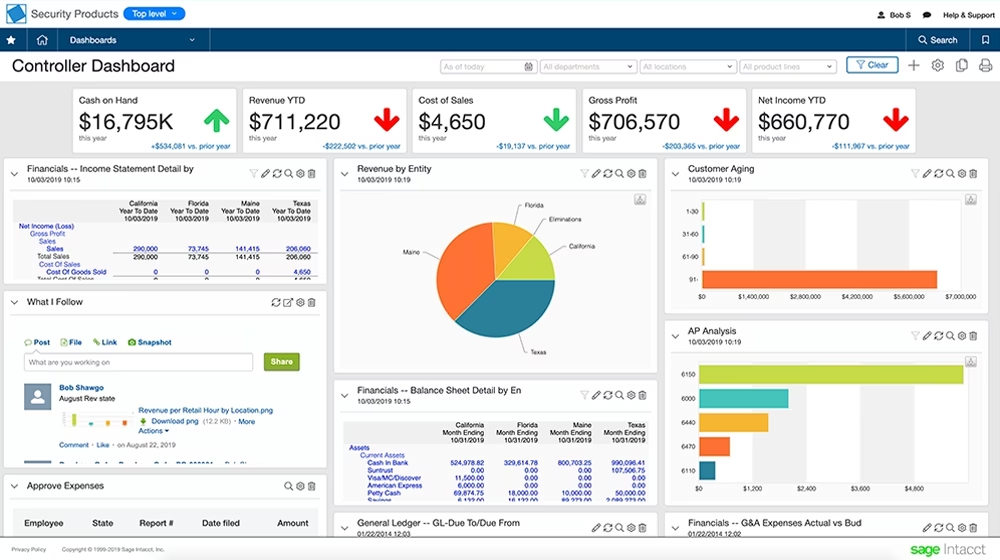
Sage Intacct (with Sage Intacct Construction)
Sage Intacct is known for strong financial management and dimensional reporting, making it a powerful solution for real estate organizations that prioritize financial clarity and performance insight. Built as a cloud-native financial management platform, it delivers real-time visibility across entities, properties, and business units. For development-driven firms, Sage Intacct Construction significantly enhances its value by adding specialized capabilities for job costing, project accounting, and contract management. Together, these solutions create a cohesive financial environment that connects corporate accounting with development and construction operations, a critical advantage for vertically integrated real estate companies.
Key capabilities for real estate
- Advanced multi-entity consolidation
- Real-time dashboards and financial reporting
- Budgeting and forecasting tools
- Job costing and project accounting (via Sage Intacct Construction)
- Cost forecasting aligned with enterprise financials
Benefits
- Clearer financial transparency across properties and entities
- Stronger control of development budgets
- Improved collaboration between finance and project teams
- Reduced financial risk during capital projects
Sage Intacct excels when financial clarity and project-level cost visibility are critical drivers.
Microsoft Dynamics 365 Finance & Operations
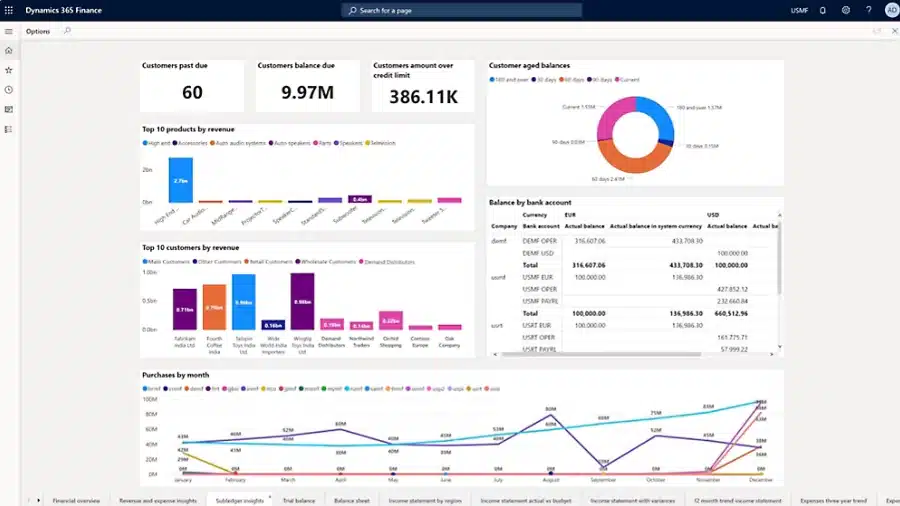
Dynamics 365 Finance & Operations (F&O) is an enterprise-grade ERP built for scale. Designed to support large and highly complex organizations, F&O delivers advanced financial management, procurement, budgeting, and operational control across multiple entities, currencies, and countries. For real estate enterprises operating across regions or managing diversified investment structures, F&O provides the governance, flexibility, and performance required at scale. Its deep integration with the broader Microsoft ecosystem, including Power BI, Power Platform, and Azure, allows organizations to extend functionality, automate processes, and gain sophisticated analytical insight across the portfolio.
Many enterprise real estate organizations also deploy Dynamics 365 Sales and Dynamics 365 Project Operations alongside F&O to unify finance, development, and relationship management within a connected Microsoft ecosystem. This approach allows firms to align leasing pipelines, capital projects, and corporate financials within a single, integrated platform.
As with other enterprise ERP platforms, Dynamics 365 F&O supports integration with specialized real estate applications, allowing organizations to combine enterprise financial governance with property-level functionality when needed.
Key capabilities for real estate
- Multi-entity, multi-currency, and multi-country financial management
- Sophisticated project accounting
- Advanced procurement and vendor management
- Enterprise budgeting and forecasting
- Deep integration with Power BI, Power Apps, and Azure
Benefits
- Enterprise-level governance and compliance
- Stronger development and capital project oversight
- Highly customizable workflows
- Global scalability
Comparison chart: Top ERP platforms for real estate
No single ERP platform dominates every category. The right choice depends on whether your organization prioritizes enterprise financial governance, development cost control, property-level workflows, or a hybrid architecture. The comparison below highlights how leading enterprise ERP platforms stack up across key decision criteria.
Because many real estate organizations oversee development and construction in addition to property ownership, we are evaluating Sage Intacct alongside Sage Intacct Construction. While Sage Intacct delivers strong financial management and multi-entity reporting, the Construction solution adds essential job costing and project accounting capabilities for development-driven firms.
Where real estate-specific systems fit
While many growing portfolios adopt a flexible ERP platform as their financial backbone, real estate-specific systems such as Yardi Voyager and MRI Software remain important for property operations.
These platforms excel in leasing management, tenant billing, asset management, and facilities workflows. Organizations with operationally intensive portfolios may deploy these systems alongside a flexible ERP platform to strengthen consolidation, development accounting, and broader financial reporting.
For many complex portfolios, the long-term architecture combines both — with the ERP serving as the financial system of record and the property platform supporting day-to-day operational workflows.
Frequently asked questions: Top ERP for real estate
Does ERP software for real estate include property management?
Most core ERP systems focus on financial management, consolidation, reporting, and project accounting rather than day-to-day property management functions. Real estate companies often extend their ERP with industry-specific applications or integrations to handle leasing, tenant billing, or maintenance workflows.
What ERP is best for real estate developers?
Real estate developers typically need strong project accounting, job costing, and capital project visibility. Sage Intacct with Sage Intacct Construction and Dynamics 365 Finance & Operations are particularly strong for development-heavy organizations because they provide robust financial controls aligned with construction and capital project management.
What features should I look for in a real estate ERP?
When evaluating the top ERP for real estate, prioritize:
- Multi-entity and multi-book accounting
- Development and project accounting
- Portfolio-level reporting and dashboards
- Budgeting and forecasting
- Integration capabilities
- Scalability to support growth
Why is industry expertise important when implementing ERP for real estate?
Real estate accounting and operations involve unique structures, reporting requirements, and development processes. Partnering with an ERP advisor who understands the industry helps ensure the system is configured correctly from the start and aligned with your long-term strategy.
What is the difference between a flexible ERP platform and a real estate-specific ERP?
Flexible ERP platforms, such as NetSuite, Sage Intacct, or Microsoft Dynamics 365, focus on multi-entity financial management, project accounting, and portfolio-level reporting. Real estate-specific ERP systems are designed primarily for property operations, including leasing, tenant management, and asset workflows. Many organizations use a flexible ERP as their financial backbone and integrate property-focused systems as needed.
Choosing the best real estate ERP for your business
There is no one-size-fits-all answer when determining the top ERP for real estate. The right solution ultimately depends on your business model, growth trajectory, and operational complexity.
Organizations prioritizing scalable financial governance and multi-entity consolidation often select a flexible ERP platform as their foundation, such as NetSuite. Development-heavy firms that require tight project cost control may benefit from solutions such as Sage Intacct paired with Construction. Mid-market companies operating within a Microsoft environment frequently align well with Business Central, while global real estate enterprises often require the advanced capabilities of Dynamics 365 Finance & Operations.
Ultimately, the most successful ERP initiatives in real estate are not simply about selecting software, they are about aligning technology with long-term business strategy. Partnering with a proven ERP advisor and implementation partner ensures that alignment happens effectively, positioning your organization for smoother deployment and stronger long-term results.

Confident ERP selection with Rand Group
Selecting the top ERP for real estate is a critical decision that requires both technical expertise and industry insight. Our ERP experts help you evaluate options, align software with your business model, and build a clear roadmap for implementation. Connect with our team to ensure your ERP decision supports long-term portfolio growth.
Why partner with Rand Group for real estate ERP implementation
Selecting the right ERP for your real estate business is only the first step. True success comes from implementing and optimizing that system in a way that reflects the complexities of property ownership, development, and portfolio growth. At Rand Group, we go beyond software deployment. We combine technical expertise with deep construction and real estate industry insight to ensure your ERP solution becomes a strategic asset, not just an accounting platform.
Our approach is designed to reduce risk, accelerate adoption, and align ERP technology with your long-term business objectives.
- Current systems and workflow evaluation – We assess your existing processes, reporting gaps, and operational challenges to define a clear path forward.
- Requirements and solution design – We map your business needs to the right ERP platform and design a scalable system architecture.
- Configuration and deployment – We tailor workflows, reporting, and integrations to align with real estate and development operations.
- Training and adoption support – We equip your teams with the tools and knowledge needed for a smooth transition.
- Optimization and ongoing support – We continue refining your system as your portfolio and operational needs evolve.
Next steps
There is no one-size-fits-all answer when determining the top ERP for real estate. The right solution depends on your organization’s operational priorities, financial complexity, and long-term growth strategy. Companies focused on enterprise-level financial governance and multi-entity consolidation may gravitate toward platforms like NetSuite, Sage Intacct, or Microsoft Dynamics 365. Development-heavy or global real estate enterprises often require the advanced project accounting and scalability of Dynamics 365 Finance & Operations. Meanwhile, organizations prioritizing property operations, leasing workflows, and asset management may find real estate-specific platforms such as Yardi or MRI better aligned with their day-to-day needs.
Ultimately, the most successful ERP initiatives in real estate are not simply about choosing a platform, they are about designing the right system architecture to support both financial control and operational performance. Partnering with an experienced ERP advisor, like Rand Group, ensures your technology strategy aligns with your portfolio structure, development plans, and long-term business objectives. Contact our ERP experts today to schedule a software selection consultation and determine which ERP is the right fit for your portfolio. You can also request a demonstration of Dynamics 365, NetSuite, or Sage Intacct to see each platform in action.