NetSuite
What is NetSuite Material Requirements Planning (MRP)?

Inventory and production planning challenges are rarely caused by a lack of effort, they’re usually the result of disconnected data, manual processes, and limited visibility across the supply chain. Manufacturers and distributors often struggle to balance customer demand with material availability, leading to excess inventory, missed delivery dates, or costly production delays.
NetSuite Material Requirements Planning (MRP) is designed to solve these challenges. Built directly into the NetSuite ERP platform, NetSuite MRP provides a modern, cloud-based approach to supply planning that helps businesses determine exactly what materials they need, in what quantities, and when those materials must be available to meet demand. In this article, we’ll break down what NetSuite MRP is, how it works, its key features and benefits, and best practices for implementing it successfully.
What is Material Requirements Planning in NetSuite?
Material Requirements Planning is a supply planning methodology that ensures materials and components are available for production and customer fulfillment while minimizing excess inventory. Traditional MRP systems often rely on static calculations and spreadsheets, which quickly become outdated as demand and supply conditions change.
The MRP module modernizes this approach by using real-time ERP data to dynamically calculate supply and demand across your organization.
NetSuite MRP answers three fundamental planning questions:
- What materials are needed?
- How much is needed?
- When do those materials need to be available?
Because NetSuite MRP is embedded directly in the ERP, it uses live data from across the business, including:
- Sales orders and forecasts
- Bills of Materials (BOMs)
- Inventory levels
- Purchase orders, transfer orders, and work orders
- Lead times and safety stock settings
This integrated approach allows planners to move away from reactive planning and toward a more proactive, data-driven supply chain strategy.
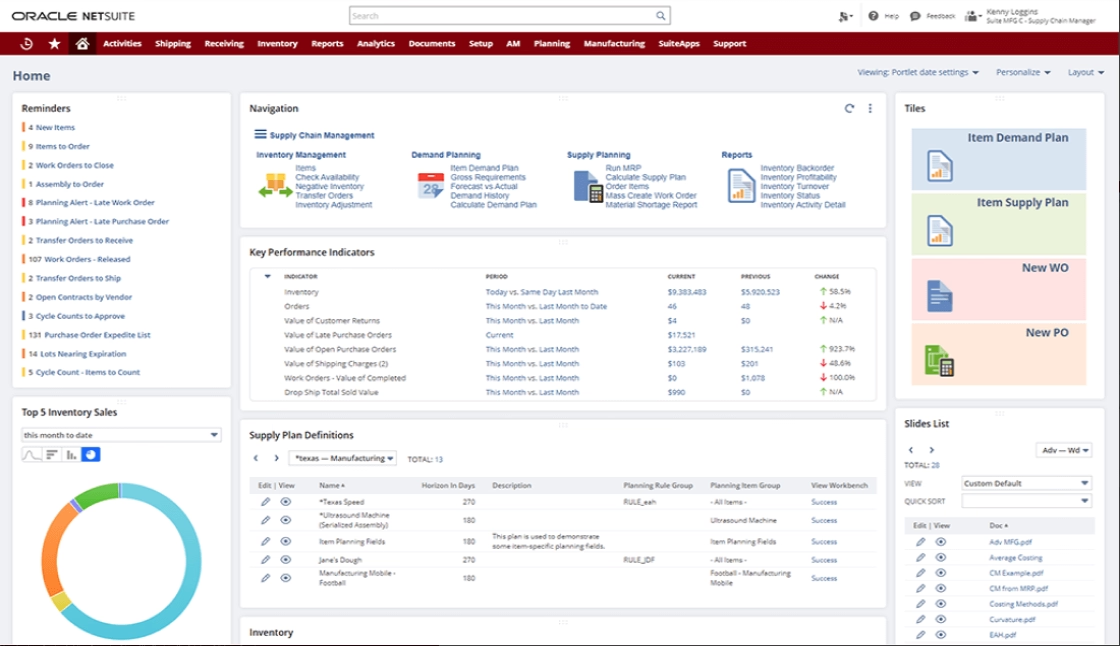

How to optimize your inventory with NetSuite Material Requirements Planning
Improve inventory visibility and balance supply and demand with NetSuite Material Requirements Planning. NetSuite offers powerful planning capabilities to support smarter purchasing and production decisions. Download this guide to explore MRP configuration, planning runs, and best practices.
How NetSuite Material Requirements Planning works
At its core, NetSuite MRP compares demand against available and expected supply to generate actionable planning recommendations.
Demand inputs
NetSuite MRP evaluates both independent and dependent demand, including:
- Open sales orders
- Demand forecasts generated through NetSuite Demand Planning
- Component and sub-assembly requirements driven by BOMs
Supply inputs
On the supply side, NetSuite MRP considers:
- On-hand inventory by location
- Open purchase orders
- Work orders and assembly builds
- Transfer orders between locations
Planning parameters
The system also factors in critical planning data such as:
- Lead times for purchased and manufactured items
- Safety stock and reorder points
- Planning horizons and calendars
Once an MRP planning run is executed, NetSuite generates action messages that recommend steps such as creating, rescheduling, or canceling supply orders. These recommendations help planners align supply with demand while avoiding overproduction or shortages.
NetSuite MRP core features
NetSuite Material Requirements Planning includes advanced tools that go far beyond traditional MRP functionality. Rather than relying on static calculations or manual spreadsheets, NetSuite MRP provides planners with real-time visibility, interactive planning tools, and actionable recommendations. These capabilities allow organizations to evaluate supply and demand holistically, respond quickly to change, and make more confident planning decisions across complex, multi-level supply chains.
Planning Workbench
The Planning Workbench serves as a centralized command center for planners. It provides a comprehensive view of supply and demand across items, locations, and time periods. This transparency helps planners trust the system’s recommendations and make informed decisions quickly.
Key capabilities include:
- Reviewing supply and demand balances in one place
- Accepting or rejecting action messages in bulk
- Drilling into pegging data to understand exactly why the system is recommending a specific order
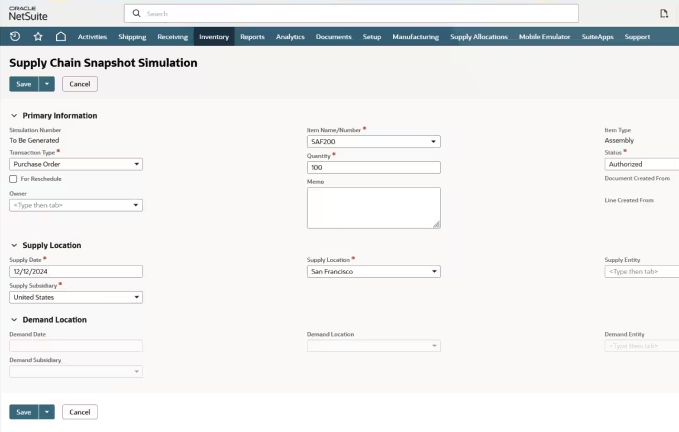
What-if scenario planning
One of the most powerful features of the MRP module is what-if scenario planning. This functionality allows businesses to test hypothetical scenarios without affecting live data.
With what-if scenarios, planners can evaluate how changes such as the following would impact inventory and service levels:
- Shifts in customer demand
- Delayed supplier shipments
- Changes to lead times or production schedules
- Different fulfillment or sourcing strategies
Multi-level pegging
NetSuite MRP provides multi-level pegging, which links demand and supply across multiple levels of production.
This means planners can trace:
- Finished goods demand back to specific sales orders
- Component and sub-assembly requirements through complex BOM structures
With multi-level pegging, planners gain full visibility into how demand flows through the supply chain, making it easier to identify bottlenecks and prioritize critical materials.
Supply allocation
Supply allocation ensures that limited inventory and incoming supply are assigned to the highest-priority demand.
NetSuite Material Requirements Planning automatically:
- Allocates on-hand inventory
- Assigns expected receipts from purchase, transfer, or work orders
- Prioritizes demand based on business rules
This capability is especially valuable for organizations managing constrained supply or high-demand environments.
Key benefits of NetSuite Material Requirements Planning
When implemented correctly, NetSuite MRP delivers measurable operational and financial benefits.
- Optimized inventory levels – By aligning supply with actual demand, NetSuite MRP helps reduce excess inventory and carrying costs while maintaining appropriate safety stock levels.
- Reduced production delays – MRP coordinates material availability with production schedules, helping prevent delays caused by missing components or late deliveries.
- Improved customer satisfaction – With better visibility and planning accuracy, businesses can improve order fulfillment rates and meet customer delivery commitments more consistently.
- Single source of truth – Because NetSuite MRP is built into the ERP, planners work with real-time data across sales, inventory, production, and finance, without relying on spreadsheets or third-party integrations.
- Increased planner efficiency – Automation and centralized planning tools allow planners to spend less time managing data and more time making strategic decisions.
NetSuite MRP setup and best practices
NetSuite Material Requirements Planning is a powerful tool, but its effectiveness depends on proper setup, clean data, and disciplined processes. Successful implementations combine feature enablement with planning best practices.
Required NetSuite features
To use NetSuite MRP, administrators typically need to enable the following features:
- Demand Planning – to generate forecasts and projected demand
- Advanced Inventory Management – for safety stock and reorder point functionality
- Material Requirements Planning – to activate the planning engine
- Supply Chain Control Tower (optional) – for enhanced visibility and risk assessment
Data readiness best practices
MRP results are only as accurate as the data behind them. Investing time in data cleanup early prevents unreliable recommendations later. Before relying on NetSuite MRP, organizations should ensure:
- Bills of Materials (BOMs) are accurate and up to date
- Lead times reflect real supplier and production performance
- Safety stock levels align with service level goals
- Item, vendor, and location data is standardized
Demand and supply planning best practices
To maximize the value of NetSuite Material Requirements Planning:
- Combine forecasts with actual sales orders for balanced planning
- Regularly review demand assumptions and planning horizons
- Validate supply sources, transfer routes, and production calendars
- Avoid overloading the system with unnecessary planning noise
These practices help ensure planning output reflects real-world conditions.
MRP planning and execution best practices
Running MRP effectively requires consistent execution and review. Establishing disciplined planning routines, validating system recommendations, and regularly refining planning parameters help ensure NetSuite MRP produces reliable, actionable results that planners can trust.
Best practices include:
- Running MRP on a regular schedule (daily or weekly, depending on the business)
- Reviewing action messages before execution rather than accepting them blindly
- Using pegging data to validate system recommendations
- Starting with a smaller planning scope and expanding gradually
Organizational and process best practices
Technology alone doesn’t guarantee success. Clear roles, consistent processes, and ongoing collaboration help ensure NetSuite MRP continues to deliver accurate insights and long-term value as your business evolves.
Organizations should:
- Clearly define planner roles and responsibilities
- Train users on interpreting MRP outputs, not just executing transactions
- Establish KPIs such as inventory turns, service levels, and shortage rates
- Continuously refine planning parameters as the business evolves
Should your business use NetSuite MRP?
NetSuite Material Requirements Planning is well-suited for organizations that need more control and visibility over their supply chain, including:
- Manufacturers with multi-level or complex BOMs
- Distributors managing fluctuating demand patterns
- Multi-location or multi-subsidiary organizations
- Businesses that have outgrown manual or basic planning tools
If inventory complexity or growth is straining your current planning process, NetSuite MRP can provide the structure and scalability you need.
NetSuite Material Requirements Planning frequently asked questions
Is NetSuite Material Requirements Planning included with NetSuite ERP?
NetSuite Material Requirements Planning is a native NetSuite feature, but it must be enabled and licensed separately. It also depends on other NetSuite features, such as Demand Planning and Advanced Inventory Management, to function effectively. A NetSuite partner can help determine licensing and configuration requirements.
How is NetSuite MRP different from Demand Planning?
Demand Planning focuses on forecasting future demand based on historical data and trends. NetSuite Material Requirements Planning takes that demand and translates it into actionable supply recommendations, such as purchase orders, work orders, and transfer orders. In short, Demand Planning predicts demand, while NetSuite MRP plans how to fulfill it.
Can NetSuite Material Requirements Planning support multi-level manufacturing?
Yes. NetSuite Material Requirements Planning supports multi-level Bills of Materials (BOMs) and uses multi-level pegging to trace demand from finished goods down through sub-assemblies and components. This makes it well-suited for manufacturers with complex production structures.
Does NetSuite MRP work for distributors as well as manufacturers?
Yes. While NetSuite Material Requirements Planning is often associated with manufacturing, it is also valuable for distributors. It helps distributors manage reorder quantities, lead times, safety stock, and multi-location inventory while aligning supply with customer demand.

Assess your NetSuite MRP readiness
NetSuite Material Requirements Planning delivers the most value when it’s built on clean data and sound planning processes. A readiness assessment with Rand Group helps you understand where your current setup stands and what’s needed to optimize your planning performance. Connect with our NetSuite experts to get started.
NetSuite Material Requirements Planning expertise from Rand Group
Implementing NetSuite Material Requirements Planning requires more than enabling a feature, it requires aligning data, processes, and people.
Our NetSuite experts help organizations maximize the value of NetSuite MRP through:
- MRP readiness and strategy assessments
- Feature enablement and configuration
- Data cleanup and planning parameter design
- User training and change management
- Ongoing optimization and NetSuite support
Our team brings deep NetSuite and supply chain expertise to help businesses move from reactive planning to proactive execution.
Get more value from NetSuite MRP
NetSuite Material Requirements Planning gives manufacturers and distributors the tools they need to plan smarter, reduce inventory risk, and meet customer demand with confidence. When paired with the right implementation strategy and best practices, it becomes a powerful driver of operational efficiency.
If you’re looking to improve inventory performance or want to ensure you’re getting the most out of NetSuite MRP, we can help. Contact our NetSuite experts to start optimizing your supply planning strategy today.