Intercompany accounting software: A guide to automating multi-entity finance

As organizations add subsidiaries, business units, investment entities, or international operations, accounting between those entities can become one of the most time-consuming parts of the financial close. Finance teams may find themselves matching due-to and due-from balances, investigating discrepancies, creating elimination entries, translating currencies, and combining financial results across multiple systems and spreadsheets.
Intercompany accounting software can reduce much of that manual work. By connecting financial activity across entities and applying consistent accounting rules, organizations can automate recurring transactions, reconciliation, eliminations, consolidation, and reporting.
The result is a more scalable approach to multi-entity finance in which accounting teams can spend less time comparing spreadsheets and preparing repetitive entries and more time reviewing exceptions and financial results.
At a glance
- Intercompany accounting software automates multi-entity finance: It can streamline reciprocal transactions, reconciliation, eliminations, consolidation, and reporting across related entities.
- Automation reduces manual close work: Matching rules, automated entries, and exception workflows help finance teams spend less time comparing spreadsheets and investigating routine transactions.
- Eliminations improve consolidated reporting: Automated elimination rules remove internal receivables, payables, revenue, expenses, and other activity that should not appear in consolidated results.
- ERP-native capabilities can create a more unified approach: Platforms such as Sage Intacct, Oracle NetSuite, Dynamics 365 Business Central, and Dynamics 365 Finance can support intercompany processes within the broader financial system.
- The right setup is critical: Entity structures, charts of accounts, intercompany relationships, elimination rules, currencies, and reporting hierarchies must be designed correctly for automation to work effectively.
- The right solution depends on your organization: Entity count, transaction volume, currencies, ownership structures, existing systems, and future growth should all factor into software selection.
What is intercompany accounting software?
Intercompany accounting software helps organizations record, reconcile, eliminate, and report financial transactions between subsidiaries or legal entities under common ownership. It can automate reciprocal entries, identify mismatches between entities, create elimination entries, translate currencies, and consolidate financial results.
Depending on the organization, these capabilities may be built directly into an enterprise resource planning (ERP) or financial management platform or provided through specialized software connected to existing accounting systems.
Common intercompany accounting software capabilities include:
- Automated intercompany transactions
- Due-to and due-from accounting
- Intercompany accounts receivable and accounts payable
- Transaction matching and reconciliation
- Exception identification and management
- Automated elimination entries
- Multi-currency accounting and translation
- Multi-entity consolidation
- Consolidated financial reporting
- Audit trails and transaction-level drill-down
Intercompany accounting is closely related to multi-entity accounting, but the two are not identical. Multi-entity accounting refers broadly to managing the financial activity of multiple legal entities. Intercompany accounting focuses specifically on transactions and balances that occur between those entities.


Find the right ERP for your business
Intercompany accounting is only one consideration when selecting an ERP. Download our Top 10 ERP software selection checklist for ten essential steps to evaluating your requirements, comparing solutions, and choosing an ERP that fits your business.
Why intercompany accounting gets harder as organizations grow
A transaction that appears straightforward at one entity may create corresponding accounting activity somewhere else in the organization. As the number of entities and transactions increases, maintaining agreement between those records can become increasingly difficult.
Common challenges include:
- Different transaction timing: One entity may record a transaction in a different accounting period than the other.
- Mismatched balances: Intercompany receivables, payables, or due-to and due-from balances may not agree.
- Different charts of accounts: Separate entities may categorize similar transactions differently.
- Currency differences: Exchange rates and revaluations can create differences between reciprocal balances.
- Manual journal entries: Accounting employees may need to create corresponding entries independently in multiple ledgers.
- Disconnected systems: Subsidiaries may operate on different ERP or accounting platforms.
- High transaction volumes: Matching transactions becomes more difficult as intercompany activity increases.
- Complex ownership structures: Partial ownership, joint ventures, and hierarchical entity structures can affect consolidation and elimination requirements.
- Limited audit trails: Spreadsheet-based adjustments can make it harder to understand how an elimination or reconciliation adjustment was calculated.
These challenges often become particularly visible during month-end close. Accounting teams may spend days tracing mismatches, preparing elimination entries, and validating consolidated results before completing financial reporting.
From Rand Group’s experience, the strongest candidates for intercompany automation are organizations where finance teams repeatedly reconcile the same entity relationships each close, maintain elimination schedules outside the ERP, or spend significant time investigating differences between reciprocal balances.
How intercompany accounting automation works
At a high level, the intercompany accounting process can be viewed as a sequence:
Record → Reconcile → Eliminate → Consolidate → Report
Software can introduce automation at each stage.
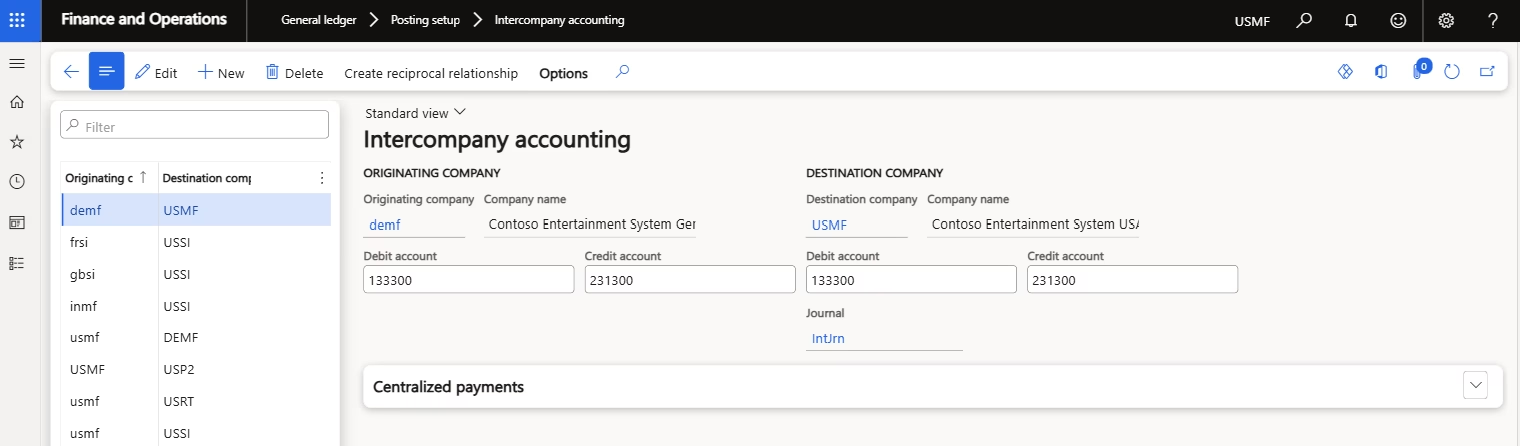
Automating intercompany transactions
One of the most effective ways to simplify intercompany reconciliation is to prevent mismatches from occurring in the first place.
When intercompany accounting software recognizes that a transaction involves two entities within the same organization, it may be able to generate the corresponding accounting activity automatically.
For example, if one entity charges another for shared services, software can create the appropriate entry for both sides of the transaction rather than requiring separate accounting teams to record each entry independently.
Automated intercompany transactions can support processes such as:
- Due-to and due-from accounting
- Intercompany accounts payable and receivable
- Shared cost allocations
- Management fees
- Internal sales and purchases
- Cash transfers
- Intercompany loans
- Interest charges
- Centralized purchasing
Creating both sides of a transaction from a common process can reduce the timing, coding, and amount differences that accountants would otherwise have to resolve later.
Automating intercompany reconciliation
Intercompany reconciliation compares accounting recorded by one entity with the corresponding activity recorded by another.
In a manual environment, finance teams may export data from multiple ledgers and compare transactions in spreadsheets. Intercompany accounting software can centralize that data and perform much of the matching automatically.
Centralize intercompany data
Software can bring together information such as:
- Transaction details
- Journal entries
- Accounts receivable
- Accounts payable
- Entity balances
- Currency information
- Exchange rates
For organizations operating multiple ERPs, specialized reconciliation platforms may aggregate data from several source systems into a common environment.
Match related transactions automatically
Matching rules can compare transactions using criteria such as:
- Document or transaction number
- Entity
- Account
- Amount
- Transaction date
- Currency
Software may also apply predefined tolerances for minor differences caused by rounding, foreign exchange movements, or other acceptable variances.
Instead of manually checking every transaction, accounting teams can focus on activity that does not match.
Manage exceptions
Transactions that fall outside established rules can be routed for review.
Common exceptions include:
- Missing reciprocal transactions
- Amount differences
- Timing differences
- Currency variances
- Duplicate transactions
- Incorrect account coding
- Tax differences
This creates an exception-based reconciliation process. Accountants investigate the transactions that need attention rather than manually comparing every intercompany transaction each month.
Automating intercompany eliminations
Intercompany eliminations remove the effect of transactions between entities within the consolidated organization.
Without eliminations, internal transactions can artificially inflate consolidated revenue, expenses, assets, or liabilities. For example, if one subsidiary records a receivable from another subsidiary, that balance should generally be eliminated when the parent organization prepares consolidated financial statements.
Common intercompany eliminations include:
- Intercompany accounts receivable and payable
- Due-to and due-from balances
- Internal sales and purchases
- Management fees
- Loans and interest
- Shared expenses
- Certain internal profits
Intercompany accounting software can apply predefined rules to determine which accounts, transaction types, and entities should be eliminated.
Depending on the platform, automation may include:
- Dedicated elimination entities or subsidiaries
- Rules-based elimination logic
- Automatically generated elimination journals
- Ownership-based elimination rules
- Recurring period-end eliminations
- Links between elimination entries and source transactions
Automation does not eliminate the need for sound accounting policies. Entity relationships, account mappings, ownership percentages, and elimination rules still need to be designed and configured correctly.
From Rand Group’s implementation experience
The impact of this automation can be substantial in organizations with complex entity structures.
Henry Resources was managing approximately 30 to 40 entities across QuickBooks, WolfePak, Excalibur, SQL Server, and spreadsheets before working with Rand Group to implement Oracle NetSuite. Its controller spent roughly a week each month manually gathering and combining financial data.
As part of the NetSuite implementation, Rand Group helped consolidate the organization’s financial structure and automate processes that had previously required significant manual effort. NetSuite could generate intercompany elimination entries automatically, and consolidation became largely automated.
The project demonstrates an important point: improving intercompany accounting often requires more than simply automating one journal entry. The underlying entity structure, chart of accounts, workflows, and reporting architecture must also support efficient consolidation.
Automating multi-entity consolidation
Once intercompany balances have been reconciled and the appropriate transactions eliminated, financial information can be rolled up into consolidated statements.
Modern financial systems can automate many activities involved in this process, including:
- Entity-level rollups
- Consolidated income statements
- Consolidated balance sheets
- Currency translation
- Ownership adjustments
- Entity hierarchy management
- Chart-of-accounts mapping
- Consolidated reporting
- Drill-down to underlying entity activity
Organizations can often view financial performance at several levels, from an individual entity or group of entities to the consolidated organization.
For global businesses, multi-currency functionality is particularly important. Software can help apply exchange rates, translate financial statements, and account for currency-related differences as part of the broader consolidation process.
The timing of these processes varies by platform and configuration. Some environments can update consolidated reporting frequently as transactions are posted, while others rely on structured period-end consolidation processes.

Benefits of automating intercompany accounting
The business case for intercompany accounting software extends beyond eliminating spreadsheets.
Potential benefits include:
- Faster close: Reduce reconciliation, elimination, and consolidation work.
- Less manual entry: Automatically create reciprocal and balancing entries.
- Fewer discrepancies: Standardized processes prevent mismatches upstream.
- Exception-based reconciliation: Focus accountants on transactions requiring review.
- Better auditability: Maintain a clearer connection between source transactions, adjustments, and eliminations.
- Greater scalability: Add entities without increasing manual accounting work at the same rate.
Key features to look for in intercompany accounting software
Not every multi-entity financial system provides the same level of intercompany automation.
When comparing intercompany accounting software, use the following capabilities as a starting-point checklist:
- Multi-entity ledger management
- Automated reciprocal entries
- Due-to and due-from accounting
- Intercompany AP and AR
- Automated transaction matching
- Matching tolerances
- Exception workflows
- Automated eliminations
- Multi-currency accounting
- Currency translation and revaluation
- Ownership hierarchy support
- Consolidated reporting
- Entity-level drill-down
- Chart-of-accounts mapping
- Approval workflows
- Audit trails
- Integration capabilities
The importance of each capability depends on the organization’s structure. A company with five domestic entities operating in one ERP may have very different requirements from a global organization managing dozens of subsidiaries across multiple financial systems.
Intercompany accounting software options
Once requirements are defined, the next question is whether those capabilities should come from your ERP or a specialized intercompany platform. Several leading ERP systems provide native intercompany and multi-entity functionality.
Sage Intacct
Sage Intacct is a cloud financial management platform designed for organizations that need to manage multiple entities within a centralized accounting environment.
Key intercompany and multi-entity capabilities can include:
- Multi-entity financial management in a shared company environment
- Inter-entity transactions across related entities
- Automated due-to and due-from entries
- Inter-entity accounts payable and receivable
- Inter-entity transaction matching and reconciliation
- Automated inter-entity eliminations during consolidation
- Domestic and global consolidations
- Multi-currency accounting, currency translation, and consolidated reporting
- Dimensional reporting by entity, entity group, or consolidated organization
This structure can help finance teams manage inter-entity activity, automate reciprocal accounting, reduce reconciliation effort, and consolidate results while preserving entity-level controls and reporting visibility.
Rand Group has worked with organizations using Sage Intacct to address complex entity structures. Spine Team Texas, for example, operates multiple clinics, ambulatory surgery centers, and investment companies. Its legacy environment created challenges around intercompany activity and shared financial processes before Rand Group helped the organization transition to Sage Intacct.

Oracle NetSuite
Oracle NetSuite supports multi-subsidiary financial management through NetSuite OneWorld, allowing organizations to manage intercompany accounting within a broader ERP environment.
Relevant capabilities include:
- Multi-subsidiary financial management through NetSuite OneWorld
- Intercompany transactions between subsidiaries
- Intercompany journal entries
- Automated intercompany eliminations
- Multi-subsidiary consolidation and rollups
- Multi-currency accounting and currency translation
- Entity-level and consolidated financial reporting
- Drill-down from consolidated results to subsidiary-level activity
Because financial and operational data can be managed within the same platform, NetSuite can help organizations standardize intercompany accounting, eliminations, consolidation, and reporting across subsidiaries while reducing reliance on separate accounting systems and offline consolidation work.
Rand Group has also used NetSuite OneWorld to help organizations such as Henry Resources automate intercompany eliminations and consolidation across complex multi-entity environments.

Microsoft Dynamics 365 Business Central
Dynamics 365 Business Central supports multi-company financial management and native intercompany functionality for midsized organizations, particularly those already operating within the Microsoft ecosystem.
Organizations can use Business Central to support processes such as:
- Intercompany sales and purchase documents
- Intercompany general journal lines
- Transfer of intercompany documents and journals between partner companies
- Due-to and due-from accounting
- Intercompany transaction review and reconciliation
- Consolidation of financial results across companies
- Multi-currency consolidation and reporting
These capabilities can reduce the need for finance teams to recreate the same transaction manually in separate companies and provide a more structured approach to managing financial activity across related entities.
Business Central’s native multi-company structure treats each legal entity as a separate company within the same environment. That can work well when each entity has its own accounting team or when users only need to work in one company at a time. However, centralized accounting teams may find it inefficient to switch between companies to enter, review, or manage transactions.
For organizations that want a more centralized multi-entity model, Business Central can be extended with solutions such as Binary Stream Multi-Entity Management, which allows entities to be managed through dimensions rather than separate companies while keeping the organization within the Microsoft platform.

Microsoft Dynamics 365 Finance
Dynamics 365 Finance is designed for larger organizations with more complex financial, operational, and global requirements.
Its intercompany and multi-entity capabilities can support:
- Multi-legal-entity financial management
- Intercompany accounting journals and transactions
- Automated due-to and due-from accounting Intercompany accounts receivable and accounts payable
- Intercompany sales, purchasing, project, and operational transactions
- Financial consolidation across legal entities
- Consolidation rules, elimination entries, and consolidation companies
- Multi-currency accounting, revaluation, and currency translation
- Complex organizational hierarchies and legal entity relationships
- Global financial reporting across entities, currencies, and operating units Integration with broader operational processes across Dynamics 365 Finance and Supply Chain Management
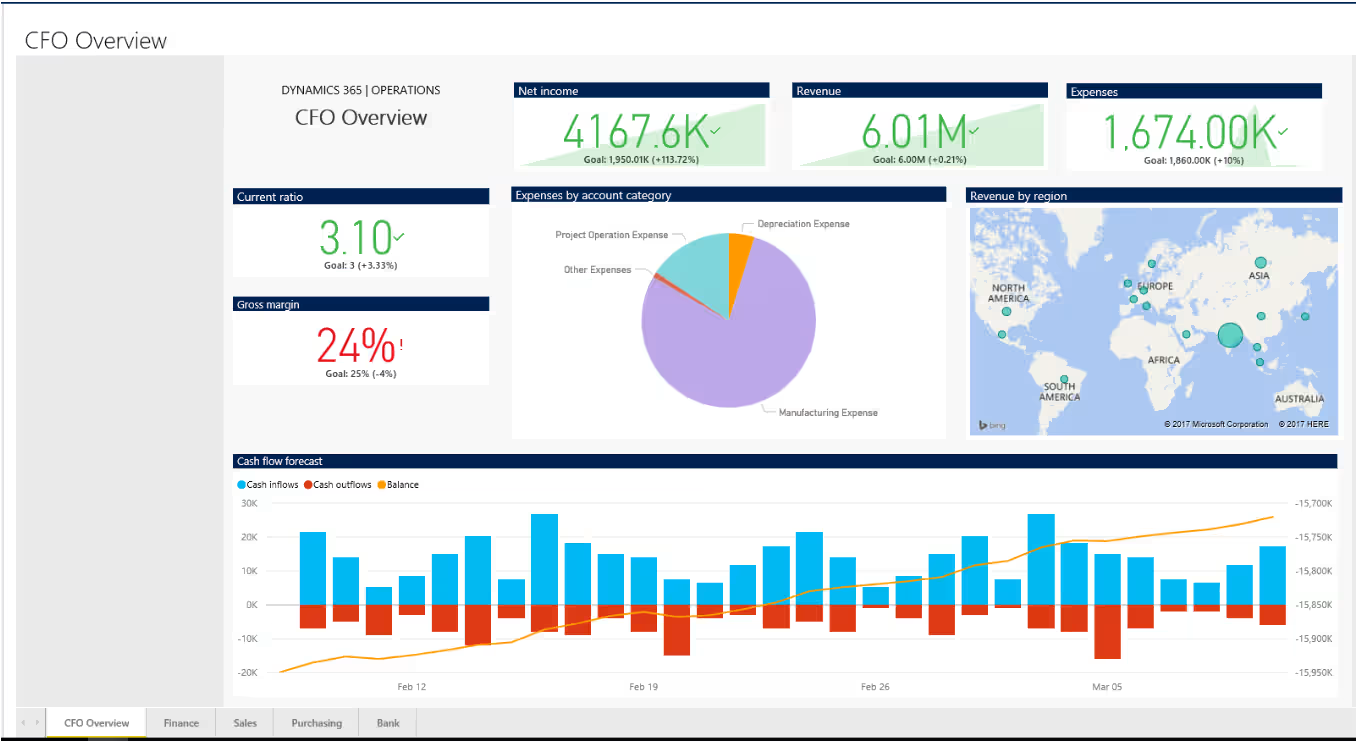
Dynamics 365 Finance can be particularly well suited for organizations where intercompany activity extends beyond accounting journals alone. Transactions may originate from procurement, sales, inventory transfers, manufacturing, projects, shared services, or other operational workflows involving multiple legal entities.
Because these financial and operational processes can operate within the broader Dynamics 365 environment, organizations can manage intercompany accounting as part of a larger enterprise architecture rather than as an isolated close process.
ERP-native intercompany accounting vs. specialized software
For many organizations, managing intercompany accounting within the ERP provides the most streamlined approach. It keeps transactions, reconciliation, eliminations, consolidation, and reporting within the core financial system, reducing integrations and creating a more unified source of financial data.
Specialized software can provide an alternative when organizations must maintain multiple ERP systems, adding a layer to aggregate data, match transactions, manage exceptions, and standardize intercompany processes across systems.
For organizations considering ERP modernization, choosing a platform with strong native intercompany and multi-entity capabilities can address more than reconciliation alone. It can create a common foundation for transactions, accounting, consolidation, and reporting as the organization grows. Specialized software may be appropriate when consolidating financial systems onto a common ERP is not practical.
How to choose intercompany accounting software
Feature lists alone do not determine whether a platform will work for a particular organization. Finance leaders should first evaluate their existing intercompany processes and future growth plans.
Questions to consider include:
Organizational complexity
- How many legal entities do we manage?
- How quickly could that number grow?
- How complex are our ownership structures?
- Do we require multiple currencies?
Current environment
- Are all entities operating on the same ERP?
- Which processes depend on spreadsheets?
- How many intercompany transactions occur each month?
Automation requirements
- Can reciprocal transactions be created automatically?
- How are discrepancies identified?
- How are eliminations generated?
- Can users drill back to source transactions?
Future scalability
- How difficult is it to add an entity?
- Will the system support acquisitions or geographic expansion?
These questions help determine whether the organization needs a new ERP, stronger configuration of an existing ERP, additional multi-entity functionality, or a specialized intercompany platform.
Why implementation matters as much as software
Intercompany accounting software can automate repetitive work, but automation depends on the financial structure behind it.
Successful implementations typically require decisions about:
- Legal entity structure
- Chart of accounts
- Intercompany relationships
- Due-to and due-from accounts
- Transaction rules
- Matching tolerances
- Elimination logic
- Currency treatment
- Ownership structures
- Approval workflows
- Reporting hierarchies
In Rand Group’s experience, the greatest benefits from intercompany automation come from combining capable software with well-designed accounting processes and data structures.

Build a better intercompany accounting strategy
Whether you need a new ERP or want to get more from your existing system, Rand Group can help. Our experts provide software selection and ERP optimization services to help you streamline intercompany processes, reduce manual work, and build a more scalable financial environment.
Partner with Rand Group for intercompany accounting automation
Intercompany accounting requirements can vary considerably depending on entity count, transaction volume, ownership structure, currencies, and existing technology.
Rand Group’s accounting and ERP consultants help organizations evaluate and improve their multi-entity financial environment. Our team can help organizations:
- Assess intercompany processes and identify close bottlenecks
- Evaluate and implement ERP and financial management platforms
- Design multi-entity structures and intercompany workflows
- Automate reconciliations, eliminations, and consolidations
- Improve financial reporting, integrations, and auditability
Rand Group works across leading financial platforms including Oracle NetSuite, Sage Intacct, Microsoft Dynamics 365 Business Central, and Dynamics 365 Finance. This cross-platform experience allows our consultants to evaluate intercompany requirements from both an accounting and technology perspective rather than forcing every organization into the same solution.
Frequently asked questions about intercompany accounting software
What is intercompany accounting software?
Intercompany accounting software helps organizations manage financial transactions between subsidiaries or legal entities under common ownership. It can automate reciprocal transactions, reconciliation, elimination entries, consolidation, currency translation, and reporting.
What does intercompany accounting software automate?
Intercompany accounting software can automate transaction creation, due-to and due-from entries, transaction matching, exception identification, elimination journals, currency translation, consolidation, and reporting. The exact capabilities vary by ERP or financial platform.
What is intercompany reconciliation?
Intercompany reconciliation is the process of comparing financial activity recorded by one entity with the corresponding activity recorded by another entity in the same organization. The goal is to identify and resolve differences before consolidated financial statements are prepared.
What are intercompany eliminations?
Intercompany eliminations remove transactions and balances between entities in the same consolidated group. This prevents internal revenue, expenses, assets, and liabilities from overstating the organization’s consolidated financial results.
Can intercompany eliminations be automated?
Yes. Intercompany accounting software can automatically generate elimination entries using predefined entity relationships, accounts, transaction types, ownership structures, and accounting rules. Proper configuration is essential to ensure that the appropriate transactions are eliminated.
How does intercompany accounting software help with consolidation?
Intercompany accounting software helps prepare financial data for consolidation by reconciling entity balances, eliminating internal activity, translating currencies, and rolling entity-level results into consolidated financial statements. Many platforms also allow users to drill from consolidated reports back to individual entities and transactions.
What is the difference between intercompany accounting and multi-entity accounting?
Multi-entity accounting is the broader process of managing financial activity across multiple subsidiaries or legal entities. Intercompany accounting specifically addresses transactions and balances that occur between those entities, including reconciliation and elimination.
Do you need separate intercompany software if your ERP supports multiple entities?
Not necessarily. Many modern ERP and financial management platforms provide native intercompany accounting, elimination, and consolidation capabilities. Organizations operating multiple ERPs or managing especially high transaction volumes and complex reconciliation requirements may benefit from specialized intercompany software.
What is the best intercompany accounting software?
The best intercompany accounting software depends on the organization’s entity structure, transaction volume, currencies, ownership relationships, existing ERP environment, and consolidation requirements. Platforms such as Sage Intacct, Oracle NetSuite, Dynamics 365 Business Central, and Dynamics 365 Finance provide different levels of multi-entity and intercompany functionality, while specialized tools can support more complex multi-system environments.
Simplify intercompany accounting with the right ERP
As organizations grow across multiple entities, manual intercompany accounting can make the financial close increasingly complex. The right intercompany accounting software can automate reconciliation, eliminations, and consolidation while improving visibility across the organization.
Rand Group’s accounting and ERP experts can help you evaluate your requirements, select the right platform, and implement multi-entity processes designed for your business. Contact our team today to discuss your accounting software needs.