NetSuite
NetSuite for manufacturing: The complete guide for modern manufacturers

Manufacturers today face increasing complexity across every part of their operations. Fluctuating demand, global supply chain disruptions, labor shortages, and rising customer expectations all put pressure on production efficiency and cost control. Many organizations are still relying on spreadsheets, disconnected systems, or legacy software that makes it difficult to gain real-time visibility into inventory, production, and financial performance. As a result, teams spend more time reacting to issues than proactively optimizing operations.
This is where NetSuite for manufacturing comes in. NetSuite is a comprehensive, cloud-based ERP solution designed to unify manufacturing, inventory, supply chain, finance, and sales within a single platform. By providing real-time insights, automated workflows, and scalable functionality, NetSuite helps manufacturers streamline operations, improve decision-making, and support long-term growth.
In this in-depth guide, we’ll explore how NetSuite supports modern manufacturing organizations, the key capabilities and benefits it offers, implementation best practices, and how partnering with Rand Group can help ensure a successful and ROI-driven deployment.
What is NetSuite and why it matters for manufacturers
NetSuite is a unified, cloud-based ERP platform designed to manage core business processes in a single system. For manufacturers, ERP solutions are essential, they replace spreadsheets, standalone applications, and disconnected tools with a centralized system that integrates production, inventory, financials, and customer management.
NetSuite offers manufacturing-specific editions, such as SuiteSuccess Manufacturing, tailored to meet the needs of both discrete and process manufacturers. These editions include modules for production planning, work order management, supply chain optimization, quality management, and more. By implementing NetSuite for manufacturing, companies gain a flexible, scalable platform that grows with their business and adapts to evolving operational requirements.

Why manufacturers choose NetSuite
Manufacturers select NetSuite for its ability to streamline operations and improve decision-making. Key benefits include:
- Unified business management: Integrate production, inventory, supply chain, financials, and CRM into a single platform, eliminating silos.
- Real-time visibility and control: Monitor inventory levels, production status, and financial performance with real-time dashboards and reports.
- Scalability and flexibility: Cloud-based architecture and modular design allow easy expansion of functionality as your business grows.
- Cost reduction and efficiency gains: Reduce overstocking, avoid stockouts, automate manual tasks, and optimize production schedules.
- Improved supply-chain and order-to-cash integration: Align procurement, production, and fulfillment to improve responsiveness and customer satisfaction.
- Quality control and compliance support: Built-in tools track inspections, defects, and compliance requirements to maintain product standards.

Why manufacturers are switching from QuickBooks to NetSuite
Discover why growing manufacturers are upgrading from QuickBooks to NetSuite to gain a unified, scalable platform for finance, operations, and production.
NetSuite’s core capabilities for manufacturers
NetSuite offers a suite of modules and features that address the unique challenges of manufacturing. Its modular structure allows companies to adopt only the functionality they need, whether that’s basic inventory control, advanced production scheduling, quality management, or end-to-end supply chain visibility. As manufacturers grow or their processes become more complex, additional modules can be seamlessly added, ensuring the system always aligns with operational requirements and supports continuous scalability.
- Work Order & Production Management: Create, release, and track work orders throughout the entire production process to ensure teams always know what to build, when to build it, and which materials are required. NetSuite supports complex assemblies, enabling manufacturers to efficiently manage batch production, custom builds, and mixed-mode environments.
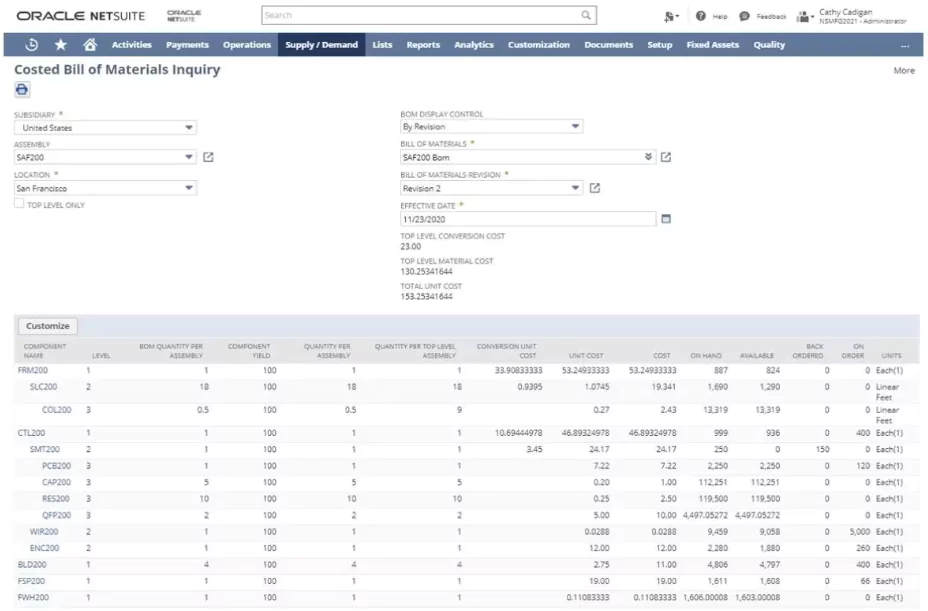
- Bill of Materials (BOM) Management: Track multi-level BOMs, subassemblies, and components with detailed version control to support both simple and sophisticated production structures. NetSuite helps maintain accurate material requirements and cost rollups, ensuring manufacturers always know the true cost of goods and can quickly adjust to engineering changes.
- Production Scheduling & Resource Planning: Schedule production runs using both finite and infinite capacity planning tools that help balance workload, machine availability, and labor constraints. Manufacturers can visualize scheduled activities, adjust timelines, and allocate resources in real time to improve throughput and reduce downtime.
- Inventory & Supply Chain Management: Gain real-time visibility into raw materials, WIP, and finished goods across all locations, including warehouses, production floors, and outsourced facilities. NetSuite’s demand planning, automated replenishment, and procurement tools help manufacturers maintain ideal inventory levels and ensure materials are available when production needs them.

- Quality Control & Compliance: Build and manage inspection plans, capture non-conformances, and enforce quality checks at every stage of production. NetSuite helps manufacturers maintain consistent product standards, meet regulatory requirements, and trace quality issues back to their source to support continuous improvement.
- Finance, Order-to-Cash & CRM Integration: Connect production and inventory data directly with financials to support accurate costing, margin analysis, and profitability reporting. By integrating CRM and order management, manufacturers gain visibility into customer demand, sales commitments, and fulfillment performance, all within a single system.
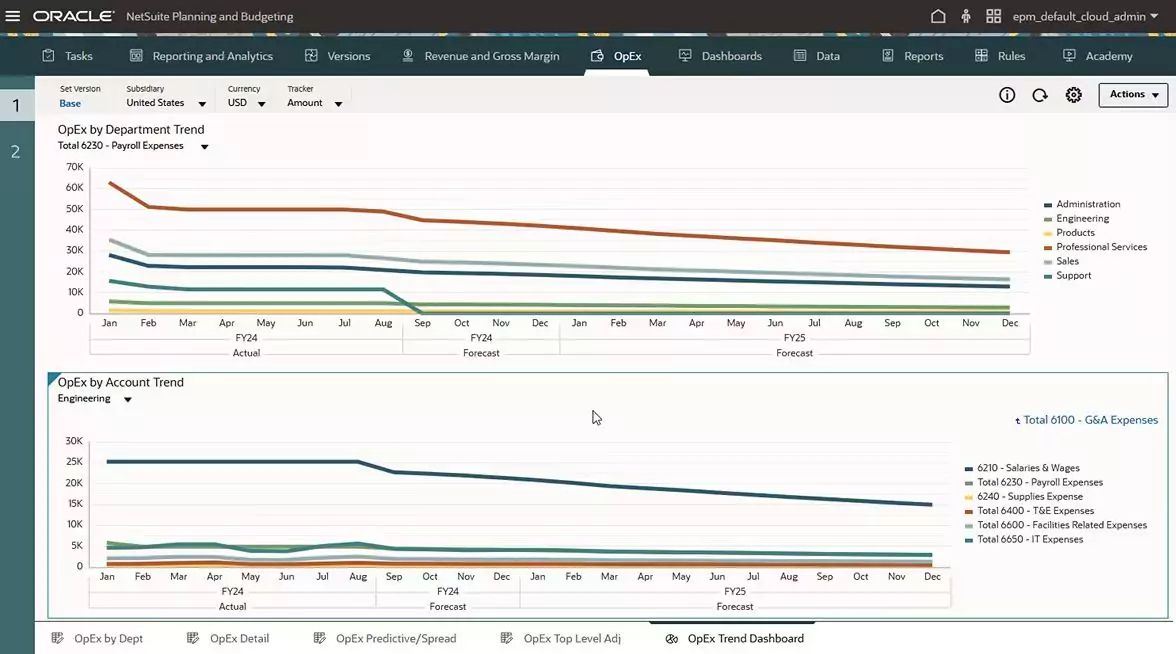
- Automation & Reporting: Automate routine workflows, such as work order creation, purchasing, approvals, and inventory updates, to reduce manual tasks and minimize errors. NetSuite’s real-time dashboards and configurable reports provide actionable insights into production efficiency, material costs, order status, and demand trends, helping leaders make faster, more informed decisions.
- AI-Driven Insights & Predictive Analytics: NetSuite’s built-in AI and machine learning capabilities help manufacturers anticipate demand shifts, identify production bottlenecks, and optimize inventory levels. Predictive analytics provide early warnings on supply shortages, quality risks, and cost variances, enabling teams to take proactive action and improve operational resilience. AI-generated recommendations also support smarter planning, more accurate forecasting, and continuous process improvement across the manufacturing lifecycle.
When to use NetSuite Manufacturing: Assessing fit & readiness
Not every manufacturer needs a complex ERP from day one. NetSuite for manufacturing is well suited for organizations that are outgrowing basic tools and need greater visibility, control, and scalability across their operations.
You should consider NetSuite if:
- You are outgrowing spreadsheets, QuickBooks, point solutions, or disconnected legacy systems.
- You need real-time visibility into inventory, production, and supply chain performance.
- You are managing increasingly complex production processes, assemblies, or multiple locations.
Beyond technical requirements, successful adoption also depends on organizational readiness. Clear business goals, stakeholder alignment across departments, and documented processes help ensure NetSuite is implemented in a way that supports both immediate needs and long-term growth.
Understanding NetSuite’s modular manufacturing approach
NetSuite’s manufacturing functionality is delivered through a modular set of cloud services, allowing manufacturers to start with foundational capabilities and expand as production complexity increases. This approach ensures you only implement what you need today while maintaining a clear path to more advanced planning, execution, and quality management as your operations scale.
Work Orders and Assemblies Cloud Service
This foundational module provides the core building blocks for manufacturers with straightforward production or assembly requirements.
- Assemblies: Build and stock assembly items from component materials to support basic production and kitting scenarios.
- Work orders: Create, release, and track work orders throughout the production lifecycle.
- Outsourced manufacturing: Track contract manufacturing, consigned inventory, and roll actual outsourced costs into final assembly costing.
This module is well suited for manufacturers with simple assemblies, light production volumes, or those transitioning from inventory-only processes into structured manufacturing workflows.
Manufacturing WIP and Routing Cloud Service
For manufacturers that require greater production visibility and cost accuracy, NetSuite offers WIP tracking and routings.
- Manufacturing work in process (WIP): Issue materials and record completions to track partially completed jobs in real time
- Routings and work centers: Define production operations and capture labor, machine, and overhead costs at each step.
This module is ideal for manufacturers that need multi-level BOMs, operational costing, and insight into how work flows through the shop floor.
Advanced Manufacturing Cloud Service
Advanced Manufacturing is designed for organizations with complex production environments or constrained resources.
- Master production scheduling: Generates time-phased schedules based on demand, resource availability, and business rules.
- Rough-cut capacity planning: Evaluates labor and equipment capacity to balance demand against available resources.
- Shop floor data collection: Enables real-time production updates directly from the shop floor via tablets.
- Quality management integration: Automatically triggers inspections during production execution.
This module supports manufacturers that require precise scheduling, real-time execution, and proactive capacity management.
Quality Management Cloud Service
NetSuite’s Quality Management SuiteApp supports manufacturers with strict quality, compliance, and traceability requirements.
- Define quality standards and inspection plans across production, inventory, and fulfillment.
- Enable mobile data collection for inspections and quality checks.
- Automatically trigger inspections for key transactions such as receipts, builds, completions, and fulfillments.
- Manage non-conformance workflows and generate Certificates of Analysis (COAs).
Quality Management is particularly valuable for manufacturers in regulated industries or those focused on continuous improvement and product consistency.
Choose the right module mix
NetSuite’s modular structure allows manufacturers to align ERP functionality with operational maturity. Whether you’re starting with basic assemblies or managing complex, resource-constrained production, NetSuite provides a scalable path forward, without forcing unnecessary complexity upfront.
NetSuite manufacturing common use cases & scenarios
Manufacturers implement NetSuite for manufacturing to overcome a wide range of operational challenges and improve visibility, efficiency, and control across their organizations. Common scenarios include:
- Growing manufacturers needing a unified system for inventory, production, finance, and sales.
As companies scale, disconnected systems and manual processes become a barrier to growth. NetSuite consolidates all core functions into one platform, giving teams accurate, real-time data and enabling leaders to manage expansion without losing operational control. - Companies managing fluctuating demand or seasonal production using real-time scheduling and inventory planning.
Businesses with cyclical or unpredictable demand often struggle to strike the right balance between inventory availability and carrying costs. NetSuite’s demand planning, production scheduling, and forecasting tools help manufacturers respond quickly to market changes while maintaining efficient production cycles. - Assembly shops with multi-level BOMs and complex production processes requiring detailed cost tracking.
Manufacturers with sophisticated assemblies, subassemblies, and custom builds rely on NetSuite to maintain BOM accuracy, track material consumption, and evaluate true production costs. This visibility supports better pricing decisions, margin optimization, and engineering change management. - Manufacturers outsourcing parts of production, requiring supply chain visibility and vendor coordination.
For companies relying on contract manufacturers or external vendors, NetSuite provides real-time insight into supplier performance, material availability, and outsourced work orders. This integration ensures smooth coordination, reduces delays, and strengthens supply chain resilience. - Organizations focused on quality control, compliance, and product traceability across all operations.
Industries with strict regulatory requirements or rigorous quality expectations, such as food and beverage, medical devices, or aerospace, use NetSuite to monitor quality checks, manage non-conformances, and maintain traceability from raw materials to finished goods. This end-to-end visibility helps protect brand reputation and supports audit readiness.
NetSuite for manufacturing in action: A client success story
One of our mid-sized manufacturing clients recently undertook a major ERP transformation, implementing NetSuite SuiteSuccess Manufacturing to replace fragmented systems and manual processes. The project spanned multiple facilities and involved close coordination between production, finance, and supply chain teams. Key objectives included multi-level BOM management, work order scheduling, and real-time inventory visibility.
Challenges before NetSuite:
- Disconnected workflows between production, procurement, and finance led to frequent delays in cost reporting.
- Manual BOM updates caused version control issues, resulting in incorrect material allocations and costly rework.
- Limited visibility into WIP and raw material availability, making it difficult to respond to demand fluctuations or prioritize urgent orders.
- Inefficient scheduling, production planners relied on spreadsheets, which lacked capacity planning and resource optimization.
Transformation & results:
After deploying SuiteSuccess Manufacturing, the client realized measurable improvements within the first quarter:
- 30% reduction in production planning time through automated scheduling and finite capacity planning tools.
- Improved cost accuracy with integrated BOM and routing data feeding directly into financials for real-time margin analysis.
- Real-time dashboards for inventory, WIP, and order status, enabling proactive decision-making and faster response to supply chain disruptions.
- Enhanced quality control by embedding inspection checkpoints into work orders, reducing non-conformance incidents by double digits.
Why it worked
NetSuite’s manufacturing modules, particularly BOM control, production scheduling, and demand planning, delivered efficiency gains while supporting scalability. The phased rollout approach and strong change management ensured rapid adoption across departments, setting the foundation for future expansion into predictive analytics and advanced supply chain optimization.
SuiteSuccess for manufacturing: Accelerate your NetSuite deployment
NetSuite SuiteSuccess for manufacturing is a preconfigured, industry-ready edition of NetSuite designed to help manufacturers go live faster and reduce implementation risk. It delivers proven best-practice workflows, role-based dashboards, prebuilt KPIs, and a standardized data model tailored specifically for discrete and hybrid manufacturers.
Key highlights of SuiteSuccess Manufacturing
- Faster time to value: Prebuilt processes for production, inventory, procurement, and financials reduce configuration time and streamline deployment.
- Manufacturing-specific workflows: Includes ready-made work order management, BOM structures, shop floor scheduling, procurement processes, and quality tracking.
- Role-based dashboards & analytics: Plant managers, production planners, operations leaders, and finance teams get real-time visibility from day one.
- Built for scale: As production increases or operations expand to new locations, SuiteSuccess grows with you through modular add-ons and flexible configuration.
Implementation best practices & tips for success
Maximizing the benefits of NetSuite for manufacturing requires careful planning and execution. Our NetSuite experts recommend the following best practices to set your organization up for long-term success:
- Start with a detailed business needs assessment.
Document current processes, identify operational pain points, and map out short- and long-term goals. This ensures your NetSuite configuration aligns with actual business requirements and avoids unnecessary complexity. - Adopt a phased implementation approach.
Roll out NetSuite in stages, beginning with core modules such as inventory, production, and financials. This phased approach helps reduce disruption and gives teams time to adapt. Additional manufacturing, supply chain, or analytics features can be introduced once foundational workflows are established. - Prioritize stakeholder alignment and user training.
Manufacturing ERP implementations touch every part of the organization, so early alignment between production, supply chain, finance, and IT teams is critical. Comprehensive training ensures users understand both the system and the new workflows that accompany it. - Maintain strong data hygiene and process consistency.
Accurate bills of materials, inventory counts, routings, and standard operating procedures are essential for reliable output. Clean data and disciplined processes maximize the value of real-time insights and automation. - Leverage dashboards, KPIs, and workflows for continuous improvement.
NetSuite’s reporting and automation tools allow manufacturers to refine processes over time. Establishing dashboards for scheduled production, material shortages, quality metrics, and costs helps teams stay proactive and data-driven. - Plan for scalability from the start.
Configure NetSuite to support future expansion, whether it’s multi-site production, new product lines, outsourced manufacturing, or increased order volumes. A forward-looking setup prevents costly rework down the line.
While NetSuite is powerful, manufacturers should be aware of potential challenges:
- Highly specialized processes may require customizations or third-party integrations.
- Over-licensing unnecessary modules can increase costs.
- Change management is critical to ensure adoption across teams.
- Integration with legacy or third-party systems can add complexity.

Thinking about NetSuite for your manufacturing operations?
Connect with one of our NetSuite experts to schedule a personalized business assessment and determine whether NetSuite is the right fit for your manufacturing operations.
Why manufacturers should partner with Rand Group for their NetSuite implementation
Partnering with our NetSuite experts ensures a smooth, optimized, and ROI-focused deployment.
We offer:
- Proven expertise in manufacturing ERP: We understand your workflows, BOMs, production scheduling, inventory management, and supply chain challenges.
- Tailored implementation approach: Solutions are customized to align with each manufacturer’s unique processes and goals.
- Flexible delivery models to match your goals: We support both rapid activation implementations using SuiteSuccess best practices and fully customized, white-glove digital transformations. Whether you need a fast go-live with proven manufacturing workflows or a tailored solution for complex, multi-site operations, our team aligns the approach to your timeline, complexity, and long-term growth goals.
- End-to-end support: Full-cycle support from planning and configuration to data migration, training, and post-go-live optimization.
- Focus on change management and adoption: Ensures teams are trained, workflows are optimized, and the ERP is fully leveraged.
- Continuous optimization and long-term partnership: Ongoing guidance to refine processes and expand NetSuite functionality as businesses grow.
Frequently asked questions about NetSuite for manufacturing
What types of manufacturers use NetSuite?
NetSuite is used by discrete, hybrid, and light process manufacturers managing everything from simple assemblies to complex, multi-level BOMs, outsourced production, and multi-location operations.
What is the difference between NetSuite Manufacturing and SuiteSuccess Manufacturing?
NetSuite Manufacturing refers to the platform’s core manufacturing capabilities. SuiteSuccess Manufacturing is a preconfigured, industry-specific deployment that includes best-practice workflows, dashboards, and KPIs designed to help manufacturers go live faster and reduce implementation risk.
How long does it take to implement NetSuite for manufacturing?
Implementation timelines vary depending on company size, complexity, and scope. Manufacturers using SuiteSuccess Manufacturing often experience faster deployments due to prebuilt configurations, while more complex environments may require phased rollouts over several months.
How much does a NetSuite manufacturing implementation cost?
NetSuite implementation costs for manufacturing organizations typically start around $35,000 for smaller or less complex deployments using a rapid activation approach. More complex manufacturing environments can range higher depending on scope, customization, and integration requirements. A detailed business assessment helps determine the right approach and investment level.
Can NetSuite support complex BOMs and production scheduling?
Yes. NetSuite supports multi-level BOMs, routings, work orders, and both finite and infinite capacity scheduling, allowing manufacturers to manage complex production processes while accurately tracking costs and materials.
Next steps
NetSuite for manufacturing is more than software, it’s a strategic tool that unifies production, inventory, supply chain, finance, and operations. Manufacturers gain real-time visibility, improved efficiency, better cost control, and integrated workflows. But success depends on selecting the right modules, aligning the system with business goals, and driving adoption across teams. In partnering with our team, manufacturers receive expert guidance to ensure smooth implementation, optimized workflows, and measurable ROI, setting the foundation for long-term operational success. Reach out today to schedule a system assessment and learn if NetSuite is the right solution for your manufacturing business.