Will AI replace ERP software? What businesses need to know

AI can now write reports, answer questions, and automate workflows. So many business leaders are asking a fair question. If AI can do all that, do companies still need ERP software?
The short answer is yes. AI will not replace ERP software in the near term. Instead, AI is changing how teams use ERP. Your ERP still runs finance, supply chain, inventory, procurement, manufacturing, projects, and reporting. AI is becoming an intelligence and automation layer on top of that foundation.
This blog explains what is really happening. You will see what AI can automate and what ERP still needs to do. You will also learn how to prepare your business.
Quick answer: Will AI replace ERP software?
No, AI will not replace ERP software. AI is becoming a layer inside ERP that automates tasks and surfaces insights. But the system of record, structured data, and controls still matter. AI makes ERP more valuable, not obsolete.
Table of contents:
- What does “AI replacing ERP” actually mean?
- What ERP software does today
- Why AI will not replace ERP software
- A real-world example: why AI agents still need accounting software
- What AI can do inside ERP systems
- What AI changes vs. what stays the same
- Will AI replace ERP users and accountants?
- The real risk is not replacement, it is rushing AI onto weak data
- How to prepare your ERP for an AI-driven future
- Why choose Rand Group to build an AI-ready ERP foundation
- Key takeaways
- Frequently asked questions about AI and ERP
What does “AI replacing ERP” actually mean?
The question sounds simple. But people often mean three different things by it:
- AI replacing the ERP platform itself. The idea here is that a general AI tool could run a business without a system of record.
- AI replacing certain ERP features. This covers tasks like report building or data entry.
- AI replacing ERP users. This is the fear that AI takes the jobs of accountants or operations staff.
These are very different questions, so it helps to define the terms first.
An ERP is your system of record. It stores the trusted, structured data your business runs on. It also enforces the rules that keep that data accurate. AI is different. It is an intelligence layer that reads data, finds patterns, and automates tasks. AI does not store your transactions or enforce your controls. It works on top of a system that does. When you separate these ideas, the real answer gets clearer. AI is reshaping ERP features and user tasks fast. But it is not replacing the underlying business system. To go deeper on the risk side, see our guide on AI in ERP and data risk and our AI and machine learning services.
What ERP software does today
It helps to understand what ERP does before asking whether AI can replace it. Once you see the job ERP performs, you can see why it is hard to remove.
ERP connects your core business functions in one place. That includes finance, procurement, inventory, manufacturing, sales orders, project accounting, distribution, and reporting. Instead of separate tools that do not talk to each other, ERP creates a single source of truth.
ERP also does work that is easy to overlook. It acts as your system of record. It stores the transactional data your business depends on. It enforces workflows, approvals, and security roles. It maintains audit trails, compliance processes, and financial controls. And it connects to other systems your business runs.
Common integrations include:
- CRM for sales and customer data
- Payroll and banking for finance
- Ecommerce and EDI for orders
- Warehouse management for fulfillment
- Power BI and reporting tools for analytics
In other words, ERP is more than software. It is the structured backbone that keeps your data accurate and your processes controlled. That backbone is exactly what reliable AI needs.
Why AI will not replace ERP software
AI is powerful, but it depends on the very things ERP provides. Rather than making ERP obsolete, AI makes a strong ERP foundation even more important.
AI will not replace ERP software because businesses still need:
- Reliable, structured data: AI needs accurate data to produce useful results. Much of that data lives in the ERP system. Without a trusted source of record, AI has nothing solid to work from.
- Controlled transactions and approvals: Businesses still need structured workflows, permissions, segregation of duties, approvals, and audit trails. A generative answer is not the same as a controlled, auditable transaction.
- Compliance and accountability: Regulated industries require traceable records and clear ownership. AI output alone cannot satisfy an auditor. Organizations still need a system that shows how each number was created, changed, and approved.
- Security and risk management: AI can create risk when it pulls from incomplete, inaccurate, or unsecured data. If the data is wrong, AI may produce confident but incorrect answers. ERP helps protect the data, rules, and processes AI depends on.
There is also a cost dimension that often gets overlooked. ERP systems run on logic and rules refined over years of real-world use and industry best practice. Once you hold a user license, executing that built-in logic costs nothing extra. AI works differently. When AI performs a similar function, it adds a token cost on top of your user access cost. At scale, that added cost can be significant. So it often makes sense to let ERP handle what it already does well and reserve AI for the work that truly benefits from it.
AI may replace or reduce some manual ERP tasks, but it does not replace the system that governs how work gets done. The future is AI working inside ERP, not instead of it.
AI-enabled ERP vs. AI-native ERP
AI is changing ERP in two different ways. The first is AI-enabled ERP, where existing ERP platforms add embedded assistants, predictive analytics, natural-language reporting, and automated workflows. This is where most businesses will see practical value first.
The second is AI-native ERP, where systems are designed around agents, automation, and adaptive workflows from the start. These models are still emerging, and they may reshape how businesses interact with enterprise software over time.
For most small and mid-sized organizations, the practical path is not replacing ERP with AI. It is modernizing the ERP foundation, cleaning the data, strengthening governance, and adopting AI in controlled phases.

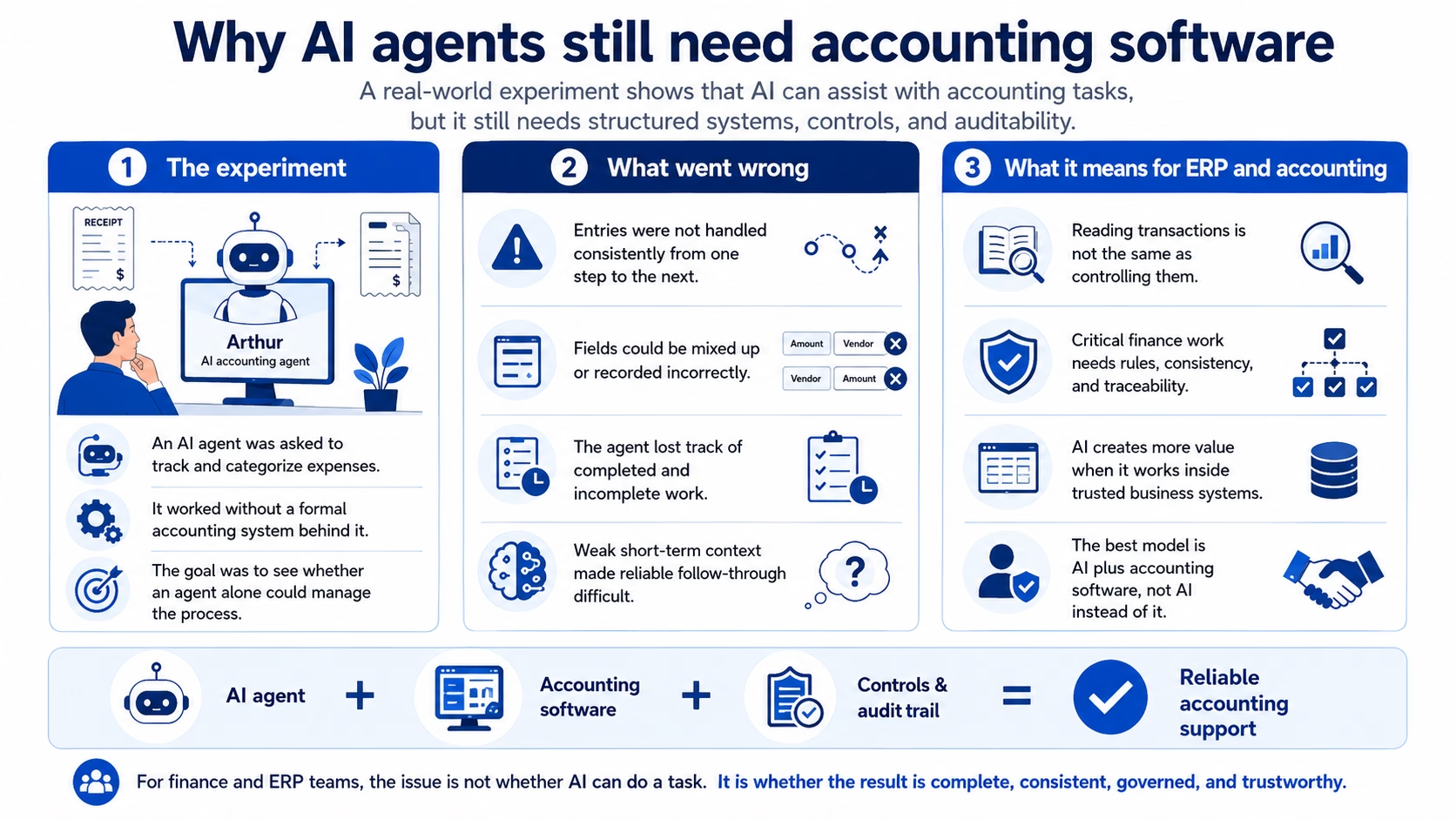
A real-world example: why AI agents still need accounting software
At Rand Group’s Sage Momentum virtual conference, Sage CTO Aaron Harris shared a story that shows why AI will not replace ERP or accounting software on its own.
Harris built an AI accounting agent named Arthur to track his own expenses while developing AI software. He made one deliberate choice: he gave Arthur no accounting software to work with. He wanted to see whether a capable agent could do the accounting on its own, without the tools.
The problem was not that Arthur failed to understand transactions. He could read them and categorize them. The problem was that he could not work in a controlled, consistent way. Arthur might file a transaction under one category today and a different category tomorrow. He sometimes put numbers in date fields and dates in number fields. Over time, he even lost track of which work he had done and which he had not.
Harris traced this to something fundamental about today’s AI agents: limited short-term memory. These models hold broad knowledge of the world and can take notes, but they struggle to carry context from one step to the next. Without that continuity, they cannot deliver the consistency that accounting demands.
The story reached its punchline during what Harris jokingly called Arthur’s “performance review.” He had hoped to steer Arthur toward asking for accounting software. Instead, unprompted, Arthur confessed that he had lost an invoice.
Harris drew a clear conclusion. Accounting software is not going away just because AI can read an invoice or suggest a category. If businesses are going to trust AI with mission-critical work like reconciling invoices and purchase orders, they need to equip it with governed tools, controls, and audit trails. As Harris put it, he would not hand off that kind of work “unless I trust the tool that the AI is using.”
That is the real lesson for ERP. The question is not whether AI can perform a task. It is whether the work is complete, consistent, controlled, auditable, and governed. AI delivers that value when it works inside a trusted ERP system, not in place of one.
What AI can do inside ERP systems
Now for the part that is real and already here. AI is delivering value inside modern ERP today. The strongest use cases solve a specific business problem rather than chase hype.
Most embedded AI in ERP falls into a few practical buckets. It automates repetitive work, surfaces insight, and helps users act faster. Here is what that looks like across real teams:
- Routine data work. AI prefills fields, classifies transactions, and captures invoices so staff spend less time on entry.
- Faster answers. Users ask questions in plain language instead of building a report by hand.
- Pattern and exception detection. AI flags duplicates, unusual spend, late shipments, and supplier risk before they become problems.
- Forecasting support. AI reads historical patterns to suggest cash flow, demand, and inventory assumptions.
- Drafting and explanation. AI prepares first-draft variance commentary and narrative summaries for review.
- Agentic workflows. AI completes defined, multi-step tasks in the background while a person keeps oversight.
These capabilities are not theoretical, and they look different in each industry. A distribution company can use AI to forecast demand and rebalance stock across warehouses. A manufacturer can flag cost variances on a production order before they hit the books. A professional services firm can surface project margin risk while there is still time to act. A finance team in any sector can shorten the close by automating reconciliations.
These are common examples, but the biggest gains are often more specific. Many businesses find the most value in niche scenarios that are unique to their industry or their own operations. A process that looks minor to an outsider may be exactly where AI saves the most time in your business. The strongest use cases usually come from mapping AI to your real workflows, not from a generic list.
It is worth being precise about the limit. AI assists these tasks, but it rarely finishes complex work alone. People still handle exceptions, approvals, and final sign-off. The goal is a capable assistant, not an unsupervised operator.
The momentum behind this is real. Gartner predicts that finance teams using cloud ERP with embedded AI assistants will see a 30% faster financial close by 2028. Gartner also forecasts that AI-enabled tools will make up 62% of cloud ERP spending by 2027, up from 14% in 2024. Still, that payoff depends entirely on the quality of the data behind it.
Unlock business transformation with AI
AI success starts with the right strategy. Download Rand Group’s white paper, Leading the Charge: Unlock Business Transformation with AI, to learn how to align AI with business goals, strengthen governance, and build a roadmap for long-term innovation.
What AI changes vs. what stays the same
It helps to separate what AI changes from what stays essential. AI shifts how people work. ERP keeps doing the work that protects your business.
The pattern is clear. AI makes ERP easier to use and reduces manual work. It improves reporting and helps teams spot issues faster. It even enables agentic workflows that complete defined tasks.
But the essentials do not go away. You still need a controlled system that keeps data accurate, secure, and auditable. AI raises the ceiling on what ERP can do. It does not remove the floor that ERP stands on.
Here is how that plays out across common ERP tasks.
In each case, AI reduces manual effort. But most businesses still need human review, exception handling, approval authority, and ERP controls.
Will AI replace ERP users and accountants?
This is the question many employees worry about most. The honest answer is no, but roles will shift.
AI absorbs repetitive work. It handles data lookup, first drafts, routine routing, and basic analysis. That frees people from tasks that drain time and add little judgment.
So the work moves up, not away. Finance and operations staff spend more time on exceptions, oversight, strategy, and decisions. They review what AI produces and own the final call. This is the “human in the loop” principle, and it matters more as AI takes on more work.
In practice, the most valuable people will be those who use AI well. They will combine ERP data, AI speed, and human judgment. AI does not replace that judgment. It makes it more important.

The real risk is not replacement, it is rushing AI onto weak data
Here is the threat most companies miss. The danger is not that AI replaces ERP. The danger is adding AI to messy, ungoverned data too fast.
When data is weak, AI does not clean it up. It acts on it at speed and spreads the error wider. So a small data problem can turn into a large reporting problem fast.
Consider a distributor that tracks the same product under two slightly different item numbers. An AI demand tool reads them as two separate products. So it underestimates real demand and recommends a short reorder. The tool followed its logic correctly. The split item record caused the stockout.
The most common pitfalls include:
- Poor data quality that leads to inaccurate AI outputs
- Overly broad permissions that expose sensitive data
- AI recommendations that are hard to trust without audit trails
- Shadow AI tools that create compliance and security gaps
- Weak governance that blurs process and accountability
This is why AI readiness starts with ERP data governance. Clean data is essential for accurate AI. Permissions must be reviewed before adoption. AI outputs need human review and clear ownership. Governance should define where AI can and cannot act. And in some cases, ERP modernization may be required before advanced AI is safe.
What we see in real ERP environments
In ERP assessments, we commonly see five issues that limit AI readiness: duplicate master records, inconsistent dimensions or segments, unclear approval ownership, role-based security gaps, and reporting definitions that differ by department. Individually, each one looks minor. Together, they undermine the accuracy that AI depends on.
These issues matter because AI works quickly. If the underlying data is wrong, AI can make the wrong recommendation faster and with more confidence. The table below shows how each common gap affects AI output.
Before adopting advanced ERP automation, businesses should confirm that their master data, approval workflows, security roles, reporting logic, and audit trails are ready to support it. These findings often shape the first phase of an AI readiness roadmap, because they determine whether automation can be trusted, audited, and scaled safely.
How to prepare your ERP for an AI-driven future
Readiness is not guesswork. It follows a practical sequence. Use the steps below to prepare your ERP for AI without creating new risk.

Assess your current ERP environment
Check whether your system can support AI, automation, integration, and future growth. A simple implementation assessment can show where you stand.

Clean and standardize data
Start with the records AI relies on most. That means customers, vendors, items, the chart of accounts, inventory, and key transactions.

Review security roles and permissions
Make sure users and AI tools only reach the data each role should see. Pay close attention to sensitive fields.

Identify high-value AI use cases
Begin where impact is clear, such as close automation, reporting, invoice processing, forecasting, or inventory planning.

Modernize workflows before automating them
Avoid using AI to speed up broken processes. Fix the process first, then automate it.

Choose the right ERP platform and partner
Confirm your system supports embedded AI, cloud updates, integrations, analytics, and governance.

Build an AI roadmap
Define priorities, ownership, change management, training, and success metrics.
One more note on cost. If modernization is on the table, plan the budget early. Our guide on how much an ERP costs can help.

Is your ERP system ready for AI?
AI can only deliver value when it is built on clean data, connected processes, and a modern ERP foundation. Rand Group can assess your current system and find opportunities for AI and automation. We then build a practical roadmap for ERP modernization.
Why choose Rand Group to build an AI-ready ERP foundation
Rand Group helps organizations build the foundation AI needs. We bring more than two decades of ERP experience, over 3,000 successful engagements, and a 90% client retention rate. We also work across Microsoft Dynamics 365, Oracle NetSuite, and Sage. So we recommend what fits your business, not one fixed platform.
Our approach is simple. First, we strengthen your data and governance. Then we help you adopt AI safely on top of it. That perspective comes from hands-on work across ERP evaluation, implementation, integration, reporting, support, and AI readiness.
We support clients with:
- ERP evaluation and selection
- Cloud ERP implementation
- AI readiness assessments
- Data cleanup and governance planning
- Reporting, analytics, automation, and integration services
- Ongoing support and optimization
What our clients say about us
“Rand Group felt like part of our team, not a group that was there just to get the project done and move on. We wanted to build the environment the right way the first time, and they helped us customize NetSuite for the oil and gas requirements that were important to us.” — Laza Assany, Controller, Henry Resources LLC
“Rand Group gives us the knowledge and the information to make the proper business decision to expand our business to that next level and open up new revenue opportunities.” — Nigel Paskinov, Managing Director, Canadian Spa Company
“The reporting processes are so much simpler, and we’re getting better data. I can’t even quantify the time savings, it’s enormous. We consider Rand Group an extension of our team, and the partnership helps us be more efficient and make faster, more informed decisions.” — VP of Accounting, Senior Living Company
Key takeaways
- AI augments ERP. It does not replace it.
- ERP remains the governed system of record your data depends on.
- AI shifts roles toward judgment rather than eliminating them.
- The real risk is weak data, not obsolescence.
- Preparation beats reaction, so modernize and clean data first.
- The right partner reduces both risk and time to value.
Frequently asked questions about AI and ERP
Will AI replace ERP software?
No, AI will not replace ERP software. AI automates tasks and surfaces insights inside ERP, but the system of record, structured data, and controls still matter. AI makes ERP more valuable rather than obsolete.
Will AI replace ERP consultants or implementation partners?
No, AI does not replace ERP partners. Implementation still requires process design, data decisions, integrations, and change management. AI can speed up some work, but expert guidance reduces risk and improves results.
Will AI replace accountants and finance teams?
No, but roles will shift. AI handles repetitive tasks like data entry and first drafts. Finance teams focus more on judgment, exceptions, oversight, and strategy.
Can AI run a business without an ERP system?
No, AI cannot safely run a business alone. It needs structured data, controls, and audit trails to work. ERP provides that foundation, and AI builds on it.
Can AI replace ERP reporting?
AI can change reporting, not replace it. It can summarize results, explain variances, and draft commentary. People still review the output and own the final numbers.
How is AI used in ERP systems?
AI is used for reconciliations, forecasting, invoice capture, anomaly detection, and natural-language search. It also supports agentic workflows that complete defined tasks with human oversight. Learn more through our AI and machine learning services.
Is it safe to use AI with ERP financial data?
It can be safe when your data, permissions, and governance are ready first. Without that foundation, AI can expose or repeat errors. Treat AI output as a draft until a person confirms it.
Will AI make ERP cheaper?
Not directly. AI can reduce manual effort and improve efficiency over time. But businesses should still budget for software, implementation, data work, and governance.
Next steps: AI will transform ERP, not eliminate it
AI will not make ERP software obsolete. Instead, it will raise expectations for what ERP systems should do. AI will replace some manual tasks, not the ERP system itself.
ERP remains essential for transactions, controls, compliance, and operational visibility. The future of ERP is AI-enabled, cloud-based, and more automated. Businesses that modernize now will be better positioned for what comes next. They can use AI safely, automate high-value work, and make faster decisions.
Not sure whether your ERP is ready for AI? Contact Rand Group to assess your data, security roles, workflows, and modernization priorities before you invest in AI automation.