Insurance ERP software: What insurance companies need in an accounting and financial management system

For insurance companies, financial management is about much more than balancing the books. Premiums, claims, commissions, reserves, reinsurance activity, and regulatory reporting often originate in specialized insurance systems, but the financial impact still needs to be accurately recorded, reconciled, reported, and controlled. As organizations grow, disconnected accounting software, policy administration systems, claims platforms, and manual spreadsheets can make it difficult to maintain accurate financial data and meet compliance requirements.
Modern insurance ERP software helps insurers centralize financial management, automate accounting processes, and connect critical business systems into a more reliable financial source of truth. In this guide, we’ll explain what ERP software does for insurance organizations, how it differs from a Policy Administration System, which features to prioritize, and how the right financial management platform can support long-term growth.
Quick answer
Insurance ERP software helps insurance companies manage accounting, financial reporting, compliance, consolidations, and the financial impact of premiums, commissions, claims, reserves, and reinsurance activity. It also connects with Policy Administration Systems, claims platforms, billing tools, and reporting systems. Unlike a Policy Administration System, which manages insurance operations, ERP serves as the financial system of record.
What is ERP software?
Enterprise Resource Planning (ERP) software is a business management platform that connects an organization’s core financial and operational processes into a single, centralized system. Rather than relying on disconnected applications and spreadsheets, ERP software provides a single source of truth for financial data, reporting, and business operations.
For insurance companies, ERP serves as the financial backbone of the organization. It manages core accounting functions while integrating with the specialized systems insurers rely on every day, including policy administration systems (PAS), claims management platforms, customer relationship management (CRM) software, payroll, and business intelligence tools.
A modern ERP system typically includes capabilities such as:
- General ledger
- Accounts payable and receivable
- Budgeting and forecasting
- Cash management
- Financial reporting
- Multi-entity and multi-currency accounting
- Regulatory reporting and audit trails
It’s important to note that an ERP system is not the same as a Policy Administration System. A PAS manages insurance-specific operational activities such as policy creation, underwriting, billing, renewals, and claims processing. An ERP solution manages the financial side of the business and, when integrated with a PAS, provides finance teams with accurate, timely data without the need for manual reconciliation between multiple systems.
When ERP is integrated with systems such as PAS, claims management, CRM, and business intelligence tools, insurance organizations can improve financial visibility, reporting accuracy, and decision-making.
ERP vs. accounting software for insurance companies
Entry-level accounting systems can manage basic financial transactions, but they often struggle with the complexity of growing insurance organizations. As insurers add entities, products, regions, agencies, claims data, commission structures, and regulatory reporting requirements, finance teams often need stronger controls, integrations, consolidations, reporting, and automation.
ERP software provides a more scalable financial foundation by connecting accounting with operational systems and creating a more reliable source of truth for reporting and decision-making.

Download our software selection checklist
Choosing the right ERP solution for your insurance business starts with asking the right questions. Our Top 10 ERP Software Selection Checklist walks you through the critical steps of evaluating ERP solutions, comparing vendors, and selecting a platform that supports your organization’s financial, operational, and long-term growth goals.
Signs your current accounting software is holding your insurance business back
Many insurers don’t replace their accounting system because it stops working. They replace it because it no longer supports the complexity of their business.
Common warning signs include:
- Finance teams manually reconciling policy and claims data every month
- Premium billing and collections requiring spreadsheets or manual processes
- Commission calculations performed outside the accounting system
- Claims reserves maintained in separate applications
- Limited visibility into profitability by product, carrier, region, or agency
- Lengthy month-end and year-end close processes
- Difficulty consolidating multiple legal entities
- Duplicate data entry across financial and operational systems
- Time-consuming audits due to incomplete documentation and manual reporting
In our experience, insurance organizations often tolerate these inefficiencies longer than they should. While workarounds may function for smaller organizations, they become increasingly difficult to maintain as transaction volumes, regulatory requirements, and organizational complexity grow.
Essential features to look for in insurance ERP software
Not every ERP platform is designed with insurance organizations in mind. While core accounting functionality is important, insurers require capabilities that support industry-specific financial processes and reporting requirements.
General ledger built for insurance accounting
The general ledger should provide the flexibility to manage the unique accounting requirements of insurance organizations while supporting accurate financial reporting across multiple business units.
Look for capabilities such as:
- Automated journal entries
- Multi-dimensional reporting
- Earned and unearned premium tracking
- Flexible chart of accounts
- Automated allocations
- Multi-book accounting
- Financial consolidations
A modern general ledger should also integrate seamlessly with policy administration and billing systems to reduce manual journal entries and reconciliation work.
Claims reserve and subledger integration
Claims represent one of the largest financial obligations for insurance companies. Financial systems should accurately track both paid claims and future liabilities.
An effective ERP should support integration with claims management systems to monitor:
- Claims payments
- Outstanding claim reserves
- Incurred But Not Reported (IBNR) reserves
- Recovery and subrogation activity
- Claims expense reporting
By synchronizing claims data with the general ledger, finance teams gain greater confidence in financial reporting while reducing reconciliation effort.
Premium billing and collections
Managing premium revenue involves much more than generating invoices.
Insurance ERP software should support:
- Premium billing
- Recurring payment schedules
- Payment collections
- Agency billing
- Revenue reconciliation
- Renewal billing
- Cash application
Automating these processes helps improve cash flow visibility while reducing manual billing errors.
Commission management
Insurance organizations frequently manage complex commission structures involving brokers, agencies, and producers.
Rather than calculating commissions manually, ERP software should support:
- Tiered commission structures
- Split commissions
- Renewal commissions
- Chargebacks
- Automated commission calculations
- Payment tracking
Automation reduces administrative effort while improving payment accuracy. For organizations using Microsoft Dynamics 365 Business Central, specialized commission management applications can further streamline commission calculations, automate payment processing, and simplify the management of complex producer and broker commission structures.
Reinsurance accounting
For organizations that participate in reinsurance arrangements, financial reporting becomes significantly more complex.
Insurance ERP software should support tracking of:
- Ceded premiums
- Assumed premiums
- Treaty accounting
- Reinsurance recoverables
- Coinsurance arrangements
- Intercompany settlements
Accurate reinsurance accounting helps finance teams maintain compliance while providing better visibility into risk exposure.
Multi-entity and global financial management
Many insurance organizations operate across multiple legal entities, regions, or subsidiaries.
An ERP platform should simplify:
- Multi-entity accounting
- Multi-currency transactions
- Intercompany accounting
- Consolidated financial statements
- Regional reporting
- Global financial management
We’ve found that organizations pursuing acquisitions or geographic expansion often outgrow entry-level accounting software faster than expected. Multi-entity financial management becomes essential for maintaining consistent reporting and operational visibility across the business.
Compliance, security, and audit readiness
Insurance organizations operate under strict regulatory and financial reporting requirements.
Modern ERP software should provide:
- Role-based security
- Detailed audit trails
- Approval workflows
- Automated financial controls
- Multi-book accounting
- Support for applicable reporting frameworks such as GAAP, IFRS, IFRS 17, Solvency II, or NAIC reporting requirements, depending on the organization’s regulatory environment
These capabilities help simplify audits while improving financial governance and reducing compliance risk.
Executive reporting and financial dashboards
Finance leaders need timely operational and financial insights, not just financial statements.
Insurance ERP software should provide dashboards and reports that track metrics such as:
- Premium revenue
- Claims trends
- Expense ratios
- Loss ratios
- Combined ratios
- Cash flow
- Profitability by product or business line
- Budget versus actual performance
Real-time reporting enables leadership teams to make faster, more informed business decisions.

Integration matters as much as ERP functionality
Even the most capable ERP platform cannot deliver its full value if it operates in isolation.
Insurance organizations benefit most when ERP software integrates with:
- Policy Administration Systems (PAS)
- Claims management platforms
- CRM solutions
- Payroll systems
- Banking platforms
- Document management systems
- Business intelligence tools
These integrations reduce duplicate data entry, improve reporting accuracy, and eliminate many of the manual reconciliation tasks that consume finance teams’ time.
In many insurance ERP projects, the most important decision is not just which accounting platform to choose, but how financial data will flow from the policy administration system, claims system, billing tools, and reporting environment. If those integrations are not planned early, finance teams may still rely on manual reconciliations even after moving to a modern ERP.
Choosing the right insurance ERP software
Every insurance organization has unique operational requirements, so selecting the right ERP involves more than comparing feature lists.
When evaluating solutions, consider:
- Industry-specific accounting capabilities
- Integration with your existing Policy Administration System
- Scalability for future growth
- Multi-entity and multi-currency support
- Financial reporting flexibility
- Security and compliance capabilities
- Cloud deployment options
- Implementation methodology
- Long-term support services
- Total cost of ownership
Organizations often focus heavily on software features while overlooking implementation methodology, change management, integration complexity, and long-term vendor support. In our experience, these factors often have a greater impact on project success than differences between ERP feature sets.
The best ERP platform should address both today’s financial requirements and tomorrow’s growth.
ERP solutions Rand Group recommends for insurance organizations
At Rand Group, we help insurance organizations evaluate and implement ERP solutions that align with their financial management needs, regulatory requirements, and growth objectives. While the right solution depends on your organization’s unique requirements, these platforms are commonly recommended for insurance companies.
At a glance, here’s how they compare:
Microsoft Dynamics 365 Business Central
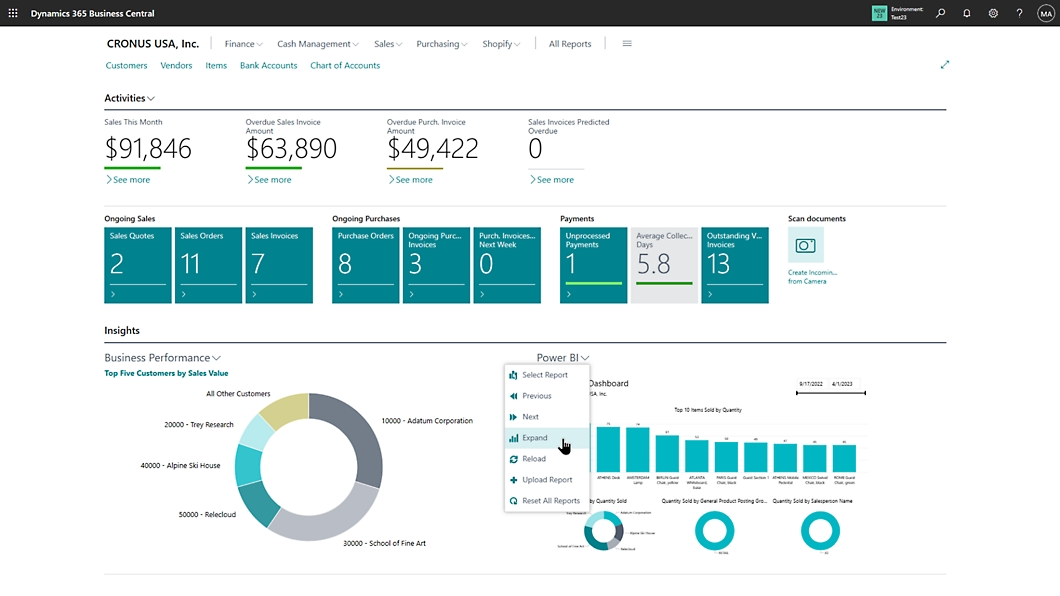
Business Central (BC) is a flexible cloud ERP that helps small and midsized insurance organizations modernize financial management, automate accounting processes, and connect Microsoft business applications.
Best fit for:
- Small and midsized insurance companies
- Organizations already using Microsoft 365
- Insurers seeking a scalable cloud ERP with strong financial management
Key strengths:
- Financial management and reporting
- Multi-entity capabilities
- Workflow automation
- Microsoft 365 and Power BI integration
- Flexible integrations with insurance applications
Considerations:
Business Central is ideal for many growing insurers, but organizations with highly complex global operations or enterprise-scale financial requirements may benefit from Microsoft Dynamics 365 Finance & Operations.
Microsoft Dynamics 365 Finance & Operations
Dynamics 365 Finance & Operations is Microsoft’s enterprise ERP platform for organizations managing large-scale financial operations, complex compliance requirements, and global business processes.
Best fit for:
- Large insurance carriers
- Multi-national insurance organizations
- Enterprises with high transaction volumes and complex regulatory requirements
Key strengths:
- Enterprise financial management
- Global consolidations and multi-currency accounting
- Advanced budgeting and forecasting
- Built-in compliance and financial controls
- Microsoft ecosystem integration and AI capabilities
Considerations:
Finance & Operations is designed for enterprise organizations and typically involves a larger implementation investment than Business Central.
Sage Intacct
Sage Intacct is a cloud-native financial management platform designed for organizations that prioritize finance automation, reporting, and visibility.
Best fit for:
- Mid-market insurance organizations
- Finance-first teams
- Organizations focused on improving reporting and close processes
Key strengths:
- Multi-entity accounting
- Dimensional reporting
- Automated consolidations
- Open API integrations
- Real-time dashboards
Considerations:
Organizations needing broader operational capabilities beyond financial management may prefer a more comprehensive ERP platform.
Oracle NetSuite
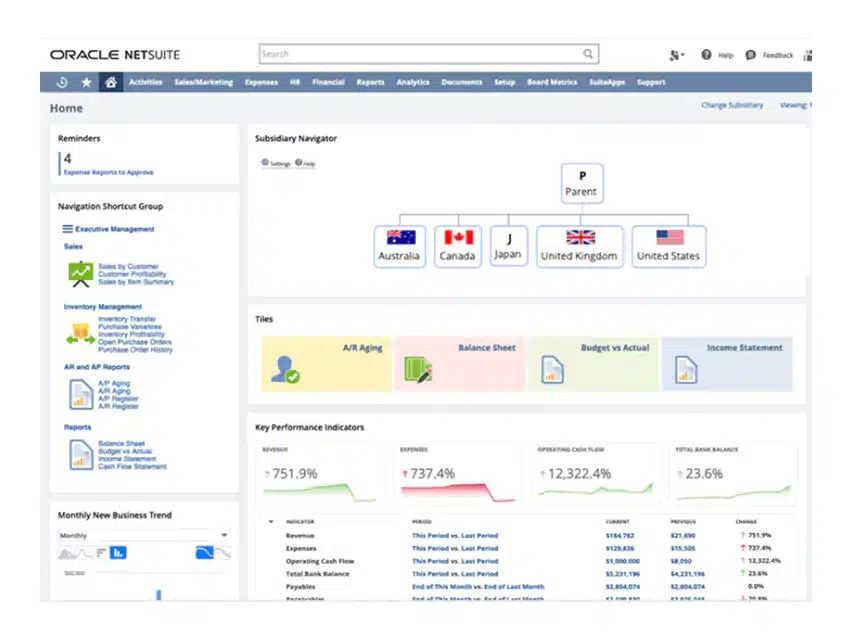
NetSuite is a unified cloud ERP that combines financial management with broader business operations, making it well suited for organizations with increasing complexity.
Best fit for:
- Growing insurers
- Multi-subsidiary organizations
- Companies expanding internationally
Key strengths:
- Global financial management
- Multi-entity and multi-currency support
- Financial planning and reporting
- Workflow automation
- Scalable cloud architecture
Considerations:
NetSuite offers broad functionality that may exceed the needs of smaller insurance organizations with less complex operational requirements.
Ultimately, the best ERP depends on your organization’s size, operational complexity, existing technology ecosystem, and long-term business strategy. An experienced ERP partner, like Rand Group, can help evaluate your requirements and recommend the solution that best supports your financial and operational goals.

Connect with our ERP software selection experts
Choosing the right ERP doesn’t have to be overwhelming. Our consultants can help you evaluate your requirements, compare leading solutions, and select the platform that best supports your organization’s financial, operational, and growth objectives.
Real-world success: Modernizing financial operations for a leading Canadian insurance provider
Rand Group worked with a leading Canadian insurance provider to replace disconnected legacy systems with Microsoft Dynamics 365 Business Central. Operating across multiple branches and currencies, the organization needed a unified financial platform that would improve visibility, automate manual processes, and support future growth.
By implementing Business Central alongside integrated automation solutions, the insurer streamlined accounts payable, expense management, payment processing, and financial reporting across multiple entities.
The results included:
- Greater financial visibility through consolidated reporting
- Reduced manual effort with automated financial workflows
- Improved compliance through standardized processes
- A scalable cloud ERP platform built to support continued growth
Why insurance organizations partner with Rand Group
Selecting insurance ERP software is only one part of a successful modernization initiative. Equally important is working with an implementation partner that understands financial processes, reporting requirements, systems integration, and organizational change management.
For more than 20 years, we’ve helped organizations evaluate, implement, integrate, and optimize ERP solutions that align with their operational and financial objectives.
Our consultants help clients:
- Evaluate ERP platforms
- Develop implementation strategies
- Integrate ERP with existing business systems
- Improve financial reporting
- Automate accounting processes
- Support user adoption and long-term optimization
Because every insurance organization has unique operational requirements, we focus on understanding your business first and recommending technology that supports your long-term strategy, not simply implementing software.
Insurance ERP software FAQs
Why do insurance companies need ERP software?
Insurance companies manage complex financial transactions involving premiums, claims, commissions, reserves, and regulatory reporting. ERP software automates these processes, improves financial visibility, reduces manual work, and supports accurate compliance reporting.
What's the difference between ERP software and a Policy Administration System?
A Policy Administration System manages insurance operations such as policy issuance, renewals, billing, and claims administration. ERP software manages the organization’s financial operations, including the general ledger, accounts payable, budgeting, financial reporting, and consolidations. The two systems are often integrated to provide a complete view of financial performance.
What features should insurance ERP software include?
Insurance ERP software should include:
• General ledger and financial management
• Premium billing support
• Claims subledger integration
• Commission management
• Reinsurance accounting capabilities
• Multi-entity accounting
• Regulatory reporting
• Audit trails
• Real-time dashboards
• Integration with policy administration systems
Can ERP software integrate with policy administration systems?
Yes. Modern ERP platforms typically integrate with Policy Administration Systems, claims management software, CRM platforms, payroll systems, banking applications, and business intelligence tools to improve reporting accuracy and reduce duplicate data entry.
Does ERP software support regulatory compliance?
Many ERP platforms provide capabilities that help organizations meet regulatory requirements through audit trails, approval workflows, role-based security, financial controls, and reporting tools that support applicable accounting and regulatory standards.
What is the best ERP software for insurance companies?
The best insurance ERP software depends on factors such as your organization’s size, reporting requirements, regulatory environment, and growth plans. Many mid-market insurance organizations evaluate solutions such as Sage Intacct and Oracle NetSuite because of their financial management capabilities, scalability, and integration flexibility.
Modernize your insurance financial management
As insurance organizations grow, the limitations of disconnected accounting systems become increasingly difficult to overcome. The right ERP software for insurance companies can help unify financial data, automate complex accounting processes, improve regulatory reporting, and provide the visibility finance leaders need to support strategic growth.
Whether you’re evaluating ERP software for the first time or replacing a legacy financial system, our experts can help you identify the solution that best aligns with your financial requirements, operational complexity, and long-term business objectives. Contact our team to schedule a consultation and start your ERP project.