Best financial management software for multi-property hospitality groups

As hospitality portfolios grow, financial management becomes increasingly complex. Finance teams must consolidate multiple entities, manage intercompany transactions, integrate data from property management systems (PMS), POS, payroll, and procurement applications, and produce timely, accurate financial reports.
While entry-level accounting software may work for a single property, it often struggles to support the needs of growing hospitality organizations. The best financial management software for hospitality centralizes financial operations, automates reporting, and provides the visibility needed to support continued growth.
In this guide, we compare four leading cloud ERP platforms for hospitality organizations:
- Sage Intacct
- Oracle NetSuite
- Microsoft Dynamics 365 Business Central
- Microsoft Dynamics 365 Finance & Operations
Each solution offers different strengths depending on your organization’s size, operational complexity, and long-term growth strategy.
Quick answer: Best financial management software for hospitality
The best financial management software for hospitality depends on the organization’s size, property structure, reporting needs, and technology ecosystem. Sage Intacct is often a strong fit for finance-first hospitality groups that need multi-entity accounting and reporting. NetSuite is a good option for organizations that want a broader cloud ERP platform. Dynamics 365 Business Central can be a strong fit for small to midsized hospitality groups already using Microsoft technologies. Dynamics 365 Finance & Operations is best suited for large or global hospitality enterprises with complex financial and operational requirements.
What is hospitality financial management software?
Hospitality financial management software is a cloud-based accounting or ERP platform that helps hotel groups, resort operators, restaurants, and other hospitality organizations manage financial operations across one or multiple properties. In addition to core accounting functions, these platforms consolidate financial data from property management systems (PMS), point-of-sale (POS) systems, payroll, procurement, and other operational applications.
Unlike entry-level accounting software, hospitality financial management solutions are designed to support the complexity of growing organizations with capabilities such as multi-entity management, intercompany accounting, and budgeting and forecasting.
The best financial management software for hospitality gives finance leaders a centralized view of performance across every property while reducing manual processes and improving reporting accuracy.
Hospitality ERP vs. hospitality accounting software
Hospitality accounting software typically focuses on core finance functions such as general ledger, accounts payable, accounts receivable, budgeting, and financial reporting. For a single property or smaller hospitality business, those capabilities may be enough.
Hospitality ERP software usually provides a broader platform for managing financial complexity across multiple properties, entities, departments, and systems. In addition to accounting, ERP can support multi-entity consolidation, intercompany transactions, procurement, workflow automation, reporting, integrations, and operational visibility.
For growing hospitality groups, the right choice depends on whether the organization needs basic accounting support or a scalable platform that connects finance with operational systems such as PMS, POS, payroll, procurement, and revenue management tools.

Top 10 ERP software selection checklist
Choosing the right ERP involves more than comparing features. Our free Top 10 ERP Software Selection Checklist walks you through the key evaluation criteria to help you identify the solution that best fits your organization’s needs, growth plans, and long-term business goals.
What hospitality organizations should look for in ERP
Hospitality organizations have unique financial requirements that extend well beyond general accounting. Before selecting an ERP platform, evaluate how well it supports the following capabilities.
Multi-entity accounting and financial consolidation
Many hospitality groups operate through multiple legal entities, ownership structures, management companies, or franchise agreements. Financial management software should simplify these complexities by providing:
- Automated multi-entity consolidations
- Intercompany accounting and eliminations
- Multi-currency support
- Standardized charts of accounts across properties
- Easy onboarding for newly acquired hotels or resorts
As hospitality portfolios grow, automated consolidation becomes increasingly important for reducing manual effort and improving reporting accuracy.

Hospitality system integrations
Hospitality organizations rely on a wide range of operational systems to manage daily operations across hotels, resorts, restaurants, and other venues. Financial management software should integrate seamlessly with these applications to automate data flow, eliminate manual data entry, and provide a complete view of financial performance.
Look for ERP platforms that integrate with:
- Property Management Systems (PMS)
- Point-of-Sale (POS) platforms
- Payroll and human capital management systems
- Procurement and inventory management
- Revenue management and forecasting
Prioritize solutions with open APIs and proven integrations with leading hospitality technologies such as Oracle OPERA, Cloudbeds, Maestro PMS, Oracle MICROS, Toast, NCR Aloha, Restaurant365, and other industry-specific applications.
Reporting and hospitality analytics
Hospitality organizations rely on timely financial reporting and operational analytics to monitor performance across multiple locations. While hotels and resorts often follow the Uniform System of Accounts for the Lodging Industry (USALI) to standardize financial reporting, restaurant groups, entertainment venues, country clubs, and other hospitality businesses also require consistent reporting frameworks to compare locations and measure profitability.
A strong hospitality ERP should support:
- Department-level revenue and expense reporting
- Property performance comparisons
- Operational metrics alongside financial data
- Executive dashboards for portfolio performance
- Flexible reporting that supports industry-specific accounting standards and KPIs
The best financial management software for hospitality combines financial and operational data to provide deeper insight into business performance. Depending on the type of hospitality organization, leaders may track metrics such as occupancy, average daily rate (ADR), revenue per available room (RevPAR), food and beverage revenue, food cost percentage, labor cost percentage, average check size, table turns, and same-store sales alongside financial results to make more informed business decisions.
Accounts payable automation and purchasing
Hospitality businesses process thousands of invoices each month from food suppliers, maintenance vendors, utilities, housekeeping services, and other operational partners.
Modern financial management software should include:
- OCR invoice capture
- Automated approval workflows
- Three-way purchase order matching
- Vendor management
- Centralized purchasing controls
Automating accounts payable reduces manual data entry while improving financial controls across every property.

Scalability for future growth
The best financial management software for hospitality should support not only today’s operations but also tomorrow’s expansion. Whether your organization plans to acquire additional properties, expand internationally, or open new locations, your ERP should scale without requiring a complete system replacement.
Best financial management software for hospitality
The following cloud ERP platforms are among the leading financial management solutions for multi-property hospitality organizations. Each excels in different areas depending on your operational requirements, financial complexity, and growth plans.
These recommendations are based not only on platform capabilities, but also on Rand Group’s experience helping hospitality organizations evaluate, implement, and optimize ERP solutions across restaurants, hotels, resorts, and multi-property hospitality businesses.
1. Sage Intacct
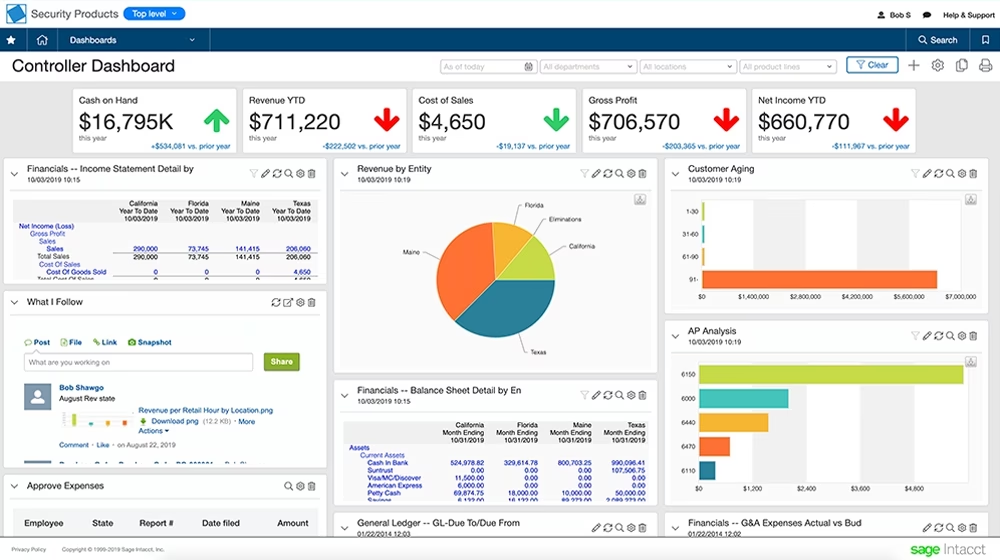
For organizations focused primarily on financial excellence, Sage Intacct stands out as one of the strongest hospitality accounting platforms available. As the AICPA’s preferred cloud financial management solution, Sage Intacct delivers sophisticated financial capabilities without the complexity of a full enterprise ERP.
Why it stands out
Sage Intacct was designed with finance teams in mind. Its cloud-native architecture enables organizations to automate financial consolidation, improve reporting accuracy, and gain visibility across multiple properties from a single platform.
Key strengths
- Advanced multi-entity accounting
- Automated intercompany transactions
- Multi-currency consolidations
- Dimensional reporting without a complex chart of accounts
- Real-time dashboards and financial reporting
- Open API ecosystem for hospitality integrations
Hospitality considerations
Sage Intacct integrates with many leading hospitality Property Management Systems (PMS), POS platforms, expense management solutions, payroll providers, and procurement applications. Rather than replacing operational systems, it serves as the financial hub that brings together data from across the hospitality technology stack.
Its dimensional accounting capabilities make it easy to analyze profitability by property, department, region, ownership group, or brand without maintaining hundreds of separate general ledger accounts. Finance leaders can quickly compare hotel performance, identify trends, and generate consolidated reports for executives and investors.
Real-world example
Rand Group helped a growing restaurant organization operating multiple locations implement Sage Intacct to modernize its financial management processes. The implementation standardized financial reporting across every location, improved visibility into location-level performance, and eliminated many of the spreadsheets previously used for financial consolidation. With a scalable cloud financial management platform in place, the organization established a stronger foundation to support continued growth as new locations were added.
Potential limitations
Sage Intacct focuses primarily on financial management rather than operational ERP functionality. Organizations requiring advanced inventory management, manufacturing, or supply chain capabilities may need additional applications.
2. Oracle NetSuite
Oracle NetSuite combines financial management with broader ERP functionality, making it an excellent choice for hospitality organizations that want to manage finance and operations within a single cloud platform.
Why it stands out
NetSuite’s unified database eliminates many of the data silos that exist between accounting and operational systems. As organizations add new properties, subsidiaries, or international operations, the platform scales alongside the business.
Key strengths
- Unified cloud ERP
- Multi-entity financial management
- Global consolidations
- Procurement and purchasing
- Inventory management
- Real-time dashboards and reporting
Hospitality considerations
Many hospitality organizations use NetSuite as the corporate financial system while integrating with operational applications such as Oracle OPERA PMS and various hospitality POS platforms. This approach allows finance teams to maintain centralized financial control while individual properties continue using specialized hospitality software.
NetSuite’s OneWorld capabilities make it particularly attractive for organizations operating across multiple countries or managing complex ownership structures.
Real-world example
Rand Group’s NetSuite experts helped a hospitality and food service organization operating multiple legal entities modernize its financial operations with Oracle NetSuite. By centralizing financial data within a unified cloud ERP, the organization streamlined reporting across entities, improved management’s visibility into business performance, and established a scalable platform to support future growth and acquisitions.
Potential limitations
NetSuite implementations are typically more involved than mid-market accounting systems, and some hospitality-specific workflows rely on third-party integrations rather than native functionality.

3. Microsoft Dynamics 365 Business Central
Microsoft Dynamics 365 Business Central (D365 BC) is a strong option for hospitality organizations already invested in the Microsoft ecosystem. It combines financial management with operational functionality while offering an extensive marketplace of industry-specific extensions.
Why it stands out
Business Central provides a flexible cloud ERP platform that integrates seamlessly with Microsoft 365, Power BI, Power Automate, and the broader Microsoft Power Platform.
Key strengths
- Financial management
- Multi-company support
- Microsoft 365 integration
- Power BI reporting
- Workflow automation
- Extensive partner ecosystem
Hospitality considerations
Out of the box, Business Central is a horizontal ERP rather than a hospitality-specific solution. However, its flexibility becomes a major advantage when paired with hospitality-focused ISVs.
Many hospitality organizations extend Business Central with solutions such as Binary Stream Multi-Entity Management for more sophisticated entity management and consolidation. Hospitality organizations may also leverage LS Central for Hospitality, which combines retail, POS, and back-office functionality within the Microsoft ecosystem.
For hospitality groups managing approximately 5 to 75 properties, Business Central often provides an attractive balance of functionality, flexibility, and total cost of ownership.
Real-world example
A hotel management company overseeing multiple properties partnered with Rand Group to implement Dynamics 365 Business Central and improve financial visibility across its portfolio. We extended the platform with multi-entity reporting capabilities, enabling the organization to standardize reporting and streamline financial management across locations. Leadership gained faster access to business information while continuing to leverage hospitality-specific applications alongside its ERP environment.
Potential limitations
Hospitality-specific capabilities generally come through third-party extensions rather than native functionality. Organizations should evaluate available ISVs during software selection.

4. Microsoft Dynamics 365 Finance & Operations
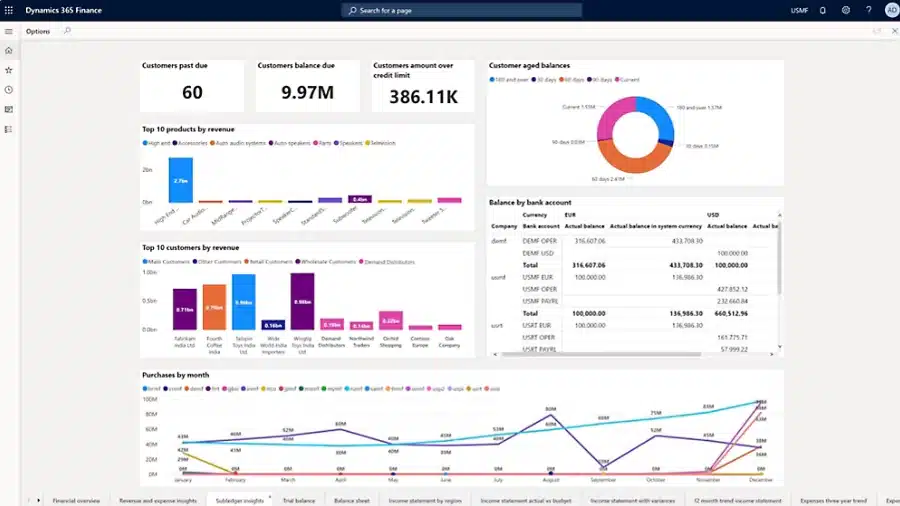
Dynamics 365 Finance & Operations (D365 F&O), comprised of Dynamics 365 Finance and Dynamics 365 Supply Chain Management, is Microsoft’s enterprise ERP platform designed for organizations managing high transaction volumes, global operations, and sophisticated financial requirements.
Why it stands out
Finance & Operations offers enterprise-grade financial controls, global compliance capabilities, advanced procurement, and powerful multi-company management for organizations operating at significant scale.
Key strengths
- Enterprise financial management
- Advanced intercompany accounting
- Global tax and regulatory compliance
- Multi-currency consolidation
- Procurement and supply chain management
- Enterprise reporting
Hospitality considerations
D365 F&O is best suited for multinational hotel brands, resort operators, gaming organizations, and hospitality enterprises with highly complex corporate structures.
Like Business Central, hospitality-specific functionality typically requires industry solutions and integrations with existing PMS and POS platforms.
Real-world example
A global hospitality and catering organization operating multiple legal entities across North America and Europe partnered with the Rand Group team to optimize its existing Dynamics 365 Finance & Operations environment. Through a comprehensive assessment of financial management, procurement, banking, and operational processes, the organization improved system utilization, streamlined workflows, and positioned its ERP environment to better support future growth.
Potential limitations
D365 Finance & Operations is designed for large, enterprise organizations with complex global operations. Implementations typically require more planning, resources, and time than mid-market ERP platforms. Hospitality organizations should carefully evaluate whether its extensive capabilities align with their operational complexity and long-term growth plans.
Best financial management software for hospitality at a glance
Which hospitality ERP is right for your organization?
Every hospitality organization has different operational priorities, growth plans, and reporting requirements. The right solution depends on where your business is today, and where it’s headed tomorrow.
Sage Intacct may be the right fit if you:
- Manage multiple ownership entities or properties
- Need sophisticated financial reporting
- Want automated consolidations
- Prioritize finance-first capabilities
- Expect continued acquisitions or expansion
NetSuite may be the right fit if you:
- Want a unified ERP platform
- Need financial and operational management together
- Operate internationally
- Require enterprise scalability without moving to a larger ERP
Business Central may be the right fit if you:
- Already use Microsoft technologies
- Operate a small to midsized hospitality portfolio
- Want a flexible ERP with industry extensions
- Need a lower total cost of ownership
Finance & Operations may be the right fit if you:
- Operate globally
- Manage extremely high transaction volumes
- Require advanced enterprise financial controls
- Have dedicated ERP resources and complex operational requirements
Frequently asked questions
What is the best financial management software for hospitality?
The best financial management software for hospitality depends on your organization’s size, operational complexity, and growth plans. Sage Intacct is well suited for finance-focused hospitality organizations requiring advanced multi-entity accounting, while Oracle NetSuite provides a unified cloud ERP for growing businesses. Microsoft Dynamics 365 Business Central and Dynamics 365 Finance & Operations are strong options for organizations invested in the Microsoft ecosystem.
Why do hospitality organizations need multi-entity accounting?
Multi-property hospitality groups often operate through separate legal entities, ownership groups, or management companies. Multi-entity accounting automates consolidations, intercompany transactions, and financial reporting while reducing manual spreadsheet work and improving visibility across the organization.
Can hospitality ERP software integrate with restaurant and hotel management systems?
Yes. Modern ERP platforms integrate with a variety of hospitality applications, including Property Management Systems (PMS), restaurant Point-of-Sale (POS) systems, payroll, procurement, inventory management, and revenue management software. These integrations help automate financial reporting by bringing operational data into a centralized financial management system.
What features should hospitality financial management software include?
The best financial management software for hospitality should include multi-entity accounting, automated financial consolidation, intercompany accounting, accounts payable automation, budgeting and forecasting, reporting and dashboards, multi-currency support, and integrations with hospitality systems such as PMS, POS, payroll, procurement, and inventory management applications.
How do I choose the right ERP for my hospitality organization?
Start by evaluating your organization’s number of locations, financial reporting requirements, operational systems, growth plans, and industry-specific needs. Working with an experienced ERP consulting partner can help you compare leading platforms, identify the right functionality, and select a solution that supports your long-term business goals.

Partner with Rand Group for hospitality ERP selection
Choosing financial management software is a long-term business decision. Rand Group helps hospitality organizations evaluate leading ERP solutions, streamline the selection process, and implement technology that supports future growth.
Why partner with Rand Group?
Selecting the best ERP for hospitality involves much more than comparing software features. Success depends on choosing a platform that aligns with your organization’s financial complexity, operational processes, technology ecosystem, and long-term growth strategy.
For more than 35 years, we’ve helped organizations evaluate, implement, and optimize leading ERP and financial management solutions. As a partner of Microsoft, Oracle NetSuite, and Sage, we provide objective guidance across multiple platforms rather than forcing every organization toward a single solution.
Our consultants help hospitality organizations:
- Evaluate ERP and financial management software
- Modernize financial processes
- Improve multi-entity reporting
- Integrate ERP with hospitality systems
- Automate accounts payable and financial workflows
- Support long-term growth through scalable cloud technology
Whether you’re replacing legacy accounting software or planning for future expansion, our team can help you select a solution that supports both today’s operational needs and tomorrow’s growth.
Choose the right financial management software for hospitality
Choosing the best financial management software for hospitality starts with understanding your organization’s financial complexity, operational requirements, and growth plans. Whether you’re evaluating Sage Intacct, Oracle NetSuite, Microsoft Dynamics 365 Business Central, or Dynamics 365 Finance & Operations, selecting the right ERP can improve visibility, automate financial processes, and accommodate continued growth.
If you’re evaluating ERP solutions for your hospitality business, we can help. Our ERP experts will help you compare leading platforms, assess your requirements, and choose the solution that’s the best fit for your organization. Contact our team to get started.