Best restaurant ERP software for growing restaurant groups

As restaurant groups grow, managing multiple locations, rising food and labor costs, inventory, and financial reporting becomes increasingly complex. Many organizations reach a point where entry-level accounting software and disconnected systems can no longer keep pace, forcing finance teams to rely on manual processes, spreadsheets, and time-consuming reconciliations that limit visibility and make it harder to protect already thin profit margins.
Modern ERP software solves these challenges by connecting accounting, inventory, purchasing, reporting, and operational data in a single platform. In this guide, we’ll compare the best restaurant ERP software for growing restaurant groups, including Oracle NetSuite, Sage Intacct, Microsoft Dynamics 365 Business Central, and Microsoft Dynamics 365 Finance & Supply Chain Management, to help you identify the solution that best supports your organization’s growth strategy.
At a glance
Selecting the best restaurant ERP software depends on your organization’s size, operational complexity, and growth strategy. This guide compares Oracle NetSuite, Sage Intacct, Microsoft Dynamics 365 Business Central, and Microsoft Dynamics 365 Finance & Supply Chain Management, highlighting each platform’s strengths for financial management, multi-location operations, inventory, reporting, AI, and scalability. You’ll also learn the key features to prioritize, questions to ask during your evaluation, and how choosing the right implementation partner can help ensure long-term ERP success.
Why growing restaurant groups need ERP software
As restaurant groups grow, disconnected accounting, inventory, purchasing, and reporting systems create inefficiencies that limit visibility and make it harder to scale. The best restaurant ERP software centralizes financial and operational data, helping organizations automate processes, improve reporting, and make more informed decisions.
Many restaurant groups are ready for ERP when they begin experiencing challenges such as:
- Managing multiple restaurant locations or brands
- Operating separate legal entities or franchise structures
- Running a commissary kitchen or central production facility
- Outgrowing QuickBooks or other entry-level accounting software
- Consolidating financial reporting across locations
- Improving inventory, purchasing, and food cost controls
- Supporting acquisitions or rapid expansion
The right ERP provides a scalable foundation that grows with your organization while delivering the financial visibility and operational control needed to support long-term success.
Restaurant ERP vs. POS and back-office systems
Restaurant ERP software does not usually replace every operational restaurant system. Most restaurant groups still rely on POS, labor management, inventory, recipe costing, loyalty, online ordering, or back-office restaurant applications. The ERP serves as the financial and operational backbone, bringing data from those systems into a centralized environment for accounting, reporting, purchasing, inventory visibility, consolidations, and decision-making.
The right ERP strategy depends on whether your organization wants an all-in-one platform, a finance-led ERP integrated with restaurant applications, or an enterprise system that connects multiple operational systems across brands and locations.
Features and capabilities to look for in restaurant ERP software
The best restaurant ERP software should connect financial management with the operational tools and integrations needed to support growth across multiple locations. Beyond core functionality, the right ERP should provide the visibility needed to monitor the financial and operational KPIs that drive restaurant profitability.
Key capabilities include:
- Financial management: Multi-entity accounting, financial consolidations, budgeting, forecasting, dashboards, and 4-4-5 calendar support.
- Restaurant operations: POS integration, recipe costing, food cost analysis, purchasing, inventory management, and invoice automation.
- Multi-location management: Intercompany accounting, consolidated reporting, commissary transfers, franchise royalty management, and shared services.
- AI and automation: Demand forecasting, purchasing recommendations, automated workflows, natural language reporting, and predictive insights.
- Performance reporting: Real-time dashboards and reporting to monitor key restaurant KPIs, including prime cost, food cost percentage, labor cost percentage, average guest check, same-store sales, inventory turnover, gross margin, and EBITDA.
Together, these capabilities help restaurant groups improve financial visibility, control food and labor costs, automate routine processes, compare performance across locations, and make more informed decisions that support profitable growth.

Need help choosing the right restaurant ERP?
Selecting an ERP is a long-term business decision, not just a software purchase. Rand Group helps restaurant organizations evaluate leading ERP solutions, define business requirements, compare platforms, and select the technology that best supports their financial, operational, and growth objectives.
Best restaurant ERP software comparison
Before diving into each platform, here’s a high-level comparison of the leading ERP solutions for growing restaurant organizations.
Each solution excels in different areas, making the right choice dependent on your restaurant group’s size, operational complexity, growth plans, and technology strategy.
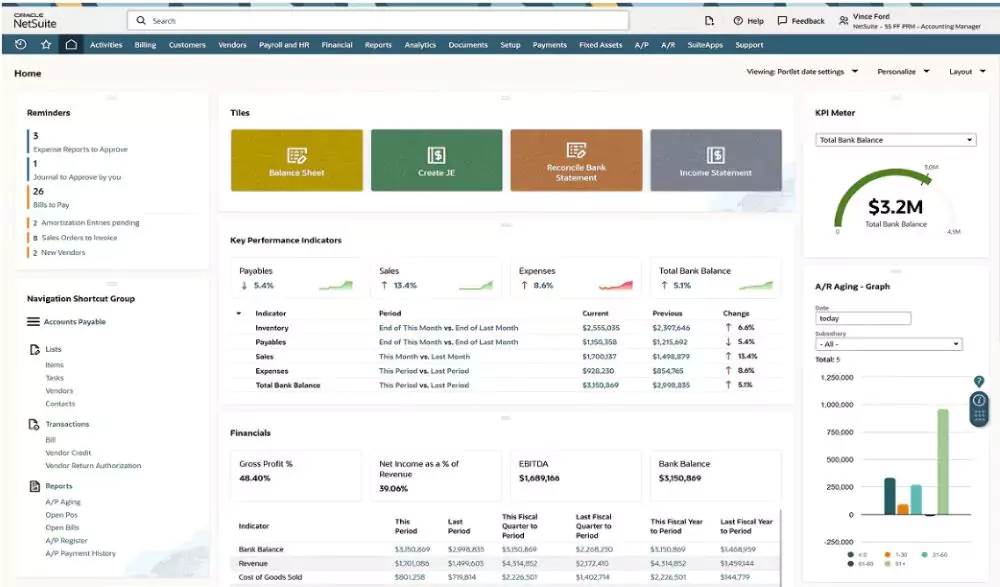
Oracle NetSuite
Oracle NetSuite combines enterprise financial management, inventory control, procurement, supply chain management, and multi-entity accounting within a unified cloud platform. Its flexibility allows organizations to support everything from regional restaurant chains to private equity-backed multi-brand hospitality groups planning aggressive expansion.
Unlike restaurant-specific platforms that focus primarily on operations, NetSuite provides the enterprise financial controls needed to scale while remaining flexible enough to integrate with leading restaurant technologies.
Key strengths for restaurant organizations
- Unified ERP platform: Manage accounting, purchasing, inventory, procurement, fixed assets, and reporting from a single cloud platform.
- Multi-entity management: Automate intercompany accounting, consolidations, franchise royalty calculations, and entity-specific reporting with NetSuite OneWorld.
- Commissary operations: Support central kitchens with manufacturing, production costing, transfer orders, inventory movements, and intercompany billing.
- Flexible POS integrations: Connect leading restaurant POS systems to automatically synchronize sales, payments, labor, and inventory data.
- Advanced reporting and AI: Gain real-time dashboards, budgeting, forecasting, workflow automation, and AI-powered insights to improve profitability and purchasing decisions.
Best fit for: Restaurant groups experiencing rapid growth, managing multiple legal entities or franchise operations, operating commissary kitchens, or preparing for acquisitions, private equity investment, or long-term enterprise expansion.
Considerations: NetSuite’s breadth of functionality means implementation typically requires experienced planning and configuration. Organizations should also evaluate their existing POS, inventory, and restaurant operations software to determine the most effective integration strategy.
Sage Intacct
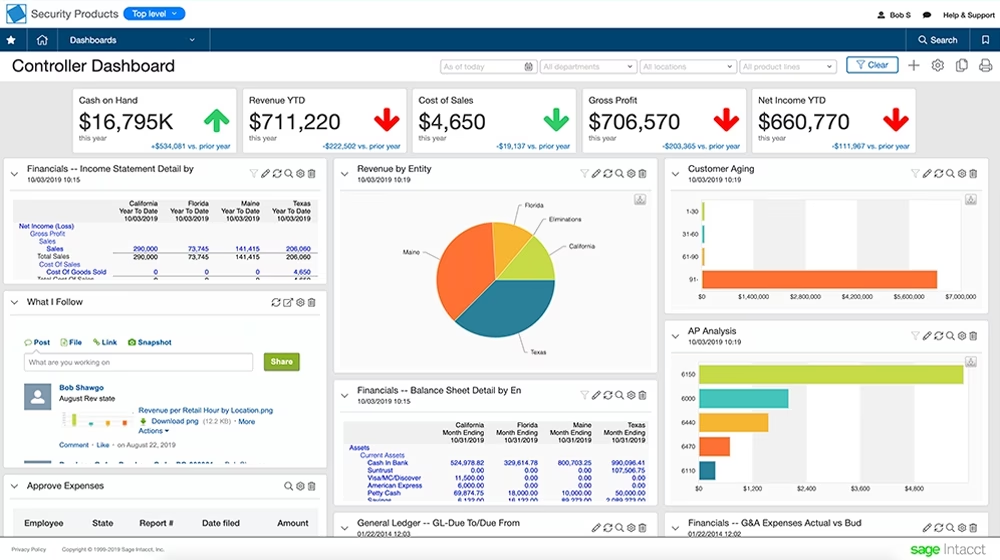
For restaurant organizations whose greatest challenge is financial visibility rather than operational execution, Sage Intacct is one of the strongest ERP platforms available. Rather than replacing every restaurant application, Sage Intacct focuses on delivering best-in-class cloud financial management while integrating with specialized restaurant technologies.
This makes it an excellent choice for growing restaurant groups that already use restaurant-specific inventory or back-office systems but need stronger accounting, reporting, and multi-entity capabilities.
Key strengths for restaurant organizations
- Dimensional accounting: Track performance by location, brand, department, region, vendor, and cost center without creating a complex chart of accounts.
- Multi-entity financial management: Automate consolidations, intercompany eliminations, ownership allocations, and consolidated financial reporting across multiple restaurant entities.
- Open integration platform: Connect specialized restaurant applications for POS, inventory, purchasing, and operations while centralizing financial management in Sage Intacct.
- Executive dashboards and reporting: Combine financial and operational data to monitor KPIs such as food costs, labor efficiency, average guest check, and location profitability.
- Budgeting and forecasting: Improve financial planning with flexible budgeting, forecasting, and real-time reporting to support strategic decision-making.
Best fit for: Restaurant groups that want stronger financial reporting, multi-location accounting, and executive visibility while continuing to use specialized restaurant applications for inventory, food costing, and operations.
Considerations: Because Sage Intacct emphasizes financial management rather than restaurant operations, organizations should ensure their inventory management, POS, purchasing, and food costing applications integrate effectively with the platform to create a connected technology ecosystem.
Microsoft Dynamics 365 Business Central
Microsoft Dynamics 365 Business Central (D365 BC) is an excellent choice for restaurant groups that have outgrown entry-level accounting software but don’t require the complexity of a large enterprise ERP. Built for small and mid-sized organizations, Business Central combines financial management, inventory control, purchasing, warehouse management, and reporting in a cloud-based platform that integrates seamlessly with Microsoft 365, Power BI, Power Automate, and Copilot.
Although Business Central is not restaurant-specific out of the box, it becomes a powerful restaurant management platform when paired with industry solutions such as LS Central. This combination gives growing restaurant groups access to integrated point-of-sale functionality while maintaining the financial controls expected from a modern ERP.
Key strengths for restaurant organizations
- Multi-company financial management: Manage multiple restaurant entities with automated intercompany transactions and consolidated financial reporting.
- Inventory and purchasing: Improve food cost control with inventory tracking, purchasing automation, vendor management, warehouse management, and lot and expiration date tracking.
- Microsoft ecosystem: Connect seamlessly with Microsoft 365, Power BI, Power Automate, Teams, and other Microsoft business applications.
- AI and automation: Leverage Microsoft Copilot, Power BI dashboards, workflow automation, and AI-assisted reporting to improve efficiency and decision-making.
- Flexible platform: Extend Business Central with industry-specific applications to support evolving operational requirements as your restaurant group grows.
Restaurant operations with LS Central
For restaurant groups that need integrated operational capabilities, Business Central can be extended with LS Central, a restaurant management solution built on Microsoft Dynamics 365 Business Central. LS Central adds restaurant-specific functionality such as:
- Point-of-sale (POS)
- Kitchen and table management
- Inventory depletion and food cost tracking
- Customer loyalty and gift cards
- Unified financial and operational data within the Microsoft ecosystem
Best fit for: Growing restaurant groups that want a scalable Microsoft-based ERP with strong financial management, inventory controls, and seamless integration with Microsoft 365, Power BI, and Microsoft Copilot.
Considerations: Business Central’s restaurant capabilities are significantly enhanced through industry-specific extensions like LS Central. Organizations should evaluate these complementary solutions during the software selection process to ensure the platform meets their operational requirements.

Microsoft Dynamics 365 Finance & Supply Chain Management
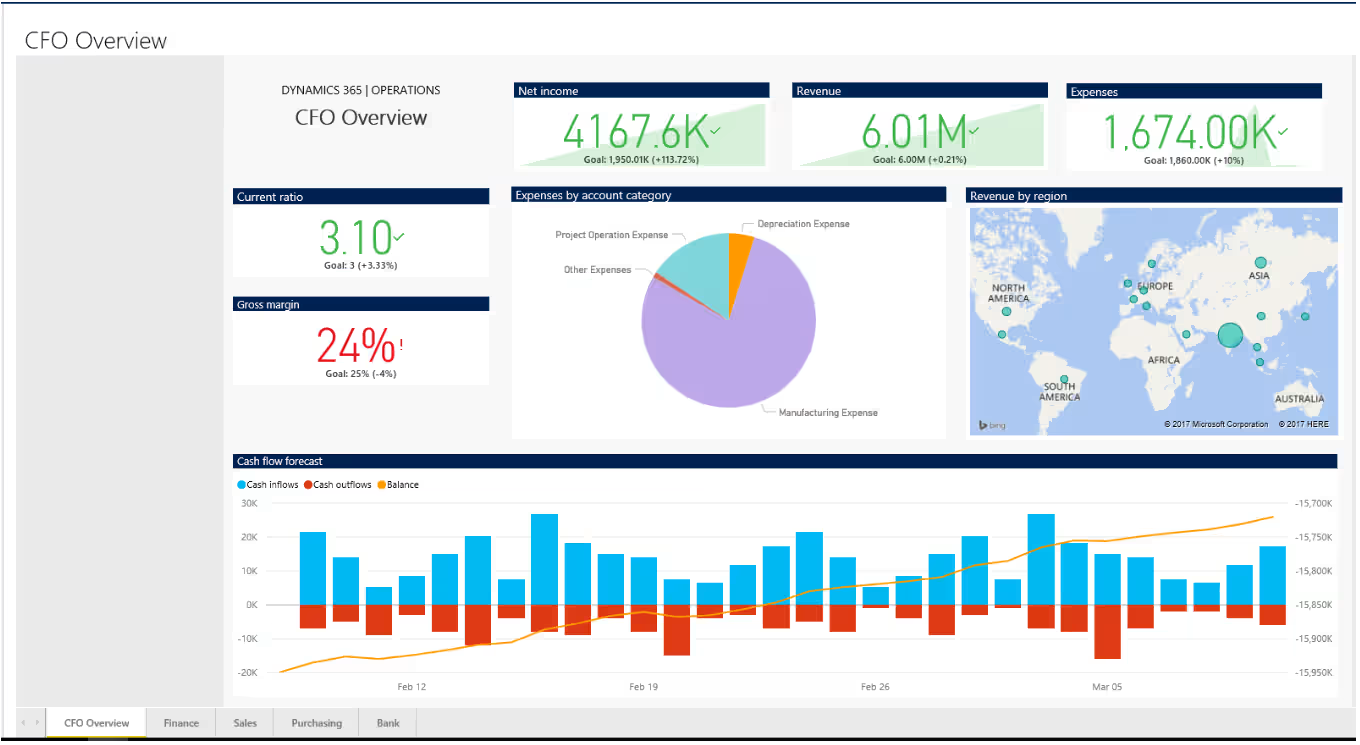
Microsoft Dynamics 365 Finance & Supply Chain Management is designed for highly complex organizations with sophisticated financial, supply chain, and operational requirements. While it may be more functionality than many restaurant groups require, it excels in enterprise environments managing hundreds of locations, multiple brands, manufacturing operations, distribution centers, or international subsidiaries.
For large restaurant organizations, franchisors, airport concessionaires, and hospitality companies with global operations, Dynamics 365 Finance & Supply Chain Management delivers the scalability needed to support long-term growth.
Key strengths for restaurant organizations
- Enterprise financial management: Support complex organizations with multi-entity accounting, global consolidations, multi-currency management, tax compliance, and enterprise budgeting.
- Advanced supply chain management: Optimize procurement, demand planning, warehouse operations, manufacturing, transportation, and vendor management.
- High-volume transaction processing: Support high transaction volumes across locations, brands, channels, and entities while maintaining financial control and reporting performance.
- AI and automation: Leverage Microsoft Copilot, predictive analytics, workflow automation, intelligent forecasting, AI agents, and natural language reporting.
- Global scalability: Support large restaurant chains operating across multiple regions or countries with enterprise-grade financial and operational controls.
Best fit for: Large restaurant chains and hospitality organizations operating multiple brands, international entities, commissary kitchens, or complex manufacturing and distribution networks.
Considerations: Finance & Supply Chain Management is a sophisticated enterprise platform that typically requires a larger implementation effort than mid-market ERP solutions. Organizations should ensure the platform’s advanced capabilities align with their operational complexity and long-term growth strategy.
How to choose the right restaurant ERP software
Every restaurant organization has different operational priorities. Rather than asking which ERP is “best,” the better question is which platform best aligns with your business model, growth plans, and technology requirements.
As you evaluate solutions, consider the following questions:
- How many restaurant locations do you currently operate?
- Are locations managed under separate legal entities?
- Do you own a commissary kitchen or production facility?
- Do you franchise locations or collect royalties?
- Which point-of-sale system do you currently use?
- How important are advanced inventory and food costing capabilities?
- Which labor scheduling, payroll, or workforce management systems need to connect with ERP?
- Are you planning acquisitions or rapid expansion?
- Do you operate internationally or expect to in the future?
- Do you prefer an all-in-one ERP or best-of-breed integrated applications?
Your answers will help narrow the field and identify the platform that offers the right balance of functionality, scalability, implementation effort, and total cost of ownership. An experienced implementation partner can also help validate your requirements, evaluate competing solutions, and guide your organization through a successful deployment.
Top 7 ERP implementation partner selection criteria
Choosing the right ERP software is only part of a successful implementation. The partner you select can have just as much impact on your project’s timeline, adoption, and long-term success. Download our guide to learn the seven key criteria for evaluating ERP implementation partners and making a confident, informed decision.
Why partner with Rand Group for restaurant ERP selection?
Choosing the right ERP is only half the equation. A successful implementation depends on selecting a partner that understands your business, industry, and long-term growth goals.
Rand Group has helped organizations modernize financial management, improve operational visibility, and implement enterprise business applications for more than 20 years. Our consultants work with finance leaders, operations teams, and executives to evaluate business requirements, identify technology gaps, and recommend ERP solutions that align with long-term strategic goals.
Our team provides end-to-end ERP services, including:
- ERP evaluation and selection
- Business process assessments
- ERP implementation and data migration
- POS and third-party integrations
- Reporting, dashboards, and AI automation
- User training and ongoing support
Whether your organization is replacing QuickBooks, consolidating multiple accounting systems, or preparing for rapid expansion, Rand Group can help you select and implement an ERP platform that supports sustainable growth.
Restaurant ERP software FAQs
What is the difference between restaurant accounting software and ERP?
Restaurant accounting software focuses primarily on bookkeeping and financial reporting, while ERP software integrates accounting with inventory, purchasing, operations, reporting, and other business processes. ERP provides greater automation, visibility, and scalability for growing restaurant organizations.
When should a restaurant upgrade from QuickBooks to ERP?
Most restaurant groups should consider ERP once they operate multiple locations, manage several legal entities, require consolidated reporting, or spend significant time manually reconciling data across systems. ERP also becomes valuable when organizations need stronger inventory management, automation, and operational reporting.
Which ERP is best for multi-location restaurant groups?
Oracle NetSuite, Sage Intacct, Microsoft Dynamics 365 Business Central, and Microsoft Dynamics 365 Finance & Supply Chain Management all support multi-location restaurant operations. The best choice depends on the number of locations, reporting requirements, operational complexity, and future growth plans.
Which ERP integrates with restaurant POS systems?
Most leading ERP platforms integrate with popular restaurant POS systems through APIs or certified integration partners. Oracle NetSuite, Sage Intacct, and Microsoft Dynamics 365 solutions can all exchange sales, inventory, labor, and payment data with many widely used POS platforms.
Can ERP software help reduce food costs?
Yes. Modern ERP software helps restaurants reduce food costs through better inventory visibility, purchasing controls, demand forecasting, recipe costing, and inventory reporting. Many organizations also integrate specialized restaurant inventory solutions to further improve food cost management.
What is the best ERP for restaurant franchises?
Restaurant franchisors and franchise operators often need multi-entity accounting, franchise reporting, royalty management, integrations, and strong financial controls. NetSuite and Dynamics 365 Finance & Supply Chain Management are often strong fits for larger or more complex franchise organizations, while Business Central or Sage Intacct may fit smaller or finance-led groups depending on operational requirements and integration needs.
How much does restaurant ERP software cost?
Restaurant ERP software costs vary based on the number of users, locations, entities, POS integrations, inventory or food-costing requirements, reporting needs, implementation scope, data migration, and ongoing support. Restaurant groups should evaluate total cost of ownership, including software, implementation services, integrations, training, reporting, and future optimization.
How long does an ERP implementation take?
Most ERP implementations take between several months and a year, depending on organizational complexity, the number of locations, required integrations, and project scope.Working with an experienced implementation partner can help reduce project risk and accelerate time to value.
Final thoughts
The best restaurant ERP software depends on far more than feature lists. The right solution should support your financial processes, operational workflows, reporting requirements, and long-term growth strategy while integrating with the restaurant technologies your organization already relies on.
Whether you’re expanding from a handful of locations, managing multiple restaurant concepts, or operating a national franchise network, modern ERP software provides the financial visibility, automation, and scalability needed to support continued growth. If you’re evaluating ERP solutions, Rand Group can help you compare leading platforms, identify the best fit for your business, and build an implementation roadmap that positions your restaurant organization for long-term success. Contact our team today to get started.