Enterprise AI in 2026: A practical guide for Microsoft customers

Artificial intelligence adoption accelerated rapidly in 2025, but speed alone has not translated into sustained business value for every organization. As we move into 2026, many enterprises are discovering that early experimentation with AI tools is giving way to more complex operational, governance, and integration challenges.
Microsoft has framed this shift clearly with the concept of the frontier firm: organizations that embed AI deeply across their operations to scale faster, improve decision-making, and reinvent how work gets done. These firms are not simply deploying individual AI tools. They are rethinking workflows, data architecture, governance, and organizational roles to support AI as a core capability.
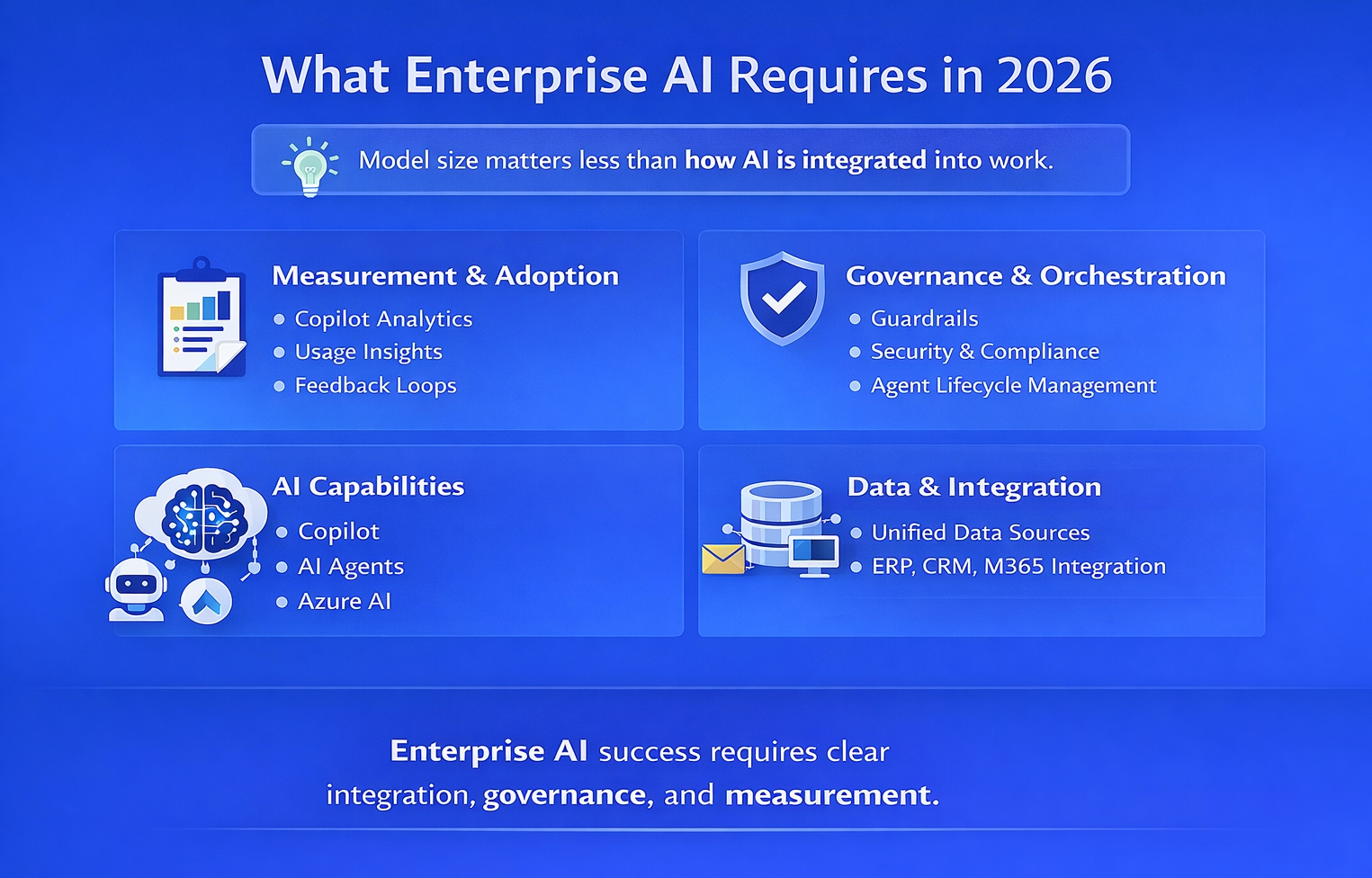
For business and IT leaders evaluating what comes next, the focus in 2026 will be less about chasing the newest model and more about how AI is orchestrated across the enterprise. This article explores the major trends shaping that transition and how Microsoft customers can prepare for the next phase of enterprise AI.
The rise of the frontier firm and what it means for AI strategy
The frontier firm represents a clear departure from the early stages of AI adoption. In 2024 and early 2025, many organizations approached AI as a collection of point solutions: a Copilot here, an analytics model there, and perhaps a proof of concept built by a specialized team.
By contrast, frontier firms treat AI as a foundational layer of their operating model. AI is embedded into finance, operations, sales, manufacturing, HR, and IT, with shared standards and coordinated objectives. This shift is driving several downstream effects that will become more visible in 2026.
One of the most important implications is that AI strategy can no longer be isolated within IT or innovation teams. Decisions about data, governance, security, and user enablement now directly affect business outcomes. Microsoft’s platform approach, spanning Copilot, Azure AI, Power Platform, and Dynamics 365, reflects this reality by emphasizing integration across workloads rather than isolated tools. Organizations that aspire to operate as frontier firms will need to align their AI investments with enterprise architecture and business strategy, not just experimentation.
Citizen developers move from experimentation to orchestration
Microsoft’s continued investment in citizen developer capabilities is one of the most significant AI trends heading into 2026. Copilot experiences, AI agents, and low-code tools are increasingly accessible to non-technical users, enabling teams to build and customize AI-powered workflows without traditional software development skills.
However, this democratization changes the nature of the work required from IT and data teams. The emphasis is shifting away from writing code and toward orchestration, enablement, and oversight.
Within this model, success depends on several factors:
- Clear guardrails for how citizen developers can use data and AI models
- Reusable components and templates that align with enterprise standards
- Integration between Copilot, Power Platform, Dynamics 365, and core systems
- Ongoing training so users understand both the capabilities and limitations of AI
When these elements are in place, citizen developers can accelerate innovation without introducing unmanaged risk. When they are not, organizations often experience duplicated effort, inconsistent outcomes, and governance gaps. In 2026, organizations that treat citizen development as an enterprise capability rather than an isolated initiative will be better positioned to scale AI responsibly.
As organizations explore how AI agents can support real business processes, reviewing practical examples can help teams identify where automation delivers the most value. Our guide to real-world examples of AI agents for ERP and business operations highlights how AI can assist with finance, operations, and decision-making workflows inside enterprise systems.
To help organizations accelerate adoption and maximize the impact of AI, Rand Group offers tailored AI workshops. These sessions provide practical, hands-on guidance for identifying high-value use cases, integrating Copilot and AI agents into workflows, and establishing governance and enablement strategies. As part of building these foundational skills, understanding how to structure effective AI prompts is essential. Our article, Top ten practical prompt engineering techniques to get better results from AI, outlines practical methods teams can use to improve output quality and consistency.
Why integration matters more than model size
A persistent misconception in AI strategy is that better outcomes always require larger or more advanced models. While model innovation continues to matter, the practical value of AI in the enterprise increasingly comes from how models are integrated into workflows.
In Microsoft environments, this distinction is especially important. Many organizations already have access to powerful models through Azure OpenAI Service and Copilot experiences. The differentiator is not the model itself, but how effectively it is embedded into day-to-day processes.
For example, an AI agent that assists with invoice reconciliation delivers limited value if it operates outside the ERP system. When that same agent is integrated directly into Dynamics 365 Finance, with access to consistent data and defined approval workflows, the impact is significantly greater.
As AI becomes more accessible, integration discipline becomes a competitive advantage. Organizations that focus on automation workflows, data consistency, and user experience will see better outcomes than those that simply adopt newer models without addressing how they fit into existing processes.
The hidden cost of fractured AI across departments
As AI adoption accelerates, many organizations encounter a common challenge: different departments pursue AI initiatives independently, often with good intentions but limited coordination. Finance may adopt one solution, manufacturing another, and engineering a third, each optimized for local needs.
This pattern leads to what is often described as fractured AI. While it may appear productive in the short term, fractured AI introduces long-term risks and inefficiencies that become more pronounced at scale.
Common symptoms include:
- Data silos that prevent models from accessing consistent, trusted information
- Inconsistent decision-making due to different models and assumptions
- Increased security and compliance risk from unmanaged AI tools
- Higher operational overhead to support disconnected systems
These challenges are rarely caused by technology limitations. More often, they stem from a lack of shared governance, architecture, and ownership. In 2026, organizations that do not address fractured AI will struggle to measure ROI, enforce security standards, and scale AI usage beyond isolated teams.

Turn Microsoft AI capabilities into business value
Microsoft’s AI platform offers powerful capabilities across Copilot and Dynamics 365. Turning those capabilities into measurable business value requires the right strategy, governance, and execution model. Rand Group helps organizations assess their AI readiness, design enterprise AI roadmaps, and implement Microsoft AI solutions that scale securely across the business.
Establishing governance without slowing innovation
Effective AI governance does not mean limiting innovation. It means providing clarity so innovation can happen safely and consistently. For Microsoft customers, governance should span data, models, workflows, and user access across the platform.
A practical governance framework typically includes:
- Standards for data usage, model selection, and prompt management
- Defined approval processes for deploying new AI agents or Copilots
- Security and compliance policies aligned with Microsoft identity and access controls
- Clear ownership for monitoring performance and usage
Governance is most effective when it is embedded into existing processes rather than treated as a separate initiative. Leveraging Microsoft Entra ID, Purview, and role-based access controls allows organizations to enforce policies without creating unnecessary friction for users. The goal is not to centralize every decision, but to ensure that AI initiatives align with enterprise objectives and risk tolerance.
As part of this governance approach, understanding data governance is critical to scaling AI responsibly. Data governance ensures that information is accurate, consistent, and accessible while protecting sensitive data and complying with regulations. With proper data governance in place, AI initiatives can rely on trusted data, reduce risk, and improve decision-making across the enterprise.
The role of a center of excellence in scaling AI
Many organizations find that governance alone is not sufficient to coordinate AI adoption. A center of excellence (CoE) provides the operational structure needed to align strategy, execution, and continuous improvement.
An effective AI center of excellence typically includes representatives from IT, operations, HR, data, and executive leadership. This cross-functional approach ensures that AI initiatives reflect both technical realities and business priorities.
Key responsibilities of an AI CoE often include:
- Aligning AI initiatives with organizational goals
- Defining and maintaining governance standards
- Prioritizing use cases and managing demand
- Establishing feedback loops with frontline users
- Supporting training and change management
Rather than acting as a bottleneck, a well-designed CoE enables faster, more consistent adoption by reducing ambiguity and duplication. In Microsoft environments, it also helps ensure that investments across Copilot, Power Platform, and Azure AI reinforce one another.
Measuring AI adoption with Copilot Analytics
As AI usage expands, executive teams increasingly ask a simple but critical question: is this investment delivering value? Measuring AI impact has historically been difficult, particularly when benefits are distributed across productivity, quality, and decision-making.
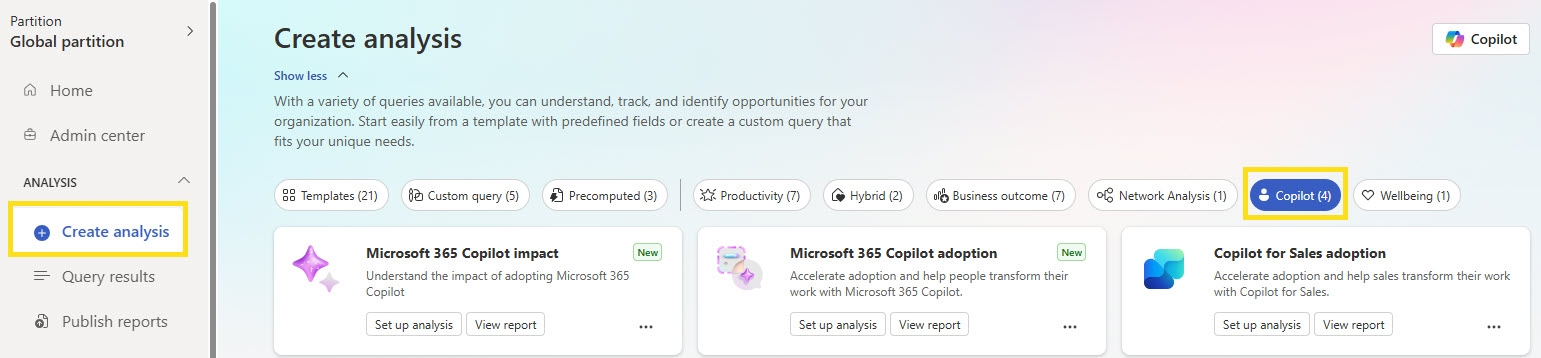
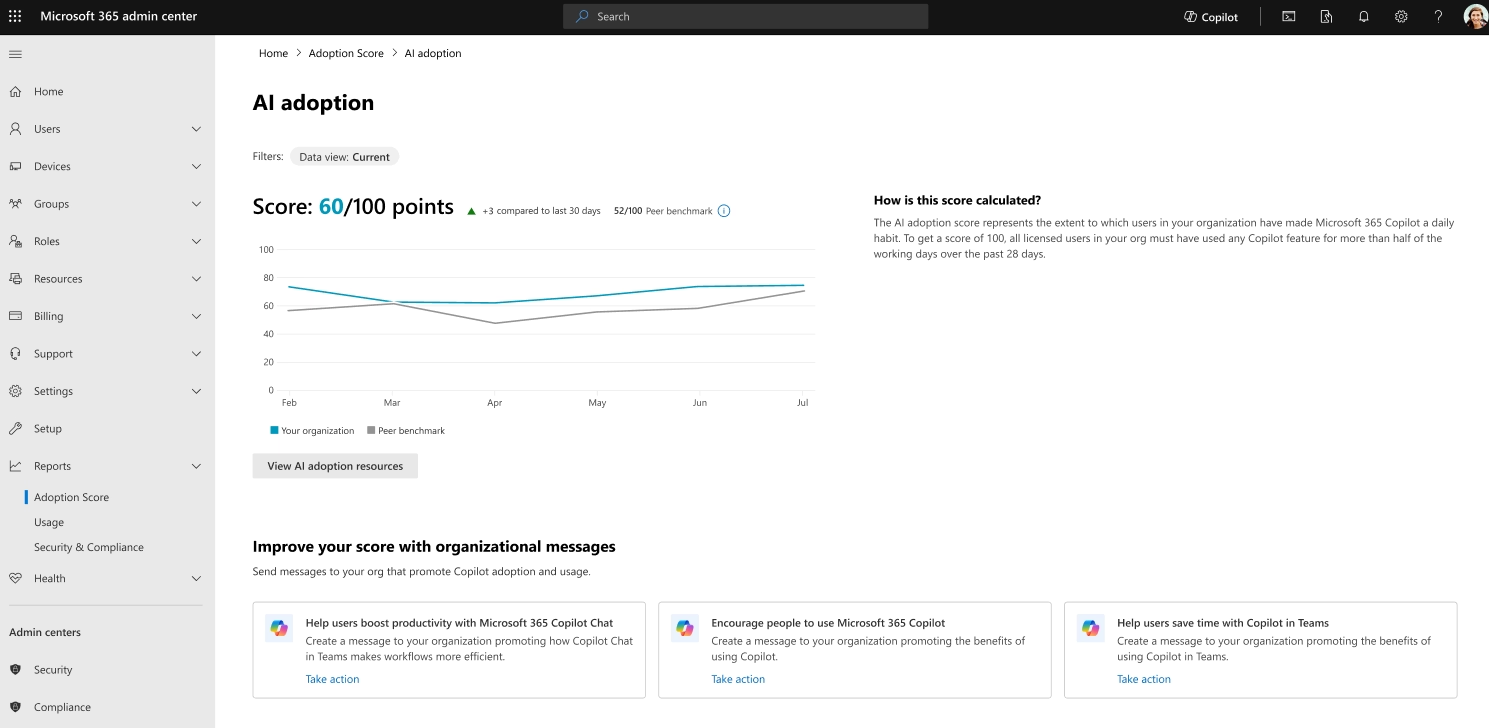
Microsoft’s Copilot Analytics addresses this challenge by providing visibility into how Copilot is being used across the organization. Pre-built Power BI reports help leaders understand adoption patterns, usage frequency, and areas where Copilot is influencing work.
Copilot Analytics is especially useful for:
- Identifying which roles and teams are adopting Copilot
- Understanding how usage evolves over time
- Informing enablement and training strategies
- Supporting ROI conversations with stakeholders
While analytics alone do not prove business value, they provide the foundation for informed decision-making. Organizations that combine usage data with qualitative feedback are better equipped to refine their AI strategy.
Governing agents at scale with Agent 365
As organizations deploy more AI agents, governance and lifecycle management become critical. Agent 365 provides IT and security teams with tools to manage, monitor, and secure AI agents across the Microsoft ecosystem.
Unlike Copilot Analytics, which focuses on measurement and insights, Agent 365 emphasizes operational control. It supports consistent deployment, versioning, and policy enforcement for AI agents that interact with enterprise systems.
Agent 365 is particularly relevant for organizations that:
- Are deploying multiple agents across departments
- Need centralized visibility into agent behavior
- Must enforce security and compliance requirements
- Want to reduce operational risk as AI usage grows
Together, Copilot Analytics and Agent 365 illustrate a broader trend: AI success depends as much on management and governance as it does on innovation.
The future of AI: What to expect in 2026?
As organizations move beyond early AI experimentation, leaders are facing new questions about scale, governance, and integration. In this video, we share our perspective on how the AI landscape is evolving in 2026—building on the momentum of 2025 and Microsoft’s concept of the Frontier Firm.

Emerging model trends and why they matter to enterprises
Beyond Microsoft’s ecosystem, changes in how large language models are designed will also influence enterprise AI strategies. Recent research suggests that models capable of learning at different rates across tiers of information may reduce the need for frequent retraining.
For enterprises, the practical implication is not the technical architecture itself, but the outcome: models that are more efficient, adaptive, and cost-effective. This trend reinforces the idea that larger models are not always better and that interaction-driven learning may reduce operational overhead.
From a Microsoft customer perspective, these developments further support a shift toward integration-first strategies. As models become more accessible and less resource-intensive, the differentiator will continue to be how well they are embedded into business processes.
What 2026 will demand from AI leaders
As AI becomes embedded in core business operations, leadership expectations will shift. In 2026, success will depend less on the speed of adoption and more on the ability to operationalize AI at scale. AI leaders will need to pair innovation with structure, ensuring that AI capabilities are durable, governed, and aligned with business priorities.
This means:
- Treating AI as an enterprise platform, not a set of isolated tools: AI must be planned as part of the broader enterprise architecture, with clear alignment to core systems and business processes. Copilots, agents, and models should operate within shared standards and contribute to end-to-end workflows rather than standalone use cases.
- Establishing governance and enablement as foundational capabilities: Clear policies for data, model usage, and security are required to support scale. At the same time, organizations must equip users with the guidance and training needed to apply AI effectively. Without both, adoption and consistency will suffer.
- Designing for integration and workflow impact: AI delivers value when embedded directly into how work gets done. Leaders should focus on integrating AI into existing processes to reduce friction, support decision-making, and improve reliability, rather than prioritizing novel implementations.
- Monitoring usage and adapting strategy over time: Ongoing visibility into adoption and performance enables informed adjustments. Usage data and user feedback should guide refinements to both AI solutions and operating models as needs evolve.
Microsoft’s roadmap increasingly supports these requirements, but technology alone is insufficient. Sustained results will depend on disciplined execution and organizational alignment as AI becomes a standard part of enterprise operations.
Frequently asked questions
What does “enterprise AI” mean in the context of Microsoft platforms?
Enterprise AI refers to the use of artificial intelligence as a core business capability rather than a set of isolated tools. In Microsoft environments, this typically includes Copilot experiences, AI agents, Azure AI services, data platforms such as Microsoft Fabric, and integration with systems like Dynamics 365 and Microsoft 365. The focus is on embedding AI into business workflows with appropriate governance, security, and measurement, so it can scale across the organization.
Why are many organizations struggling to scale AI beyond pilot projects?
Many AI initiatives stall because they are deployed as standalone solutions without integration into core systems or clear governance. When departments adopt AI independently, organizations often encounter data silos, inconsistent outcomes, and increased risk. Scaling AI requires shared standards, centralized data strategies, and alignment between business and IT teams, particularly in complex Microsoft environments.
How can Microsoft Copilot Analytics help measure AI adoption and value?
Microsoft Copilot Analytics provides visibility into how Copilot is being used across roles and teams. It offers pre-built Power BI reports that show adoption trends, usage patterns, and engagement over time. While analytics alone do not measure business impact, they help organizations understand where AI is being applied, identify enablement gaps, and support more informed decisions about future investment and optimization.
What role does governance play in successful enterprise AI adoption?
Governance ensures that AI can be used consistently, securely, and at scale. For Microsoft customers, this includes defining standards for data usage, model deployment, access controls, and compliance. Effective governance does not slow innovation; it provides guardrails that allow teams to adopt AI confidently while reducing operational and regulatory risk.
How can Rand Group help organizations prepare for the next phase of enterprise AI?
Rand Group helps organizations design and execute enterprise AI strategies aligned with Microsoft platforms. This includes assessing AI readiness, defining governance models, integrating Copilot and AI agents into business workflows, and establishing operating models such as AI centers of excellence. By focusing on both strategy and execution, Rand Group supports sustainable AI adoption that delivers measurable business value.
Next steps
As AI becomes more deeply embedded in enterprise operations, Microsoft customers need a clear strategy for scaling adoption without introducing unnecessary risk or complexity. Copilot, Azure AI, Power Platform, and Dynamics 365 offer powerful capabilities, but realizing their full value requires thoughtful integration, governance, and measurement.
Rand Group works with organizations at every stage of their AI journey, from defining enterprise AI strategies to implementing and governing Microsoft AI solutions at scale. Whether you are evaluating Copilot adoption, establishing an AI center of excellence, or addressing fragmented AI initiatives across departments, our team brings practical experience across Microsoft platforms.
If you are planning your next phase of AI investment in 2026, a structured assessment or roadmap can help clarify priorities and reduce risk. Contact Rand Group to start a conversation about how to turn Microsoft AI capabilities into sustained business value.