Integrated healthcare dashboards: Connecting financial, operational, and clinical data

Healthcare organizations generate massive volumes of clinical, operational, and financial data every day. Patient vitals, treatment plans, patient billing, staffing levels, and medical supplies all produce valuable information. However, many healthcare leaders still struggle to turn this complex data into actionable insights.
Integrated healthcare dashboards address this challenge. They unify data from electronic health records (EHRs), ERP platforms, billing systems, and operational tools in a centralized location. As a result, healthcare executives gain a clearer understanding of how patient care, operational efficiency, and financial health are connected. When dashboards are built on a modern ERP foundation, they support better decision-making. They also help improve patient outcomes, optimize resource utilization, and strengthen long-term organizational performance.
What are healthcare dashboards?
A healthcare dashboard is an interactive dashboard that visualizes healthcare data in a clear, accessible way. Instead of reviewing disconnected reports, healthcare professionals can monitor key performance indicators from a single view.
Modern healthcare dashboards integrate multiple data sources. These include EHR systems, ERP platforms, billing, payroll, and supply chain applications. The most effective dashboards connect clinical dashboards, operational dashboards, and financial dashboards. This approach shows how patient care decisions affect staffing levels, resource allocation, and financial metrics. By simplifying complex data, dashboards help healthcare teams move from reactive reporting to informed decisions.

Software selection made easy
Take the guesswork out of software selection. Partner with Rand Group to identify your requirements, evaluate top ERP, CRM, and analytics solutions. We can help you confidently choose the platform that best fits the demands of your healthcare organization.
Common challenges with healthcare dashboards
Many healthcare organizations attempt to build dashboards without addressing underlying data challenges. As a result, dashboards often lack trust, consistency, and relevance.
Common issues include:
- Patient data and financial data are stored in separate systems, which limits visibility
- Manual reporting processes that delay operational decision-making
- Inconsistent healthcare KPIs across departments
- Limited insight into direct costs, indirect costs, and cash flow
- Weak data governance that affects data accuracy and compliance
Without integration, dashboards may show what happened. However, they rarely explain why it happened or what actions to take next.
Why integrated healthcare dashboards matter
Traditional dashboards typically focus on one function, such as finance or clinical performance. Integrated healthcare dashboards are different. They show how patient care decisions influence operational efficiency and financial health.
For example, changes in average length of stay affect bed availability, staffing levels, patient flow, and reimbursement. Integrated dashboards make these relationships visible. This allows healthcare executives and department heads to balance care quality, cost control, and patient outcomes more effectively. Real-time dashboards and alerts further support timely decisions, especially during health crises or periods of rapid change.
Integrated healthcare dashboards are most effective when built on a modern healthcare ERP. ERP platforms provide the unified data foundation needed to connect clinical, operational, and financial systems. For a deeper look at leading platforms, see our guide to the top healthcare ERP systems.
Core types of healthcare dashboards
Clinical dashboards
Clinical dashboards track patient outcomes, treatment outcomes, patient vitals, recovery rates, and readmission trends. When combined with operational and financial data, these dashboards help care teams evaluate treatment plans, discharge status, and overall health outcomes.
Operational dashboards
Operational dashboards focus on patient flow, staffing levels, average wait time, wait times in the emergency room, and bed availability. A hospital operations dashboard may also track overtime hours, medical supplies, and staffing costs to support operational efficiency and resource utilization.
Financial dashboards
Financial dashboards monitor cash flow, claim denial rate, claim status, payment delays, and patient billing performance. When linked to clinical and operational data, these dashboards support reducing costs while maintaining quality care.

The CFO’s guide to healthcare ERP
Discover how modern ERP systems help healthcare organizations unify financial management, streamline operations, and strengthen compliance. This guide walks CFOs and finance teams through key evaluation criteria, common pitfalls to avoid, and practical ways to improve efficiency while gaining real-time insight into the data that drives smarter decisions.
Benefits of integrated healthcare dashboards
By delivering up-to-the-minute dashboards and alerts, healthcare teams can respond quickly when risk indicators or performance trends shift.
Key benefits include:
- Improved patient outcomes and care quality
- Better visibility into financial health and operational performance
- Faster, more confident decision-making
- More effective resource utilization and staffing decisions
- Stronger data accuracy and governance
Integrated dashboards support a wide range of stakeholders. Healthcare executives gain strategic visibility, while department heads manage workflows more effectively. Care teams track patient outcomes and patient satisfaction scores. Public health officials benefit from population health insights that support long-term planning.
Key metrics tracked in integrated healthcare dashboards
The table below highlights important metrics commonly tracked across clinical, financial, and integrated views.
Integrated healthcare dashboard examples
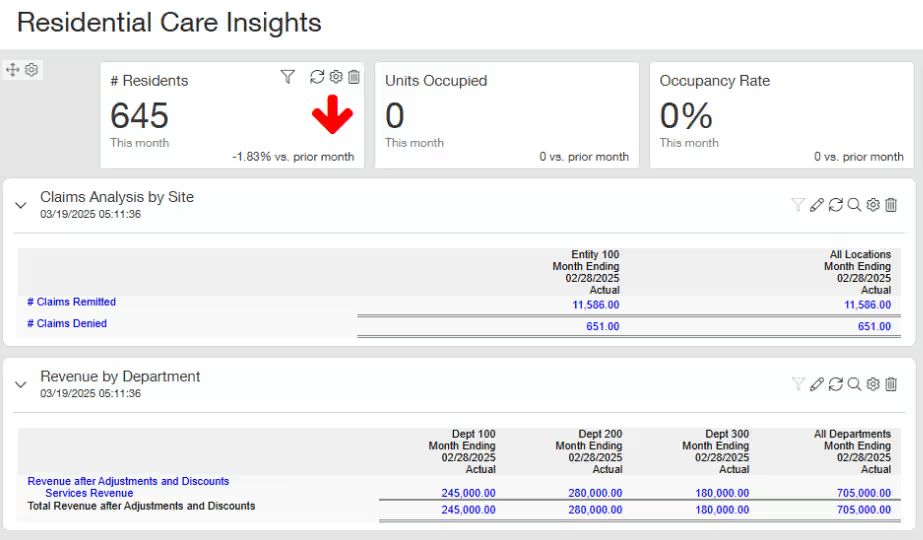
The following healthcare dashboard examples show how ERP-enabled dashboards support different use cases across healthcare organizations. An experienced ERP partner ensures these dashboards align with healthcare-specific reporting needs.
Requirements for an effective healthcare dashboard
To deliver meaningful insights, healthcare dashboards must meet these requirements:
- Integrated data sources across clinical, operational, and financial systems
- Clearly defined key metrics and key performance indicators
- Interactive dashboards tailored to different roles and care teams
- Ongoing governance to maintain data accuracy and relevance
When these elements are in place, dashboards transform complex data into actionable insights that support proactive care and informed decisions.
Case studies: How Rand Group helps healthcare organizations improve performance with integrated dashboards
At Rand Group, we specialize in helping healthcare organizations leverage modern ERP systems to connect clinical, operational, and financial data. With decades of experience guiding software selection, implementation, and optimization, we empower healthcare leaders to make informed decisions, improve efficiency, and drive better patient outcomes.
The following case studies highlight Rand Group’s direct work with three healthcare organizations, showcasing how our expertise in ERP-enabled dashboards delivers measurable results:
Client: Central Management Company LLC | Sage Intacct
- Automated reporting reduced manual data compilation by 50%
- Role-based dashboards improved visibility into patient flow, staffing, and financial health
- Insights revealed staffing and resource allocation bottlenecks
“Our dashboards now give us actionable insights across clinical, operational, and financial data.”
—Jeff Cantrell, CFO, Central Management Company LLC

Client: Healthcare technology company | Dynamics 365 Business Central
- Faster financial reporting and month-end close
- Improved visibility into costs and operational performance
- Real-time dashboards enabled data-driven decisions

Client: Mann Eye Institute | NetSuite
- AP reporting time reduced from minutes to seconds
- Consolidated dashboards support multi-location reporting
- Leadership gained real-time visibility into financial performance
“We’ve grown significantly since moving to NetSuite, and the system has scaled with us every step of the way.”
—Joseph Lo, Head of Accounting, Mann Eye Institute

Frequently asked questions (FAQs)
What is an integrated healthcare dashboard?
An integrated healthcare dashboard is a centralized, interactive view that combines clinical, operational, and financial data. It pulls information from EHRs, ERP systems, billing platforms, and operational tools to help healthcare leaders understand performance, identify trends, and make informed decisions that balance care quality, efficiency, and cost control.
How do integrated dashboards improve decision-making?
By connecting data across departments, integrated dashboards reveal how clinical decisions affect staffing, patient flow, and financial results. Real-time visibility helps leaders move beyond static reports, respond faster to issues, and make proactive, data-driven decisions that improve patient outcomes and operational performance.
What data sources feed an integrated healthcare dashboard?
Integrated healthcare dashboards typically pull data from EHR systems, ERP platforms, billing and revenue cycle tools, payroll, supply chain applications, and operational systems. Combining these sources creates a single source of truth that supports accurate reporting, consistent KPIs, and better cross-functional insights.
What metrics are often tracked in an integrated healthcare dashboard?
Common metrics include patient outcomes, readmission rates, average length of stay, staffing levels, wait times, cost per encounter, cash flow, and claim denial rates. Tracking these metrics together helps organizations understand how clinical performance, operations, and financial health are interconnected.
Why are ERP-based dashboards important to modern healthcare organizations?
ERP-based dashboards provide a secure, scalable foundation for integrated reporting. They support real-time data access, strong governance, and role-based views across clinical, operational, and financial teams. This enables healthcare organizations to improve efficiency, maintain compliance, and support long-term strategic planning.
Conclusion: Use integrated healthcare dashboards to drive better outcomes
Integrated healthcare dashboards help organizations move beyond reactive reporting. By connecting patient data, operational performance, and financial metrics, ERP-enabled dashboards support timely decisions and improve patient care.
For healthcare organizations evaluating ERP solutions, dashboards are more than reporting tools. They are a foundation for quality care, operational efficiency, and long-term financial health. Contact us to schedule an ERP assessment and unlock integrated, real-time insights for your healthcare organization.