Dynamics 365
 Power Platform
 Dynamics
 Cloud & Productivity
Dynamics 365 vs monday CRM: Choosing the right CRM for long-term growth

As revenue targets rise and sales organizations grow more complex, the CRM platform you choose becomes a strategic decision that impacts forecasting accuracy, operational visibility, and long-term scalability.
For many businesses evaluating Dynamics 365 vs monday CRM, the comparison often begins with surface-level differences like ease of use, pricing, or interface design. But the real distinction lies deeper, in scalability, ecosystem alignment, intelligence, and long-term growth potential. Both platforms support sales teams. Both offer automation and reporting. However, they are built for very different levels of operational complexity and business maturity.
In this guide, we’ll compare Dynamics 365 vs monday CRM across capabilities, scalability, integrations, automation, and total cost of ownership, so you can determine which solution aligns with where your business is headed.
What is Microsoft Dynamics 365 Sales?
Before diving deeper, it’s important to clarify terminology. “Dynamics 365 CRM” is often used as a broad reference to Microsoft’s customer engagement applications. Dynamics 365 Sales is the specific CRM app within the Dynamics 365 suite designed to manage sales processes, forecasting, pipeline tracking, and revenue operations.
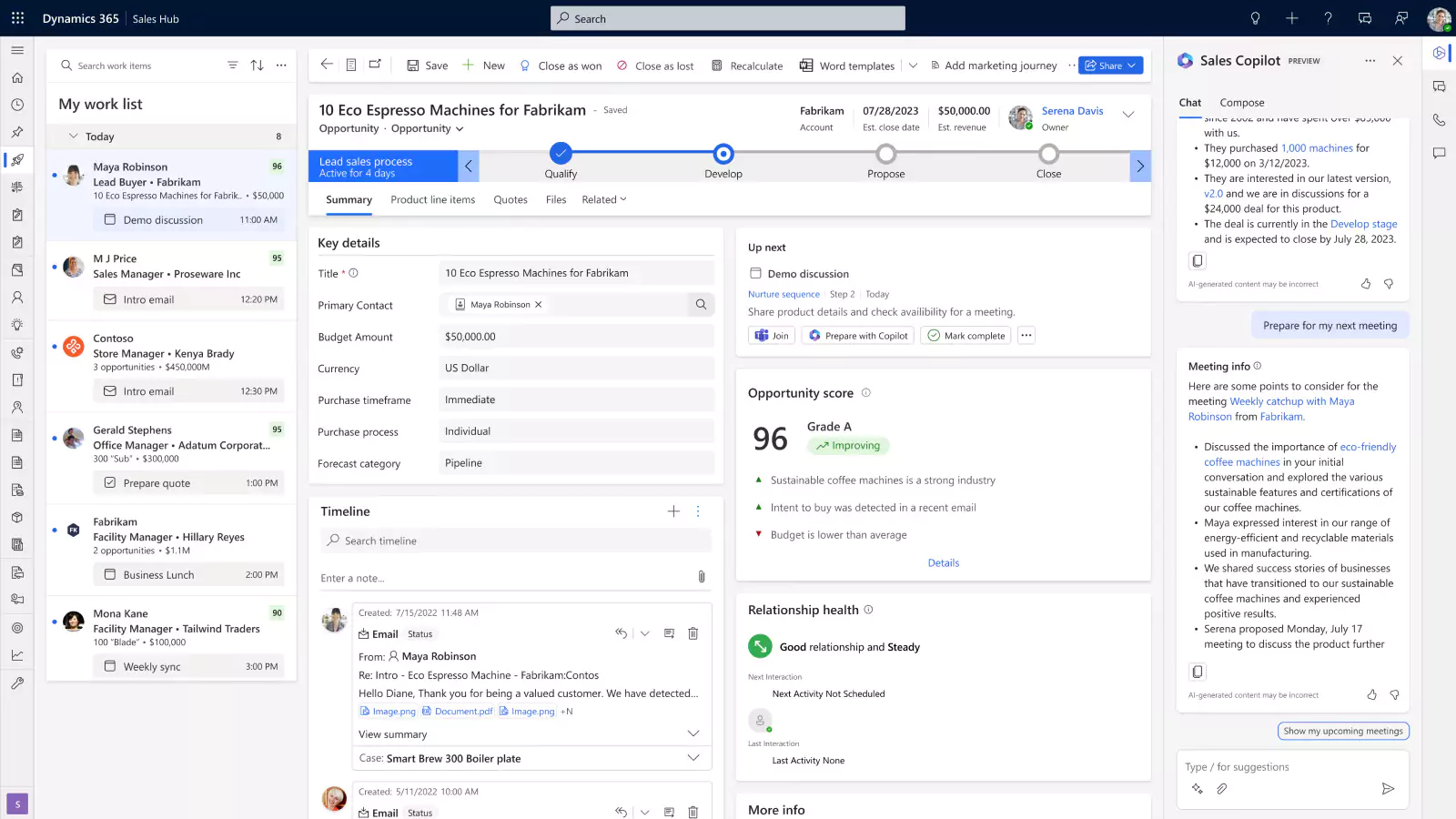
Microsoft Dynamics 365 Sales (D365) is an enterprise-grade CRM platform designed to support complex, data-driven sales organizations. It integrates natively with Microsoft 365, the Power Platform, Azure, and other Dynamics 365 applications.
Unlike standalone CRM tools, D365 is built to function as a connected business platform, linking sales, customer service, finance, operations, and marketing within a unified data environment.
Key capabilities include:
- AI-powered forecasting and predictive scoring
- Microsoft Copilot for sales productivity
- Advanced sales insights and relationship intelligence
- Territory and quota management
- Customizable dashboards and enterprise reporting
- Role-based security and governance controls
Dynamics 365 Sales is particularly well suited for mid-market and enterprise organizations that operate across multiple business units, geographies, or regulated industries. It is designed not just to track opportunities, but to standardize processes, improve forecasting accuracy, and support long-term operational growth.
What is monday CRM?
At it’s core, monday CRM is a visual, workflow-focused CRM platform designed for ease of use and quick deployment. Built on the monday.com Work OS framework, it emphasizes customizable board-style pipelines, drag-and-drop functionality, and flexible workflow configuration. Sales teams can tailor stages, fields, and processes without heavy technical involvement, making it accessible for organizations that want to get up and running on a new CRM system quickly.
Because of its intuitive interface and low barrier to entry, monday CRM is often a strong fit for small to mid-sized businesses that prioritize fast implementation, visual pipeline management, and operational flexibility over deep enterprise complexity.
Core strengths include:
- Visual pipeline boards
- No-code workflow automation
- Task and activity tracking
- Simple reporting
- Broad SaaS integrations


Evaluating Dynamics 365 vs monday CRM?
We help organizations assess their sales processes, growth strategy, and technology ecosystem to determine the right CRM path. If you’re exploring D365 vs monday CRM, connect with our team to evaluate whether Dynamics 365 Sales is the right foundation for your long-term success.
Microsoft Dynamics 365 vs monday CRM: Key differences at a glance
Dynamics 365 vs. monday CRM: Key differences explained
While both platforms can manage pipelines and automate sales activities, the true distinction in Dynamics 365 vs monday CRM lies in how each platform enables long-term growth, operational maturity, and strategic alignment across the business.
Scalability & operational depth
One of the most significant distinctions in the D365 vs monday CRM comparison is scalability. If your CRM must evolve alongside a broader digital transformation strategy, Dynamics 365 typically delivers greater long-term flexibility and sustainability.
Dynamics 365 Sales is built to support complex sales hierarchies, multi-entity organizations, global operations, and compliance-heavy industries. It provides structured architecture, standardized processes, and enterprise governance controls that allow organizations to scale without sacrificing data integrity. For businesses planning growth over the next three to five years, expanding territories, adding divisions, or integrating acquisitions, D365 offers significant headroom.
On the other hand, monday CRM, is designed for agility. Teams can quickly create pipelines, adjust workflows, and onboard users. While it scales well for growing teams, organizations with increasing regulatory requirements or multi-system integration needs may eventually require more depth than it provides.
Ecosystem & integration strategy
When evaluating monday.com vs Dynamics 365, integration strategy often becomes a deciding factor.
Dynamics 365 Sales integrates natively with:
- Outlook
- Microsoft Teams
- Excel
- SharePoint
- Power BI
- Power Platform (Power Automate, Power Apps, Power Pages)
This native integration creates a unified data model across your organization. Sales conversations in Outlook sync directly with CRM records. Teams collaboration connects to opportunity data. Power BI dashboards deliver executive visibility into pipeline performance. For organizations already invested in Microsoft technologies, D365 acts as an extension of the tools employees use every day.
With more than 200 integrations across a broad range of SaaS platforms, monday CRM offers flexibility for companies operating in varied tech environments. These integrations, however, typically function as connectors between systems rather than as part of a unified platform with a shared data architecture. As a result, monday CRM functions more as a configurable workflow tool within a broader SaaS stack.
For organizations specifically evaluating Microsoft Dynamics CRM and monday integration scenarios, it’s important to understand that while connectors are available, the platforms operate on fundamentally different architectures and data models.
Intelligence, automation, and AI
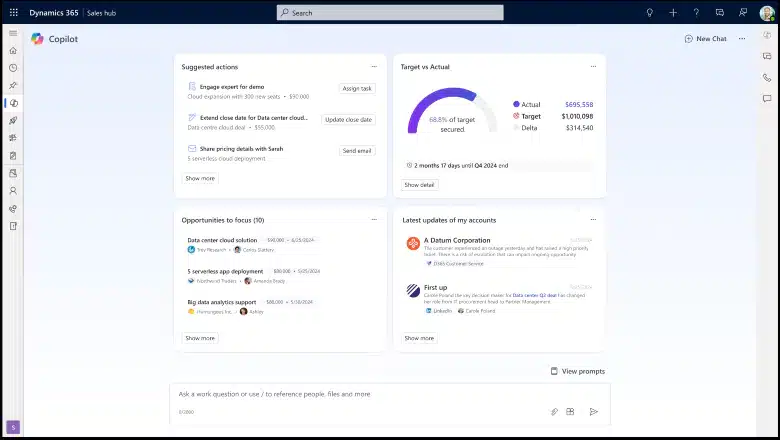
Modern CRM platforms must do more than track deals, they must transform sales data into actionable intelligence that drives revenue strategy and long-term growth. In the Dynamics 365 Sales vs monday CRM discussion, Dynamics 365 stands out in advanced intelligence.
Dyanmics 365 Sales provides:
- AI-driven opportunity scoring
- Predictive forecasting
- Relationship analytics
- Sales insights dashboards
- Microsoft Copilot for AI-assisted productivity
These capabilities support strategic decision-making at the leadership level, improving forecast accuracy and identifying risk within pipelines.
Focused primarily on operational automation, monday CRM uses no-code workflow triggers to automate tasks, notifications, and stage changes. This can improve efficiency and reduce manual work, but the platform does not offer the same level of predictive intelligence or enterprise analytics.
User experience & data discipline
Known for its intuitive, board-style interface, monday CRM is easy for teams to adopt and often requires minimal training. For organizations that prioritize speed and ease of use, this can be a clear advantage.
Dynamics 365 Sales offers a more structured interface. While it may require additional onboarding, that structure reinforces standardized processes, data accuracy, and reporting consistency. As organizations grow, data discipline becomes increasingly important. Executive reporting, compliance audits, and cross-functional visibility depend on reliable CRM data. In many cases, the structured approach of D365 supports stronger long-term data governance over highly flexible board-based systems.
Pricing & total cost of ownership
With a lower entry cost and simpler pricing model, including free options for small teams, monday CRM can be appealing to organizations seeking minimal upfront investment.
Dynamics 365 Sales involves more structured licensing and implementation planning. However, it’s important to consider total cost of ownership over time.
Organizations that begin with simpler platforms often add additional tools for:
- Advanced reporting
- Marketing automation
- Service management
- Compliance tracking
- Custom workflows
Over time, managing disconnected systems can increase costs and complexity. Dynamics 365’s broader ecosystem often reduces the need for additional platforms, consolidating functionality within a single environment. While the initial investment may be higher, the long-term value and reduced fragmentation can offset those costs.

Want a deeper understanding of D365 Sales pricing?
When comparing D365 vs monday CRM, pricing and long-term value are key factors in the decision. Download our free whitepaper, The Definitive Guide to Dynamics 365 Sales Pricing, to better understand licensing tiers, cost considerations, and how to build a scalable CRM investment strategy.
Which platform is right for your business?
When evaluating Dynamics 365 vs monday.com, the right choice depends on your organization’s current complexity and future growth plans.
Dynamics 365 Sales is often the better fit if:
- You operate across multiple entities or geographies
- You require advanced forecasting and reporting
- You need enterprise-grade governance and compliance controls
- You are invested in Microsoft technologies
- You anticipate significant operational growth
monday CRM may be suitable if:
- You need rapid deployment with minimal IT involvement
- Your sales processes are straightforward
- You prioritize visual pipeline management
- You are an SMB with limited complexity
The decision is less about feature checklists and more about strategic alignment. Simplicity may serve today’s needs, but scalability determines tomorrow’s success.
Frequently asked questions: Dynamics 365 vs monday CRM
Is Dynamics 365 better than Monday CRM?
For organizations requiring enterprise scalability, advanced AI forecasting, and deep Microsoft integration, Dynamics 365 Sales is often the stronger long-term solution. For smaller teams with simpler sales processes, monday CRM may be sufficient.
Is Monday CRM more affordable than D365?
Although monday CRM typically offers lower upfront pricing, Dynamics 365 may deliver greater long-term value for organizations that would otherwise need multiple systems to achieve similar functionality.
Which platform is easier to implement?
With its no-code configuration, monday CRM generally deploys faster, while Dynamics 365 requires a more structured implementation but provides deeper customization and greater scalability.
Can Monday CRM support enterprise organizations?
While monday CRM can support growing mid-market organizations, highly complex, multi-entity, or regulated enterprises often require the governance and scalability offered by Dynamics 365.
Selecting the right CRM is only part of the equation. Successful implementation, user adoption, and long-term optimization ultimately determine the return on your investment. As a trusted Microsoft partner, Rand Group helps organizations unlock the full potential of Dynamics 365 Sales.
Our team brings deep expertise in Microsoft technologies and real-world business process transformation. We work closely with your leadership and sales teams to design a Dynamics 365 solution that aligns with your operational goals, reporting requirements, and long-term growth strategy.
Strategic CRM evaluation – We assess your processes, growth plans, and technology landscape to determine which CRM solution supports your business for long-term success.
Tailored implementation & configuration – We design and configure Dynamics 365 Sales to align with your unique sales structure, workflows, and reporting requirements.
Seamless Microsoft ecosystem integration – We ensure Dynamics 365 integrates smoothly with Microsoft 365, Teams, Outlook, Power BI, and the Power Platform for unified data and collaboration.
Optimization & continuous improvement – We provide ongoing enhancements to refine automation, reporting, and forecasting as your business evolves.
User adoption & training – We drive successful adoption through structured training and change management that empowers your teams to use Dynamics 365 effectively.
Final thoughts: Dynamics 365 vs monday CRM
Both platforms bring value to sales teams. For organizations prioritizing simplicity and rapid adoption, monday CRM can be a strong fit, while Dynamics 365 Sales offers greater scalability, intelligence, and strategic depth.
If your organization prioritizes long-term growth, cross-functional visibility, advanced forecasting, and ecosystem alignment, Dynamics 365 often provides a more future-ready foundation. Contact our Microsoft experts today to learn more about how D365 can support your growing business.