Financial close and consolidation software: Features, benefits, and implementation

Month-end close becomes more complex as organizations add entities, locations, currencies, transactions, and financial systems. Processes once managed in spreadsheets can become difficult to scale, creating more reconciliation, intercompany, approval, and reporting work.
Financial close and consolidation software helps automate these processes, from account reconciliations and close task management to intercompany eliminations, multi-currency translation, and consolidated reporting. The right technology can reduce manual work, improve consistency, and give finance leaders greater visibility into financial results.
Successful implementation also requires the right financial structures, workflows, controls, integrations, and reporting design. This guide explores the key features, benefits, and implementation considerations for financial close and consolidation software.
At a glance: Financial close and consolidation software
Financial close and consolidation software helps finance teams automate period-end accounting, from reconciliations and close workflows to intercompany eliminations, currency translation, and consolidated reporting. These capabilities may be built into an ERP or financial management platform or provided through dedicated close and consolidation software, depending on the complexity of the organization.
What is financial close and consolidation software?
Financial close and consolidation software is technology that helps organizations manage and automate the processes required to close accounting periods and combine financial results across entities, subsidiaries, business units, or locations.
Financial close and financial consolidation are closely related, but they address different parts of financial reporting.
Financial close focuses on completing accounting activities for a reporting period, including:
- Account reconciliations
- Journal entries and adjustments
- Accruals
- Transaction matching
- Close task management
- Reviews and approvals
- Variance analysis
- Financial reporting
Financial consolidation focuses on combining financial results across multiple entities. This may include:
- Aggregating trial balances and general ledger data
- Mapping charts of accounts
- Reconciling intercompany transactions
- Creating intercompany eliminations
- Translating foreign currencies
- Recording consolidation adjustments
- Managing entity and ownership structures
- Producing consolidated financial statements
Together, these capabilities can help finance teams create a more controlled path from transaction processing through final financial reporting.
Financial close vs. financial consolidation: What’s the difference?
Financial close occurs at the individual accounting level, while financial consolidation combines the completed financial results of multiple entities into group-level reporting.
For multi-entity organizations, the processes are highly interconnected. Each entity needs accurate financial information before consolidated reporting can be completed reliably. Delays or errors in reconciliations, journal entries, or intercompany accounting can therefore slow the entire group close.
ERP-native vs. dedicated financial close and consolidation software
Financial close and consolidation capabilities can be delivered in different ways. Some organizations can manage these processes within their ERP or financial management platform, while others require dedicated close and consolidation software that works across multiple financial systems.
Understanding this distinction is important when evaluating technology because not every organization needs another standalone application. The right approach depends on the complexity of the financial environment, entity structure, reporting requirements, and existing systems.
ERP-native functionality may be sufficient when:
- Most financial data already resides within one ERP.
- Entity structures are relatively standardized.
- The ERP can support required intercompany processes and eliminations.
- Currency and ownership requirements fit the platform’s capabilities.
- Existing financial reporting meets stakeholder requirements.
- The organization wants to minimize additional systems and integrations.
Platforms such as Sage Intacct, Oracle NetSuite, Microsoft Dynamics 365 Business Central, and Dynamics 365 Finance provide different levels of functionality for financial close, intercompany accounting, multi-entity management, consolidation, workflow, and reporting.
Organizations should evaluate these capabilities before assuming that another application is necessary.

Dedicated close and consolidation software may make sense when:
- Financial information must be consolidated from numerous ERP or GL systems.
- Entity or ownership structures are exceptionally complex.
- The organization must accommodate extensive global or statutory reporting.
- Multiple accounting standards create additional consolidation requirements.
- ERP-native functionality cannot support required consolidation processes.
- Finance requires sophisticated enterprise performance management capabilities.
The decision should begin with business and accounting requirements rather than a predetermined software category. Regardless of whether those capabilities come from an existing ERP or a dedicated application, the first step is identifying where the current close and consolidation process is creating unnecessary manual work, delays, or risk.

Take the next step toward smarter financial consolidation
See how next-generation cloud financial management can simplify complex consolidations, reduce manual effort, improve accuracy, and give finance teams faster access to trusted financial insights.
Signs your organization may need financial close and consolidation software
Whether close and consolidation capabilities are delivered through an ERP or a dedicated application, the starting point should be the same: identifying where the current financial close is creating unnecessary complexity, manual work, or risk.
There is no single point at which an organization needs to automate its financial close. However, increasing complexity can expose limitations in processes that previously worked well.
Common warning signs include:
- Month-end close consistently takes longer than expected.
- Finance depends heavily on spreadsheets for reconciliations or consolidation.
- Employees manually collect trial balances from multiple systems.
- Intercompany balances frequently require investigation.
- Consolidation requires numerous manual journal entries.
- Finance teams repeatedly switch between different companies or systems.
- Controllers lack visibility into which close activities are complete.
- Multiple currencies complicate consolidated reporting.
- Management reports require extensive manipulation after the general ledger closes.
- Audit support depends on schedules and documentation stored outside the financial system.
- Acquisitions, new entities, or geographic expansion are making the existing process harder to scale.
These issues often become more pronounced when financial information is distributed across multiple systems.
For example, Henry Resources was managing 30 to 40 entities using QuickBooks, WolfePak, Excalibur, SQL Server reporting, and spreadsheets. Separate charts of accounts and fragmented systems meant the controller spent roughly a week each month pulling files together and manually consolidating financial data. Rand Group implemented Oracle NetSuite and unified the organization’s financial environment, including automated elimination entries and consolidated reporting. Monthly consolidation became largely automated, saving approximately 40 hours per month.
Watch the Henry Resources story
See how Henry Resources moved from disconnected accounting systems and manual consolidation to a unified NetSuite environment with Rand Group, improving consolidation, reporting, financial visibility, and day-to-day accounting.

Key features of financial close and consolidation software
The functionality organizations need will depend on their financial structure and technology environment. However, several capabilities are common across modern financial close software and financial consolidation software.
Automated financial data collection
Financial close and consolidation software can collect financial information from source systems instead of requiring employees to repeatedly export, manipulate, and import data.
Depending on the environment, these sources can include:
- ERP and general ledger systems
- Subsidiary accounting systems
- CRM and operational applications
- Banking and financial systems
- Spreadsheets and other external data sources
For organizations operating multiple systems, account mapping can also help standardize financial information before consolidation.
Account reconciliation and transaction matching
Account reconciliation is often one of the most time-consuming parts of the month-end close. Automation can help match transactions according to predefined rules and surface exceptions that require human review.
Capabilities may include:
- Automated transaction matching
- Reconciliation rules
- Exception management
- Supporting documentation
- Review and approval workflows
- Reconciliation status tracking
Instead of manually reviewing every transaction, finance employees can spend more time investigating exceptions and higher-risk accounts.
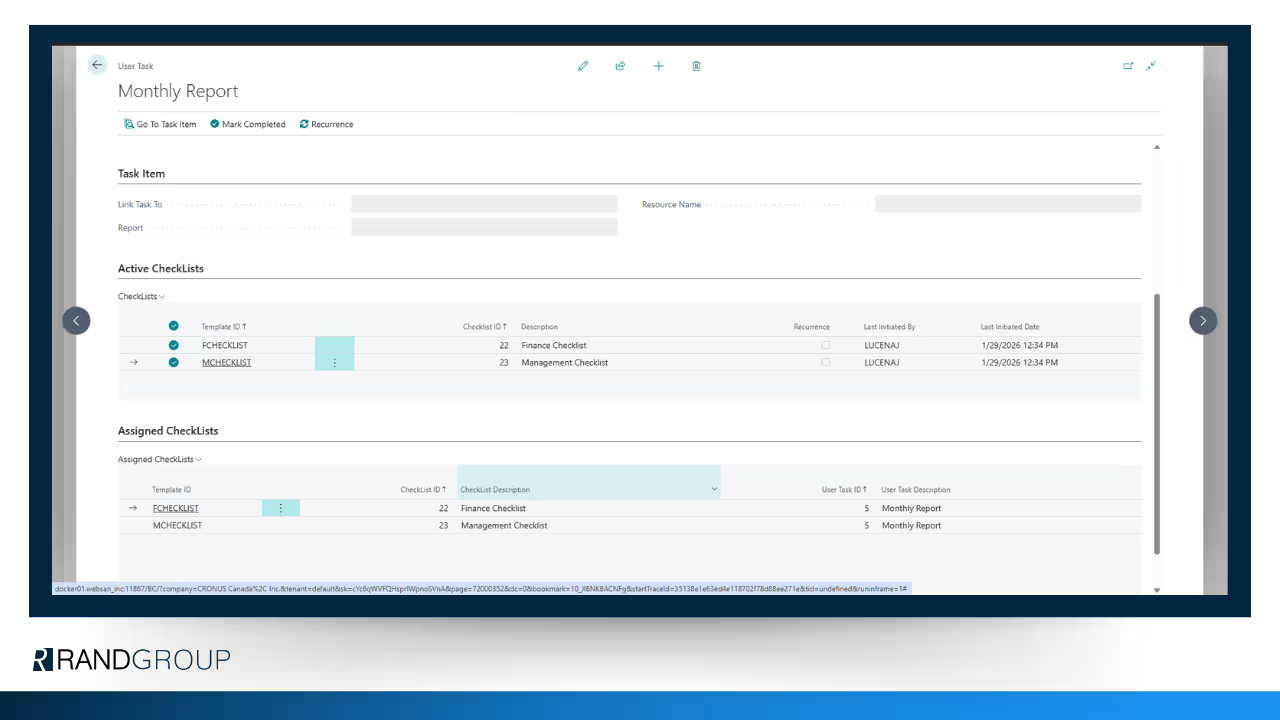
Close workflow and task management
Close management software can provide a centralized environment for coordinating the activities required to complete month-end, quarter-end, and year-end close.
Functionality may include:
- AI-powered close assistance
- Close checklists
- Assigned task owners
- Due dates
- Task dependencies
- Automated notifications
- Review and sign-off workflows
- Close-status dashboards
These tools can give controllers greater visibility into bottlenecks and reduce reliance on email, spreadsheets, or meetings to determine the status of the close.
Intercompany accounting and eliminations
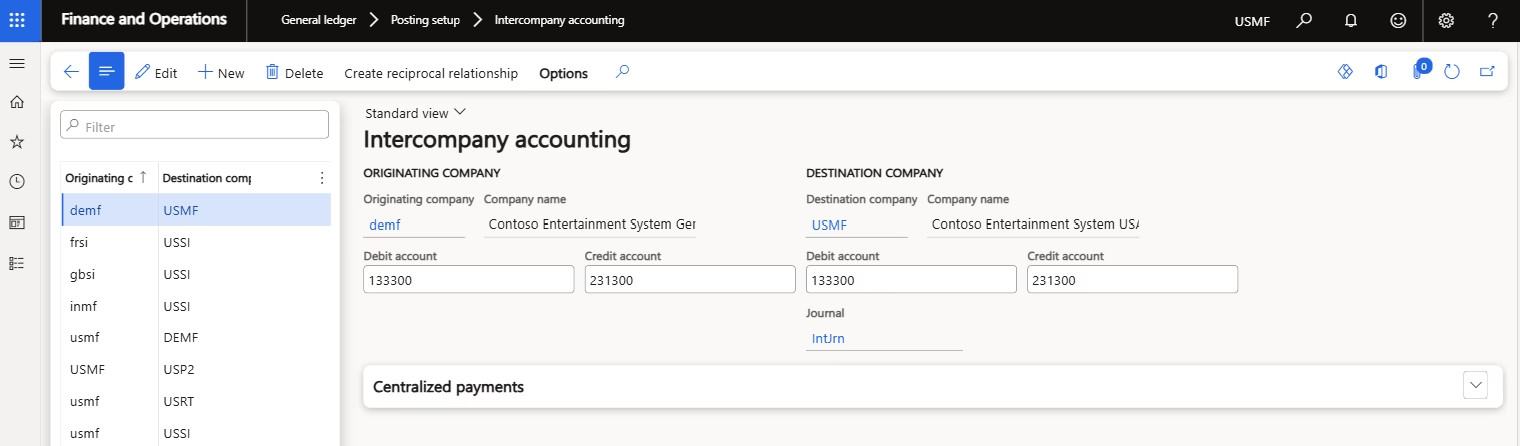
Intercompany accounting becomes increasingly difficult as organizations add legal entities and increase the volume of transactions between them.
Financial consolidation software can help automate:
- Due to/due from transactions
- Intercompany transaction matching
- Balance reconciliation
- Elimination entries
- Exception identification
- Consolidated intercompany reporting
Automation reduces the need for finance teams to manually identify reciprocal transactions and create elimination entries during every reporting period.
Multi-entity financial consolidation
Organizations operating multiple legal entities need to combine financial results while maintaining visibility into individual companies.
Consolidation functionality can support:
- Parent and subsidiary structures
- Entity hierarchies
- Consolidation groups
- Ownership structures
- Entity-level reporting
- Group-level financial reporting
A well-designed system allows finance leaders to review consolidated results while still drilling into the entities and transactions behind those numbers.

Multi-currency translation
Global organizations may need to consolidate entities that maintain their books in different functional currencies.
Financial consolidation software can help apply the appropriate currency translation rules and exchange rates, calculate translation adjustments, and convert entity financials into the organization’s reporting currency.
Because accounting treatment varies by account type and reporting requirements, currency translation rules should be carefully configured and validated during implementation.
Financial reporting and analytics
Closing the books is only valuable if the resulting information can be used effectively.
Modern financial management platforms can support:
- Balance sheets
- Income statements
- Cash flow statements
- Entity-level reporting
- Consolidated reporting
- Management reporting
- Variance analysis
- Drill-down into supporting transactions
Connecting reporting directly to the underlying financial system can also reduce the amount of spreadsheet manipulation required after close.
Controls and audit trails
Financial close software can strengthen governance by documenting how financial information moves through the close.
Depending on the platform, controls can include:
- Role-based permissions
- Approval workflows
- Change histories
- Supporting documentation
- Journal entry audit trails
- Drill-down to source transactions
These capabilities can make it easier to understand who completed or approved an activity and provide auditors with supporting information.

AI and intelligent automation
Artificial intelligence is also becoming part of financial close automation. Capabilities vary significantly by platform, but AI may be used to help finance teams:
- Identify unusual transactions or anomalies
- Assist with transaction matching
- Surface reconciliation exceptions
- Analyze variances
- Identify potential data or mapping issues
- Monitor close activity
- Generate or assist with financial commentary
AI does not eliminate the need for accounting judgment or financial controls. Instead, its greatest value may be helping finance teams identify where their attention is needed so employees can spend less time reviewing routine activity.

Benefits of automating financial close and consolidation
Financial close automation can do more than help organizations close the books faster. By reducing manual work and standardizing processes, financial close and consolidation software can improve efficiency, visibility, and control throughout the reporting cycle.
Key benefits include:
- Faster close cycles: Automate repetitive reconciliations, journal entries, approvals, data transfers, and consolidation activities to reduce manual steps during month-end close.
- Fewer manual errors: Standardize calculations, workflows, and validation rules to reduce errors associated with spreadsheets and manual data entry.
- Greater close visibility: Use dashboards and workflows to track outstanding tasks, bottlenecks, reconciliation exceptions, and approvals.
- Stronger controls and audit readiness: Maintain approvals, supporting documentation, permissions, and audit trails within a controlled financial environment.
- More scalable multi-entity finance: Standardize intercompany accounting and consolidation processes as organizations add subsidiaries, locations, or acquired businesses.
- More time for analysis: Reduce time spent collecting and manipulating data so finance teams can focus on variances, trends, forecasting, and business insights.
How to choose financial close and consolidation software
Selecting financial close and consolidation software starts with understanding the complexity of your current financial environment and where improvements are needed. Key considerations include:
- Close process: Identify how long the close takes, where delays occur, and which activities or reconciliations require the most manual work.
- Entity complexity: Consider the number of entities, ownership structures, accounting requirements, and expected growth or acquisitions.
- Intercompany requirements: Evaluate transaction volume, reconciliation processes, and elimination requirements.
- Currency requirements: Determine which currencies, translation rules, and reporting requirements must be supported.
- Technology environment: Identify which ERP, CRM, payroll, banking, operational, and other systems need to exchange financial data.
- Reporting requirements: Consider the financial information needed by management, leadership, investors, lenders, auditors, and other stakeholders.
- Controls and compliance: Evaluate approvals, permissions, segregation of duties, documentation, and audit trail requirements.
- Scalability: Ensure the solution can support future growth in entities, transactions, users, currencies, and reporting complexity.

Is your close process holding finance back?
Rand Group can help you evaluate your current financial systems and identify opportunities to automate close, consolidation, reporting, and other accounting processes.
Best practices for implementing financial close and consolidation software
Successful implementation requires more than configuring technology. Organizations should use the project to improve the processes, data, controls, and reporting behind the financial close.
Key implementation best practices include:
- Redesign before automating: Identify bottlenecks, manual work, and unnecessary steps rather than simply recreating legacy processes in new software.
- Standardize financial structures: Review charts of accounts, entity hierarchies, dimensions, mappings, and master data to support reliable consolidation and reporting.
- Plan integrations carefully: Define how financial data will move between systems, who owns it, how it will be validated, and how exceptions will be resolved.
- Configure consolidation rules early: Establish entity relationships, intercompany eliminations, currency translation, ownership structures, and consolidation adjustments before testing.
- Build in controls and reporting: Define workflows, approvals, permissions, documentation, and reporting requirements as part of the initial design.
- Test the complete close: Validate reconciliations, integrations, eliminations, adjustments, currency translations, and financial statements under realistic close conditions.
- Train and continuously improve: Provide role-based training and track close time, exceptions, manual entries, consolidation effort, and reporting turnaround after go-live.
At Henry Resources, Rand Group helped consolidate three accounting platforms and dozens of separate charts of accounts into a unified NetSuite environment. Automated eliminations and standardized financial structures transformed a consolidation process that previously required roughly a week of manual work each month into a largely automated process.
From Rand Group’s implementation experience, the strongest financial transformation projects address process, data, controls, reporting, and technology together, rather than treating financial close automation as a software configuration project alone.
Key takeaways
- Financial close and consolidation address different but connected processes: Close software helps complete period-end accounting, while consolidation software combines financial results across entities.
- ERP-native capabilities may be enough for some organizations: Platforms such as Microsoft Dynamics 365, Oracle NetSuite, and Sage Intacct can support close, intercompany accounting, consolidation, workflows, and reporting without requiring a separate application.
- Complexity should drive the technology decision: Multiple entities, currencies, ERP systems, ownership structures, and reporting requirements can increase the need for more advanced close and consolidation capabilities.
- Automation can improve more than close speed: The right technology can reduce manual work and errors while strengthening financial visibility, controls, audit readiness, and scalability.
- Successful implementation starts with the underlying financial processes: Organizations should evaluate and standardize data structures, integrations, consolidation rules, workflows, controls, and reporting rather than simply automating existing processes.
Partner with Rand Group to modernize financial close and consolidation
Selecting and implementing financial close and consolidation software requires both accounting knowledge and technical expertise. Organizations need to understand not only what software can do, but how technology should support their unique entity structures, reporting requirements, workflows, controls, and growth plans.
Rand Group works with finance teams to evaluate and improve the complete financial management environment. Our consultants can help organizations:
- Assess financial close and consolidation processes and identify opportunities for automation
- Evaluate ERP and financial management platforms against business requirements
- Design financial structures and configure multi-entity and intercompany accounting
- Automate workflows, approvals, consolidations, and reporting
- Integrate systems, migrate data, and validate financial information
- Train accounting teams and optimize financial processes after go-live
Our consultants work across Microsoft Dynamics 365, Oracle NetSuite, and Sage solutions, allowing organizations to evaluate financial transformation in the context of their broader ERP and technology strategy.
The results can extend well beyond a new system. When Sapphire Gas Solutions partnered with Rand Group to implement Microsoft Dynamics 365 Business Central, Rand Group worked with the company to rethink financial and operational processes rather than simply replacing its legacy ERP. Streamlined workflows and better financial data helped Sapphire complete its monthly financial close in one-third of the previous time, while also improving reporting and financial visibility.
Frequently asked questions about financial close and consolidation software
What is financial close and consolidation software?
Financial close and consolidation software helps organizations automate and manage period-end accounting and consolidated financial reporting. It can support account reconciliations, journal entries, close workflows, intercompany eliminations, currency translation, multi-entity consolidation, financial reporting, and audit trails.
What is the difference between financial close and financial consolidation?
Financial close is the process of completing an organization’s accounting for a reporting period, including reconciliations, adjustments, approvals, and financial statements. Financial consolidation combines the completed financial results of multiple entities or subsidiaries into group-level financial statements, including intercompany eliminations and currency translation where required.
What does financial consolidation software automate?
Financial consolidation software can automate the collection and mapping of entity financial data, intercompany matching and eliminations, currency translation, consolidation adjustments, entity aggregation, and consolidated financial reporting. The exact level of automation depends on the platform and the organization’s financial structure.
What are the benefits of financial close software?
Financial close software can reduce manual work, accelerate close cycles, improve process consistency, strengthen financial controls, provide greater visibility into close progress, and improve auditability. By automating routine activities, it can also give finance employees more time for analysis and strategic work.
How does financial close software help reduce month-end close time?
Financial close software reduces month-end close time by automating repetitive activities such as data collection, transaction matching, reconciliations, recurring journal entries, approvals, task management, and reporting. It can also surface exceptions and bottlenecks earlier so finance teams can address problems before they delay the close.
Does an ERP include financial close and consolidation capabilities?
Many modern ERP and financial management platforms include capabilities for financial close, intercompany accounting, multi-entity management, consolidation, workflow, and reporting. However, functionality varies by platform. Organizations should compare their accounting and reporting requirements with existing ERP capabilities before deciding whether additional close or consolidation software is necessary.
Do I need separate consolidation software if my ERP supports consolidation?
Not necessarily. ERP-native consolidation may be sufficient when financial data is largely centralized and entity, currency, ownership, and reporting requirements fit the ERP’s capabilities. Organizations with multiple ERP systems or highly complex consolidation, ownership, statutory, or reporting requirements may benefit from a dedicated solution.
How does financial close and consolidation software support multi-entity organizations?
Financial close and consolidation software can help multi-entity organizations standardize financial data, manage entity hierarchies, reconcile intercompany activity, automate eliminations, translate currencies, and produce entity-level and consolidated reports. This can reduce the manual effort required as the organization adds subsidiaries, locations, or business units.
How long does it take to implement financial close and consolidation software?
Implementation timelines vary based on the number of entities, existing financial systems, integrations, data quality, currencies, ownership structures, reporting requirements, and the amount of process redesign required. A well-planned implementation should include requirements gathering, configuration, data integration, testing, a parallel close where appropriate, user training, and go-live support.
How should a company choose financial close and consolidation software?
Companies should evaluate financial close and consolidation software based on their current close challenges, entity structure, intercompany activity, currencies, reporting requirements, controls, integrations, existing ERP environment, and future growth plans. Organizations should also determine whether their existing or prospective ERP can meet these requirements before investing in another application.
Build a faster, more scalable financial close
Financial close and consolidation software can help finance teams reduce manual work, streamline reconciliations and consolidation, strengthen controls, and gain greater visibility into financial performance. Achieving those benefits requires the right technology supported by well-designed financial structures, workflows, data, and reporting.
Rand Group can help you evaluate your current close and consolidation processes, identify opportunities for improvement, and implement technology that supports your financial and operational goals. Contact our team today to start building a faster, more scalable financial close.