Dynamics 365
 Power Platform
 Dynamics
 Cloud & Productivity
What is Microsoft Dynamics 365 Finance and Operations (D365 F&O)?

Microsoft Dynamics 365 Finance and Operations (D365 F&O) is a cloud-based enterprise resource planning (ERP) platform designed for medium to large organizations with complex financial, manufacturing, and supply chain operations. The solution combines Dynamics 365 Finance and Dynamics 365 Supply Chain Management into a unified ERP platform that helps companies automate processes, improve operational visibility, and support global business growth.
Organizations commonly use Dynamics 365 F&O to manage financial reporting, procurement, inventory, manufacturing, warehouse operations, supply chain processes, and multi-entity business operations within a single system. In this guide, we explain what D365 F&O is, how it works, who it is designed for, and the key capabilities, benefits, pricing, and implementation considerations organizations should understand before adopting the platform.
Table of contents
- What is Dynamics 365 Finance & Operations?
- What does Dynamics 365 F&O do?
- Who should use Dynamics 365 Finance & Operations?
- Core capabilities of Dynamics 365 Finance & Operations
- Dynamics 365 Finance vs Dynamics 365 Supply Chain Management
- AI and Copilot in Dynamics 365 Finance & Operations
- How much does Dynamics 365 F&O cost?
- How long does a Dynamics 365 Finance & Operations implementation take?
- How to get Dynamics 365 Finance & Operations
- Partner with Rand Group for Dynamics 365 Finance & Operations
- Real-world results with Dynamics 365 Finance & Operations
- Frequently asked questions
What is Dynamics 365 Finance & Operations?
Microsoft Dynamics 365 Finance and Operations is a cloud-based enterprise resource planning (ERP) solution within the Microsoft Dynamics 365 ERP suite. Microsoft also refers to the platform as Dynamics 365 Finance & Supply Chain Management because it combines two core applications: Dynamics 365 Finance and Dynamics 365 Supply Chain Management.
Dynamics 365 Finance is designed to help organizations manage accounting, financial reporting, budgeting, compliance, and global financial operations. Dynamics 365 Supply Chain Management focuses on procurement, inventory, manufacturing, warehouse management, logistics, and distribution processes.
These applications can be deployed individually or together depending on an organization’s operational requirements. In our experience, many medium to large enterprises implement both applications together to create a more unified ERP environment across finance, operations, and supply chain teams.
Because it is part of the broader Dynamics 365 ecosystem, D365 F&O integrates closely with Microsoft 365, Power BI, Power Platform, and other Dynamics 365 applications. These integrations help organizations centralize business data, automate workflows, and improve reporting across departments.

What does Dynamics 365 F&O do?
Dynamics 365 Finance and Operations helps businesses manage and automate core business processes across finance, supply chain, manufacturing, procurement, inventory, warehousing, and distribution operations. Organizations use D365 F&O to centralize business data, improve operational visibility, automate manual workflows, and support more informed decision-making across departments. The platform is commonly deployed by companies managing complex operations, multiple business entities, global supply chains, or high transaction volumes.
With D365 F&O, organizations can:
- Manage financial reporting, budgeting, forecasting, and compliance
- Automate procurement, purchasing, and vendor management processes
- Track inventory levels and optimize supply chain operations
- Manage manufacturing, production planning, and shop floor operations
- Improve warehouse management, fulfillment, and distribution workflows
- Support multi-entity, multi-currency, and global business operations
- Centralize operational reporting and business analytics
- Integrate business processes with Microsoft 365, Power BI, Power Platform, and Copilot
- Improve operational efficiency through workflow automation and AI-driven insights

Evaluating Dynamics 365 Finance & Operations?
Request a demo or consultation to explore how this powerful ERP solution can elevate your operations and lead your business to greater success.
Who should use Dynamics 365 Finance & Operations?
Dynamics 365 Finance and Operations is designed for firms that need advanced financial management, supply chain visibility, manufacturing capabilities, and operational scalability within a single ERP platform. The solution is commonly used by medium to enterprise organizations with complex business processes, multiple operational departments, or global business requirements.
Organizations best suited for Dynamics 365 Finance & Operations
Dynamics 365 Finance & Operations is typically a strong fit for organizations managing large volumes of transactions, complex supply chains, multiple legal entities, or advanced manufacturing and distribution operations. Many businesses adopt D365 F&O when older ERP systems can no longer support growth, automation, reporting requirements, or operational complexity.
Dynamics 365 Finance & Operations is commonly used by:
- Medium to enterprise organizations with complex operational requirements
- Companies managing multiple business entities or global operations
- Manufacturers with production planning and shop floor management needs
- Distribution and supply chain companies managing inventory across locations
- Organizations requiring advanced financial reporting, compliance, and forecasting
- Businesses managing large transaction volumes or complex procurement processes
- Businesses modernizing legacy ERP systems such as Dynamics AX, Dynamics GP, SAP Business One, or QuickBooks Enterprise
Industries commonly using Dynamics 365 Finance & Operations
Dynamics 365 Finance & Operations is used across a wide range of industries that require advanced ERP functionality, operational visibility, and scalable financial and supply chain management tools. The platform is especially common in industries with complex operations, inventory management requirements, manufacturing workflows, or global business structures.
Industries commonly using the platform include:
- Manufacturing
- Distribution and supply chain management
- Energy and utilities
- Retail and commerce
- Professional services
- Industrial equipment and machinery
- Automotive and transportation
- Food and beverage
- Multi-entity and global organizations
When another ERP solution may be a better fit
Dynamics 365 Finance & Operations provides extensive functionality for organizations with complex operational requirements. However, the platform may be more advanced than necessary for smaller companies with simpler financial processes, limited operational complexity, or fewer users.
Organizations with straightforward accounting, light inventory management, or less complex operational needs may benefit from a more streamlined ERP solution with lower implementation and maintenance requirements. In many cases, Dynamics 365 Business Central is a better fit for small to mid-sized organizations that want core ERP functionality without the complexity of an enterprise ERP platform.
Organizations that may be better suited for another ERP solution include:
- Small businesses with simple accounting and operational requirements
- Organizations without manufacturing or complex supply chain processes
- Companies with limited inventory management needs
- Businesses with fewer users or a single legal entity
- Teams looking for faster deployments and lower ERP costs
To learn more about the differences between these platforms, read our guide comparing Dynamics 365 Business Central vs Dynamics 365 Finance & Operations.

Core capabilities of Dynamics 365 Finance and Operations
Dynamics 365 Finance and Operations includes a broad range of capabilities designed to help organizations manage financial operations, supply chain processes, manufacturing, procurement, inventory, warehousing, and global business operations within a centralized ERP platform. The solution is commonly used by medium to large organizations that need greater operational visibility, workflow automation, reporting capabilities, and scalability across multiple departments, business entities, or locations.
- Financial management: Manage accounting, budgeting, forecasting, compliance, and financial reporting within a centralized system. Dynamics 365 Finance helps organizations improve financial visibility, support multi-entity operations, and streamline month-end and year-end close processes.
- Business processes management: Standardize and automate business workflows across departments to reduce manual tasks and improve operational consistency. Organizations can use workflow automation, approvals, and business rules to improve efficiency and reduce process bottlenecks.
- Global operations management: Support multiple legal entities, currencies, tax structures, and international business operations within a single ERP environment. This helps global organizations centralize reporting and maintain operational visibility across regions and subsidiaries.
- Planning, forecasting, and inventory management: Improve inventory visibility and support more accurate demand forecasting across warehouses and supply chain operations. Organizations can monitor inventory levels in real time, reduce stock shortages, and improve planning decisions using centralized operational data.
- Procurement and sourcing: Streamline purchasing, vendor management, procurement approvals, and sourcing processes across the organization. Dynamics 365 F&O helps businesses reduce manual procurement activities and improve visibility into purchasing and supplier performance.
- Manufacturing and shop floor management: Manage production planning, bill of materials (BOM), material requirements planning (MRP), shop floor operations, and manufacturing workflows within a connected ERP platform. Manufacturers can improve production efficiency, reduce delays, and gain greater visibility into production operations.
- Order management and pricing: Manage sales orders, pricing structures, customer agreements, and fulfillment workflows within a centralized system. Organizations can improve order accuracy, streamline fulfillment processes, and maintain more consistent pricing across operations.
- Warehouse management and fulfillment: Support warehouse operations including inventory movement, picking, packing, shipping, and fulfillment processes across multiple locations. Businesses can improve warehouse efficiency, reduce fulfillment errors, and gain real-time visibility into inventory and distribution operations.
These features, combined with its scalability and integration capabilities with other Microsoft products, make Dynamics 365 F&O an all-encompassing solution for organizations looking to enhance their operations and stay ahead in today’s competitive business landscape. Whether your organization needs to streamline financial processes, optimize supply chains, or manage complex manufacturing operations, Dynamics 365 F&O is a valuable solution for businesses of various sizes and industries.

Dynamics 365 Finance vs Dynamics 365 Supply Chain Management
Dynamics 365 Finance and Dynamics 365 Supply Chain Management are the two core applications that make up Dynamics 365 Finance & Operations. While the applications are closely connected, each one is designed to support different areas of business operations. Organizations can deploy these applications individually or together depending on operational requirements, business goals, and ERP strategy.
Dynamics 365 Finance focuses primarily on financial management, accounting, reporting, compliance, budgeting, and global financial operations. The application also includes automation and AI-driven capabilities that help finance teams improve forecasting, streamline financial processes, monitor cash flow, and support more informed financial decision-making.
Dynamics 365 Supply Chain Management is designed to help organizations manage procurement, inventory, manufacturing, warehousing, logistics, transportation, and fulfillment operations. The platform includes AI-powered planning, demand forecasting, inventory optimization, and warehouse management capabilities that help manufacturers and distributors improve operational efficiency and supply chain visibility.
In many ERP implementations, organizations deploy both applications together to create a more unified system across finance, operations, manufacturing, and supply chain teams. This approach helps centralize business data, improve cross-department collaboration, and support more connected operational reporting.
The table below lists the Dynamics 365 Finance & Operations modules.
AI and Copilot in Dynamics 365 Finance & Operations
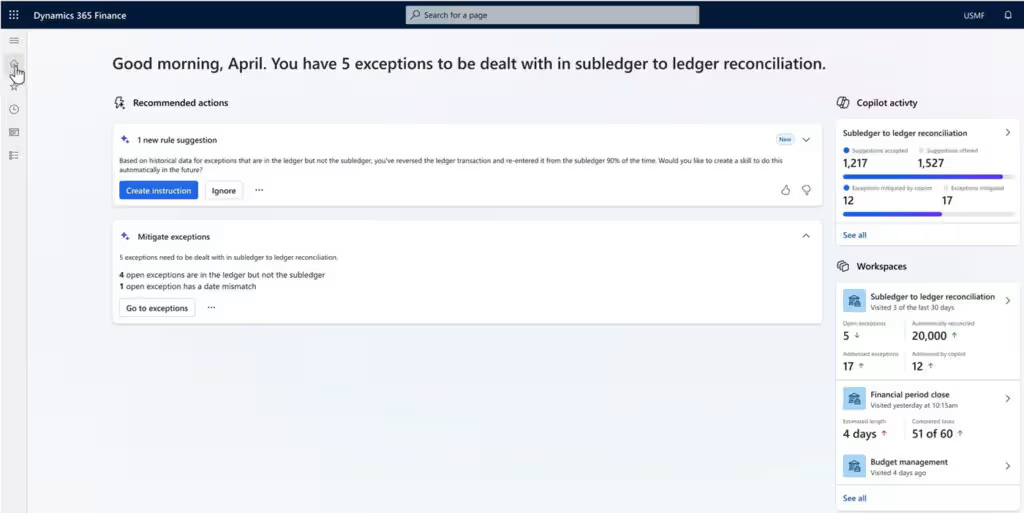
Dynamics 365 Finance & Operations includes built-in AI and Copilot capabilities designed to help finance, supply chain, manufacturing, and operations teams work more efficiently. These capabilities support financial reporting, financial close processes, forecasting, inventory planning, workflow automation, and operational decision-making directly within the ERP platform.
Copilot in Dynamics 365 F&O allows users to interact with ERP data through natural language prompts, AI-generated summaries, workflow insights, and automated recommendations. AI agents extend these capabilities further by monitoring ERP data, identifying exceptions, automating repetitive tasks, and supporting operational workflows across finance and supply chain operations. Organizations can also build custom AI agents and integrations using Microsoft Copilot Studio, Power Platform, and MCP-connected AI experiences.
Key AI and Copilot capabilities in Dynamics 365 Finance & Operations include:
- AI-generated summaries for customers, vendors, purchase orders, inventory, and operational data
- Natural language chat experiences for interacting with Dynamics 365 F&O data
- AI-assisted financial close, reconciliation, and variance analysis processes
- Automated workflow summaries and approval insights for finance and operations teams
- AI-driven demand forecasting and supply chain planning recommendations
- Inventory optimization and warehouse workload insights powered by Copilot
- Supplier communications agents that automate vendor follow-ups and purchase order communications
- AI-powered reporting and operational analytics through Microsoft Copilot and Power BI
To learn more, read our blog on AI agents in Dynamics 365 Finance & Operations or our guide to Copilot capabilities in Dynamics 365 Finance & Operations.
How much does Dynamics 365 F&O cost?
Dynamics 365 Finance & Operations is licensed on a per-user, subscription basis. Each user who accesses the system must have their own named user license. Licenses are not shared or concurrent, but they can typically be reassigned if an employee leaves the organization. Microsoft offers monthly, annual, and multi-year subscription terms. Monthly subscriptions provide greater flexibility but typically cost about 20% more, while annual and multi-year agreements offer more predictable pricing and long-term savings.
Dynamics 365 F&O pricing depends on the type of application, user role, and level of functionality required. Organizations can license Dynamics 365 Finance, Dynamics 365 Supply Chain Management, or both applications together depending on operational requirements.
- Dynamics 365 Finance: $210 per user, per month. Includes core financial management capabilities such as general ledger, budgeting, financial reporting, compliance, cash flow management, and financial automation.
- Dynamics 365 Finance Premium: $300 per user, per month. Includes all standard Dynamics 365 Finance capabilities plus advanced business performance management tools for financial planning, forecasting, budgeting, and analysis.
- Dynamics 365 Supply Chain Management: $210 per user, per month. Provides capabilities for procurement, inventory management, manufacturing, warehouse operations, transportation management, and supply chain planning.
- Dynamics 365 Supply Chain Management Premium: $300 per user, per month. Includes all standard Supply Chain Management functionality plus advanced demand planning and forecasting capabilities.
- Team Members: $8 per user, per month. Designed for light users who need limited access to the ERP system. Team Members can complete basic tasks such as entering time or expenses, reviewing reports, approving workflows, creating maintenance requests, or updating inventory and quality control information.
To learn more, read our Dynamics 365 Finance & Operations pricing and licensing guide.

D365 Finance licensing & pricing guide
Download our exclusive guide to understand the details of Dynamics 365 Finance licensing, capabilities, and pricing. Gain valuable insights into licensing structures and how they can be tailored to your organization’s needs.
How long does a Dynamics 365 Finance & Operations implementation take?
Dynamics 365 Finance & Operations implementation timelines vary based on an organization’s operational complexity, business requirements, number of users, legal entities, integrations, reporting needs, and level of customization. ERP implementations for global manufacturers or multi-entity organizations typically require more planning, testing, data migration, and process alignment than smaller or less complex deployments.
Based on decades of consulting experience and hundreds of ERP implementations, Rand Group offers multiple implementation approaches depending on an organization’s goals, timeline, and operational requirements. Our traditional Dynamics 365 F&O implementation approach typically takes between 8 and 24 months from planning through go-live. For organizations looking to accelerate deployment timelines, we also offer D365 F&O rapid implementation plans that reduce implementation timelines to approximately 6 to 18 months depending on project scope and complexity.
D365 F&O implementation costs also vary significantly based on the size of the organization, number of applications being deployed, integration requirements, data migration complexity, manufacturing processes, reporting needs, and customization requirements. Our rapid implementation plans typically start around $250,000, while larger enterprise deployments can increase substantially depending on project scope.
While lower-cost implementation options may exist, organizations should carefully evaluate the experience, methodology, and long-term support capabilities of the implementation partner. In many ERP environments, correcting a failed or poorly executed implementation can cost significantly more than investing in a structured implementation approach from the beginning. Proper planning, testing, training, and change management are often critical factors in long-term ERP success.
To learn more, read our Dynamics 365 Finance & Operations implementation guide.
How to get Dynamics 365 Finance & Operations
Microsoft offers Dynamics 365 Finance & Operations through its Microsoft partner network. These partners do more than license software. They provide ERP consulting, implementation services, solution architecture, training, support, and long-term optimization services to help organizations successfully deploy and manage the platform.
Choosing the right Dynamics 365 F&O partner is an important part of a successful ERP implementation. An experienced implementation partner can help evaluate business requirements, define implementation scope, identify process improvements, manage data migration, configure integrations, and reduce implementation risk throughout the project lifecycle.
Many organizations also rely on their implementation partner for ongoing support after go-live. This often includes user training, system administration, reporting improvements, upgrade planning, process optimization, compliance support, and guidance around new Microsoft capabilities such as Copilot, AI agents, automation, and Power Platform integrations.
At Rand Group, we are a Microsoft-certified partner with decades of ERP consulting and implementation experience across manufacturing, distribution, energy, professional services, and other complex industries. Our team works closely with organizations to design implementation strategies, modernize business processes, and deploy Dynamics 365 Finance & Operations solutions that support long-term operational growth and scalability.
To learn more about licensing, implementation planning, or ERP modernization strategies, contact Rand Group today.

Get Dynamics 365 F&O today
Whether you’re upgrading from a legacy system or starting fresh, our team can help you implement D365 F&O with confidence. We’ll tailor the solution to your needs and support your team from planning to go-live.
Partner with Rand Group for Dynamics 365 Finance & Operations
Choosing the right partner is critical to long-term ERP success. Enterprise ERP projects require more than technical configuration. They demand structured methodology, industry expertise, executive alignment, process optimization, and disciplined project management. Rand Group brings over 20 years of experience delivering Microsoft ERP solutions for mid-sized and enterprise organizations across North America.
Our team has successfully guided thousands of clients through complex ERP initiatives, maintaining a 90% client retention rate by focusing on long-term partnerships rather than one-time projects. As a Microsoft Partner of the Year 2025 recipient, Rand Group combines deep Dynamics 365 expertise with practical business process knowledge. We help organizations modernize operations, improve financial visibility, streamline supply chain processes, and deploy ERP systems that support long-term growth and scalability.
When partnering with Rand Group for Dynamics 365 Finance & Operations, organizations benefit from:
- Experience with enterprise ERP environments: Proven expertise implementing and supporting Dynamics 365 Finance & Operations in complex, multi-entity organizations.
- Industry expertise: Specialized experience across manufacturing, distribution, energy, professional services, and other operationally complex industries.
- Structured implementation methodologies: Flexible implementation approaches, including traditional and rapid implementation plans designed to align with organizational goals and project timelines.
- ERP modernization expertise: Experience helping organizations migrate from legacy ERP systems such as Dynamics AX, Dynamics GP, QuickBooks Enterprise, and other aging platforms.
- Long-term support and optimization: Ongoing support, user training, reporting improvements, system optimization, and strategic ERP guidance after go-live.
- Microsoft ecosystem expertise: Deep experience across Dynamics 365, Power Platform, Copilot, AI agents, Power BI, Microsoft 365, and ERP integrations.
Real-world results with Dynamics 365 Finance & Operations
Organizations across manufacturing, energy, nonprofit, and distribution industries use Dynamics 365 Finance & Operations to modernize financial processes, improve operational visibility, automate workflows, and replace disconnected legacy systems. Below are examples of measurable business outcomes organizations achieved with Dynamics 365 Finance & Operations implementations led by Rand Group.
Conquest Completion Services modernizes operations with Dynamics 365 Finance & Operations
Conquest Completion Services, LLC, an oilfield services company, replaced disconnected systems including QuickBooks, Excel spreadsheets, and paper-based processes with Dynamics 365 Finance & Operations and Dynamics 365 Field Service. After implementing D365 F&O with Rand Group, Conquest improved financial reporting, streamlined procurement workflows, improved inventory visibility, and gained real-time operational reporting through integrated Power BI dashboards.
To learn more, read the full Conquest Completion Services case study.
0 ×
faster purchase order approval
0 %
reduction to days sales outstanding
0
reduction in A/R and A/P staff
The Museum of Fine Arts, Houston modernizes nonprofit financial operations
The Museum of Fine Arts, Houston (MFAH) replaced an outdated paper-based financial system with Dynamics 365 Finance & Operations to support nonprofit accounting, procurement approvals, project tracking, and financial reporting. With D365 F&O, MFAH improved procurement visibility, accelerated financial close processes, automated approval workflows, and centralized financial reporting across departments.
To learn more, read the full Museum of Fine Arts, Houston case study.
0 %
reduction in monthly close cycle
0
day financial close timeline
0 %
faster purchase approval process
Frequently asked questions
What is Dynamics 365 Finance and Operations?
Dynamics 365 Finance and Operations is a cloud ERP solution from Microsoft designed for medium to large organizations. It combines Dynamics 365 Finance and Dynamics 365 Supply Chain Management to help businesses manage finance, manufacturing, inventory, procurement, warehousing, and supply chain operations within a single system.
What is Dynamics 365 Finance and Operations used for?
Organizations use Dynamics 365 Finance and Operations to manage accounting, financial reporting, budgeting, procurement, inventory, manufacturing, warehouse management, and supply chain operations. The platform is commonly used to centralize business processes and replace disconnected legacy systems.
Is Dynamics 365 F&O an ERP?
Yes. Dynamics 365 F&O is an enterprise resource planning (ERP) platform within the Microsoft Dynamics 365 ERP suite. It helps organizations manage finance, supply chain, manufacturing, procurement, and operational workflows within a centralized system.
What is the difference between Dynamics 365 Finance and Dynamics 365 Supply Chain Management?
Dynamics 365 Finance focuses on accounting, budgeting, compliance, forecasting, and financial reporting. Dynamics 365 Supply Chain Management focuses on procurement, inventory, manufacturing, warehousing, logistics, and fulfillment operations. Organizations can deploy each application separately or together.
Who should use Dynamics 365 F&O?
Dynamics 365 F&O is designed for medium to enterprise organizations with complex financial processes, manufacturing operations, supply chains, or multi-entity business structures. It is commonly used by manufacturers, distributors, energy companies, retailers, and global organizations.
Is Dynamics 365 F&O cloud-based?
Dynamics 365 F&O can be deployed in the cloud or on premises. Most organizations choose the cloud deployment model to support scalability, automatic updates, AI capabilities, and Microsoft integrations.
How much does Dynamics 365 F&O cost?
Dynamics 365 Finance and Dynamics 365 Supply Chain Management licenses start at approximately $210 per user, per month. Premium licenses start at approximately $300 per user, per month. Team Member licenses start at $8 per user, per month. Implementation costs vary based on project scope and complexity.
What industries use Dynamics 365 F&O?
Dynamics 365 F&O is commonly used in manufacturing, distribution, supply chain management, energy, retail, professional services, automotive, food and beverage, and industrial equipment industries.
What replaced Dynamics AX?
Microsoft Dynamics AX evolved into Dynamics 365 Finance and Dynamics 365 Supply Chain Management as part of Microsoft’s cloud-based Dynamics 365 ERP platform. Many organizations migrate from Dynamics AX to Dynamics 365 F&O to modernize legacy ERP systems and gain cloud, AI, and automation capabilities.
Next steps
Dynamics 365 Finance & Operations helps organizations centralize financial management, supply chain operations, manufacturing, procurement, inventory, and reporting within a unified cloud ERP platform. With built-in AI capabilities, Microsoft ecosystem integrations, and enterprise-scale functionality, D365 F&O supports organizations looking to improve operational visibility, automate workflows, and modernize legacy business systems.
Whether you are evaluating ERP platforms, replacing a legacy system, or planning a Dynamics 365 Finance & Operations implementation, choosing the right strategy and implementation partner can have a major impact on long-term success. Rand Group brings decades of Microsoft ERP consulting experience across manufacturing, distribution, energy, nonprofit, and other complex industries. Contact us today to learn how Dynamics 365 Finance & Operations can support your organization’s growth and operational goals.