 Dynamics 365
 Power Platform
 Dynamics
 Cloud & Productivity
Microsoft Dynamics 365 Finance & Supply Chain Management for oil and gas
Microsoft Dynamics 365 Finance & Supply Chain Management is an enterprise ERP platform for oil and gas companies with complex financial and operational requirements. Often referred to as Dynamics 365 Finance & Operations (D365 F&O), the platform brings Dynamics 365 Finance and Dynamics 365 Supply Chain Management together to manage financials, projects, procurement, inventory, assets, maintenance, reporting, and other operational activity in one connected Microsoft environment.

Why choose Dynamics 365 Finance & SCM for oil and gas?
Oil and gas companies often operate across multiple legal entities, service lines, regions, field locations, projects, warehouses, and equipment fleets. When these areas rely on separate systems, finance and operations teams can struggle to understand costs, margins, inventory, asset activity, and overall financial performance.
Dynamics 365 Finance & Supply Chain Management connects enterprise financial management with procurement, inventory, project accounting, warehouse management, equipment maintenance, and reporting. The platform is well suited for larger oil and gas companies, oilfield service providers, and energy service organizations that need greater control and scalability than smaller accounting or ERP systems can provide.
Headquartered in Houston, Rand Group has decades of experience helping oil and gas organizations implement, integrate, and extend Microsoft ERP solutions. Our experience spans oilfield services, natural gas compression, coiled tubing, equipment-intensive operations, maintenance, field service, project accounting, inventory, and complex multi-company environments.

Connect field activity with financial performance
Connect operational activity with the financial data used by accounting and leadership. Costs, materials, purchasing, projects, service activity, and billing can move through connected processes so finance teams have more current information and fewer manual handoffs.

Improve control across complex operations
Create consistent processes across legal entities, service lines, projects, warehouses, locations, and equipment. Financial dimensions, approvals, workflows, and reporting help oil and gas organizations understand where costs originate and how different parts of the business are performing.

Scale without adding disconnected systems
Support growth without adding another spreadsheet or point solution each time the business expands. Dynamics 365 can support additional entities, locations, warehouses, assets, users, and business processes while connecting with the broader Microsoft ecosystem.
Dynamics 365 Finance & Supply Chain Management for oil and gas capabilities
Dynamics 365 Finance & Supply Chain Management combines enterprise financial management with supply chain and operational capabilities that can be configured around complex oil and gas business models. Rand Group can also integrate or extend the platform when standard functionality does not fully support an industry-specific workflow.
Financials
Multi-entity and intercompany accounting
Manage multiple legal entities, operating companies, and subsidiaries within Dynamics 365 Finance. Finance teams can process intercompany activity while maintaining separate accounting records for each company and producing consolidated financial results. This is especially useful for oil and gas organizations with operations spread across multiple entities, regions, or service businesses.
Financial dimensions and profitability tracking
Use financial dimensions to add operational context to accounting transactions and reporting. Dimensions can reflect structures such as region, location, cost center, customer, project, basin, well, or other areas that matter to the business. Rand Group can design dimension structures that give oil and gas companies more detailed visibility into service lines, equipment, operating areas, and profitability.
AP, AR, cash flow and financial close
Manage accounts payable, accounts receivable, collections, cash and bank activity, and financial close within Dynamics 365 Finance. These capabilities help finance teams handle high volumes of vendor invoices, customer billing, payments, and purchasing activity across distributed operations. Cash flow forecasting can also help organizations anticipate future cash requirements using current financial data.
Budgeting, forecasting and financial controls
Build budgets, forecasts, approval workflows, and financial controls around the way the organization operates. Oil and gas companies can use these tools to monitor spending, plan for changing operating costs, and maintain stronger control over financial activity. Role-based access and structured workflows also help support consistent processes across a multi-entity organization.

Projects & billing
Project and job costing
Track labor, materials, expenses, items, fees, and other costs against projects. Oilfield service companies can use project accounting for service jobs, equipment work, installations, mobilizations, maintenance projects, and other project-based activity. Dynamics 365 Finance supports project models including time-and-material and fixed-price work.
Budgets, commitments and actual costs
Compare planned project costs with purchasing activity and actual costs as work progresses. This gives project and finance teams a clearer view of spending before a job or initiative is complete. For oil and gas organizations, that visibility can help control service work, equipment projects, capital initiatives, and other cost-intensive activities.
Billing and revenue recognition
Support different billing and revenue models for project-based work. Time-and-material projects can bill hours, expenses, items, and fees, while fixed-price projects can follow contract-based billing schedules and revenue recognition methods. This flexibility can support a range of oilfield service and energy service contract structures.
Project, service line and equipment profitability
Combine project accounting, financial dimensions, and reporting to understand more than total revenue. Companies can analyze results by project, customer, region, service offering, or other operating dimensions. Rand Group can extend the accounting and reporting structure when an oil and gas company needs more specialized service-line or equipment-level profitability analysis.

Procurement & inventory
Purchase requisitions and approval workflows
Manage purchasing from internal request through approval and purchase order creation. Workflows can route requisitions to the right reviewers before purchasing moves forward. Oil and gas organizations can use these controls for field supplies, equipment, maintenance materials, critical parts, and purchases across remote locations.
Vendor invoice processing and matching
Connect purchasing and accounts payable so invoices can be validated against purchasing activity before payment. Invoice Capture can extract information from digital vendor invoices and move it into Dynamics 365 Finance for review and processing. This can reduce manual work for organizations processing large volumes of vendor invoices and purchase orders.
Multi-site inventory and warehouse management
Manage inventory across multiple sites, warehouses, yards, depots, and stocking locations. Dynamics 365 Supply Chain Management supports receiving, put-away, picking, transfers, cycle counts, and warehouse inventory processes. Oil and gas organizations can use these capabilities to maintain visibility across central warehouses and distributed operating locations.
Critical spares and parts consumption
Connect inventory with equipment maintenance so teams can manage the parts and materials required to keep assets operating. Maintenance work can consume parts while inventory teams maintain visibility into available stock and replenishment needs. This helps reduce the risk of critical stockouts without carrying unnecessary spare-parts inventory.
Intercompany inventory movement
Manage inventory transactions between related operating companies while keeping the corresponding purchasing and sales activity aligned. Dynamics 365 Supply Chain Management can automatically create related intercompany orders between legal entities. Rand Group can extend this process when oil and gas operations require more complex scenarios such as work-order-driven intercompany parts consumption.

Assets & maintenance
Asset hierarchies and functional locations
Asset management capabilities in Dynamics 365 Supply Chain Management let companies organize equipment into asset hierarchies and functional locations. Functional locations help track where equipment is installed or operating and can support location-based cost reporting. Oil and gas companies can apply these structures to compressor packages, coiled tubing units, rotating equipment, vehicles, facilities, and other field assets.
Preventive, corrective and counter-based maintenance
Plan preventive maintenance while also managing corrective repairs and unplanned equipment issues. Maintenance plans can be based on time or equipment counters, including operating hours or other usage measurements. Counter-based maintenance is particularly useful for compressors, rotating equipment, vehicles, and other assets that require service based on runtime rather than a fixed calendar schedule.
Maintenance work orders and inspections
Create work orders for planned maintenance, repairs, inspections, and other equipment activity. Maintenance schedules can generate recurring work based on asset or functional-location requirements. This gives oil and gas maintenance teams a structured process for planning work and maintaining equipment history.
Equipment downtime and maintenance KPIs
Track maintenance activity, work orders, equipment issues, and downtime to better understand asset performance. Maintenance teams can use this information to identify recurring problems and evaluate the workload required to keep equipment available. This creates better visibility into reliability across equipment fleets and operating locations.
Spare parts and maintenance costs
Connect maintenance activity with inventory and financial information to understand the cost of keeping equipment operational. Labor, parts, and other maintenance costs can be associated with assets and functional locations. Oil and gas companies can use this information to evaluate maintenance spending and identify high-cost equipment or operating areas.

Field operations
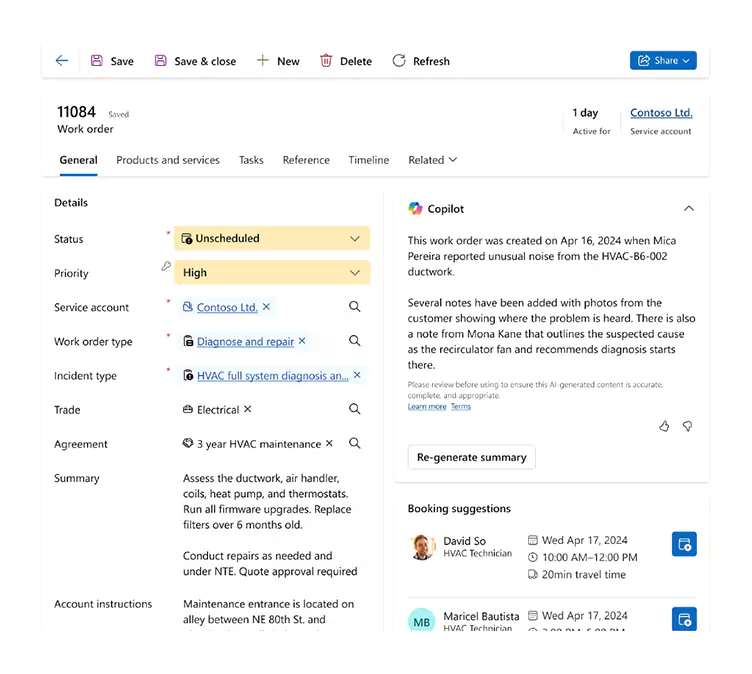
Connected work orders and ERP processes
Dynamics 365 Field Service is a separate Dynamics 365 application that can be connected with Microsoft’s project, finance, and supply chain applications. Field work can then be tied to projects, materials, inventory, costs, and downstream financial activity. Rand Group can design this connected environment around the operating and accounting requirements of an oil and gas organization.
Digital field tickets
Replace paper field tickets and manual re-entry with digital processes that capture completed work closer to where it occurs. Rand Group has built oilfield workflows that move completed field activity into downstream ERP and billing processes. This helps reduce delays between work performed in the field and the financial processes that follow.
Field inventory and parts visibility
Connect field execution with the inventory information maintained in the broader Dynamics 365 environment. Field teams can record material usage while inventory and finance processes remain aligned with the work being performed. Rand Group can extend these integrations for technician inventory, service depots, remote warehouses, and more detailed location-level inventory requirements.
Scheduling, dispatch and mobile execution
Use Dynamics 365 Field Service to manage work orders, resource scheduling, dispatch, and mobile field execution. Technicians and crews can access assigned work and record labor, materials, and other service activity from the field. That information can then support connected project and financial processes.
Work order-to-billing automation
Connect completed field work with project costing and downstream billing processes. Labor and material usage recorded on work orders can flow into the appropriate project and financial structure instead of being manually entered again. Rand Group has implemented this type of field-to-finance automation for oilfield service organizations with complex operational requirements.
Reporting & AI
Financial and operational reporting
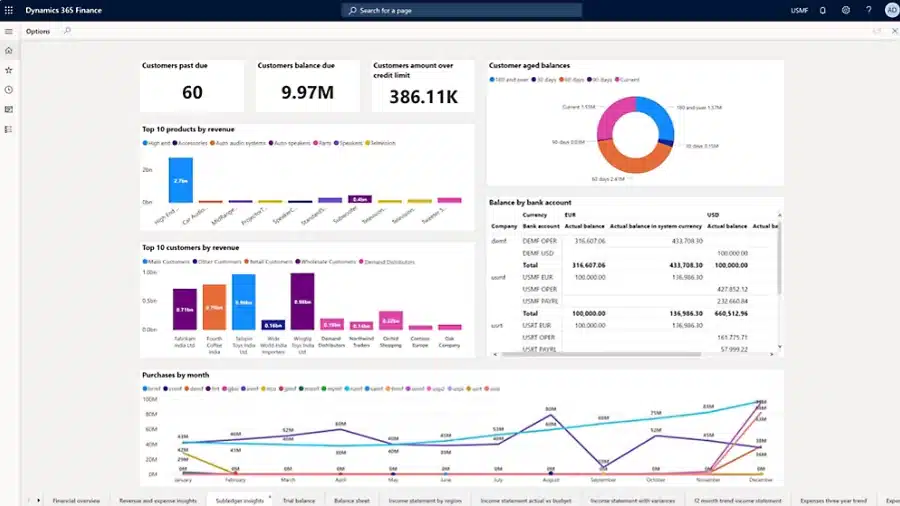
Bring financial and operational information together for reporting and analysis. Oil and gas organizations can build reporting around entities, projects, service lines, assets, inventory, locations, and other business dimensions. This gives finance and operations leaders a more connected view of performance without relying on separate spreadsheets for every reporting need.
Power BI dashboards and profitability analysis
Extend Dynamics 365 reporting with Microsoft Power BI to create visual dashboards and more detailed analysis. Leaders can monitor cash flow, margins, projects, purchasing, inventory, asset activity, and other KPIs in one reporting environment. Rand Group can also build custom data models and measures when the business requires more specialized oil and gas reporting.
AI-assisted finance
Use AI-supported capabilities to help finance teams focus on exceptions and higher-value work. Dynamics 365 Finance can help predict customer payments and cash flow, while Copilot can summarize collections information and support customer communications. These capabilities can help oil and gas finance teams manage receivables and cash more proactively.
AP and workflow automation
Reduce repetitive accounts payable work with Invoice Capture, invoice matching, and configurable approval workflows. Vendor invoice information can be captured and routed into Dynamics 365 Finance for validation and processing. This is particularly useful for oil and gas organizations managing large volumes of purchasing and vendor activity.
Copilot, AI agents and extensibility
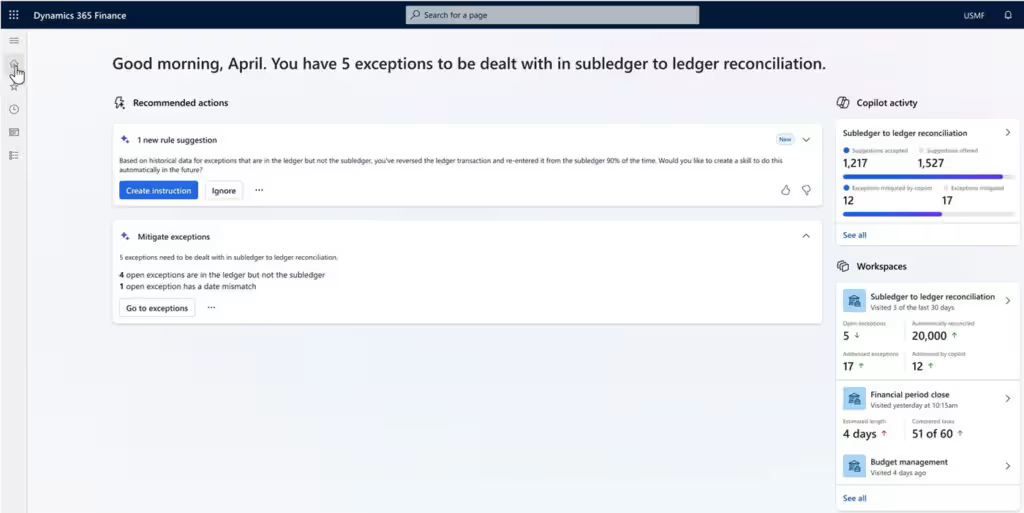
Microsoft continues to add Copilot, AI agents, and AI-powered analytics across Dynamics 365 Finance and Supply Chain Management. These tools can help users analyze information, prioritize exceptions, and automate defined finance and supply chain activities. Rand Group can help determine where Microsoft AI capabilities fit and where custom agents or Power Platform automation can extend the process.

Real clients
Real results
Faster purchase order approvals
%
Reduction in days sales outstanding
Reduction in A/R and A/P staffing needs

Case Study
How Rand Group helped Conquest modernize oilfield operations
Conquest Completion Services partnered with Rand Group to replace QuickBooks, Excel spreadsheets, paper field tickets, and other manual processes with Dynamics 365 Finance & Operations and Dynamics 365 Field Service. Rand Group helped Conquest select and implement the connected Microsoft platform, giving the oilfield services company better visibility into financials, inventory, purchasing, field operations, and equipment costs while reducing manual work across the business.
Extend Dynamics 365 F&SCM for oil and gas workflows
Oil and gas companies often have accounting and operational requirements that go beyond standard ERP configuration. Rand Group combines decades of industry experience with Dynamics 365 consulting and software engineering to configure, integrate, and extend the platform around each company’s operating model, ownership structure, cost tracking, and reporting needs.
Our oil and gas Dynamics 365 experience includes:
- Well, property, and owner accounting structures
- AFE, project, rig, and operational cost tracking
- Revenue distribution and specialized billing requirements
- Multi-entity operations, intercompany automation, and joint interest billing
- Service-line accounting and custom financial dimensions
- Equipment and rental management requirements
- Industry-specific data structures, posting logic, and business rules

Connect finance and field operations with Dynamics 365 Field Service
Rand Group can connect Dynamics 365 Finance & Supply Chain Management with Dynamics 365 Field Service to create a more connected environment for oil and gas operations. This helps field teams, operations, inventory, project teams, and finance share information across systems while reducing manual handoffs and duplicate data entry.
A connected Dynamics 365 environment can help:
- Connect completed field activity with project and financial processes
- Align parts consumption with inventory and warehouse records
- Capture labor, materials, and service costs closer to where work occurs
- Reduce manual data entry between field and back-office teams
- Shorten the time between completed work and customer billing
- Improve visibility into service costs, field activity, and operational performance
We have always felt like a top priority when working with Rand Group’s team and have the utmost confidence in their industry and technical knowledge.
Manage equipment throughout the asset lifecycle
Oil and gas companies depend on high-value equipment that moves between locations, requires ongoing maintenance, and may be reconfigured or redeployed throughout its useful life. Rand Group can configure and extend Dynamics 365 Finance & Supply Chain Management to support asset, fleet, and equipment lifecycle processes while connecting maintenance activity with inventory, costs, and operational reporting.
Our oil and gas equipment management experience includes:
- Compression fleets, coiled tubing units, rotating equipment, and mobile field assets
- Equipment deployment, mobilization, preservation, reconfiguration, and retirement
- Service and rental equipment tracking
- Preventive, corrective, meter-based, and runtime-based maintenance
- Work orders, inspections, service history, and downtime tracking
- Spare-parts consumption and maintenance costs
- Equipment utilization, asset costs, and profitability reporting

Put AI to work across oil and gas finance and operations
AI in Dynamics 365 can help oil and gas finance and operations teams act faster on the ERP data they already use. Copilot, analytics, automation, and AI agents can reduce repetitive work, surface exceptions, and help teams focus on the financial and supply chain issues that need attention.
Oil and gas teams can use AI and automation to:
- Prioritize overdue receivables and collections activity
- Forecast cash flow and customer payment timing
- Reduce manual work in vendor invoice processing
- Surface reconciliation issues and financial exceptions
- Analyze purchasing, demand, inventory, and supplier changes
- Summarize financial and supply chain information with Copilot
- Automate defined finance and procurement tasks with AI agents
- Extend Dynamics 365 with custom agents and Power Platform automation
Why partner with Rand Group?
Dynamics 365 F&SCM tailored for oil and gas
Rand Group delivers Dynamics 365 Finance & Supply Chain Management solutions tailored to oil and gas companies, oilfield service providers, compression companies, and other asset-intensive energy businesses. We configure and extend the platform around financial management, project accounting, procurement, inventory, equipment, maintenance, reporting, and other operational requirements.
Proven results with Microsoft
Rand Group has a 90% client retention rate and experience helping oil and gas companies modernize complex financial and operational systems with Microsoft Dynamics 365. Our projects have helped energy companies improve financial visibility, purchasing, inventory management, field operations, equipment management, and access to real-time business data.
Oil and gas industry experience
Rand Group has decades of experience working with oil and gas organizations that manage field operations, equipment fleets, projects, multiple legal entities, and specialized accounting requirements. We help determine where standard Dynamics 365 capabilities fit and where integrations, industry applications, or custom development are needed for processes such as joint interest billing, AFE management, field ticketing, and equipment lifecycle management.
Microsoft Partner of the Year
Rand Group is a Microsoft Partner of the Year in North America, recognized for our work with Microsoft Business Applications. Our U.S. and Canada-based teams provide Dynamics 365 implementation, integration, custom development, optimization, AI, and ongoing support services in-house.
Frequently Asked Questions (FAQs)
What is Dynamics 365 Finance & Supply Chain Management for oil and gas?
Dynamics 365 Finance & Supply Chain Management for oil and gas refers to using Dynamics 365 Finance and Dynamics 365 Supply Chain Management as the ERP foundation for oil and gas operations. The platform supports financial management, project accounting, procurement, inventory, warehousing, equipment maintenance, and reporting, while industry-specific processes can be added through configuration, integrations, or custom development.
Is Dynamics 365 Finance & Supply Chain Management the same as Dynamics 365 F&O?
Dynamics 365 F&O, or Finance & Operations, is still commonly used as shorthand for Microsoft’s enterprise finance and operations ERP platform. Microsoft now develops and licenses Dynamics 365 Finance and Dynamics 365 Supply Chain Management as separate applications that can work together in the same environment.
What types of oil and gas companies are a good fit for Dynamics 365 F&SCM?
Dynamics 365 F&SCM is a strong fit for larger or more complex oil and gas organizations. This includes oilfield service companies, natural gas compression providers, multi-entity energy companies, and businesses with significant equipment, inventory, project, warehouse, or field operations.
Can Dynamics 365 F&SCM support multi-entity and intercompany oil and gas operations?
Yes. Dynamics 365 Finance supports multiple legal entities, intercompany accounting, consolidations, and consolidated financial reporting, while Dynamics 365 Supply Chain Management supports intercompany purchasing and sales processes. Rand Group can extend these capabilities for more complex oil and gas scenarios involving inventory ownership, service activity, and transactions across operating companies.
Can Dynamics 365 F&SCM manage oil and gas equipment and preventive maintenance?
Yes. Asset management capabilities in Dynamics 365 Supply Chain Management support equipment hierarchies, functional locations, maintenance work orders, inspections, and preventive maintenance. Maintenance can also be triggered by time or equipment counters, making the platform useful for runtime- and meter-based maintenance of compressors, rotating equipment, vehicles, and other field assets.
How does Dynamics 365 F&SCM integrate with Dynamics 365 Field Service?
Dynamics 365 Field Service is a separate Dynamics 365 application that can be connected with finance, supply chain, project, and inventory processes. Rand Group can help create a connected environment for field work, digital tickets, parts consumption, project costing, equipment service, and downstream billing.
Can Dynamics 365 F&SCM support oilfield project accounting and job costing?
Yes. Dynamics 365 supports project costs, budgets, time-and-material projects, fixed-price projects, billing, and revenue recognition. Oilfield service companies can use these capabilities for service jobs, mobilizations, installations, equipment work, maintenance projects, and other project-based operations.
Can Dynamics 365 be customized for oil and gas-specific requirements?
Yes. Dynamics 365 can be configured and extended through custom development, integrations, Power Platform, Dataverse, and industry applications. Rand Group has experience extending Dynamics 365 for oil and gas workflows such as service-line accounting, field tickets, intercompany automation, project costing, field inventory, and equipment lifecycle management.
What AI capabilities are available in Dynamics 365 Finance & Supply Chain Management?
Dynamics 365 includes AI, Copilot, and automation capabilities across finance and supply chain processes. Examples include collections assistance, cash flow and payment predictions, invoice processing, business performance analytics, and AI agents for defined finance and procurement tasks. Specific capabilities depend on licensing, release status, and deployment.
When should an oil and gas company choose D365 F&SCM instead of Dynamics 365 Business Central?
Dynamics 365 F&SCM is typically the better fit when an oil and gas company has complex legal entities, higher transaction volumes, advanced warehouse requirements, extensive equipment maintenance, sophisticated project accounting, or highly integrated field operations. Dynamics 365 Business Central can be a better fit for small and midsized organizations with less complex financial and operational requirements.
Does Dynamics 365 Finance & Supply Chain Management support AFE, joint interest billing, royalty accounting, and well accounting?
Dynamics 365 Finance & Supply Chain Management does not include dedicated out-of-the-box oil and gas modules for every specialized process. Rand Group can configure, extend, or integrate Dynamics 365 to support requirements such as AFE management, joint interest billing, well and property accounting, owner accounting, revenue distribution, and other industry-specific workflows.
The right approach depends on the company’s operating model and accounting requirements. Rand Group can determine which processes should use standard Dynamics 365 functionality and which require configuration, custom development, or integration with specialized oil and gas applications.
Related Insights

Dynamics 365 Finance & Supply Chain Management fall 2026 update: What’s new
The Dynamics 365 Finance & Supply Chain Management fall 2026 update introduces enhancements to financial management, production planning, manufacturing, and supplier collaboration. Explore the key features in version 10.0.49, including new capabilities, generally available enhancements, and preview features organizations should know about.

What is Dynamics 365 Finance? Features, pricing, AI, and more
Microsoft Dynamics 365 Finance is a cloud ERP application for organizations with complex financial management needs. Learn about its capabilities, AI and agents, benefits, pricing, licensing, integrations, and implementation considerations.

What is Microsoft Dynamics 365 Supply Chain Management? Features, pricing, and benefits
Microsoft Dynamics 365 Supply Chain Management connects inventory, procurement, manufacturing, warehousing, planning, and logistics. Learn about its features, AI capabilities, pricing, implementation, and ideal use cases.