Dynamics 365
 Power Platform
 Dynamics
 Cloud & Productivity
Dynamics 365 vs HubSpot: choosing the right platform for your business

Customer relationship management has evolved far beyond simple contact lists. Today, organizations need platforms that not only track leads and manage sales pipelines but also connect marketing, operations, finance, and service into a unified system. Choosing the right solution is critical: it impacts how efficiently teams collaborate, how accurately data drives decisions, and how effectively the business scales over time. This is where the comparison of Dynamics 365 vs HubSpot becomes meaningful. While HubSpot offers a user-friendly, marketing-focused CRM that enables fast adoption and quick wins, Dynamics 365 provides a broader, enterprise-grade platform that connects customer engagement with operational and financial systems. Understanding the unique strengths and ideal use cases of each platform helps businesses make informed decisions when evaluating Dynamics 365 vs HubSpot.
Understanding the Dynamics 365 ecosystem
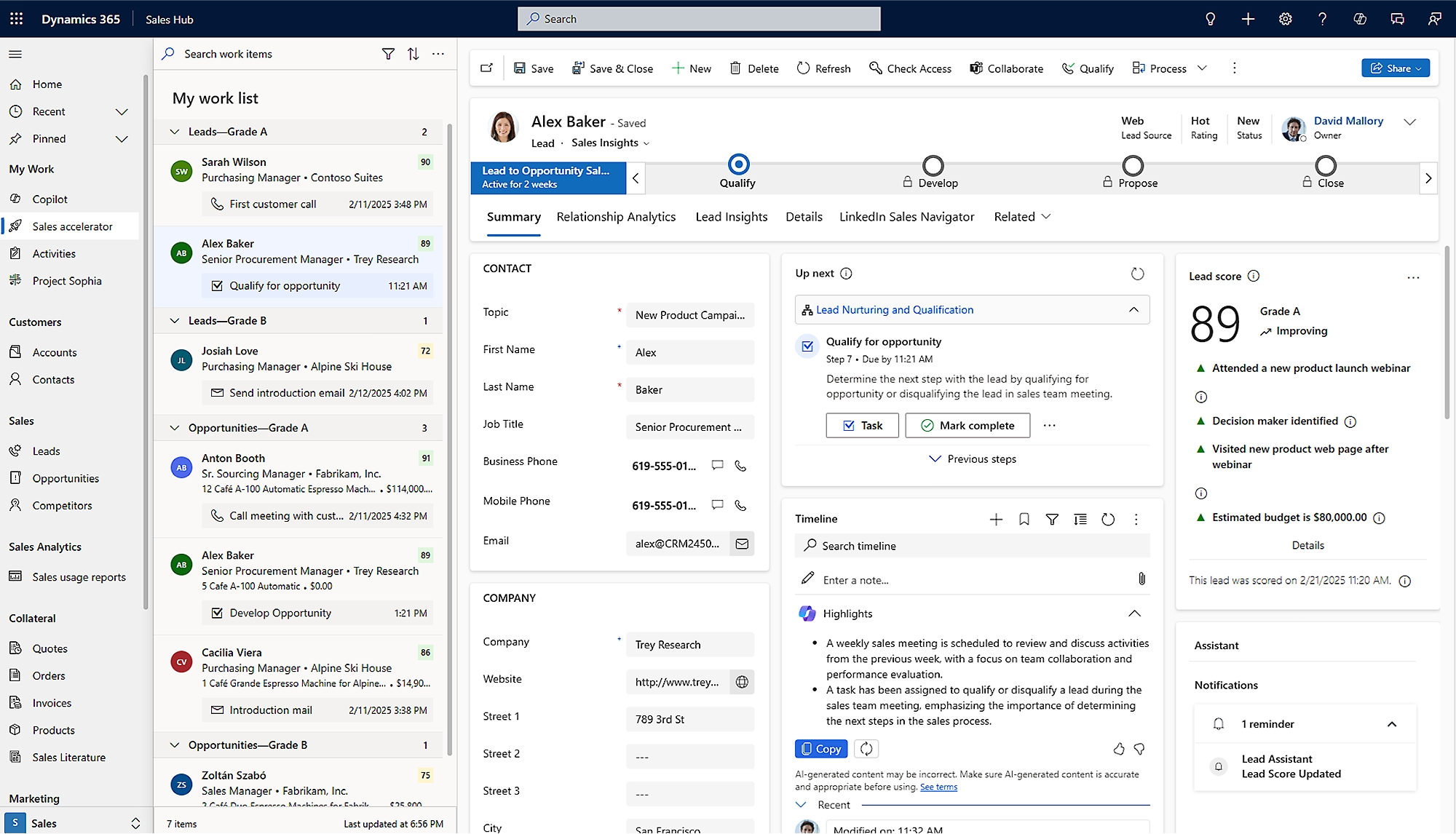
Before comparing platforms, it’s important to clarify what Dynamics 365 really is, and our guide Is Dynamics 365 an ERP or CRM? provides helpful context. While many associate it with CRM alone, the platform extends far beyond customer engagement to support a wide range of enterprise operations. Dynamics 365 is built within the broader Microsoft ecosystem, which means users benefit from a familiar interface and native connections to Outlook, Teams, Excel, Word, and Copilot. This consistency not only improves usability but also streamlines collaboration and day-to-day workflows across the organization. At its core, Dynamics 365 is a modular suite of business applications that can connect finance, supply chain, sales, marketing, customer service, field operations, HR, and analytics—each working independently or together as a unified system.
The versatility of Dynamics 365 allows organizations to align processes across departments in ways that drive measurable business outcomes. For example, a manufacturing company may integrate Dynamics 365 Finance, Supply Chain Management, and Sales to synchronize production schedules with demand forecasting, reducing stockouts and improving on-time delivery. A professional services organization might leverage Project Operations, Sales, and Customer Service to manage every step of the client lifecycle—from opportunity tracking to project execution and post-project support. Meanwhile, a distributor could use Business Central alongside Dynamics 365 Marketing and Sales to streamline inventory planning, automate order workflows, and coordinate multi-channel customer engagement.
The key takeaway is that Dynamics 365 is not a point solution. It is a connected platform designed for organizations that require deep process automation, integrated data, and enterprise-grade scalability. By unifying operations across business functions—and doing so within a cohesive Microsoft environment—it helps teams work more efficiently, provides leadership with comprehensive insights, and supports growth at scale.
Understanding HubSpot’s strengths and positioning
While Dynamics 365 focuses on broad operational transformation, HubSpot was designed with a different philosophy: simplicity, usability, and frictionless adoption. HubSpot excels in organizations that want to improve marketing, sales, and service effectiveness without introducing excessive complexity or requiring extensive IT resources. Its core strengths include:
- A modern, intuitive CRM interface that encourages fast adoption
- Strong inbound marketing capabilities, including email campaigns, landing pages, forms, and content management
- Rapid deployment with minimal configuration required
- A single workspace that integrates marketing, sales, service, and website content
- Low technical overhead, reducing dependency on IT for day-to-day operations
HubSpot’s user experience is one of its most compelling advantages. Teams can launch campaigns, track deals, manage content, and monitor performance with minimal learning curve, making it ideal for smaller marketing-driven organizations or departments looking for fast time-to-value. HubSpot also offers a wide ecosystem of integrations, allowing businesses to connect easily with other cloud-based tools to extend functionality without complex development.
However, it is important to understand HubSpot’s scope. While it offers operational tools to manage customer interactions and marketing workflows, it is not a financial system, supply chain platform, or full ERP solution. Organizations with complex back-office processes, such as multi-entity finance, advanced manufacturing, or integrated logistics. Will often need to combine HubSpot with other foundational systems to achieve enterprise-wide efficiency.
Key differences in the Dynamics 365 vs HubSpot comparison
To help organizations evaluate Dynamics 365 vs HubSpot more clearly, the table below summarizes their core differences across usability, functionality, scalability, and ecosystem scope. This high-level comparison can guide teams as they assess which platform aligns more closely with their immediate needs and long-term vision.

Take the next step in selecting the right platform
Choosing the right business platform is critical for aligning operations, marketing, and customer engagement with your long-term growth strategy. Our team at Rand Group can help you evaluate how Dynamics 365, HubSpot, or a hybrid approach fits your organization’s unique needs.
Use cases where Dynamics 365 excels
Dynamics 365 shines when organizations need more than CRM or marketing automation alone. Because the platform connects sales, service, finance, supply chain, and operations, it supports scenarios that require deeper process alignment and long-term scalability. Key use cases include:
- Complex sales cycles: Dynamics 365 Sales, combined with Finance and Operations, helps teams manage multi-stage quotes, pricing rules, and approvals while integrating real-time inventory and production data. Sales pipelines reflect operational realities, improving accuracy and accelerating the sales-to-cash process.
- Advanced financial or supply chain needs: Manufacturers, distributors, and multi-entity organizations benefit from integrated CRM and ERP. Shared data supports accurate forecasting, demand planning, and order management, reducing manual reconciliation and enabling strategic decision-making across finance and operations.
- Industry-specific workflows: Dataverse, Power Apps, and Power Automate allow teams to build custom workflows tailored to regulatory requirements, asset management, field service scheduling, or project intake processes. Centralized data ensures consistency and eliminates the need for siloed tools.
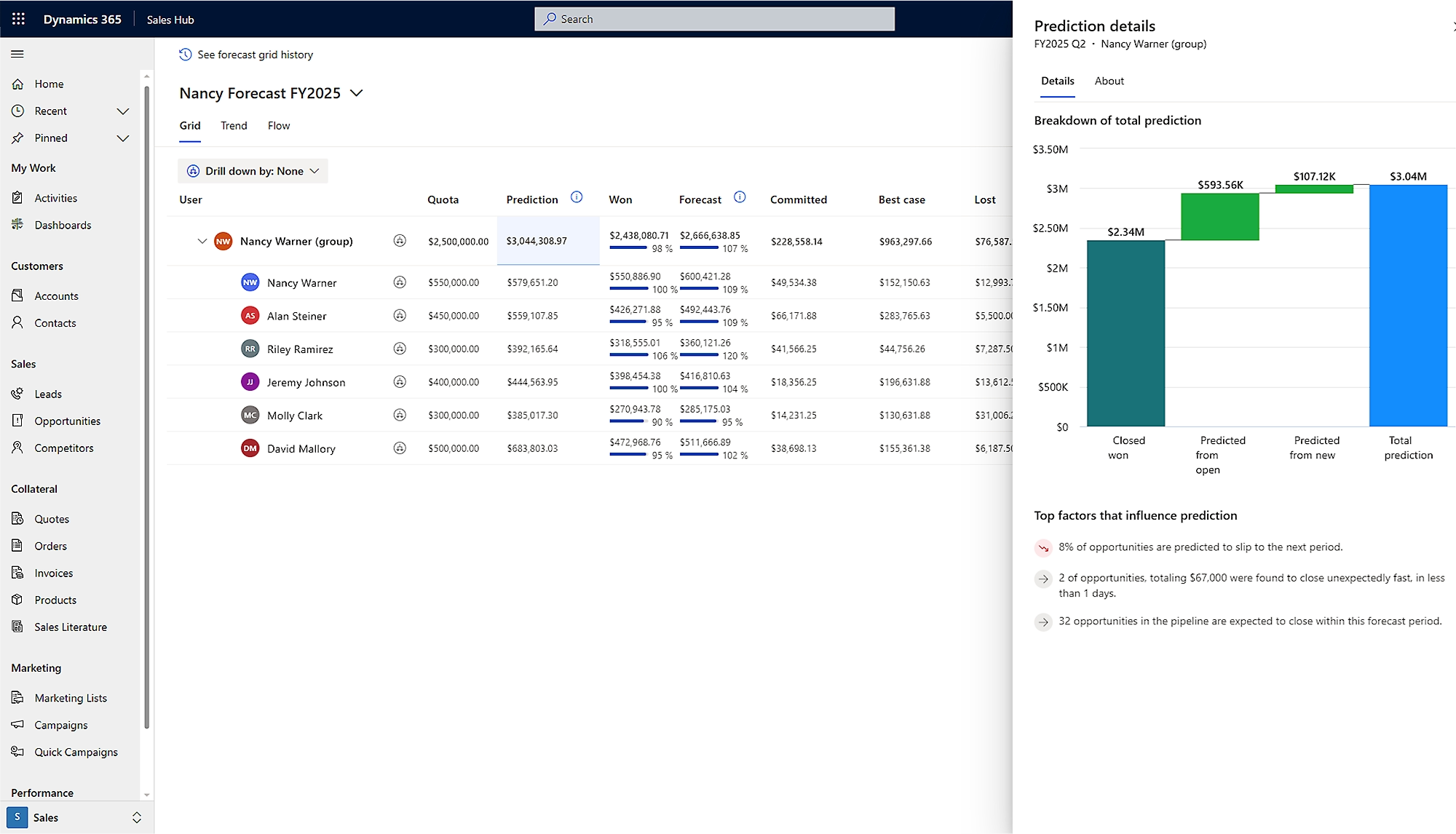
- Microsoft-first strategies: Organizations using Microsoft 365, Power Platform, Azure, or Teams gain seamless collaboration and automation. Opportunities can be updated in Outlook or Teams, workflows can be automated across departments, and Power BI dashboards provide unified insights—all within a consistent, secure ecosystem.
Use cases where HubSpot excels
HubSpot is designed to help organizations grow quickly by simplifying how teams manage marketing, sales, and customer engagement. Its strengths become most evident in businesses that prioritize marketing efficiency, ease of use, and rapid adoption, allowing teams to focus on results rather than system complexity. Key use cases include:
- Inbound marketing teams: HubSpot combines content creation, landing pages, blog hosting, SEO tools, and email campaigns in a single interface, allowing marketing teams to launch and optimize programs without relying on external systems.
- Organizations without dedicated technical resources: HubSpot’s no-code configuration and intuitive interface make it easy for non-technical users to manage day-to-day operations.
- Businesses prioritizing CRM adoption: The highly intuitive interface encourages consistent usage and rapid onboarding, reducing adoption challenges common with more configurable platforms.
- Companies seeking rapid deployment: HubSpot can be deployed in weeks rather than months, enabling teams to see immediate value with minimal complexity.
Common pitfalls when comparing HubSpot vs Dynamics 365
When evaluating Dynamics 365 and HubSpot, organizations often encounter a few misconceptions that can lead to misalignment if not addressed early. One common misunderstanding is mistaking HubSpot for a full enterprise solution. While HubSpot provides operational tools, it does not replace core systems such as financials, inventory, or transactional processing. Teams with complex back-office requirements will still need additional platforms to support these critical operations.
Conversely, many organizations underestimate Dynamics 365 by assuming it is “just a CRM.” While the platform includes robust CRM functionality, it is fundamentally a suite of connected business applications that extend across finance, supply chain, operations, and analytics. Viewing it solely as a CRM overlooks the full value of its integrated capabilities, particularly for organizations that require cross-departmental coordination and enterprise-grade automation.
Another frequent pitfall is overlooking the long-term data strategy. HubSpot simplifies data management for marketing and sales activities, but organizations requiring enterprise-level data modeling or comprehensive reporting may need external tools. Dynamics 365, by contrast, centralizes data in Dataverse, providing a foundation for advanced analytics, AI-driven insights, and consistent reporting across departments.
Finally, choosing a platform based solely on usability can be misleading. HubSpot offers an intuitive interface and rapid deployment, making it highly attractive for teams that need immediate results. However, organizations with complex operational workflows—such as multi-entity finance, manufacturing processes, or integrated supply chain planning—often require capabilities that extend beyond HubSpot’s scope. Evaluating platforms with both short-term usability and long-term operational needs in mind ensures a more strategic decision and reduces the risk of future system misalignment.
Choosing the right platform for your organization
When deciding between Dynamics 365 vs HubSpot, the right choice depends not only on the features a platform offers but also on how your business operates today and how you expect it to evolve in the future. Both Dynamics 365 and HubSpot deliver strong CRM capabilities, but their strengths cater to different operational needs and strategic goals. Understanding these distinctions helps ensure the platform you select aligns with both immediate requirements and long-term growth.
Consider Dynamics 365 if your organization needs more than a CRM. This platform is ideal when you require CRM functionality that is fully integrated with finance, supply chain, or operations, enabling teams to connect customer engagement with operational processes. Dynamics 365 is well-suited for organizations planning to scale globally, supporting multi-entity operations, cross-department workflows, and enterprise-level security and compliance requirements. It is particularly valuable if your business relies on advanced forecasting, automation, or AI-driven insights to make data-informed decisions, or if you aim to consolidate systems within a unified Microsoft ecosystem, taking advantage of seamless integration with Microsoft 365, Power Platform, and Teams.
Consider HubSpot if your priorities center around marketing efficiency, usability, and rapid deployment. HubSpot offers a modern, intuitive CRM experience for sales and marketing teams, allowing them to quickly adopt the system and start seeing results. It is especially effective for organizations that want to minimize technical overhead and complexity while leveraging strong digital marketing tools—including email automation, landing pages, SEO, and content management—all within a single workspace. HubSpot is a compelling choice when you do not need to replace or consolidate existing ERP systems and want to focus on improving customer engagement and lead generation quickly.
In many cases, the optimal solution is not an either/or decision. Organizations frequently deploy both platforms in a complementary way, integrating HubSpot with Dynamics 365 ERP or combining HubSpot Marketing Hub with Dynamics 365 Sales. This hybrid approach allows businesses to leverage HubSpot’s marketing and usability strengths while maintaining the operational, financial, and analytical capabilities of Dynamics 365. Ultimately, the best platform choice depends on the role each system will play within your broader technology ecosystem, and how well it supports both current processes and future growth.
Next steps
Whether you are evaluating Dynamics 365 vs HubSpot, or a hybrid approach, it’s important to assess not only immediate needs but also long-term strategy. Dynamics 365 offers a comprehensive, enterprise-grade ecosystem that unifies CRM and ERP, supporting complex operational processes and scalable growth. HubSpot provides an intuitive, marketing-focused CRM experience that accelerates adoption and empowers teams to achieve fast results. Many organizations find value in combining both platforms, leveraging HubSpot for marketing efficiency and Dynamics 365 for integrated operational control.
Our team at Rand Group works with organizations to evaluate these factors pragmatically. We help identify the platform or combination of platforms that aligns with your business objectives, industry requirements, and future growth strategy. By taking a holistic view, we ensure your technology decisions not only solve today’s challenges but also position your organization for long-term success.
To explore your options or discuss how these platforms could support your business, connect with a Rand Group advisor. We provide expert guidance, real-world implementation insights, and strategic recommendations tailored to your organization’s goals, so you can confidently select the right solution for both today and tomorrow.



Subscribe to our Insights