Dynamics 365
 Power Platform
 Dynamics
 Cloud & Productivity
Dynamics 365 Finance & Operations for wholesale distribution

Wholesale distributors need to keep products available without tying up too much cash in inventory. They also need to fulfill customer orders, manage supplier costs, and protect margins. Dynamics 365 Finance & Operations for wholesale distribution connects purchasing, inventory, warehouse activity, sales orders, and financial management so teams can manage these decisions using shared business data.
“Finance & Operations” commonly refers to Microsoft Dynamics 365 Finance and Microsoft Dynamics 365 Supply Chain Management, two separately licensed applications. Supply Chain Management supports distribution processes, while Finance provides broader financial management and control. This article follows the wholesale workflow from replenishment and receiving through fulfillment and financial reporting, then outlines integration needs and implementation priorities.
At a glance
Dynamics 365 Finance & Operations connects wholesale purchasing, inventory, warehouse fulfillment, and financial reporting. It is worth evaluating when advanced warehouse processes, complex customer agreements, or multi-entity financial requirements create substantial operational demands. Implementation also requires planning for integrations, data preparation, and user adoption.
Why wholesale distributors outgrow disconnected systems
Growth often exposes gaps between purchasing, warehouse operations, sales, and accounting. A spreadsheet may help one employee track an exception, but it rarely gives everyone else the information they need.
For example, a salesperson might promise an item that another order has already reserved. A buyer might reorder stock without knowing that another warehouse has excess inventory. Finance might report a healthy sales margin before accounting for freight or supplier rebates.
These problems affect more than productivity:
The goal is to connect these processes so employees can act on the same information, with clear rules for handling exceptions.
How Dynamics 365 Finance & Operations supports wholesale distribution
Dynamics 365 Finance & Operations supports purchasing, inventory, warehouse, transportation, and sales order processes through its Supply Chain Management application. The value of these applicatons depends on how well the configuration reflects your distribution model, customer commitments, and financial requirements.
Plan replenishment and manage supplier purchasing
Purchasing decisions need to account for more than the quantity currently on the shelf. Buyers also need to consider expected demand, open orders, incoming supply, and supplier lead times.
Master planning helps calculate supply requirements and generate planned orders using configured planning rules. Buyers can review those recommendations before converting them into purchasing activity.
For a wholesaler, this means replacing some manual calculations with a repeatable planning process. Purchase agreements and order settings also help teams manage supplier terms and ordering requirements. Accurate supplier lead times and order multiples are essential to useful recommendations. The Demand planning application adds forecasting and collaborative planning capabilities; each relevant production user needs an eligible license.

Track inventory across warehouses and locations
A total inventory balance does not tell a salesperson whether stock is available for a new order. Some units may already be reserved, blocked, or stored at a different location.
Dynamics 365 Finance & Operations supports on-hand inventory tracking, reservations, inventory status, transfer orders, and cycle counting. Batch, serial, and expiration tracking can support additional control where the product requires it.
These capabilities help answer practical questions:
- Which warehouse holds the stock?
- How much remains available after existing commitments?
- Can another location supply the order?
- Does the inventory require inspection or other handling before release?
Wholesalers should also define how products move between purchasing, storage, and sales units. Buying by the pallet and selling by the case requires accurate conversions. Warehouse unit sequence groups support packaging relationships such as individual pieces, boxes, and pallets.

Move goods through receiving, picking, and shipping
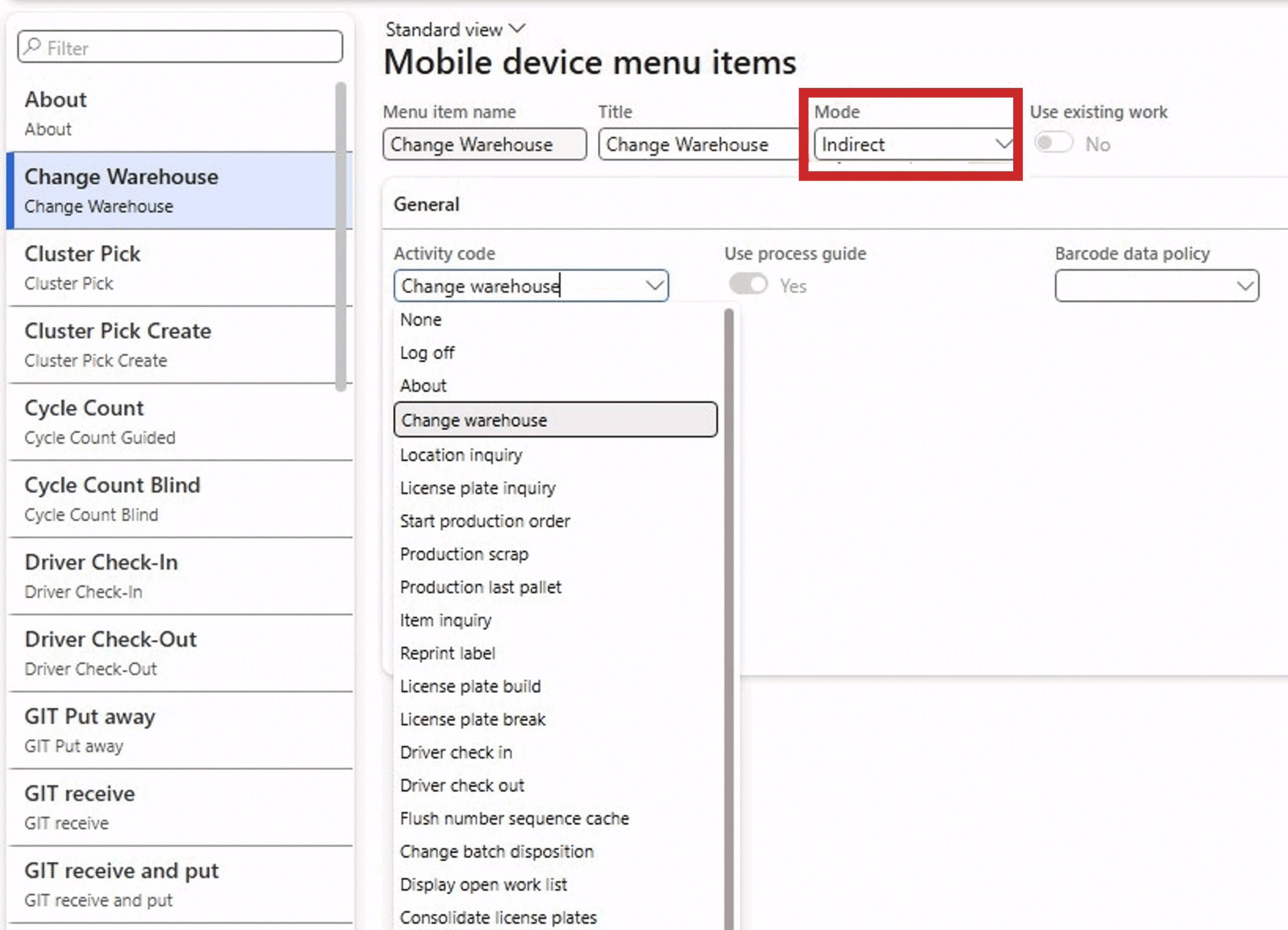
The Warehouse management module supports receiving, put-away, replenishment, picking, packing, and shipping. Work templates and location directives help determine what employees do and where goods move.
The Warehouse Management mobile app supports scanning and directed work on suitable devices. This gives warehouse employees a way to record activity as they perform it, rather than relying entirely on paper documents and later data entry.
A typical workflow might involve receiving a pallet, directing it to a storage location, replenishing a picking area, and creating picking work for customer orders.
However, having stock available does not resolve every fulfillment decision. Your implementation must define when employees can release partial orders, how they handle shortages, and when customers require complete shipments. Test these exceptions alongside the standard process. Warehouse layout, device setup, wireless coverage, and employee training all influence how well the process works on the floor.
Manage B2B orders, customer pricing, and rebates
Wholesale customer relationships often involve negotiated prices, quantity discounts, and ongoing purchase commitments. Supplier programs can introduce another layer of rebate calculations and settlement requirements.
Dynamics 365 Finance & Operations provides sales agreements, pricing and discount capabilities, and rebate management. These help teams apply negotiated terms to orders and administer customer and supplier programs.
For example, a customer may have an agreed price and request delivery in two shipments, while the products qualify for a supplier rebate. Sales, purchasing, and finance need those terms reflected consistently as the order moves through fulfillment and settlement.
Vendor rebate capabilities support eligible purchase calculations, claims, and settlement. For a closer look at commercial rules and inventory structure, explore Dynamics 365 pricing, rebates, and inventory management for distributors.

Account for freight and imported inventory costs
The supplier’s price does not always represent the full cost of acquiring a product. Freight, duties, insurance, and other charges can change the economics of an order.
Dynamics 365 Finance & Operations offers two distinct capabilities to evaluate:
- Transportation management: Supports activities such as planning inbound and outbound loads, rating, routing, and freight reconciliation.
- Landed cost: Supports inbound shipment and voyage tracking, estimated costs, cost allocation, and goods-in-transit processes.
A domestic wholesaler arranging deliveries may have different requirements from an importer managing overseas shipments. Start with the costs, shipment processes, and accounting treatment your business needs to manage, then determine which capabilities belong in the project.

Connect distribution activity with financial control
Inventory movements, customer shipments, supplier invoices, and returns all have financial consequences. Connecting those transactions helps finance investigate results without rebuilding the operational story in spreadsheets.
Dynamics 365 Finance & Operations brings inventory accounting together with financial processes such as accounts payable, accounts receivable, and reporting.
For a wholesale distributor, useful management questions include:
- How much cash is tied up in inventory?
- Which customers have overdue balances?
- Where are product costs or freight charges changing?
- How do results differ across entities or business units?
Standard reports may answer some questions, while customer profitability analysis or a management dashboard may require additional configuration, data modeling, or Power BI development.
Explore Rand Group’s financial management and reporting solutions for more ways to connect operational activity with financial decisions.
How AI, Copilot, and agents support wholesale operations
Wholesale teams spend time reviewing supplier updates, investigating order changes, and following up on deliveries. Microsoft Copilot and AI agents in Dynamics 365 Finance & Operations help with selected tasks so employees can focus on exceptions and decisions.
Relevant capabilities include:
- Purchase order change summaries: Copilot summarizes changes to confirmed purchase orders and their identified direct effects on downstream demand, helping buyers prioritize follow-up.
- Demand plan analysis: Planners select predefined questions in the Demand planning application to analyze shifts, trends, outliers, and deviations.
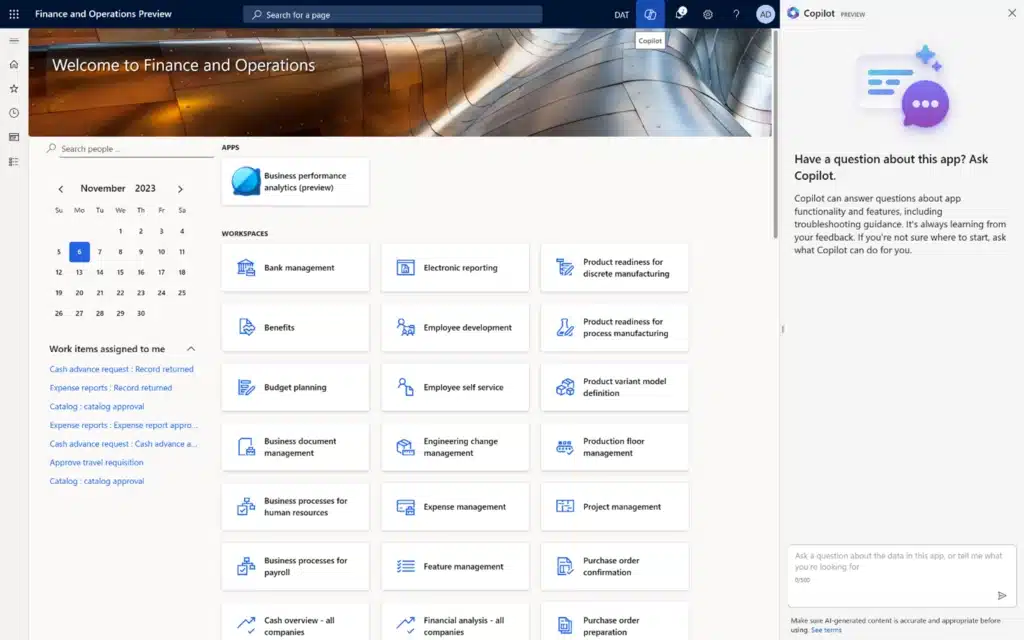
- Conversational guidance: Users can ask questions in natural language to find help with supported application processes.
- Supplier communications: The Procurement Agent can automate purchase order follow-up and identify confirmations and proposed changes in vendor emails for buyer review.
For example, when a supplier proposes a later delivery date, these tools can help a buyer review the change and decide whether to adjust purchasing plans or customer commitments.

Plan your Dynamics 365 investment with clearer licensing guidance
Understand the pricing and licensing options that can shape your wholesale ERP budget. Download Rand Group’s guide to prepare for a more informed evaluation of Dynamics 365 Finance & Operations.
What requires an integration or additional solution?
Core ERP functionality does not cover every distribution requirement automatically. Trading partners, online channels, and outside warehouses can introduce additional applications and data exchanges.
For each integration, establish which system owns the data and who handles failures. An order connection is incomplete if nobody knows what to do when a transaction does not reach the warehouse.
Is Dynamics 365 Finance & Operations right for your wholesale business?
Dynamics 365 Finance & Operations is a strong candidate when distribution complexity creates a need for advanced warehouse control, coordinated purchasing, and detailed financial management. Operational complexity matters more than revenue or employee count alone.
It is particularly worth evaluating when:
- Warehouse operations require advanced coordination: You need directed work, mobile scanning, replenishment, and defined receiving, picking, packing, and shipping processes.
- Inventory spans a complex distribution network: You need to manage stock, reservations, transfers, and supply requirements across multiple sites and warehouses.
- Commercial agreements are difficult to administer: Customer pricing, volume discounts, sales agreements, and supplier rebates create substantial manual work.
- Financial requirements extend across entities or countries: You need to coordinate operational activity with accounting, currencies, reporting, and financial controls.
- Freight and imported inventory materially affect costs: You need more structured transportation or landed cost processes.
- Your business can support the implementation: You have people available to define requirements, prepare data, test workflows, and train employees.
Dynamics 365 Finance & Operations makes sense when this operational depth addresses real requirements and justifies the implementation and ongoing administration involved.
When Business Central is worth considering
Microsoft Dynamics 365 Business Central is another option for wholesalers that want connected purchasing, inventory, sales, warehouse activity, and accounting.
It is worth evaluating when its standard capabilities, supported by suitable extensions where needed, meet your requirements with a more manageable project scope. Business Central also supports multiple warehouses and companies, so those requirements alone do not settle the choice.
Include extension and integration costs in the comparison. For example, a complete barcode warehouse solution or EDI connection in Business Central typically involves an extension or integration. Explore Dynamics 365 Business Central for wholesale distribution to understand that alternative.
What should wholesalers prepare before implementation?
Before configuration begins, prepare the data, operating rules, and people that support daily wholesale activity:
- Clean core data: Review items, customers, suppliers, pricing, units of measure, and packaging conversions.
- Define operating rules: Confirm reservations, replenishment settings, warehouse locations, and inventory tracking requirements.
- Document exceptions: Include backorders, damaged goods, partial receipts, returns, and short shipments.
- Map integrations: Identify data owners, update timing, reconciliation needs, and error handling.
- Test with frontline employees: Have buyers, sales staff, warehouse workers, and finance users complete realistic scenarios.
- Establish baseline measures: Track inventory accuracy, order turnaround, manual processing, and other measures you want to improve.
Budget beyond subscriptions. Depending on scope, costs may include migration, integrations, extensions, scanning equipment, training, and ongoing support.
For end-to-end testing, follow an order with negotiated pricing through a stock shortage, warehouse transfer, partial shipment, invoicing, and payment. Check the resulting inventory value and accounting entries, then repeat the process with a return.
Learn how Rand Group approaches ERP implementation to connect business requirements, system configuration, and user adoption.

Find the right ERP approach for your wholesale business
Bring your biggest inventory, purchasing, warehouse, or financial challenges to a conversation with Rand Group. Our team can help you assess solution fit, identify integration needs, and prioritize the work required for implementation—giving you a clearer basis for defining scope and next steps.
Why work with Rand Group for wholesale distribution ERP?
Choosing an ERP requires a clear view of how your business operates today and what needs to change. Rand Group helps organizations evaluate those requirements, select an appropriate solution, and plan the work needed to implement it.
Rand Group’s recognition as a top Dynamics ERP partner for distribution companies provides another reason to consider our team when evaluating Microsoft business applications.
With more than 20 years of experience and a 90% client retention rate, Rand Group supports clients through implementation and continued system improvement. Our services include migration, integrations, reporting, training, and ongoing support.
For wholesale distributors, that means bringing purchasing, sales, warehouse, and finance requirements into the same project. We help identify where standard capabilities fit, where additional solutions may be needed, and which decisions should come before configuration.
Our Dynamics 365 Finance & Operations implementation and support services also help organizations maintain and improve their systems as business requirements change.
Hear what our clients say
“Rand Group gives us the knowledge and the information to make the proper business decisions to expand our business to that next level and open up new revenue opportunities.” – Nigel Paskinov, Managing Director, Canadian Spa Company
“We have always felt like a top priority when working with Rand Group’s team and have the utmost confidence in their industry and technical knowledge.” – Christa Curette, VP of Engineering & Technology, Conquest Completion Services, LLC.
Key takeaways
- Dynamics 365 Finance & Operations connects distribution processes with financial management.
- Wholesale requirements should include packaging units, partial shipments, customer agreements, freight, and inventory control.
- EDI, ecommerce, outside warehouses, and advanced AI can add applications, integrations, or costs.
- Business Central is an alternative worth evaluating against your actual workflows.
- Data preparation, realistic testing, and user training help turn software capabilities into usable processes.
Frequently asked questions
What is Dynamics 365 Finance & Operations for wholesale distribution?
Dynamics 365 Finance & Operations is a commonly used term for Dynamics 365 Finance and Dynamics 365 Supply Chain Management. Together, these applications support wholesale purchasing, inventory, warehousing, sales orders, and financial processes. The applications are separately licensed, and the required combination depends on your business needs.
What is the difference between Dynamics 365 Finance and Supply Chain Management?
Dynamics 365 Finance focuses on financial management. Dynamics 365 Supply Chain Management focuses on processes such as purchasing, inventory, warehousing, planning, and fulfillment. These applications are commonly grouped under the term Dynamics 365 Finance & Operations.
Can Dynamics 365 Finance & Operations manage inventory across multiple warehouses?
Yes. Dynamics 365 Finance & Operations supports inventory across sites, warehouses, and storage locations, along with transfers and warehouse processes. Your configuration determines how employees reserve, move, count, and fulfill that inventory.
Does Dynamics 365 Finance & Operations support warehouse barcode scanning?
Yes. Dynamics 365 Finance & Operations supports scanning through the Warehouse Management mobile app on suitable devices. You must configure the relevant warehouse processes, barcodes, users, and devices. Business Central generally requires an extension or additional solution for a complete barcode warehouse workflow. Learn more about Business Central warehouse and fulfillment capabilities.
Can wholesalers manage customer pricing and supplier rebates?
Yes. Dynamics 365 Finance & Operations includes pricing, agreements, and rebate capabilities. Businesses should test their actual contract terms, calculation rules, and settlement requirements during evaluation.
How much does Dynamics 365 Finance & Operations cost for a wholesaler?
Costs depend on application licenses, user responsibilities, implementation scope, integrations, migration, and support. Additional capabilities may introduce separate licensing or consumption charges. Rand Group’s Dynamics 365 Finance & Operations pricing and licensing guide explains the licensing considerations.
Choose an ERP that fits your wholesale operations
Connected purchasing, warehouse fulfillment, and financial reporting help wholesale distributors manage customer commitments and inventory investment together. Dynamics 365 Finance & Operations provides the operational depth to support that coordination. To discuss your distribution priorities and define the next step, contact Rand Group.