 Dynamics 365
 Power Platform
 Dynamics
 Cloud & Productivity
Microsoft Dynamics 365 Contact Center capabilities
Dynamics 365 Contact Center delivers a modern, AI-powered service experience across every channel. As a Copilot-first solution, it unifies voice, digital engagement, self-service, and operations in a single platform to help organizations resolve issues faster, improve service quality, and reduce costs. With built-in intelligence, automation, and seamless integrations, teams can deliver consistent, personalized support at scale.

Dynamics 365 Contact Center features & capabilities
Dynamics 365 Contact Center brings together omnichannel engagement, AI-powered self-service, agent productivity tools, and operational insights in a single platform. These capabilities help organizations deliver faster, more personalized support while improving efficiency and scalability. From intelligent routing to real-time analytics, every feature is designed to enhance both customer and agent experiences.
Omnichannel
Unified engagement across channels
Dynamics 365 Contact Center brings voice, chat, email, SMS, and social channels into a single, unified platform. Service representatives can manage every conversation from one workspace, reducing context switching and improving efficiency. This ensures consistent, connected experiences regardless of how customers choose to engage.
Seamless transitions between channels
Customers can move seamlessly between channels without losing context or starting over. Conversations persist across touchpoints, allowing service teams to pick up where the interaction left off. This flexibility supports modern customer expectations for convenience and continuity.
Persistent conversations across sessions
Ongoing conversations are maintained across sessions, giving service representatives full visibility into prior interactions. This eliminates the need for customers to repeat information and helps accelerate resolution times. It also enables more personalized, context-aware support.
Real-time translation for global support
Built-in AI enables real-time translation across digital channels, allowing service representatives to support customers in multiple languages. This helps organizations deliver consistent global service without requiring multilingual teams. It also improves accessibility and reduces communication barriers.

Voice
Intelligent voice routing based on skills and context
Dynamics 365 Contact Center uses unified routing to intelligently direct inbound calls to the most qualified service representative. Routing decisions consider agent skills, availability, and customer context to improve first-contact resolution. This ensures customers are connected quickly to the right person without unnecessary transfers.
Conversational IVR powered by natural language
The platform includes a modern, conversational IVR powered by Nuance that understands natural language and caller intent. Customers can speak naturally instead of navigating rigid menu trees, making interactions faster and more intuitive. This reduces frustration while improving containment for common inquiries.
Call intelligence with transcription and summarization
Voice interactions are enhanced with real-time transcription, recording, and AI-generated summaries. Service representatives can quickly review conversations, capture key details, and reduce manual note-taking. This improves accuracy, saves time, and ensures better continuity across interactions.
Outbound calling and proactive engagement
Dynamics 365 Contact Center supports outbound dialing and calling to enable proactive customer engagement. Teams can follow up on cases, send reminders, or conduct outreach campaigns directly from the platform. This helps organizations move beyond reactive support to more proactive service experiences.
Voicemail and asynchronous voice interactions
Dynamics 365 Contact Center supports voicemail to ensure customer inquiries are captured even when agents are unavailable. Messages can be routed, transcribed, and prioritized for follow-up, helping teams respond efficiently without missing requests. This enables more flexible, asynchronous voice engagement while maintaining service continuity.

Self-service
AI-powered chatbots and virtual agents
Dynamics 365 Contact Center enables organizations to deploy intelligent chatbots and virtual agents across digital channels. These AI-driven tools handle common inquiries, guide users through processes, and resolve issues without agent involvement. This improves containment rates while reducing call volume and operational costs.
Context-aware self-service experiences
Self-service interactions are enhanced with context from CRM data, allowing experiences to be personalized based on customer history and intent. Virtual agents can tailor responses, recommend next steps, and provide more relevant support. This leads to faster resolutions and a more seamless customer experience.
Conversational IVR for voice self-service
The platform includes a modern, conversational IVR powered by natural language understanding. Customers can speak naturally and express intent, rather than navigating traditional menu-based systems. This makes voice self-service more intuitive while improving resolution rates for routine requests.
Continuous learning through AI agents
AI agents like the Customer Intent Agent continuously learn from customer interactions across channels. They identify new intents and refine responses over time, ensuring self-service stays accurate and relevant. This creates an evergreen self-service experience that evolves with customer needs.
Knowledge-driven automation
Self-service is supported by continuously updated knowledge through AI-driven insights. The Customer Knowledge Management Agent helps keep content current by analyzing case notes and interactions. This ensures customers and virtual agents always have access to accurate, up-to-date information.

Agent experience
AI-powered assistance with Copilot
Dynamics 365 Contact Center equips service representatives with Copilot to provide real-time guidance during interactions. Copilot suggests responses, summarizes conversations, and surfaces relevant knowledge to help agents resolve issues faster. This reduces manual effort while improving consistency and quality across every interaction.
Unified workspace for all interactions
Service representatives can manage conversations across channels from a single, unified interface. This eliminates the need to switch between systems and gives agents a complete view of ongoing work. As a result, teams can respond more efficiently and maintain better focus during customer interactions.
Intelligent routing to the right service representative
Unified routing automatically assigns each interaction to the most qualified service representative based on skills, availability, and customer context. This improves first-contact resolution rates and reduces unnecessary transfers. It ensures work is distributed efficiently while delivering faster, more accurate service.
360-degree customer view in real time
Agents have access to a comprehensive view of each customer, including interaction history, sentiment, case data, and key topics. This context allows representatives to deliver more personalized and informed support. It also helps reduce handle time by eliminating the need to search for information across systems.
Supervisor visibility and intervention tools
Supervisors can monitor live interactions, track performance metrics, and step in when assistance is needed. They have visibility into queues, agent workloads, and active sessions in real time. This enables proactive support, improved coaching, and better overall service quality.

Intelligence
AI-driven insights across every interaction
Dynamics 365 Contact Center uses AI to analyze conversations across voice and digital channels in real time. It surfaces insights such as key topics, trends, and emerging issues to help teams stay ahead of customer needs. These insights enable more proactive service and continuous improvement across the contact center.
Real-time sentiment analysis and guidance
AI continuously evaluates customer sentiment during interactions, identifying frustration or urgency as it happens. Service representatives receive real-time cues and recommendations to adjust their approach and improve outcomes. This helps teams deliver more empathetic, effective service while increasing customer satisfaction.
Copilot-powered recommendations and automation
Copilot provides intelligent recommendations, suggested responses, and automated summaries throughout the service experience. It reduces manual effort by handling repetitive tasks and guiding agents with relevant information at the right time. This accelerates resolution times and ensures more consistent service delivery.
Continuous learning with AI agents
AI agents, such as the Customer Intent Agent and Quality Evaluation Agent, continuously learn from interactions to improve performance over time. They refine intent recognition, evaluate service quality, and enhance knowledge accuracy without manual intervention. This creates a system that evolves alongside customer behavior and service needs.

Operations
Real-time reporting and performance dashboards
Dynamics 365 Contact Center provides real-time dashboards and historical reporting to monitor service performance. Supervisors can track key metrics such as queue volumes, agent workloads, and service levels in a single view. These insights help teams quickly identify trends, address issues, and make more informed operational decisions.
Workforce optimization and capacity planning
Organizations can optimize workforce performance by analyzing agent skills, availability, and workload in near real time. This enables better scheduling, resource allocation, and forecasting to meet service demand. Integration with workforce management (WFM) solutions further enhances planning and operational efficiency.
Unified data with Microsoft Dataverse
All interaction data across channels is centralized within Microsoft Dataverse, creating a single source of truth for the contact center. This eliminates data silos and ensures consistency across reporting, AI, and service experiences. Teams can leverage this unified data to drive better insights and more connected operations.
Simplified telephony and system management
Dynamics 365 Contact Center integrates with Microsoft Teams Phone and Azure Communication Services to streamline telephony management. This reduces infrastructure complexity while improving scalability and performance. Organizations can manage voice and digital channels within a single, flexible platform.
Extensibility and integration across systems
The platform integrates with Dynamics 365, Salesforce, and other third-party systems to unify service operations. With Power Platform, organizations can customize workflows, dashboards, and applications to meet specific business needs. This flexibility allows teams to adapt quickly while maintaining a connected ecosystem.


See Dynamics 365 Contact Center in action
Discover how Dynamics 365 Contact Center can transform your customer service operations with a live demo of the platform. See how omnichannel engagement, intelligent routing, and AI-powered Copilot capabilities enable your team to deliver faster, more consistent support. Explore the agent workspace, self-service tools, and real-time insights to understand how the solution improves efficiency and customer experience.
Copilot and AI capabilities in Dynamics 365 Contact Center
Copilot and AI are built into Dynamics 365 Contact Center to provide real-time assistance, automation, and insights. These capabilities help teams resolve issues faster and deliver more consistent service.
- Copilot in the agent workspace: Service representatives use Copilot to ask questions, retrieve summaries, and get suggested next steps without leaving the conversation. It surfaces relevant knowledge and context in real time to support faster, more confident responses.
- Suggested responses and conversation summaries: Copilot generates replies for chat and email based on conversation context and knowledge content. It also summarizes interactions automatically, reducing after-call work and improving efficiency.
- AI agents for self-service and automation: AI agents built with Copilot Studio handle common inquiries, guide customers through tasks, and escalate to live agents when needed. They continuously learn from interactions to improve accuracy and expand self-service over time.
- Real-time sentiment analysis and transcription: AI monitors customer sentiment across interactions and alerts agents when tone shifts. Voice conversations are transcribed and analyzed to provide context and support quality and coaching.
- Copilot analytics and performance insights: Supervisors can track Copilot usage, agent productivity, and interaction trends through built-in analytics. These insights help measure impact and identify opportunities to optimize service operations.

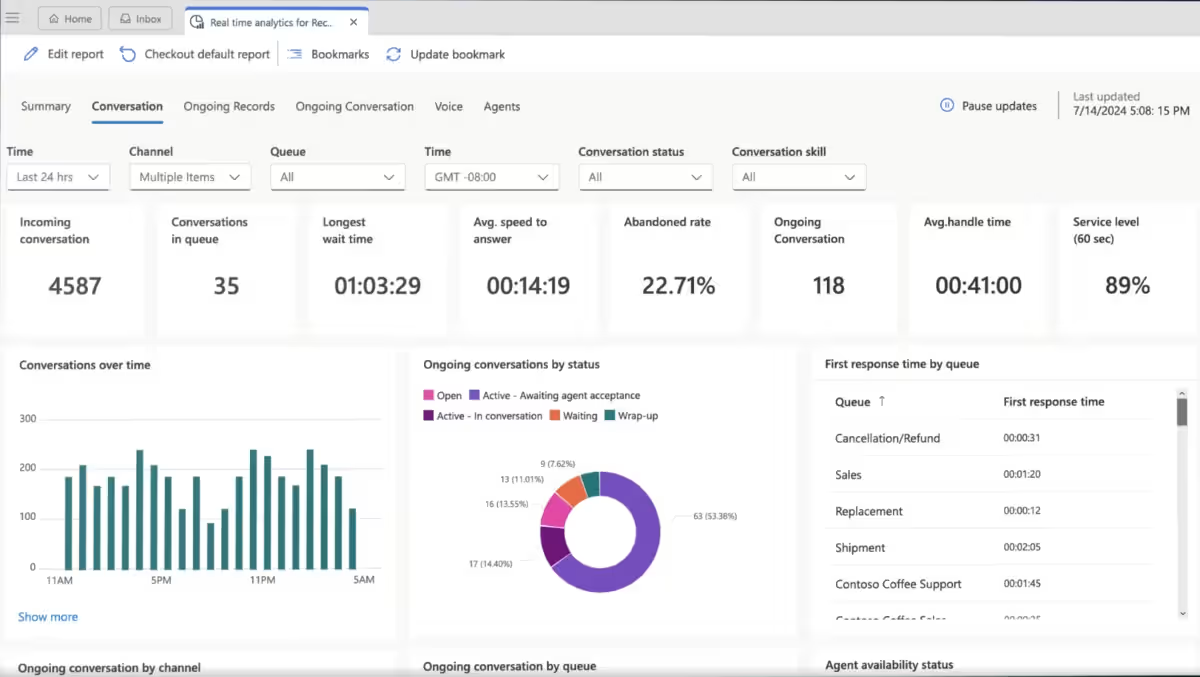
Analytics and reporting capabilities in Dynamics 365 Contact Center
Dynamics 365 Contact Center provides built-in analytics and reporting to give teams real-time visibility into performance, customer interactions, and operational trends. With unified data and AI-driven insights, organizations can monitor service levels, optimize resources, and continuously improve service delivery.
- Real-time and historical performance dashboards: Monitor key metrics such as queue volumes, service levels, agent workloads, and resolution times in real time and over time. These insights help supervisors quickly identify issues and adjust operations.
- Omnichannel analytics across voice and digital channels: Gain visibility into performance across voice, chat, email, SMS, and social interactions. Track wait times, abandonment rates, and channel workloads to optimize staffing and routing.
- Copilot analytics and AI-driven insights: Analyze how Copilot and AI capabilities are used across the contact center, including productivity trends and interaction outcomes. AI-driven insights help identify patterns and improve service performance.
- Unified data and customizable reporting: Use Microsoft Dataverse as a single source of truth for interaction data across the contact center. Build custom dashboards or integrate with tools like Power BI to meet specific reporting needs.
Why partner with Rand Group for Dynamics 365 Contact Center?
Deep industry expertise
Our team brings hands-on experience designing and implementing modern contact center solutions across industries. We understand the complexities of omnichannel service, workforce optimization, and customer experience, ensuring your solution aligns to real-world operational needs.
Long-term partnership and support
Rand Group builds lasting partnerships that extend beyond implementation. We provide ongoing support, optimization, and strategic guidance to help you continuously improve performance and maximize your investment in Dynamics 365 Contact Center.
Proven Microsoft D365 expertise
As a top North American Microsoft partner, Rand Group has a strong track record delivering successful Dynamics 365 solutions. We combine technical depth with business insight to help organizations fully leverage AI, Copilot, and unified service capabilities.
Award-winning Microsoft partner
Rand Group was named Microsoft Americas Channel Emerging Partner of the Year, recognizing our ability to deliver innovative, high-impact solutions. This distinction reflects the expertise, dedication, and results we bring to every Dynamics 365 Contact Center engagement.
Frequently Asked Questions (FAQs)
What is Dynamics 365 Contact Center?
Dynamics 365 Contact Center is a cloud-based, AI-powered contact center solution from Microsoft. It enables organizations to manage customer interactions across voice and digital channels in a single platform. The solution uses Copilot and AI to automate tasks, improve agent productivity, and deliver more efficient customer service.
What does Dynamics 365 Contact Center do?
Dynamics 365 Contact Center helps organizations handle customer interactions across channels such as phone, chat, email, SMS, and social media. It includes capabilities for self-service, intelligent routing, agent assistance, and real-time analytics. These tools help improve response times, increase resolution rates, and enhance the overall customer experience.
How does AI work in Dynamics 365 Contact Center?
AI in Dynamics 365 Contact Center powers chatbots, virtual agents, conversation summaries, and sentiment analysis. Copilot provides real-time assistance to agents by suggesting responses, surfacing knowledge, and automating repetitive tasks. AI also analyzes interactions to deliver insights that improve performance and customer satisfaction.
Does Dynamics 365 Contact Center integrate with other applications?
Yes, Dynamics 365 Contact Center integrates with Microsoft tools like Teams, Power Platform, and Dynamics 365, as well as third-party systems such as Salesforce and other CRMs. These integrations connect data and workflows across systems, creating a more unified service experience. The platform is designed to fit into existing technology environments.
What is the difference between Dynamics 365 Customer Service and Dynamics 365 Contact Center?
Dynamics 365 Customer Service focuses on case management and structured support within a CRM system. Dynamics 365 Contact Center expands on this by adding voice capabilities, omnichannel engagement, advanced routing, and AI-driven automation. Many organizations use both together, with D365 Customer Service managing cases and D365 Contact Center handling real-time, high-volume interactions across channels.
Related Insights

Rand Group recognized as a best Microsoft Dynamics 365 CRM partner for 2026
CRM Software Blog has named Rand Group to its 2026 Best Microsoft Dynamics 365 CRM Partner List. The editorial selection recognizes our 23 years of CRM experience and the results we deliver for clients across Dynamics 365 Sales, Customer Service, and Field Service.

Dynamics 365 integration services: Architecture, costs, and partner selection
Learn how Dynamics 365 integration services help organizations connect Microsoft and third-party systems. Explore integration approaches, common scenarios, architecture considerations, costs, timelines, and what to look for when choosing a Dynamics 365 integration partner.

The complete guide to Dynamics 365 Contact Center
Learn how Dynamics 365 Contact Center manages voice and digital customer interactions with intelligent routing, self-service, Copilot, AI agents, and analytics. Compare capabilities, pricing, licensing options, deployment paths, and integrations to determine if Dynamics 365 Contact Center is right for your organization.