Dynamics 365
 Power Platform
 Dynamics
 Cloud & Productivity
Dynamics 365 Finance & Supply Chain Management for automotive suppliers: Manufacturing, quality, and traceability

Automotive suppliers must meet strict production schedules, maintain consistent quality, and track components throughout the manufacturing process. Microsoft Dynamics 365 Finance & Operations helps manufacturers manage these requirements by connecting production planning, quality control, inventory traceability, and financial operations.
Dynamics 365 Finance & Operations (F&O) is a commonly used name for Microsoft’s enterprise ERP solutions. Today, Microsoft offers Dynamics 365 Finance and Dynamics 365 Supply Chain Management as separate applications, which are often referred to together as Dynamics 365 Finance & Supply Chain Management (F&SCM). For automotive suppliers, these solutions work together to provide greater visibility into manufacturing operations, improve quality management, and support complex supply chain requirements.
At a glance
Dynamics 365 Finance & Supply Chain Management helps automotive suppliers connect manufacturing, quality control, inventory, and financial management within one ERP environment. Its production planning, quality management, and traceability capabilities can help manufacturers respond to changing customer demands and investigate quality issues. Specialized automotive requirements, including OEM integrations and quality documentation, may require additional solutions.
Why automotive suppliers need more than basic manufacturing ERP
Automotive suppliers operate under demanding production and quality requirements. A late delivery, defective component, or incorrect engineering revision can disrupt customer schedules, increase costs, and create additional work across the supply chain. These challenges become harder to manage when manufacturers rely on disconnected systems for production, quality, inventory, and finance.
Common challenges include:
- Strict OEM delivery requirements: Automotive suppliers must coordinate materials, production capacity, and shipping schedules to meet customer commitments.
- Changing production demand: Customer forecasts and order schedules can change, forcing manufacturers to adjust purchasing and production plans.
- Component traceability: Manufacturers need reliable records that connect purchased components with production activity and finished products.
- Quality control: Incoming materials, production processes, and finished goods must meet defined specifications.
- Engineering changes: Product revisions can affect bills of materials (BOMs), routings, inventory, and production orders.
- Cost pressures: Scrap, rework, material price changes, and production delays can reduce margins.
An automotive supplier might have accurate financial records but still struggle to identify which production orders consumed a defective component. Another may track inventory quantities but lack the planning visibility needed to respond to revised customer schedules.
Dynamics 365 Finance & Supply Chain Management helps address these gaps by connecting manufacturing activities with the information needed to plan, execute, monitor, and financially manage operations. For a broader overview, explore how Dynamics 365 Finance & Supply Chain Management supports complex manufacturing.
How Dynamics 365 Supply Chain Management supports automotive production
Automotive manufacturers need to coordinate materials, equipment, labor, and customer demand while maintaining consistent production processes. Dynamics 365 Supply Chain Management provides production control, planning, and engineering change capabilities that support these requirements.
Production planning and scheduling
Production schedules depend on available inventory, supplier lead times, material requirements, and production capacity.
Planning Optimization, the master planning service in Dynamics 365 Supply Chain Management, evaluates supply and demand to generate planned production, purchase, and transfer orders based on configured planning parameters.
For automotive suppliers, relevant features include:
- Master planning and Planning Optimization: Evaluate material requirements, demand, inventory, lead times, and supply policies to generate planned orders.
- Capacity planning: Helps planners evaluate resource requirements and scheduling constraints.
- Planned order management: Allows teams to review, adjust, and firm planned orders before committing to production or purchasing.
For example, an automotive parts supplier receives a revised OEM forecast that increases demand for a component. Planners can review additional material requirements, available supply, and proposed orders before adjusting the production plan.
Customer forecasts received through EDI or other systems must be integrated and processed appropriately before they can inform ERP planning.

Shop floor execution and production visibility
Production managers need to know what is being manufactured, which materials have been consumed, and whether production is meeting planned quantities. Production control and the production floor execution interface in Dynamics 365 Supply Chain Management help manufacturers record and monitor shop floor activities.
Key features include:
- Production orders: Manage manufacturing activities from scheduling and release through reporting and completion.
- Production floor execution: Allows workers to start and stop jobs, record labor time, and report production activity.
- Material consumption reporting: Records components consumed during production, supporting inventory accuracy and costing.
- Production scrap reporting: Captures rejected quantities and material losses for review.
- Production status tracking: Helps supervisors monitor order progress, completed quantities, and remaining work.
A supplier manufacturing automotive brackets may produce several thousand parts per shift. Workers can report completed quantities and scrap against production orders, allowing supervisors to compare actual output with the production plan.
When detailed machine-level data collection, automated inspection results, or specialized operator controls are required, manufacturers should evaluate additional manufacturing execution system (MES) integrations.
Engineering change management
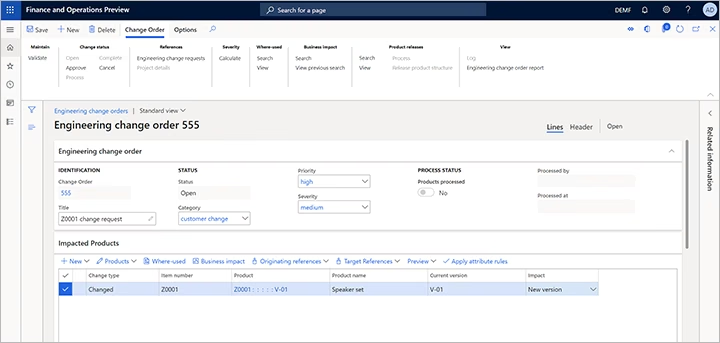
Automotive suppliers frequently receive engineering revisions that affect component specifications, production instructions, and material requirements. A poorly managed revision can result in outdated components entering production or finished products being manufactured against the wrong specification. Engineering change management in Dynamics 365 Supply Chain Management helps manufacturers control product information throughout its lifecycle.
Relevant features include:
- Engineering versions: Maintain controlled versions of engineering products and related product information.
- Engineering change requests: Document proposed product changes for evaluation.
- Engineering change orders: Manage approved changes to product structures and related information.
- Approval workflows: Route engineering changes through defined review and approval processes.
- Product readiness and lifecycle controls: Help manage when product versions can be released and used.
For example, an OEM may approve a revised component that replaces an earlier design. The supplier can use engineering change management to document the revision, review the affected BOM, and coordinate the release of updated product information.
The manufacturer must also define how existing inventory, open production orders, and changeover dates should be handled. When engineering data originates in a product lifecycle management (PLM) system, integration may be necessary to synchronize approved revisions.
Lean and repetitive manufacturing
Many automotive suppliers produce components in high volumes and rely on repeatable production processes. Lean manufacturing in Dynamics 365 Supply Chain Management supports production flows, kanban rules, and demand-based replenishment processes.
Relevant features include:
- Production flows: Define the sequence of activities used in lean manufacturing processes.
- Kanban rules: Establish replenishment processes based on configured demand or consumption signals.
- Production kanbans: Support the manufacture of products or subassemblies in a lean environment.
- Withdrawal kanbans: Support material replenishment between inventory locations and production areas.
- Work cells: Organize production resources and activities used in repetitive manufacturing.
An automotive supplier may use production orders to manufacture finished components while relying on kanban replenishment to supply frequently consumed parts to assembly stations.
The appropriate manufacturing model depends on the product and production process. Some automotive suppliers use discrete manufacturing, lean manufacturing, or a combination of both.
How Dynamics 365 Supply Chain Management improves automotive quality control
Quality problems can create significant costs for automotive suppliers. A defective component may require additional inspections, rework, replacement materials, or customer notifications. Quality management in Dynamics 365 Supply Chain Management provides features that help manufacturers document inspections, control material usage, and investigate defects.
Incoming material inspections and quality testing
Automotive suppliers often need to inspect purchased components before releasing them into production. Dynamics 365 Supply Chain Management includes quality associations, quality orders, test groups, and inventory blocking to support inspections at defined points in purchasing, production, and inventory processes.
Key features include:
- Quality associations: Define when the system should generate quality orders based on configured business events.
- Quality orders: Record required inspections, tests, and inspection results.
- Test groups: Organize tests and acceptance criteria.
- Item sampling: Define how materials are sampled for quality testing.
- Inventory blocking: Helps prevent affected inventory from being used during inspections or investigations.
An automotive manufacturer receiving electronic sensors can configure quality associations to generate inspections when qualifying materials are received. Quality personnel can record test results against acceptance criteria before releasing the inventory.
If the sensors fail inspection, the manufacturer can investigate the issue and determine the appropriate disposition.
Managing nonconformances and corrective actions
Not every quality problem is discovered during receiving. Defects may appear during production, final inspection, or after shipment. Dynamics 365 Supply Chain Management provides nonconformance management and correction capabilities that help quality teams document and address these issues.
Relevant features include:
- Nonconformance records: Document products or materials that fail to meet defined requirements.
- Nonconformance types: Classify issues based on their source, such as vendor, production, or customer-related problems.
- Correction records: Document actions taken to address a nonconforming item.
- Related operations: Record activities and associated costs connected with nonconformance handling.
- Quality reporting: Provide information for reviewing quality records and recurring issues.
For example, if a production inspection identifies a component with an incorrect measurement, the quality team can create a nonconformance record and document the corrective work.
Manufacturers can also review this information to identify recurring defects and assess their operational costs. More advanced corrective and preventive action (CAPA) workflows may require additional configuration or specialized quality management software.
Supporting automotive quality requirements
Automotive manufacturers may need to meet requirements associated with IATF 16949, Advanced Product Quality Planning (APQP), and the Production Part Approval Process (PPAP). Dynamics 365 Supply Chain Management can support parts of these processes through quality records, product information, engineering changes, inspections, and traceability.
Features such as quality orders, engineering change management, nonconformance records, and batch or serial tracking can provide information that supports documented quality processes. However, Dynamics 365 Supply Chain Management is not automatically a complete automotive quality management system or a guarantee of IATF 16949 compliance.
Specialized requirements such as PPAP document packages, control plans, process failure mode and effects analysis (PFMEA), and other quality workflows may require additional software, integrations, or custom processes. Automotive suppliers should document these requirements during ERP selection rather than assuming every quality process is available out of the box.
How does Dynamics 365 Supply Chain Management support parts traceability?
Automotive parts traceability helps manufacturers identify where components originated, how they moved through production, and which finished products may contain them. Dynamics 365 Supply Chain Management provides batch and serial number tracking, inventory tracing, and production transaction records that help manufacturers investigate material movements.
The completeness of product genealogy depends on how material identification, production reporting, and related records are configured and maintained.
Lot, batch, and serial number tracking
Automotive manufacturers may need to track components by lot, batch, or individual serial number. Dynamics 365 Supply Chain Management uses tracking dimensions, including batch and serial numbers, to identify inventory during receiving, storage, production, and distribution.
Relevant features include:
- Batch number tracking: Identifies groups of materials or products that share a batch identifier.
- Serial number tracking: Identifies individual items when unit-level tracking is required.
- Tracking dimension groups: Define how batch and serial tracking applies to specific items.
- Inventory transactions: Record movements and changes involving tracked materials.
- Inventory tracing: Helps users investigate tracked inventory and related transactions.
A manufacturer may receive several batches of the same component from a supplier. Recording batch information allows the company to distinguish affected materials if a quality problem is discovered later.

Forward and backward traceability
Dynamics 365 Supply Chain Management includes an item tracing capability that helps users examine inventory transactions involving tracked items.
Traceability investigations generally follow two directions.
- Backward traceability helps manufacturers investigate the origins of affected materials or products. A quality team may need to identify the supplier, purchase order, or component batch associated with a defective finished product.
- Forward traceability helps manufacturers investigate where affected materials were used or distributed. Teams may need to identify related production transactions, finished products, and customer shipments.
Consider a hypothetical automotive supplier that manufactures electronic control modules. A supplier reports a defect in one batch of electronic components. The manufacturer needs to determine which production orders consumed that batch, which finished modules may be affected, and whether those modules were shipped to customers.
When the required tracking and production relationships have been captured, Dynamics 365 Supply Chain Management records can support the investigation.
However, standard item tracing has limitations when tracing through multiple levels of a bill of materials (BOM). Microsoft’s standard tracing functionality traces production relationships one BOM level at a time rather than automatically delivering a complete, multi-level component genealogy in a single trace.
Automotive suppliers manufacturing complex assemblies may need to investigate additional production relationships or evaluate specialized traceability capabilities to establish complete component-to-finished-product genealogy.
Managing recalls and quality investigations
When an automotive component fails, manufacturers need to investigate the scope of the issue before deciding which actions to take. Dynamics 365 Supply Chain Management features such as item tracing, inventory transactions, inventory blocking, quality orders, and nonconformance records can support these investigations.
These capabilities help quality teams:
- Identify affected inventory batches or serial numbers
- Investigate related production and material transactions
- Locate inventory that may require inspection or blocking
- Review shipment records
- Document quality issues and related actions
For example, if a defective component batch has been used in several production orders, the manufacturer can investigate related material movements and determine which records require further review.
However, ERP traceability does not replace a documented recall process. Manufacturers remain responsible for validating affected products, coordinating customer notifications, and meeting applicable requirements.
The Dynamics 365 Supply Chain Management Traceability add-in
Microsoft also offers a Traceability add-in for Dynamics 365 Supply Chain Management, designed to support more detailed product genealogy. The add-in includes capabilities for recording as-built bills of materials and tracing components through related manufacturing and supply chain events.
This can be particularly relevant to automotive suppliers that need to understand relationships between raw materials, subassemblies, and individual finished products.
Availability note: Microsoft’s Traceability add-in is documented as a preview feature and is not intended for production use. Manufacturers should evaluate its availability and limitations separately from generally available inventory tracking functionality.
Managing automotive inventory, warehouse operations, and OEM deliveries
Automotive suppliers need accurate inventory information to keep production moving and meet customer delivery commitments. Dynamics 365 Supply Chain Management includes inventory management, warehouse management, and transportation management capabilities that connect material movements with purchasing, production, and shipping processes.
Inventory visibility across manufacturing facilities
Manufacturers need visibility into raw materials, work in process, and finished goods across their facilities. Dynamics 365 Supply Chain Management provides features for managing inventory across sites, warehouses, and storage locations.
Relevant capabilities include:
- Inventory on-hand inquiries: Review available and physical inventory quantities by relevant inventory dimensions.
- Inventory reservations: Allocate inventory to specific demand where appropriate.
- Transfer orders: Manage inventory movements between sites and warehouses.
- Inventory status: Help distinguish available, blocked, or otherwise restricted inventory based on configuration.
- Cycle counting: Support inventory accuracy through periodic physical inventory checks.
For example, a production planner may need to determine whether components are available at another plant before creating an additional purchase order. Connected inventory information helps teams evaluate supply and coordinate material movements across locations.

Meeting OEM shipping and delivery requirements
Automotive customers may require suppliers to meet defined delivery schedules, packaging instructions, and shipping procedures. Warehouse management in Dynamics 365 Supply Chain Management supports warehouse activities from receiving through outbound shipment processing.
Relevant features include:
- Warehouse work: Directs warehouse activities such as picking, put-away, and movement.
- Wave processing: Organizes warehouse work for outbound operations.
- Mobile warehouse workflows: Allow workers to perform supported warehouse transactions using mobile devices.
- Packing and containerization: Support configured packing and shipping processes.
- Shipment and load management: Help organize and track outbound shipment activities.
For automotive suppliers, these capabilities can support material staging, finished-goods picking, and preparation of customer shipments.
However, manufacturers should validate customer-specific packaging rules, shipping labels, shipment documentation, and other OEM requirements during implementation.

EDI and automotive customer integrations
Electronic data interchange (EDI) plays an important role in communication between automotive suppliers and their customers. Suppliers may need to exchange purchase orders, forecasts, shipping notices, and other business documents electronically.
Dynamics 365 Supply Chain Management provides data entities, APIs, and integration capabilities that support information exchange with external systems. Specialized automotive EDI transactions, trading-partner mappings, and customer-specific requirements may require additional integration software or development.
An OEM may require advance shipping notices (ASNs), customer-specific shipping labels, and electronic production schedules. An automotive supplier should confirm how these requirements will be received, processed, generated, validated, and transmitted.
A complete integration may need to connect customer EDI messages with sales orders, demand forecasts, inventory, warehouse shipments, and transportation records.
Connecting automotive production performance with Dynamics 365 Finance
Automotive suppliers must control production costs while meeting quality and delivery commitments. Scrap can increase material usage, rework can add labor costs, and delayed production can affect customer deliveries. Dynamics 365 Finance and Dynamics 365 Supply Chain Management connect operational transactions with inventory valuation, manufacturing costing, and financial reporting.
Relevant features include:
- Costing versions: Dynamics 365 Supply Chain Management manages planned or standard cost information according to the configured costing approach.
- Production cost estimates: Calculate expected production costs based on material, labor, and other configured cost components.
- Work-in-process accounting: Track eligible manufacturing costs while production remains in progress.
- Production variances: Help identify differences between expected and actual manufacturing results.
- Inventory valuation: Support financial reporting of inventory values and related transactions.
- Financial reporting and cost analysis: Dynamics 365 Finance provides financial reporting capabilities that help finance teams assess overall business performance, using manufacturing and inventory cost information from integrated operational processes.
An automotive supplier may experience increased scrap after introducing a revised component. Production records in Dynamics 365 Supply Chain Management can identify additional material consumption and scrap, while manufacturing costing provides information about the resulting cost differences. Finance and operations teams can use this information to investigate whether the problem relates to component quality, production processes, material pricing, or another cause. For more information, read how Dynamics 365 connects manufacturing performance with financial outcomes.
How Copilot and AI agents support automotive manufacturing in Dynamics 365 Finance & Supply Chain Management
Microsoft Copilot and AI agents can help automotive manufacturers review operational information, identify exceptions, and reduce repetitive work across planning, purchasing, and warehouse operations.
Relevant capabilities include:
- Analyze demand plans with Copilot: Demand planning capabilities in Dynamics 365 Supply Chain Management can help planners review demand trends, anomalies, and forecast accuracy. Automotive suppliers can use these insights when assessing customer demand and future material requirements.
- Improve supplier communications: The Procurement Agent in Dynamics 365 Supply Chain Management can help purchasing teams follow up on purchase orders, interpret supplier responses, and manage proposed changes. This may reduce manual follow-up when deliveries are late or suppliers request changes. The supplier communications capability is currently in production-ready preview.
- Evaluate the impact of purchase order changes: Procurement Agent impact analysis helps teams examine how supported supplier changes may affect inventory, production schedules, and customer deliveries. This capability is also in production-ready preview.
- Review warehouse workload with Copilot: Workload insights with Copilot in the Dynamics 365 Supply Chain Management Warehouse Management mobile app can summarize supported receiving and picking workloads, helping warehouse teams review tasks and resource needs.
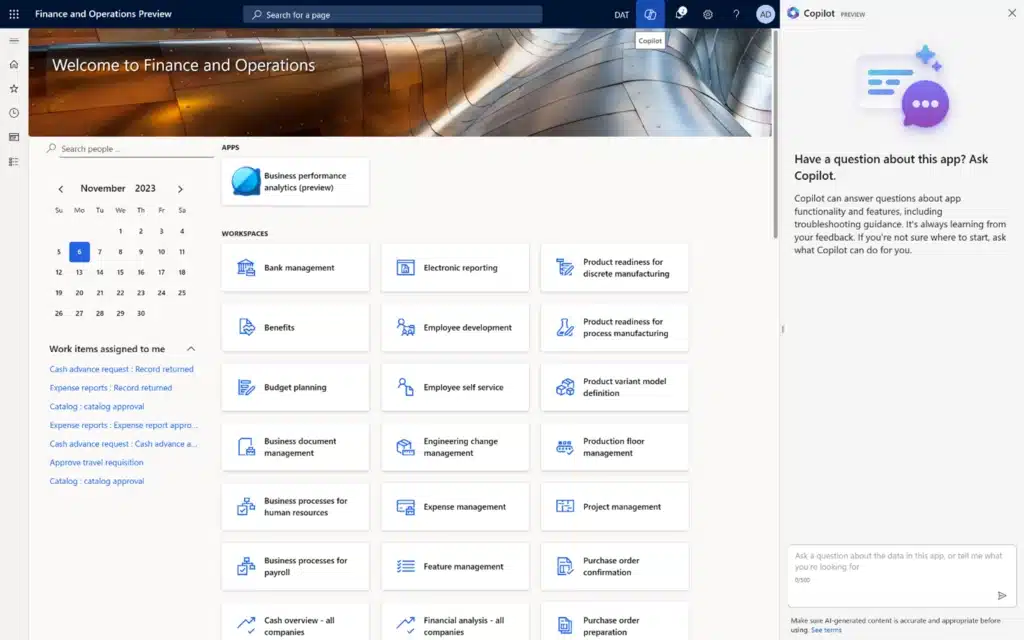
- Summarize operational information: Copilot can provide AI-generated summaries on supported Dynamics 365 Finance and Supply Chain Management pages, helping employees review information without manually examining every record.
- Extend processes with custom AI agents: Organizations can evaluate Microsoft Copilot Studio and integrations to develop agents for routing quality issues, summarizing production exceptions, or assisting with supplier inquiries. These are custom scenarios, not standard automotive-specific agents included with Dynamics 365 Finance & Supply Chain Management.
AI should support employees rather than replace quality, engineering, or production decisions. Organizations must also review availability, licensing, security, data readiness, and human approval requirements before adopting these capabilities.

Understand Dynamics 365 Finance & Operations pricing and licensing
Evaluating Dynamics 365 Finance & Supply Chain Management for your automotive manufacturing business? Download Rand Group’s pricing and licensing guide to explore subscription options, user types, and licensing considerations before planning your ERP investment.
Is Dynamics 365 Finance & Supply Chain Management right for your automotive manufacturing business?
Dynamics 365 Finance & Supply Chain Management is a strong option for automotive suppliers with complex production processes, advanced planning requirements, multiple facilities, or detailed financial and operational reporting needs.
However, not every automotive supplier needs the same level of ERP functionality. For smaller Tier 2 or Tier 3 suppliers with more straightforward manufacturing processes, Microsoft Dynamics 365 Business Central may be a better fit.
Business Central Premium includes manufacturing functionality such as production orders, bills of materials, routings, and capacity planning. It also supports inventory management, lot and serial tracking, purchasing, and financial management.
For example, a smaller supplier producing a limited range of components at one facility may find that Business Central meets its production and financial requirements without the complexity of a larger enterprise ERP implementation.
On the other hand, a supplier operating several plants with advanced planning, quality management, warehouse execution, and complex integration requirements may benefit from Dynamics 365 Finance & Supply Chain Management. Supplier tier alone should not determine ERP selection. A smaller Tier 3 manufacturer may still have demanding traceability or OEM requirements that require advanced capabilities. The right choice depends on manufacturing complexity, quality requirements, system integrations, reporting needs, and future growth plans. For a more detailed comparison, read Dynamics 365 Finance & Operations vs. Business Central: Key differences.
What automotive suppliers should evaluate before implementing Dynamics 365 Finance & Supply Chain Management
A successful ERP implementation starts with understanding how the business operates and which customer requirements the system must support. Automotive suppliers should evaluate the following areas before selecting or implementing Dynamics 365 Finance & Supply Chain Management:
- Production requirements: Document manufacturing methods, scheduling needs, capacity constraints, and material planning processes.
- Quality management: Identify inspection requirements, nonconformance processes, quality records, and automotive-specific documentation needs.
- Traceability: Determine whether tracking is required at the batch, lot, serial, component, or finished-product level.
- OEM integrations: Document customer EDI transactions, forecasts, shipping labels, ASNs, and other trading-partner requirements.
- Engineering processes: Review product revisions, BOM changes, engineering approvals, and PLM integrations.
- Data migration: Assess existing inventory, customer, supplier, product, and manufacturing records.
- Reporting and automation: Identify essential operational information and opportunities for workflow automation or AI.
Manufacturers should also involve production managers, quality teams, supply chain leaders, finance, and IT early in the evaluation. Bringing these departments together helps ensure the ERP supports actual business processes rather than simply meeting a technical checklist.

Simplify complex automotive manufacturing with Dynamics 365 Finance & Supply Chain Management
From OEM delivery requirements and production scheduling to quality management and component traceability, automotive suppliers face challenges that standard ERP functionality may not fully address. Rand Group can help you evaluate your requirements, identify integration gaps, and determine whether Dynamics 365 Finance & Supply Chain Management or Business Central is the right fit for your manufacturing operations.
Why work with Rand Group for automotive manufacturing ERP?
Automotive manufacturers need more than ERP software. They need a partner who understands how production, inventory, quality, and finance work together and can translate those requirements into a reliable system.
Rand Group has more than 20 years of experience helping organizations implement and improve business technology. As a Microsoft Solutions Partner, our team brings together financial, operational, and technical expertise to support complex ERP requirements. With a 90% client retention rate, Rand Group focuses on long-term relationships that extend beyond the initial implementation.
Our Dynamics 365 consulting services help manufacturers:
- Implementation: Configure and deploy Dynamics 365 Finance & Supply Chain Management around manufacturing, quality, inventory, and financial processes.
- Integrations: Connect Dynamics 365 Finance & Supply Chain Management with existing systems, including MES, PLM, EDI, and other business applications.
- Custom development: Extend standard functionality to address specialized manufacturing workflows and business requirements.
- Data migration: Move and validate financial, inventory, production, customer, and supplier information.
- Training: Train employees across finance, production, quality, and operations to support adoption.
- Reporting: Develop reports and dashboards that improve production, inventory, quality, and financial visibility.
- AI enablement: Identify opportunities to use Copilot, AI agents, and automation to improve operational efficiency.
- Support: Provide ongoing technical assistance, optimization, and guidance as manufacturing requirements evolve.
For automotive suppliers, the goal is to build an ERP environment that supports everyday operations while providing flexibility to respond to changing customer and production requirements.
Hear what our clients say
“We have always felt like a top priority when working with Rand Group’s team and have the utmost confidence in their industry and technical knowledge.” – Christa Curette, VP of Engineering & Technology, Conquest Completion Services, LLC
“Rand Group as a whole made us feel like we always knew who to call if there was an issue, and they always took it seriously. We were very happy overall.” – Susanna Stewart, Director of Finance & Administration, M&H Enterprises
Key takeaways
- Dynamics 365 Supply Chain Management supports complex automotive manufacturing: Planning Optimization, production floor execution, engineering change management, and lean manufacturing help coordinate production and material requirements.
- Quality management helps reduce operational risk: Quality orders, inspections, nonconformance records, and inventory blocking help manufacturers identify defects and manage affected materials.
- Traceability supports quality investigations: Batch and serial tracking, item tracing, and production records help investigate affected materials, although detailed multi-level genealogy may require additional capabilities.
- AI and automation can improve productivity: Copilot and AI agents can help employees analyze demand, manage supplier communications, and review operational exceptions. Availability varies, and certain Procurement Agent capabilities remain in production-ready preview.
- ERP selection depends on business complexity: Dynamics 365 Finance & Supply Chain Management supports advanced requirements, while Business Central may be a better fit for smaller suppliers with less complex operations.
- Connected operational and financial information supports cost analysis: Manufacturing costing, inventory valuation, production variances, and financial reporting help teams assess how production performance affects business results.
Frequently asked questions
Can Dynamics 365 Finance & Supply Chain Management support automotive suppliers?
Yes. Dynamics 365 Supply Chain Management supports manufacturing, production planning, inventory management, quality control, and traceability, while Dynamics 365 Finance supports financial management and reporting. Together, these applications help automotive suppliers coordinate manufacturing and financial operations. Specialized processes such as OEM EDI, PPAP documentation, and certain shop floor integrations may require additional solutions.
Does Dynamics 365 Supply Chain Management support IATF 16949 compliance?
Dynamics 365 Supply Chain Management can support records and processes relevant to IATF 16949, including quality inspections, engineering changes, nonconformance management, and traceability. However, implementing the software does not automatically make a manufacturer compliant or certified. Automotive suppliers must evaluate their specific quality management requirements and may need additional software or procedures.
How does Dynamics 365 Supply Chain Management track automotive parts and components?
Dynamics 365 Supply Chain Management supports batch and serial number tracking, inventory transactions, and item tracing. Manufacturers can use these capabilities to investigate material movements and related production activity. Standard item tracing has limitations when following components through multiple BOM levels, so detailed component-to-finished-product genealogy may require additional capabilities.
Can Dynamics 365 Supply Chain Management help manage automotive recalls?
Yes. Dynamics 365 Supply Chain Management inventory and production records can support recall investigations by helping manufacturers identify affected materials, inventory transactions, and shipments. Features such as item tracing, inventory blocking, and quality orders can support the process. However, manufacturers must still validate affected products and maintain procedures for containment, customer notification, and regulatory obligations.
Does Dynamics 365 Supply Chain Management include quality management for automotive manufacturing?
Yes. Dynamics 365 Supply Chain Management includes quality orders, inspections, test groups, sampling, inventory blocking, and nonconformance management. Specialized automotive processes, including certain PPAP, APQP, and control-plan requirements, may require additional software or customization.
Can Dynamics 365 Supply Chain Management integrate with automotive OEM EDI systems?
Yes. Dynamics 365 Supply Chain Management provides data entities, APIs, and other integration capabilities for exchanging information with external systems. Automotive suppliers can use EDI integrations to exchange customer orders, forecasts, and advance shipping notices. Specific transactions, trading-partner mappings, and labeling requirements often require integration software or additional development.
How can Copilot and AI agents help automotive manufacturers using Dynamics 365 Finance & Supply Chain Management?
Copilot and AI agents can help automotive manufacturers analyze demand plans, summarize operational information, review warehouse workloads, and manage supplier communications. These capabilities can reduce repetitive work and help employees identify issues earlier. Feature availability varies, and certain Procurement Agent capabilities remain in production-ready preview.
Should automotive suppliers choose Dynamics 365 Finance & Supply Chain Management or Business Central?
Dynamics 365 Finance & Supply Chain Management is generally better suited to manufacturers with advanced planning, complex quality requirements, multiple facilities, and extensive integrations. Business Central may be more appropriate for smaller suppliers with simpler production and financial processes. The decision should be based on manufacturing complexity and operational requirements rather than company size or supplier tier alone.
Build a more connected automotive manufacturing operation
Automotive suppliers need reliable production processes, consistent quality controls, and accurate component traceability to meet customer expectations. Dynamics 365 Finance & Supply Chain Management connects these activities with inventory, supply chain planning, and financial management. With the right implementation and integrations, manufacturers can improve visibility, investigate quality issues, and make better operational decisions.
Whether your business requires the advanced capabilities of Finance & Supply Chain Management or the manufacturing functionality of Business Central, selecting the right ERP starts with understanding your requirements. To evaluate your options and develop a plan for your automotive manufacturing business, contact Rand Group.